Loading...
Loading...
The civilian and federal jobs that hire Navy Naval Aircrewman (Operator)s — with real salaries and the resume that gets callbacks.
Every AWO has more options than a Google search will tell you. Below: career paths, BLS salary data, federal GS series, certifications by target career, and how to translate your experience without losing what made you valuable to the Navy in the first place.
Free · No credit card · Tailored resume in under 5 minutes
After the Navy I got hired into 6 federal career fields and tech sales, and sat on federal hiring panels along the way. I spent the last 2 years rebuilding everything I learned into BMR, tuned for how AI actually screens resumes today. This is the system I wish I'd had on day one.
As a Naval Aircrewman (Operator), you flew the mission-systems seats on the P-8A Poseidon, and before it the P-3C Orion and EP-3E Aries II. You were not a passenger and you were not maintenance. You ran the sensors. Acoustic operators worked the sonobuoy field, dropping and monitoring DIFAR and DICASS buoys, reading sonograms in real time, and classifying surface and subsurface contacts by their acoustic signature. Non-acoustic operators ran the radar, the electro-optical and infrared (EO/IR) turret, electronic support measures (ESM), and the magnetic anomaly detector (MAD). The whole job came down to one thing: take a flood of raw sensor returns, separate signal from noise, and turn it into a tactical picture the tactical coordinator and the rest of the fleet could act on.
That work sat at the center of anti-submarine warfare (ASW), anti-surface warfare (ASUW), and intelligence, surveillance, and reconnaissance (ISR). You localized, tracked, and reported contacts across thousands of square miles of open ocean, often on missions that ran ten-plus hours. The training pipeline that got you there started at Naval Aircrew Candidate School (NACCS) in Pensacola for flight physiology and water survival, ran through Naval Air Technical Training Center (NATTC) for acoustic analysis, wave propagation, oceanography, and signals fundamentals, and finished at the fleet replacement squadron on your platform. Most AWOs held a Top Secret/SCI clearance because the sensor data and the ISR product were classified at that level.
Civilian employers value this background for a reason that has nothing to do with the word "aircrewman." You spent years doing real-time signal interpretation under time pressure, fusing data from four or five sensors into one decision, and writing it up so someone else could act on it. That is a rare skill set. If you are mapping where it goes next, start with the military career crosswalk tool, and look at how related Navy ratings translate, like the STG Sonar Technician (Surface) and the broader Aviation Warfare Systems Operator / Naval Aircrewman path. For data-side roles, the veterans in data analytics guide maps the analyst route.
I pivoted into tech sales after the Navy, and an AWO has a credibility most reps would kill for. You operated sonar, ESM, radar, and EO/IR systems for real, so when you sit across from a program office buying sonobuoys, ISR pods, or acoustic processing software, you actually understand the product and the mission it serves. That technical authority is what closes defense-electronics deals, and it is exactly the kind of background I help translate onto a resume that civilian hiring teams take seriously. — Brad Tachi, Navy Diver veteran & BMR founder
The number that matters when you're deciding what's next: how does civilian pay compare to what you make now?
Military comp is approximate (varies by location/dependents). Civilian is BLS median. Federal includes locality pay. Your real number depends on duty station, family status, GS step, and overtime.
The most direct civilian paths use your sensor and analysis work without much translation. Intelligence and ISR analyst roles at defense contractors map closely to what you did in the tube. The Bureau of Labor Statistics groups intelligence analysts under detectives and criminal investigators (O*NET 33-3021.06), which reported a median wage of $93,580 in May 2024. Avionics and electronics technician roles are another close match: avionics technicians earned a median of $81,390 and electrical and electronic engineering technologists and technicians earned $77,180, both per BLS OEWS May 2024. These figures are national medians, and cleared work near fleet concentration areas like Jacksonville, Whidbey Island, and the DC corridor tends to run higher.
Be honest with yourself about the market shape. The cleared ISR and defense-electronics field is steady but geographically concentrated. The best-paying roles cluster around major defense hubs, and a TS/SCI clearance is the single biggest factor in your offer. If you let the clearance lapse, you lose leverage, so time your job search before separation when you can. The clearance salary premium breakdown walks through what that is worth in dollars.
Veterans from other branches compete for the same airborne-ISR and signals roles, so it helps to see how the field looks across services. The Air Force 1A8X1 Airborne Cryptologic Linguist and the Army 35N Signals Intelligence Analyst chase overlapping civilian targets. When you are ready to put your sensor experience into hiring-manager language, the military resume builder structures it, or you can build your resume now.
| Civilian Job Title | Industry | BLS Median Salary | Outlook | Match |
|---|---|---|---|---|
Intelligence Analyst O*NET: 33-3021.06 | Defense & Government | $93,580 | About as fast as average | strong |
Avionics Technician O*NET: 49-2091.00 | Aerospace & Defense | $81,390 | 3% (As fast as average) | strong |
Electronics Engineering Technician O*NET: 17-3023.00 | Defense Electronics | $77,180 | 1% (Little change) | strong |
Geospatial / Imagery Analyst O*NET: 33-3021.06 | Defense & Government | $93,580 | About as fast as average | strong |
Field Service Engineer (Sensor Systems) O*NET: 17-3023.00 | Defense Electronics | $77,180 | 1% (Little change) | moderate |
Operations Research Analyst O*NET: 15-2031.00 | Defense & Government | $91,290 | 23% (Much faster than average) | moderate |
Electronic Warfare / SIGINT Analyst O*NET: 33-3021.06 | Defense & Government | $93,580 | About as fast as average | moderate |
BMR rewrites your AWO experience for any of the civilian roles above — keywords, achievements, and language hiring managers actually scan for.
Free · No credit card · 2 tailored resumes included
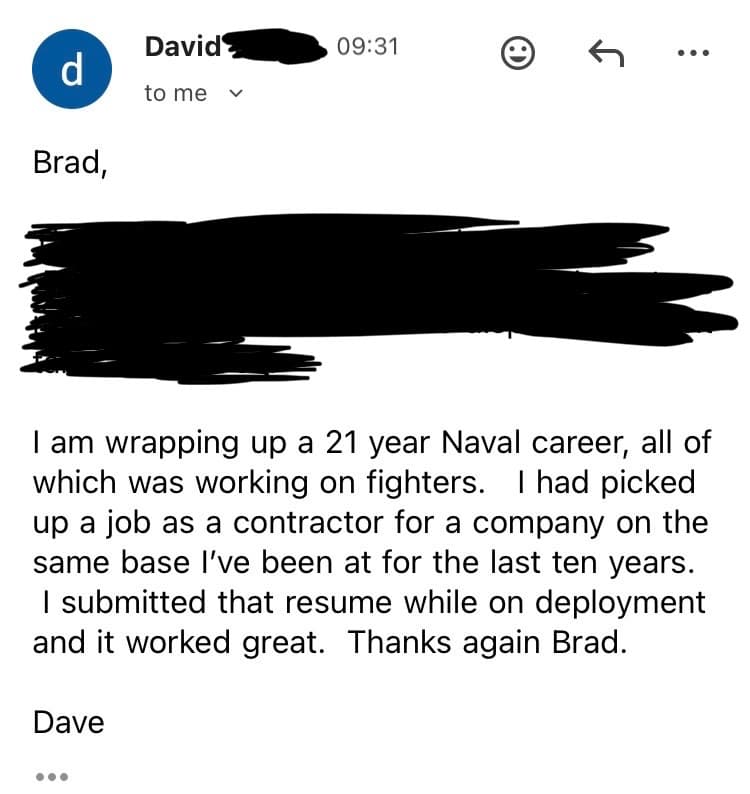
“I am wrapping up a 21 year Naval career, all of which was working on fighters. I had picked up a job as a contractor for a company on the same base I’ve been at for the last ten years. I submitted that resume while on deployment and it worked great. Thanks again Brad. Dave ”
Federal hiring is one of the strongest landing spots for an AWO because so much of the work happens inside DoD, where your clearance and sensor background are already understood. The clearest crosswalk is the GS-0132 Intelligence series, which covers all-source and tactical analysis roles across the Office of Naval Intelligence, NGA, DIA, and the combatant commands. At GS-9 through GS-12, the qualifying experience is exactly the contact analysis, reporting, and multi-source fusion you ran in flight.
Several technical series fit the non-acoustic side of the house. GS-0855 Electronics Engineering and GS-0856 Electronics Technician map to the ESM, radar, and EO/IR systems work. GS-1310 Physics and GS-0150 Geography line up with the wave-propagation, oceanography, and environmental side of acoustic prediction. GS-0391 and GS-0392 Telecommunications fit the signals and data-link experience, and GS-1515 Operations Research suits analysts who want to move toward modeling and tactical decision support. GS-0080 Security Administration is a common entry point for those who want to leverage the clearance directly.
Veterans preference applies on top of all of it, and your TS/SCI is a tangible asset that civilian applicants cannot match. To translate flight-hour experience into the format federal boards score, read the 2026 OPM federal resume format guide and learn to decode a USAJOBS announcement. The federal resume builder handles the hours-per-week and grade-matching mechanics, or you can start your federal resume here. The Navy IS Intelligence Specialist page shares the GS-0132 target.
| GS Series | Federal Job Title | Typical Grades | Match | Explore |
|---|---|---|---|---|
| GS-0132 | Intelligence | GS-9, GS-11, GS-12 | View Details → | |
| GS-0080 | Security Administration | GS-7, GS-9, GS-11 | View Details → | |
| GS-0855 | Electronics Engineering | GS-9, GS-11, GS-12 | View Details → | |
| GS-0856 | Electronics Technician | GS-7, GS-9, GS-11 | View Details → | |
| GS-1515 | Operations Research | GS-9, GS-11, GS-12 | View Details → | |
| GS-1310 | Physics | GS-9, GS-11, GS-12 | View Details → | |
| GS-0150 | Geography | GS-9, GS-11, GS-12 | View Details → | |
| GS-0391 | Telecommunications | GS-7, GS-9, GS-11 | View Details → | |
| GS-2152 | Air Traffic Control | GS-7, GS-9, GS-11 | View Details → |
Federal hiring uses keyword-matching and structured experience. BMR builds federal-format resumes (USAJobs-ready) with the right keywords, hours/week, and supervisor info — for any GS series above.
Free · No credit card · Federal + civilian resume formats included
Not everyone wants to stay in a related field. These career paths leverage your transferable skills — leadership, risk management, logistics, project planning — in completely different industries.
Reading an ultrasound is the same core skill as reading a sonogram: interpret returning acoustic energy in real time and recognize patterns others miss. AWOs who worked the acoustic station already think this way.
AWO acoustic prediction draws on the same wave-propagation and oceanographic physics that geophysicists use to image the subsurface. The mental model of energy moving through a medium transfers directly.
Years spent discriminating frequencies and cleaning signal out of noise is exactly the ear and the analytical habit that audio engineering rewards. The medium changes; the acoustic intuition does not.
Hydrographic survey work uses multibeam sonar and acoustic positioning, the same family of tools and physics an acoustic operator already understands. The maritime-domain awareness is a bonus.
Collecting and interpreting environmental and geophysical field data mirrors how AWOs read oceanographic conditions to predict sensor performance. The methodical data discipline carries over.
Ultrasonic NDT detects flaws by reading reflected acoustic energy, the same physics as sonar contact detection. An acoustic operators trained ear for anomalies is a direct asset.
The discipline of turning messy, high-volume information into a clear, defensible recommendation is the heart of management consulting, and AWOs do exactly that every mission.
The skills that made you a good Marine, Sailor, Airman, or Soldier transfer further than you think. BMR rewrites your bullets for any of the pivot careers above — without making you sound like you've never done the work.
Free · No credit card · Try unlimited career angles
If you are staying in ISR, acoustics, or defense electronics, your terminology translates directly and the hiring managers already speak it. This section is for AWOs targeting careers OUTSIDE the sensor-operator field, where "sonobuoy" and "MAD" mean nothing to the person reading your resume. The fix is to describe the underlying skill, not the gear.
The 50 military terms translated to civilian language glossary covers the common cases, and the hidden military skills article is worth a read before you write a single bullet. Here is how a few AWO lines convert for a non-field reader.
When you are ready to build these out across a full resume, the military resume builder handles the translation pattern for you, or get started here.
BMR turns your AWO duties and accomplishments into civilian bullets that match the job you're applying for — no manual translation, no rewriting.
Free · No credit card · Tailored to each job posting
Which certifications you need depends on where you're headed. Find your target career path below.
The wrong placement can sink an otherwise strong application. BMR knows where each cert ranks, what to call it, and how to frame it for ATS keyword matching and hiring manager attention.
Free · No credit card · Built around your real certs and clearance
For staying in ISR, acoustics, and defense electronics: Keep your clearance active and time your search before separation. SkillBridge can place you with a defense-electronics or ISR contractor during your last months of service. Professional bodies worth tracking include the Association of Old Crows for electronic warfare and the AUVSI community for the unmanned-ISR field your sensor experience feeds. The defense contractor jobs guide covers the cleared-hiring landscape.
For careers outside the field: American Corporate Partners (ACP) offers free one-on-one mentorship if you are crossing into an unfamiliar industry. Use the career crosswalk tool to explore where your skills land, and the SFL-TAP transition resources for the formal timeline. The GI Bill and VR&E both fund the retraining that several career-change paths require.
See also: STS Sonar Technician (Submarine), the CTT Cryptologic Technician (Technical) ELINT path, and the Air Force 1N2X1 Signals Intelligence Analyst. To put it all on paper, build it with the military resume builder or build your resume now. Two resume reads worth your time: converting evals into resume bullets and military vs civilian workplace culture.
Most veterans do this backwards — they wait until terminal leave to start, then panic. Here's the actual sequence that works.
Print this. Tape it to your monitor. Veterans who treat the transition like a 90-day op get hired faster than the ones who treat it like an emergency.
Stop rewriting from scratch every time you apply. BMR turns your military experience into civilian and federal resumes — tailored to each job.