Loading...
Loading...
The civilian and federal jobs that hire Air Force Airborne ISR Operators — with real salaries and the resume that gets callbacks.
Every 1A8X2 has more options than a Google search will tell you. Below: career paths, BLS salary data, federal GS series, certifications by target career, and how to translate your experience without losing what made you valuable to the Air Force in the first place.
Free · No credit card · Tailored resume in under 5 minutes
After the Navy I got hired into 6 federal career fields and tech sales, and sat on federal hiring panels along the way. I spent the last 2 years rebuilding everything I learned into BMR, tuned for how AI actually screens resumes today. This is the system I wish I'd had on day one.
One page, built in our template, with your military experience translated into civilian terms hiring managers and ATS systems read. Use it as a reference for your own. Drop your email and we'll send you the download link.
Free. We'll also send occasional job-search tips. Unsubscribe anytime.
If you flew as a 1A8X2 Airborne ISR Operator, you spent your service exploiting multiple sensor feeds in real time at altitude, building the intelligence picture, and pushing time-sensitive threat calls to the crew and the ground while the aircraft was still moving. You are a rated aircrew member with a TS/SCI clearance and Tactical Systems Operator (TSO) experience on low-density, high-demand platforms. None of that is in question. The problem is what happens when that experience hits a civilian resume.
"Airborne ISR Operator" reads as "aircrew" to a recruiter who has never sat in a mission aircraft. It looks specialized to the point of being non-transferable, the same way "rifleman" reads as "no office skills" to someone who has never been downrange. The work itself is some of the most cognitively demanding intelligence work in the force. The translation is where the callbacks get lost, not the work.
The 1A8X2 pipeline runs through Air Force Basic Military Training, the 3-level (1A832) awarding course where you earn aircrew wings, survival training (SERE and water survival), and platform-specific mission qualification on systems used by the 28th, 97th, and other intelligence squadrons. You learned multi-source collection, real-time exploitation, sensor management, and crew-resource communication under operational tempo. Civilian employers in intelligence, analytics, live-operations monitoring, and aviation value exactly that combination of sustained attention, pattern recognition, and clear communication under pressure once it is described in their language.
If you are weighing where your skills actually map, start with the military career crosswalk tool. If your career field touched language or cryptologic work, the 1A8X1 Airborne Cryptologic Linguist and 1N2X1 Signals Intelligence Analyst pages cover adjacent paths.
When I separated from the Navy I spent 18 months applying with no callbacks. The issue was never my experience. It was how I described it. Specialty aircrew carry that problem doubled. "Airborne ISR Operator" reads as "no transferable skills" to a civilian recruiter, and the clearance and the real-time analysis underneath it never get a chance to show. The translation is what costs callbacks, not the work. — Brad Tachi, Navy Diver veteran & BMR founder
The number that matters when you're deciding what's next: how does civilian pay compare to what you make now?
Military comp is approximate (varies by location/dependents). Civilian is BLS median. Federal includes locality pay. Your real number depends on duty station, family status, GS step, and overtime.
Your most direct civilian paths sit in intelligence and security analysis, where the clearance and the real-time exploitation experience carry the most weight. These are roles where the hiring market already understands what airborne collection means, so the terminology translates with little friction.
Intelligence Analyst roles in the defense-contractor and federal-support market are the closest match. BLS groups civilian intelligence analysts under Detectives and Criminal Investigators (O*NET 33-3021.06); the bureau does not publish a separate intelligence-analyst wage, so confirm pay against the specific posting and clearance level. Security clearance salary data by level is a better pay benchmark for cleared analyst work than a single BLS median.
Information Security Analyst is a strong adjacent path for operators who worked sensor and signals systems. BLS reports a median wage of $124,910 (May 2024, O*NET 15-1212.00), with employment projected to grow much faster than average. Operations Research Analyst ($91,290 median, May 2024, 15-2031.00) fits operators who built collection plans and assessed mission effectiveness. Data and Business Intelligence Analyst work is an increasingly common landing spot for ISR backgrounds; the broader path is covered in veterans moving from military intelligence into business analytics.
The cleared analyst market is concentrated geographically. The heaviest demand sits around the National Capital Region, San Antonio, Tampa, Colorado Springs, and Augusta, where the supporting commands and contractors cluster. Outside those hubs, cleared openings thin out fast, which is worth weighing before you set a relocation budget. The work is steady because the contracts are long, but it is tied to those locations and to maintaining the clearance. Veterans in other branches reach the same analyst market from Navy Intelligence Specialist and Army 35F Intelligence Analyst backgrounds, so you are competing against and alongside those candidates.
When you are ready to put the experience on paper in language a civilian hiring team reads cleanly, the military resume builder is built for exactly this translation, or you can build your resume now.
| Civilian Job Title | Industry | BLS Median Salary | Outlook | Match |
|---|---|---|---|---|
Intelligence Analyst O*NET: 33-3021.06 | Defense and Intelligence | — | Tracked under Detectives and Criminal Investigators | strong |
Information Security Analyst O*NET: 15-1212.00 | Information Technology | $124,910 | 33% (Much faster than average) | strong |
Operations Research Analyst O*NET: 15-2031.00 | Analytics | $91,290 | 23% (Much faster than average) | strong |
Data Scientist O*NET: 15-2051.00 | Analytics | $112,590 | 36% (Much faster than average) | moderate |
Computer Network Support Specialist O*NET: 15-1231.00 | Information Technology | $73,340 | 7% (Faster than average) | moderate |
Market Research Analyst O*NET: 13-1161.00 | Business and Analytics | $76,950 | 8% (Faster than average) | moderate |
Geospatial Intelligence Analyst O*NET: 33-3021.06 | Defense and Intelligence | — | Tracked under Detectives and Criminal Investigators | strong |
BMR rewrites your 1A8X2 experience for any of the civilian roles above — keywords, achievements, and language hiring managers actually scan for.
Free · No credit card · 2 tailored resumes included
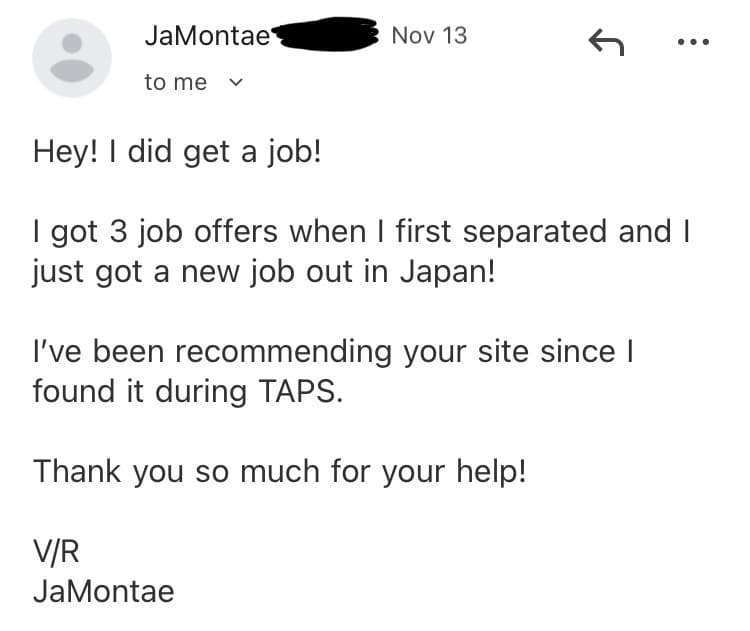
“Hey! I did get a job! I got 3 job offers when I first separated and I just got a new job out in Japan! I’ve been recommending your site since I found it during TAPS. Thank you so much for your help! V/R JaMontae ”
Federal service is the path where your clearance and ISR background do the most work, because the qualifying experience maps to published GS standards instead of an employer guessing at what aircrew means. A TS/SCI that is current saves an agency the cost and the months of a new investigation, and that is a concrete line item in your favor.
The anchor series is GS-0132 Intelligence. Airborne ISR Operators routinely qualify here because real-time collection, multi-source exploitation, and reporting are the exact duties the 0132 standard describes. Cleared veterans commonly enter at GS-7 to GS-9 with operator experience and move toward GS-11 and GS-12 as analytical responsibility grows. Landing a GS-12 after service walks through how the grade jump actually happens.
Beyond 0132, your background opens several adjacent series. GS-0080 Security Administration fits operators who handled classified material control and SCIF operations (see the GS-0080 security specialist resume guide). GS-0391 Telecommunications and GS-0856 Electronics Technician fit operators whose time leaned heavily into sensor and signals equipment. GS-1801 General Inspection and GS-1811 Criminal Investigator are realistic for those drawn to federal investigative work. GS-0343 Management and Program Analyst and GS-0340 Program Management capture the planning and assessment side, and GS-2210 Information Technology Management fits operators who ran mission data systems.
Veterans' Preference adds 5 or 10 points to your federal application rating, and the clearance is the multiplier on top of it. Federal intelligence work routes through agencies and combatant-command staffs rather than a single hub. The same GS-0132 path is reached by Navy CTR Cryptologic Technician Collection and Marine Corps 0231 Intelligence Specialist veterans, so the federal resume has to make your specific collection record stand out. Start the federal version with the federal resume builder or get started here.
| GS Series | Federal Job Title | Typical Grades | Match | Explore |
|---|---|---|---|---|
| GS-0132 | Intelligence | GS-7, GS-9, GS-11, GS-12 | View Details → | |
| GS-0080 | Security Administration | GS-7, GS-9, GS-11 | View Details → | |
| GS-2210 | Information Technology Management | GS-9, GS-11, GS-12 | View Details → | |
| GS-1811 | Criminal Investigator | GS-9, GS-11, GS-12 | View Details → | |
| GS-0391 | Telecommunications | GS-7, GS-9, GS-11 | View Details → | |
| GS-0343 | Management and Program Analyst | GS-9, GS-11, GS-12 | View Details → | |
| GS-0856 | Electronics Technician | GS-7, GS-9, GS-11 | View Details → |
Federal hiring uses keyword-matching and structured experience. BMR builds federal-format resumes (USAJobs-ready) with the right keywords, hours/week, and supervisor info — for any GS series above.
Free · No credit card · Federal + civilian resume formats included
Not everyone wants to stay in a related field. These career paths leverage your transferable skills — leadership, risk management, logistics, project planning — in completely different industries.
Running multiple live sensor feeds and calling time-critical changes is the same cognitive load a technical director carries in a live broadcast control room.
Airborne ISR Operators already live in the flight environment and the crew-communication discipline that commercial flying demands, which shortens the cultural learning curve into the cockpit.
The high-tempo, sustained-attention, communicate-fast-and-accurately discipline of airborne ISR maps cleanly onto emergency medical response, especially air-medical work.
Pattern-of-life analysis is anomaly detection by another name. The instinct for finding the signal in noisy data is exactly what data science rewards.
Spotting the one feed that does not fit the pattern is the daily work of fraud and forensic analysis. ISR operators are trained to find exactly that deviation in noisy data.
Synthesizing many sources into a clear assessment for a commander is the same skill a research analyst uses to turn market data into a recommendation.
Assessing mission effectiveness and recommending changes is the consulting skill set. The structured-assessment habit transfers directly.
The skills that made you a good Marine, Sailor, Airman, or Soldier transfer further than you think. BMR rewrites your bullets for any of the pivot careers above — without making you sound like you've never done the work.
Free · No credit card · Try unlimited career angles
If you are staying in intelligence, signals, or cleared analysis, your terminology already translates. Hiring teams in that market know what collection, exploitation, and TSO mean. This section is for operators targeting careers OUTSIDE the intelligence specialty, where a hiring manager has never heard a single term on your evaluation.
The fix is not to dumb the work down. It is to name the underlying skill in the language the target industry uses. Below are translations drawn from real 1A8X2 duties, with before and after resume bullet examples aimed at non-intelligence roles. The 50 military terms translated to civilian language glossary covers the broader vocabulary, and translating your EPR/OPR into civilian resume language is written specifically for Air Force evaluations.
A few high-value translations for 1A8X2 operators: "real-time sensor exploitation" becomes "live data monitoring and rapid decision-making"; "threat-warning calls to aircrew" becomes "time-critical communication to operational teams"; "multi-source collection management" becomes "multi-feed data prioritization." Keep the rigor, change the dictionary. The military resume builder handles this mapping automatically, or you can build your resume now and see the translated bullets first.
BMR turns your 1A8X2 duties and accomplishments into civilian bullets that match the job you're applying for — no manual translation, no rewriting.
Free · No credit card · Tailored to each job posting
Which certifications you need depends on where you're headed. Find your target career path below.
The wrong placement can sink an otherwise strong application. BMR knows where each cert ranks, what to call it, and how to frame it for ATS keyword matching and hiring manager attention.
Free · No credit card · Built around your real certs and clearance
If you are continuing in the cleared world, keep your clearance current and document it correctly. Verifying your clearance status after separation and listing your clearance on LinkedIn are the two things that get cleared recruiters to call. Professional associations worth joining include AFCEA and the Intelligence and National Security Alliance (INSA). DoD SkillBridge can place you with a defense contractor for your final months on active duty; the SkillBridge to federal career guide covers how to line that up.
If you are leaving the specialty, lead with transferable skills and credentials a civilian industry recognizes. PMP for project work, CompTIA Security+ for IT-adjacent roles, and Six Sigma for process roles all carry weight; Six Sigma for veterans explains the fit. American Corporate Partners (ACP) offers free year-long mentorship matching that is genuinely useful for a clean break into a new field. For federal paths, USAJobs is the front door, and SFL-TAP resources cover the transition timeline.
Tools and next steps: build a private-sector resume with the military resume builder or a GS version with the federal resume builder, explore where else your skills map with the career crosswalk, or just get started here.
See also: Air Force 1N2X1 Signals Intelligence Analyst, Air Force 1N0X1 All Source Intelligence Analyst, and Air Force 1U0X1 RPA Sensor Operator for related career paths.
Most veterans do this backwards — they wait until terminal leave to start, then panic. Here's the actual sequence that works.
Print this. Tape it to your monitor. Veterans who treat the transition like a 90-day op get hired faster than the ones who treat it like an emergency.
Stop rewriting from scratch every time you apply. BMR turns your military experience into civilian and federal resumes — tailored to each job.