Loading...
Loading...
The civilian and federal jobs that hire Marines Unmanned Aircraft System (UAS) Operators — with real salaries and the resume that gets callbacks.
Every 7314 has more options than a Google search will tell you. Below: career paths, BLS salary data, federal GS series, certifications by target career, and how to translate your experience without losing what made you valuable to the Marines in the first place.
Free · No credit card · Tailored resume in under 5 minutes
After the Navy I got hired into 6 federal career fields and tech sales, and sat on federal hiring panels along the way. I spent the last 2 years rebuilding everything I learned into BMR, tuned for how AI actually screens resumes today. This is the system I wish I'd had on day one.
If you held MOS 7314, you ran the sensor ball and air vehicle on the MQ-9A Reaper. You conducted multi-imagery reconnaissance and surveillance, slewed electro-optical, infrared, and low-light full-motion video onto targets, worked synthetic aperture radar (SAR) returns, and ran the laser target marker to identify and illuminate for other combat assets. You assisted the pilot with air navigation, flight planning, and crew coordination, and you held a TS/SCI ticket to do it. The training pipeline ran you through the USAF Remotely Piloted Aircraft Course Basic Sensor Operator School at Randolph AFB and the MQ-9 Initial Qualification Training at Holloman AFB, so your foundation is the same enlisted Group 4-5 UAS crew training the Air Force uses.
That is a far more transferable background than the resume usually shows. The commercial drone field is one of the fastest-growing pieces of the civilian economy. Construction firms, energy and utility companies, precision agriculture, public-safety agencies, and survey and mapping shops are all standing up UAS programs, and they need operators who already understand airspace, sensor payloads, mission planning, and the discipline of flying a real aircraft remotely. The civilian on-ramp is the FAA Part 107 Remote Pilot Certificate, and a 7314 walks into that knowledge test already understanding airspace classes, weather, and crew resource management most candidates have to learn cold.
The skill that actually separates you is not "flew a drone." It is sustained, full-attention interpretation of multiple live sensor feeds, precise remote control of optical payloads, and calm decision-making under operational time pressure. Those translate into commercial UAS operations, geospatial and imagery analysis, and public-safety drone programs. Use the military career crosswalk to map the full picture, and if you are leaning toward the imagery side, the 0241 Imagery Analysis Specialist and 0261 Geographic Intelligence Specialist pages cover adjacent geospatial paths. For the broad translation framework, the military to civilian career paths guide is a good starting read.
I pivoted into tech sales after the Navy, and the UAS operators I have watched transition do best when they stop calling it "drone experience" and start describing the sensor and airspace judgment behind it. A 7314 already reasons about airspace, weather, and payload tradeoffs the way a commercial pilot does, and that credibility is exactly what drone-program employers and UAS hardware companies are hunting for. The Part 107 cert is cheap. The operational judgment behind it took the Marine Corps years to build into you. — Brad Tachi, Navy Diver veteran & BMR founder
The number that matters when you're deciding what's next: how does civilian pay compare to what you make now?
Military comp is approximate (varies by location/dependents). Civilian is BLS median. Federal includes locality pay. Your real number depends on duty station, family status, GS step, and overtime.
Commercial UAS is a young, fast-moving market, so be honest with yourself about geography and timing. The best-paid, most stable roles cluster around energy, infrastructure inspection, survey and mapping, and large agriculture operations, and many of those are tied to specific regions (oil and gas corridors, utility service territories, large-acreage farm belts). Media and real-estate drone work exists everywhere but pays less and is more freelance and feast-or-famine. Read each path below for what it actually pays.
Commercial Drone / UAS Pilot. O*NET maps commercial drone operations to Commercial Pilots (53-2012.00), where BLS reports a May 2024 median of $122,670. That figure spans manned and unmanned flying, so pure-UAS roles often start lower and climb with program responsibility, but the certification path (FAA Part 107) is short and the operator shortage is real in energy and inspection work.
Geospatial / Photogrammetry Imagery Analyst. Cartographers and Photogrammetrists (17-1021.00) earned a BLS May 2024 median of $78,380, with employment projected to grow 6 percent through 2034. Your habit of extracting meaning from EO/IR and SAR imagery is the core of this work.
GIS Analyst. Geographers (19-3092.00) carry a BLS May 2024 median of $97,200. Drone-collected imagery feeds GIS pipelines directly, and operators who learn the analysis software become the rare hire who understands both collection and the product.
Remote Sensing Scientist / Analyst. Remote Sensing Scientists and Technologists (19-2099.01) report a BLS May 2024 median of $100,340. This is the deeper-science end of imagery work and usually wants a degree, but your collection background is a genuine advantage.
Drone Survey and Mapping Technician. Surveying and Mapping Technicians (17-3031.00) earned a BLS May 2024 median of $51,940, with 5 percent projected growth. This is a common, accessible entry point into the geospatial industry that pairs naturally with a Part 107 cert.
Aerial Cinematography / UAS Camera Operator. Camera Operators in Television, Video, and Film (27-4031.00) earned a BLS May 2024 median of $68,810. Gimbal and payload framing under live conditions is exactly the muscle you built on the sensor ball.
For where these careers concentrate and how hiring is trending, where veterans are getting hired in 2026 is worth a look, and the geospatial / GIS imagery analyst career guide goes deep on the imagery side. Operators from other branches share these exact civilian paths: see Army 15W UAS Operator and Air Force 1U0X1 RPA Sensor Operator. When you are ready to put this on paper, the military resume builder is built for exactly this translation.
| Civilian Job Title | Industry | BLS Median Salary | Outlook | Match |
|---|---|---|---|---|
Commercial Drone / UAS Pilot O*NET: 53-2012.00 | Unmanned Aviation | $122,670 | About as fast as average | strong |
Geospatial / Photogrammetry Imagery Analyst O*NET: 17-1021.00 | Geospatial | $78,380 | 6% (Faster than average) | strong |
GIS Analyst O*NET: 19-3092.00 | Geospatial | $97,200 | About as fast as average | strong |
Remote Sensing Scientist / Analyst O*NET: 19-2099.01 | Geospatial | $100,340 | About as fast as average | emerging |
Drone Survey and Mapping Technician O*NET: 17-3031.00 | Geospatial | $51,940 | 5% (Faster than average) | moderate |
Aerial Cinematography / UAS Camera Operator O*NET: 27-4031.00 | Media Production | $68,810 | About as fast as average | moderate |
BMR rewrites your 7314 experience for any of the civilian roles above — keywords, achievements, and language hiring managers actually scan for.
Free · No credit card · 2 tailored resumes included
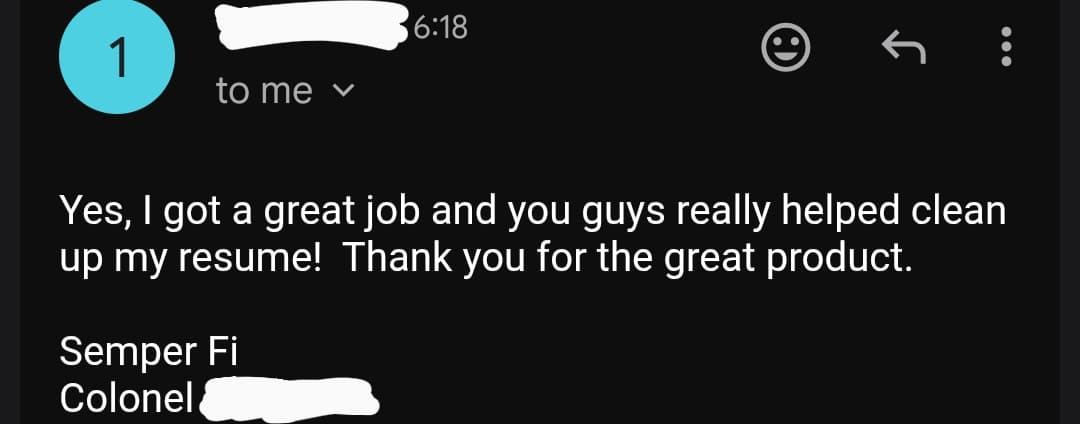
“Hey Brad, Just wanted to send out a quick thank you. You've created something amazing with BMR and your continued advocacy for transitioning service members does not go unnoticed. It was the most effective resource I used in my transition and I know it played a key role in landing a six figure…”
Your TS/SCI clearance is the single most valuable thing you carry into federal hiring, and the UAS field has a clear federal lane across DoD, the FAA, and the intelligence community. Match your record to the series, then build to the qualification standard, not just the job title.
GS-0132 Intelligence. The direct analytic match for your ISR and imagery-exploitation work. Cleared 7314s slot into all-source and imagery analyst roles across DoD components and combatant commands, typically entering around GS-7 to GS-9 and climbing with experience.
GS-0150 Geography and GS-1370 Cartography. These cover the geospatial and mapping side of what you collected. If you want to stay close to imagery and GIS, this is the federal home for it.
GS-1825 Aviation Safety. The FAA runs the civilian UAS regulatory system, and aviation safety specialists who understand UAS operations are in demand as Part 107 and beyond-visual-line-of-sight rules expand. Your operational airspace background is directly relevant.
GS-0080 Security Administration and GS-0855 Electronics Engineering. Adjacent series for operators who moved toward program security or the sensor-systems engineering side of UAS during their enlistment.
Veterans' Preference adds 5 or 10 points to your competitive score, and your TS/SCI can let an agency skip the cost and delay of a fresh investigation, which is a real hiring advantage worth naming in your application. To translate your record into the federal format correctly, read how to find your military job series equivalent in USAJobs and the 10 federal job series every veteran should search. The federal resume builder handles the OPM formatting so your experience is scored on substance.
| GS Series | Federal Job Title | Typical Grades | Match | Explore |
|---|---|---|---|---|
| GS-0132 | Intelligence | GS-7, GS-9, GS-11 | View Details → | |
| GS-1370 | Cartography | GS-7, GS-9, GS-11 | View Details → | |
| GS-1825 | Aviation Safety | GS-9, GS-11, GS-12 | View Details → | |
| GS-0150 | Geography | GS-7, GS-9 | View Details → | |
| GS-0855 | Electronics Engineering | GS-7, GS-9, GS-11 | View Details → | |
| GS-0080 | Security Administration | GS-7, GS-9, GS-11 | View Details → | |
| GS-2210 | Information Technology Management | GS-7, GS-9, GS-11 | View Details → |
Federal hiring uses keyword-matching and structured experience. BMR builds federal-format resumes (USAJobs-ready) with the right keywords, hours/week, and supervisor info — for any GS series above.
Free · No credit card · Federal + civilian resume formats included
Not everyone wants to stay in a related field. These career paths leverage your transferable skills — leadership, risk management, logistics, project planning — in completely different industries.
Reading a sonography screen to find and capture a clear, diagnostic image is the same real-time imaging judgment and steady hand you used on the sensor ball, applied to the body instead of the ground.
A control-room dispatcher watches a live grid and reacts to faults without losing composure, which is the exact vigilance and procedural discipline you ran for hours on an ISR mission.
Examining evidence and writing it up precisely is the same disciplined, detail-obsessed analysis you applied to imagery, now feeding investigations instead of mission reports.
Selling UAS, sensor, or geospatial technology rewards the operator who has actually flown the mission, because that credibility closes deals no pure salesperson can match.
Running a live broadcast control room means watching many feeds and reacting instantly without error, the same multi-feed attention and steady technical hand you used on a live mission.
The planning and after-action analysis you ran for ISR missions is the same structured problem-solving consultants sell, applied to business operations.
You already reason about airspace, traffic, and risk in real time under pressure, which is the core of air traffic control, a different aviation lane from sensor operations with no degree required to start.
The skills that made you a good Marine, Sailor, Airman, or Soldier transfer further than you think. BMR rewrites your bullets for any of the pivot careers above — without making you sound like you've never done the work.
Free · No credit card · Try unlimited career angles
If you are applying to a UAS, drone, or geospatial employer, your terminology already fits and you should keep it. This section is for the careers OUTSIDE the UAS specialty, where a hiring manager has never heard of an MQ-9 sensor ball and needs you to speak their language.
Sensor operations becomes monitoring and interpretation. "Operated EO/IR and SAR sensors to detect and track targets" reads better to a non-aviation employer as "Monitored and interpreted multiple real-time imaging and data feeds to identify, classify, and report items of interest under time pressure."
Crew coordination becomes team communication. "Coordinated MQ-9 crew tasks with the pilot to achieve mission objectives" translates to "Coordinated a networked operations team through structured voice and data communication to execute time-critical objectives with zero error tolerance."
Mission planning becomes operations planning. "Conducted flight planning and airspace deconfliction" becomes "Planned complex operations under regulatory and safety constraints, sequencing assets and managing risk across multiple variables."
Payload control becomes precision technical operation. "Slewed and stabilized the sensor payload onto designated points" reads to a civilian employer as "Operated precision remote-control imaging equipment to capture and stabilize high-value data in dynamic conditions."
The point is to lead with the transferable judgment, not the platform. For more before-and-after examples, the 50 military terms translated to civilian language glossary and hidden military skills civilians do not know you have are both useful. The military resume builder applies this translation automatically so your bullets land with civilian recruiters.
BMR turns your 7314 duties and accomplishments into civilian bullets that match the job you're applying for — no manual translation, no rewriting.
Free · No credit card · Tailored to each job posting
Which certifications you need depends on where you're headed. Find your target career path below.
The wrong placement can sink an otherwise strong application. BMR knows where each cert ranks, what to call it, and how to frame it for ATS keyword matching and hiring manager attention.
Free · No credit card · Built around your real certs and clearance
For staying in UAS, drone, and geospatial work: The first move for almost any civilian UAS job is the FAA Part 107 Remote Pilot Certificate, which requires passing the Unmanned Aircraft General (UAG) aeronautical knowledge test at an FAA-approved testing center and recurrent online training every 24 months. Your military airspace and weather knowledge gives you a real head start on that exam. For the geospatial side, the GIS Certification Institute (GISP) and Esri technical certifications are the recognized credentials. AUVSI (the Association for Uncrewed Vehicle Systems International) is the major industry body and a strong place to network and track where UAS programs are hiring. SkillBridge can place you with a commercial drone or geospatial company before you separate, and you can use the career crosswalk to scope adjacent jobs.
For careers outside UAS: American Corporate Partners (ACP) offers free one-on-one veteran mentorship across industries. Project Management (PMP or CAPM) and Six Sigma credentials translate your mission-planning discipline into business roles. Your TS/SCI clearance has direct cash value in cleared private-sector work, so know what it is worth before you negotiate. Start your transition admin early through SFL-TAP transition resources.
Build the resume: Start with the military resume builder for private-sector roles or the federal resume builder for USAJobs, then build your resume now when you are ready to move.
See also: Navy AWV Naval Aircrewman (Avionics), Air Force 1U1X1 RPA Pilot, and the Marine 0241 Imagery Analysis Specialist page. Helpful reads: SkillBridge: land a civilian job before you separate, what your security clearance is worth, and how to explain military experience in a civilian interview.
Most veterans do this backwards — they wait until terminal leave to start, then panic. Here's the actual sequence that works.
Print this. Tape it to your monitor. Veterans who treat the transition like a 90-day op get hired faster than the ones who treat it like an emergency.
Stop rewriting from scratch every time you apply. BMR turns your military experience into civilian and federal resumes — tailored to each job.