Loading...
Loading...
The civilian and federal jobs that hire Navy Naval Aircrewman (Avionics)s — with real salaries and the resume that gets callbacks.
Every AWV has more options than a Google search will tell you. Below: career paths, BLS salary data, federal GS series, certifications by target career, and how to translate your experience without losing what made you valuable to the Navy in the first place.
Free · No credit card · Tailored resume in under 5 minutes
After the Navy I got hired into 6 federal career fields and tech sales, and sat on federal hiring panels along the way. I spent the last 2 years rebuilding everything I learned into BMR, tuned for how AI actually screens resumes today. This is the system I wish I'd had on day one.
As a Naval Aircrewman (Avionics), you operated the communications and avionics systems that keep the nation's nuclear command-and-control link alive in the air. AWVs are the airborne systems operators on the E-6B Mercury, the Navy's TACAMO ("Take Charge And Move Out") aircraft that relays orders from the National Command Authority to the ballistic-missile submarine force. You worked the Very Low Frequency (VLF) transmission suite, the dual trailing-wire antenna reel system, and the UHF, SHF, and SATCOM links that carry survivable Nuclear Command, Control, and Communications (NC3) traffic. When the Looking Glass mission is airborne, AWVs are part of the crew running the Airborne Launch Control System (ALCS) communications path.
This is not generic aircrew work. You managed a 200-kilowatt VLF transmitter feeding antennas that trail thousands of feet behind the aircraft, troubleshot encrypted circuits in flight with no bench to fall back on, and held strict communications-security discipline on the most sensitive traffic in the Department of Defense. The E-6B fleet flies out of Tinker Air Force Base, Oklahoma, and AWVs deploy worldwide to keep the strategic comms picture unbroken. Some AWVs also crew unmanned aircraft systems as the rating has expanded its mission set.
Civilian employers value this background because it pairs hands-on RF and avionics systems operation with the kind of disciplined, high-consequence reliability that almost no civilian training produces. You diagnosed complex electronics in real time, under pressure, where a dropped circuit was not an option. If you want to see how your rating maps to civilian work, start with our military-to-civilian career crosswalk, and compare paths with related Navy aircrew ratings like the AWO Naval Aircrewman (Operator) and the broader Naval Aircrewman community.
After my Navy time I pivoted into tech sales, and the AWV background is one of the more underrated tickets into that world. You operated SATCOM, VLF, and SHF systems on the most demanding comms platform the Navy flies. That technical credibility opens doors at companies selling secure communications, SATCOM services, and avionics systems, because you can talk to an engineering buyer as a peer instead of reading off a slide. — Brad Tachi, Navy Diver veteran & BMR founder
The number that matters when you're deciding what's next: how does civilian pay compare to what you make now?
Military comp is approximate (varies by location/dependents). Civilian is BLS median. Federal includes locality pay. Your real number depends on duty station, family status, GS step, and overtime.
If you want to stay close to RF and avionics work, several civilian fields hire your exact skill set. Salary figures below are BLS Occupational Employment and Wage Statistics (OEWS) medians from May 2024.
Avionics Technician (O*NET 49-2091.00) is the closest direct match. These technicians install, test, and repair radar, radio, navigation, and communications systems on aircraft. BLS reports a median wage of $81,390. The work sits inside the aircraft and avionics equipment mechanics group, which BLS projects to grow about 5 percent through 2033.
Telecommunications Equipment Installer and Repairer (O*NET 49-2022.00) covers the switching, routing, and transmission gear that carries voice and data. BLS median pay is $64,310. Radio, Cellular, and Tower Equipment Installers and Repairers (O*NET 49-2021.00) handle the transmitting and receiving side of two-way radio and cellular networks, which lines up tightly with your VLF and UHF transmitter experience.
Electrical and Electronics Installers and Repairers, Transportation Equipment (O*NET 49-2093.00) maintain communications, navigation, and surveillance electronics on aircraft, ships, and other mobile platforms. BLS reports a median of $71,270. Computer Network Support Specialists (O*NET 15-1231.00) draw on the circuit-troubleshooting and systems-integration side of your background, with a BLS median of $73,340.
Be realistic about geography. Avionics and aviation electronics jobs cluster around aircraft manufacturing hubs, major airline maintenance bases, and defense contractor sites, so the strongest markets are concentrated rather than spread evenly. The telecommunications side is more geographically flexible. If you are weighing a same-field move against a federal route, the AWF Naval Aircrewman (Mechanical) page and the Air Force 1A1X1 Flight Engineer page cover adjacent aircrew civilian paths. When you are ready to put this on paper, our military resume builder turns your flight log and systems quals into language a hiring manager reads cleanly, or you can build your resume now.
| Civilian Job Title | Industry | BLS Median Salary | Outlook | Match |
|---|---|---|---|---|
Avionics Technician O*NET: 49-2091.00 | Aviation & Aerospace | $81,390 | 5% (As fast as average) | strong |
Telecommunications Equipment Installer and Repairer O*NET: 49-2022.00 | Telecommunications | $64,310 | Little or no change projected | strong |
Radio, Cellular, and Tower Equipment Installer and Repairer O*NET: 49-2021.00 | Telecommunications | $64,310 | Little or no change projected | strong |
Electrical and Electronics Installers and Repairers, Transportation Equipment O*NET: 49-2093.00 | Aviation & Transportation | $71,270 | 2% (Slower than average) | strong |
Computer Network Support Specialist O*NET: 15-1231.00 | Information Technology | $73,340 | 7% (Faster than average) | moderate |
Aerospace Engineering and Operations Technician O*NET: 17-3021.00 | Aviation & Aerospace | $79,830 | 7% (Faster than average) | moderate |
Broadcast, Sound, and Video Technician O*NET: 27-4012.00 | Media & Broadcasting | $56,600 | 8% (Faster than average) | emerging |
BMR rewrites your AWV experience for any of the civilian roles above — keywords, achievements, and language hiring managers actually scan for.
Free · No credit card · 2 tailored resumes included
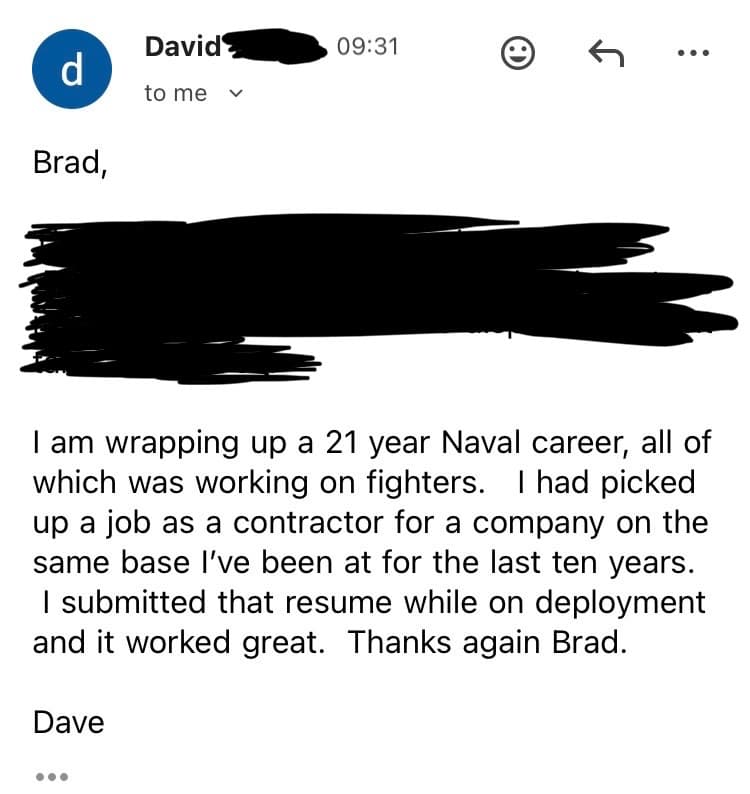
“I am wrapping up a 21 year Naval career, all of which was working on fighters. I had picked up a job as a contractor for a company on the same base I’ve been at for the last ten years. I submitted that resume while on deployment and it worked great. Thanks again Brad. Dave ”
Federal service rewards the AWV background heavily, and a security clearance plus airborne-comms experience is a combination that maps onto several General Schedule series. Veterans' Preference adds 5 or 10 points to your numerical rating on most competitive-service jobs, and the Veterans Recruitment Appointment authority lets agencies hire you outside the standard competitive process. Keep your DD-214 and any disability rating letter ready for that preference verification, since that is the one place those documents belong in the hiring process.
The GS-0391 Telecommunications series is the most direct fit. It covers planning and operating communications systems and aligns with your VLF, UHF, and SATCOM work. Strong entrants land at the GS-7 to GS-11 range depending on experience. The GS-0856 Electronics Technician series and the GS-0802 Engineering Technician series both value hands-on diagnosis of complex electronic systems, which is the core of what you did in flight.
Look also at GS-0855 Electronics Engineering if you finished a relevant degree, GS-2210 Information Technology Management for the network and systems side, and GS-0390 Telecommunications Processing for message and data handling roles. Agencies that run heavy comms and avionics workloads include the Naval Air Systems Command, the Defense Information Systems Agency, the FAA, and the Department of the Air Force civilian workforce. For the federal application itself, the format is its own discipline. Our federal resume builder handles the USAJobs structure, and the federal resume tips guide and Veterans' Preference breakdown walk through the details. The Army 25S Satellite Communication Systems Operator page targets several of the same GS series.
| GS Series | Federal Job Title | Typical Grades | Match | Explore |
|---|---|---|---|---|
| GS-0391 | Telecommunications | GS-7, GS-9, GS-11 | View Details → | |
| GS-0802 | Engineering Technician | GS-7, GS-9, GS-11 | View Details → | |
| GS-0855 | Electronics Engineering | GS-9, GS-11, GS-12 | View Details → | |
| GS-0856 | Electronics Technician | GS-9, GS-11, GS-12 | View Details → | |
| GS-1815 | Air Safety Investigating | GS-9, GS-11 | View Details → | |
| GS-0390 | Telecommunications Processing | GS-6, GS-7, GS-9 | View Details → | |
| GS-2210 | Information Technology Management | GS-9, GS-11, GS-12 | View Details → |
Federal hiring uses keyword-matching and structured experience. BMR builds federal-format resumes (USAJobs-ready) with the right keywords, hours/week, and supervisor info — for any GS series above.
Free · No credit card · Federal + civilian resume formats included
Not everyone wants to stay in a related field. These career paths leverage your transferable skills — leadership, risk management, logistics, project planning — in completely different industries.
AWVs spend years turning dense systems behavior into precise checklists and reports under zero-error standards. That is the core of technical writing for aerospace, defense-electronics, and software companies.
Naval aircrew training is rigorous, standardized, and consequence-driven. AWVs who ran qualification programs already do the work of designing curricula and measuring competency.
Coordinating the electrical grid means watching a complex system continuously and acting decisively when something fails. That is the same operational mindset AWVs used managing airborne comms systems where a dropped link was not an option.
Calibration work demands the same precision and documentation discipline AWVs applied to airborne electronics. Your habit of verifying systems to an exact standard transfers directly to a metrology lab.
Your electrical and high-power systems experience maps cleanly onto solar installation and commissioning. This is one of the fastest-growing trades in the country, and the electrical fundamentals are already yours.
AWVs who trained junior aircrew on complex systems already deliver structured, outcome-based technical training. Companies need that skill to onboard technical staff quickly.
The skills that made you a good Marine, Sailor, Airman, or Soldier transfer further than you think. BMR rewrites your bullets for any of the pivot careers above — without making you sound like you've never done the work.
Free · No credit card · Try unlimited career angles
If you are staying in avionics, RF, or telecommunications, your terminology already lands. Recruiters in those fields know what a VLF transmitter and a trailing-wire antenna are. This section is for AWVs targeting careers OUTSIDE the comms and avionics specialty, where a hiring manager has never heard your rating language and needs it in plain business terms.
Lead with outcomes and systems, not acronyms. A line like "operated E-6B VLF transmission suite during TACAMO sorties" means nothing to a civilian recruiter. Rewritten as "operated a 200-kilowatt high-power transmission system supporting continuous mission-critical communications across multi-hour operations," it reads as real technical responsibility. The same logic applies to your security discipline and your real-time troubleshooting. Our 50 military terms translated to civilian language guide and the explaining military experience in interviews guide go deeper on this. When you are drafting bullets, the resume builder keeps the translation consistent across the whole document.
BMR turns your AWV duties and accomplishments into civilian bullets that match the job you're applying for — no manual translation, no rewriting.
Free · No credit card · Tailored to each job posting
Which certifications you need depends on where you're headed. Find your target career path below.
The wrong placement can sink an otherwise strong application. BMR knows where each cert ranks, what to call it, and how to frame it for ATS keyword matching and hiring manager attention.
Free · No credit card · Built around your real certs and clearance
Keep your aircrew and systems quals current and translate them onto paper without dumbing them down. The FAA repairman certificate and the FCC General Radiotelephone Operator License are worth pursuing if you are moving toward avionics or broadcast RF work. SkillBridge can place you with an avionics or defense-electronics employer in your last months of service. Start with the SkillBridge guide and the top SkillBridge companies list. Your clearance is a real asset on the defense-electronics side; the clearance salary guide covers what it is worth.
If you are leaving comms work behind, American Corporate Partners (ACP) offers free one-on-one veteran mentorship that helps you map a path into a new field. Certifications like PMP, CompTIA Security+, and Six Sigma open doors in project, IT, and operations roles. For federal routes, see our federal resume builder and the SFL-TAP transition resources. Explore options across branches and fields with the career crosswalk. When you are ready, build your resume now.
See also: AWO Naval Aircrewman (Operator), the Air Force 1A1X1 Flight Engineer, and the Marine Corps 2841 Ground Radio Repairer for related transition paths. For interview prep, read how veterans use informational interviews to land jobs.
Most veterans do this backwards — they wait until terminal leave to start, then panic. Here's the actual sequence that works.
Print this. Tape it to your monitor. Veterans who treat the transition like a 90-day op get hired faster than the ones who treat it like an emergency.
Stop rewriting from scratch every time you apply. BMR turns your military experience into civilian and federal resumes — tailored to each job.