Loading...
Loading...
The civilian and federal jobs that hire Navy Naval Aircrewman (Mechanical)s — with real salaries and the resume that gets callbacks.
Every AWF has more options than a Google search will tell you. Below: career paths, BLS salary data, federal GS series, certifications by target career, and how to translate your experience without losing what made you valuable to the Navy in the first place.
Free · No credit card · Tailored resume in under 5 minutes
After the Navy I got hired into 6 federal career fields and tech sales, and sat on federal hiring panels along the way. I spent the last 2 years rebuilding everything I learned into BMR, tuned for how AI actually screens resumes today. This is the system I wish I'd had on day one.
As a Naval Aircrewman (Mechanical), you flew as the mechanical heartbeat of a fixed-wing or tilt-rotor crew. You served as Flight Engineer, Crew Chief, Loadmaster, or Reel Operator aboard the C-130 Hercules, C-2 Greyhound, CMV-22 Osprey, C-40, C-37, and the E-6B Mercury. Your job was the airplane itself: monitoring and operating propulsion, hydraulic, fuel, electrical, and environmental systems while airborne, running engine-start and emergency checklists, and keeping the aircraft flyable when a system started misbehaving at altitude.
The skill that defines an AWF is judgment about machinery under conditions you cannot pause. A Flight Engineer reads engine instruments, fuel state, and bleed-air and hydraulic pressures in real time and decides whether a fluctuation is normal or the first sign of a failure. As a Loadmaster you calculated weight and balance for every load, supervised cargo rigging and tie-down, and ran airdrop and aerial-delivery sequences where a center-of-gravity error is not survivable. On the E-6B you operated the trailing-wire antenna reel that connects national command authority to the ballistic-missile force. None of that is forgiving work, and employers who run complex equipment know it.
The training pipeline ran through Naval Aircrew Candidate School in Pensacola, Aircrew School, rescue and water survival (including Class II swim qualification and aviation physiology), and then platform-specific Fleet Replacement Squadron training as a Flight Engineer or Loadmaster. You held a SECRET or higher clearance, logged flight hours in your aircrew logbook, and earned your aircrew wings. Civilian employers in aviation, heavy equipment, and federal aircraft maintenance recognize that combination of mechanical-systems depth, checklist discipline, and accountability for outcomes that cannot be undone.
If you are mapping out your move, start with the military-to-civilian career crosswalk. Two close Navy neighbors worth comparing are the broader Naval Aircrewman (AW) career guide and the Aviation Machinist's Mate (AD) page, since both share the powerplant and propulsion vocabulary you already speak. For the language side of the move, our Navy rating translation guide walks through turning aircrew duties into civilian resume bullets.
I spent years in federal engineering and environmental work after the Navy, and the AWF background lands hard in that world. A Flight Engineer who reads hydraulic and propulsion systems in flight is exactly the profile NAVAIR depots, the FAA, and DLA aviation look for in their aircraft-mechanic and equipment-systems series. The trick is writing your logbook hours and W and B work as engineering judgment, not just flight time. — Brad Tachi, Navy Diver veteran & BMR founder
The number that matters when you're deciding what's next: how does civilian pay compare to what you make now?
Military comp is approximate (varies by location/dependents). Civilian is BLS median. Federal includes locality pay. Your real number depends on duty station, family status, GS step, and overtime.
Your AWF experience points at several civilian fields where in-flight mechanical-systems knowledge and weight-and-balance precision carry real wage value. All salary figures below are BLS Occupational Employment and Wage Statistics medians (May 2024). Aviation is geographically concentrated and cyclical, so where you live matters as much as what you know.
Aircraft and avionics maintenance. Aircraft Mechanics and Service Technicians (O*NET 49-3011.00) earn a median of $79,140, and the field is tied to airline fleets, MRO (maintenance, repair, and overhaul) shops, and defense depots. Your Flight Engineer time means you already understand these systems as an operator, which shortens the learning curve on the wrench side. The work clusters around major airline hubs, depot cities, and defense-contractor sites.
Flight engineering and aircrew operations. Some carriers and contract-flying operations still crew turboprop and special-mission aircraft where flight-engineer and loadmaster experience transfers directly. Aerospace Engineering and Operations Technologists and Technicians (O*NET 17-3021.00) earn a median of $77,830 and support flight test and systems work where your real-world systems knowledge is rare.
Logistics, cargo, and load planning. Your loadmaster weight-and-balance and cargo-rigging work maps to ground and air cargo operations. Logisticians (O*NET 13-1081.00) earn a median of $79,400, and the load-planning niche inside air-freight and aerospace logistics values the discipline that AWFs bring to every manifest. For a parallel Navy logistics path, compare the Navy Logistics Specialist (LS) page.
Industrial and powered-equipment maintenance. Industrial Machinery Mechanics (O*NET 49-9041.00) earn a median of $63,550 and run the hydraulic, pneumatic, and drive systems you already troubleshoot. Manufacturers and energy operators hire heavily for this skill, and it is far less geographically restricted than airline maintenance.
If you want to see what other Navy aviation ratings translate into, the Aviation Structural Mechanic (AM) guide covers the airframe and hydraulics side. When you are ready to put this on paper, our military resume builder turns aircrew duties into civilian-readable accomplishments, or you can build your resume now.
| Civilian Job Title | Industry | BLS Median Salary | Outlook | Match |
|---|---|---|---|---|
Aircraft Mechanic and Service Technician O*NET: 49-3011.00 | Aviation Maintenance | $79,140 | 5% (Faster than average) | strong |
Aerospace Engineering and Operations Technician O*NET: 17-3021.00 | Aerospace | $77,830 | 7% (Faster than average) | strong |
Logistician (Load Planning) O*NET: 13-1081.00 | Aerospace Logistics | $79,400 | 19% (Much faster than average) | strong |
Industrial Machinery Mechanic O*NET: 49-9041.00 | Manufacturing | $63,550 | 15% (Much faster than average) | strong |
Avionics Technician O*NET: 49-2091.00 | Aviation Maintenance | $79,140 | 5% (Faster than average) | moderate |
Mobile Heavy Equipment Mechanic O*NET: 49-3042.00 | Heavy Equipment | $62,330 | 4% (As fast as average) | moderate |
Aircraft Cargo Handling Supervisor O*NET: 53-1042.00 | Air Cargo | $58,360 | 4% (As fast as average) | moderate |
BMR rewrites your AWF experience for any of the civilian roles above — keywords, achievements, and language hiring managers actually scan for.
Free · No credit card · 2 tailored resumes included
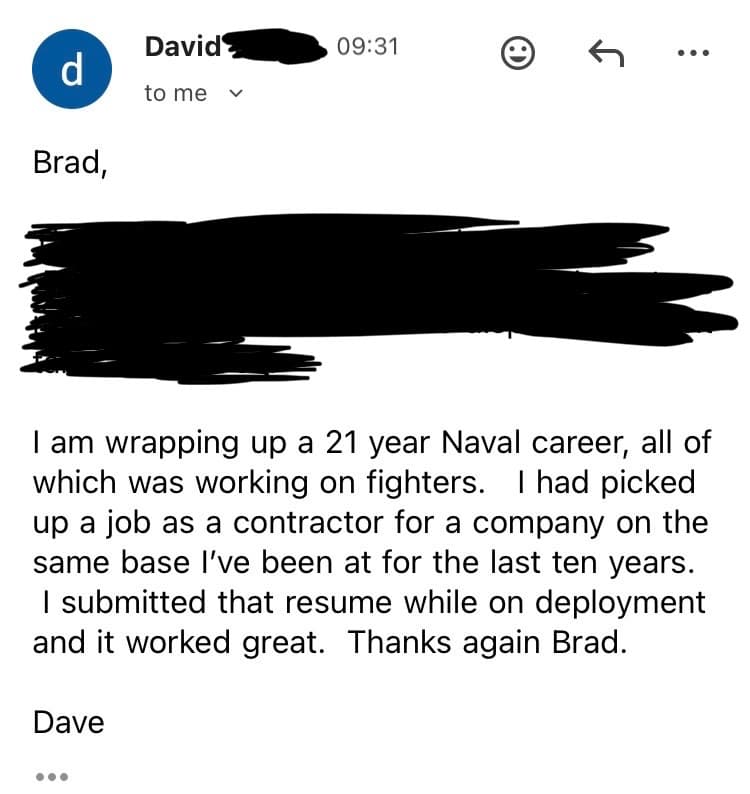
“I am wrapping up a 21 year Naval career, all of which was working on fighters. I had picked up a job as a contractor for a company on the same base I’ve been at for the last ten years. I submitted that resume while on deployment and it worked great. Thanks again Brad. Dave ”
Federal aircraft and equipment work is one of the strongest landing zones for AWFs, because the government runs its own fleets and depots and pays a Veterans' Preference advantage on top. Your flight-engineer and systems experience maps to both Wage Grade (WG) trade series and General Schedule (GS) technical series. Qualification standards live on OPM.gov, and our OPM qualification standards guide shows how to credit military experience toward a grade.
Aircraft Mechanic (WG-8852) is the core federal trade for AWFs at NAVAIR Fleet Readiness Centers, Air Force depots, and Coast Guard aviation. Your hands-on systems work and logbook history document the experience these positions require. Adjacent trade series include Aircraft Pneudraulic Systems Mechanic (WG-8268) for hydraulic and flight-control rigging, and Powered Support Systems Mechanic (WG-5378) for aviation ground equipment.
Engineering Technician (GS-0802) fits AWFs who want to move off the floor into test, evaluation, and systems-support roles at NAVAIR, the FAA, or a research command. The series rewards the ability to read a system, document a discrepancy, and reason about a fix, which is precisely what a Flight Engineer does. Electronics Technician (GS-0856) opens for crewmembers whose platform work leaned into avionics and mission systems.
Transportation Specialist (GS-2101) and Equipment Services (WG-1670) capture the loadmaster and cargo side of the rating for veterans drawn to load planning and fleet support. For the engineering ladder itself, the Mechanical Engineering (GS-0830) series is reachable with the right degree, and many AWFs use the GI Bill to qualify after separating.
Federal aviation grades commonly run WG-10 and WG-11 for trade roles and GS-7 through GS-11 for technician roles, with room to climb. Veterans' Preference adds 5 or 10 points to your rating. Our Veterans' Preference guide explains which you qualify for. To translate aircrew duties into a federal resume that survives the HR screen, use our federal resume builder or start your federal resume. If federal aircraft work appeals, the Aviation Electronics Technician (AT) page shares several of these GS targets.
| GS Series | Federal Job Title | Typical Grades | Match | Explore |
|---|---|---|---|---|
| GS-8268 | Aircraft Pneudraulic Systems Mechanic | WG-9, WG-10, WG-11 | View Details → | |
| GS-8852 | Aircraft Mechanic | WG-10, WG-11, WG-12 | View Details → | |
| GS-0802 | Engineering Technician | GS-7, GS-9, GS-11 | View Details → | |
| GS-1825 | Aviation Safety | GS-7, GS-9 | View Details → | |
| GS-5378 | Powered Support Systems Mechanic | WG-9, WG-10 | View Details → | |
| GS-0856 | Electronics Technician | GS-7, GS-9, GS-11 | View Details → | |
| GS-1670 | Equipment Services | WG-8, WG-9, WG-10 | View Details → | |
| GS-2101 | Transportation Specialist | GS-7, GS-9, GS-11 | View Details → |
Federal hiring uses keyword-matching and structured experience. BMR builds federal-format resumes (USAJobs-ready) with the right keywords, hours/week, and supervisor info — for any GS series above.
Free · No credit card · Federal + civilian resume formats included
Not everyone wants to stay in a related field. These career paths leverage your transferable skills — leadership, risk management, logistics, project planning — in completely different industries.
Reactor operators live in the same world an AWF Flight Engineer does: continuous gauge monitoring, rigid procedures, and instant fault response on a system that cannot fail. Utilities actively recruit veterans with this exact temperament.
Treatment plants run on the pump, valve, and pressure-monitoring instincts a Flight Engineer uses daily. The job rewards steady operators who track readings and act on deviations before they become failures.
The aircrew habit of running calm, precise communications while a situation unfolds is exactly what a 911 dispatch floor demands. AWFs already coordinate crews and information under stress without losing the thread.
Weight-and-balance work is metrology under another name: getting a number exactly right and proving it against a standard. Calibration labs value the precision and documentation habits AWFs build doing W and B.
The operating room runs on checklist discipline and procedural anticipation, the same rhythm a Loadmaster or Flight Engineer follows through a launch sequence. AWFs adapt quickly to environments where a missed step has consequences.
Aircrew operate inside a constant risk-management framework, weighing hazards before every flight. That instinct transfers directly to industrial and aviation safety roles where spotting risk early is the whole job.
AWFs who ran aircrew readiness and standardization develop a sharp eye for where a process breaks down. That analytical habit fits consulting and internal-operations analyst roles.
The skills that made you a good Marine, Sailor, Airman, or Soldier transfer further than you think. BMR rewrites your bullets for any of the pivot careers above — without making you sound like you've never done the work.
Free · No credit card · Try unlimited career angles
If you are staying in aviation maintenance or flight operations, your terminology already matches the industry. MRO shops, depots, and contract-flying outfits use "weight and balance," "flight engineer," and "hydraulic system" the same way you do. This section is for AWFs targeting careers OUTSIDE aviation, where a hiring manager has never read an aircrew logbook and needs your experience in business language.
Flight Engineer becomes systems operator and equipment reliability lead. The civilian reader hears "Flight Engineer" and pictures a pilot. Reframe it as continuous real-time monitoring of mechanical systems and decision-making on equipment faults.
Before: "Served as C-130 Flight Engineer monitoring propulsion, hydraulic, and fuel systems in flight."
After: "Monitored and operated propulsion, hydraulic, and fuel systems on a multi-million-dollar platform in real time, diagnosing faults and executing corrective procedures under operational time pressure with zero margin for error."
Weight and balance becomes load engineering and precision compliance. Loadmaster math is risk management with numbers, and that is exactly how a logistics or manufacturing manager wants to hear it.
Before: "Calculated weight and balance and supervised cargo loading on C-130 aircraft."
After: "Performed weight, balance, and center-of-gravity calculations governing the safe operation of a $70M asset, supervising load rigging and securing teams to exacting regulatory tolerances."
Aircrew checklist discipline becomes quality and process control. Civilian operations and quality roles run on standard work and procedure adherence, the civilian name for the checklist culture you lived in.
Before: "Executed normal and emergency aircrew checklists."
After: "Executed standardized operating and emergency procedures on complex equipment, maintaining process discipline that prevented errors in a zero-fault-tolerance environment."
For a full glossary of military-to-civilian phrasing, see our 50 military terms translated to civilian language post and the hidden military skills guide. Our military resume builder applies these rewrites automatically, or you can get started here.
BMR turns your AWF duties and accomplishments into civilian bullets that match the job you're applying for — no manual translation, no rewriting.
Free · No credit card · Tailored to each job posting
Which certifications you need depends on where you're headed. Find your target career path below.
The wrong placement can sink an otherwise strong application. BMR knows where each cert ranks, what to call it, and how to frame it for ATS keyword matching and hiring manager attention.
Free · No credit card · Built around your real certs and clearance
For staying in aviation and equipment maintenance. If you want to keep working on aircraft, the fastest civilian credential is the FAA Airframe and Powerplant (A&P) certificate. Time-in-service as an AWF can count toward the experience requirement under FAA rules, and many veterans test out faster than the standard 18-month track. SkillBridge can place you with an MRO or airline maintenance program before you separate. Compare options in our SkillBridge guide and the top SkillBridge companies list. For industry networking and mentorship, American Corporate Partners (ACP) pairs transitioning veterans with corporate mentors.
For careers outside aviation. If you are leaving the flight line, the resume language is the work. Read our guide to converting evaluations into resume bullets and the highest-paying civilian jobs breakdown. For interviews, our 25 behavioral interview questions post helps you turn flight stories into STAR answers. For TAP resources, start with the SFL-TAP overview.
Federal path. If a NAVAIR depot or FAA role is the goal, our USAJOBS announcement decoder and federal resume format guide cover the mechanics.
See also: the general Naval Aircrewman (AW) guide, the Aviation Machinist's Mate (AD) guide, and the cross-branch Air Force Flight Engineer (1A1X1) page.
Ready to translate your aircrew career? Use our military resume builder, the federal resume builder, explore the full career crosswalk, or build your resume now.
Most veterans do this backwards — they wait until terminal leave to start, then panic. Here's the actual sequence that works.
Print this. Tape it to your monitor. Veterans who treat the transition like a 90-day op get hired faster than the ones who treat it like an emergency.
Stop rewriting from scratch every time you apply. BMR turns your military experience into civilian and federal resumes — tailored to each job.