Loading...
Loading...
The civilian and federal jobs that hire Air Force Mobility Force Aviators — with real salaries and the resume that gets callbacks.
Every 1A1X2 has more options than a Google search will tell you. Below: career paths, BLS salary data, federal GS series, certifications by target career, and how to translate your experience without losing what made you valuable to the Air Force in the first place.
Free · No credit card · Tailored resume in under 5 minutes
After the Navy I got hired into 6 federal career fields and tech sales, and sat on federal hiring panels along the way. I spent the last 2 years rebuilding everything I learned into BMR, tuned for how AI actually screens resumes today. This is the system I wish I'd had on day one.
Across the more than 60,000 resumes BMR has built, mobility aircrew records stand out for one reason: the experience is dense, but the language on the page hides it. As a 1A1X2 Mobility Force Aviator you ran weight and balance on a fully loaded C-17, briefed a load plan against aircraft center-of-gravity limits, monitored engine and fuel systems through a six-hour leg, and made calls on a malfunctioning system with the airplane already off the ground. That is a heavy operational resume. The problem is that "loadmaster" or "boom operator" on a job application reads like a job title, not a skill set, and the civilian recruiter never sees the planning, the systems knowledge, or the decision-making underneath it.
The 1A1X2 career field consolidated the legacy enlisted aircrew jobs on mobility aircraft into one Mobility Force Aviator specialty. It covers the loadmaster, flight engineer, and boom operator roles across airlift and refueling airframes such as the C-130J, C-17, C-5, KC-135, and KC-46. The work splits into a few core areas: cargo and passenger load planning with weight and balance computation, aerial delivery and airdrop of personnel and equipment, in-flight monitoring and operation of aircraft and engine systems, aerial refueling of receiver aircraft, and aeromedical and passenger movement. If you held a flight engineer shred, you also managed performance data, takeoff and landing computations, and systems troubleshooting in flight. If you flew as a boom operator, you executed air refueling contacts and fuel transfer under tight tolerances.
Training ran through the enlisted aircrew pipeline at Joint Base San Antonio-Lackland, followed by aircrew fundamentals, survival training, and airframe-specific qualification at the formal training unit for your assigned aircraft. The job carries a Top Secret clearance requirement on most assignments and flying status with recurring physiological and altitude-chamber qualification. Civilian employers value this background because mobility aircrew operate a multi-million-dollar system safely, under time pressure, with a checklist discipline and a load-planning rigor that transfers straight into aviation operations, logistics, and safety roles. If you also worked an Air Force loadmaster or flight engineer assignment under the older codes, see the related Aircraft Loadmaster (1A2X1) and Flight Engineer (1A1X1) pages, and use the career crosswalk tool to map your exact shred.
I have watched thousands of aircrew resumes come through BMR, and the ones that land interviews are the ones that stop saying "loadmaster" and start saying "managed weight-and-balance and load planning for cargo aircraft, then made real-time systems calls in flight." Your AFSC is not your resume. The work underneath it is. — Brad Tachi, Navy Diver veteran & BMR founder
The number that matters when you're deciding what's next: how does civilian pay compare to what you make now?
Military comp is approximate (varies by location/dependents). Civilian is BLS median. Federal includes locality pay. Your real number depends on duty station, family status, GS step, and overtime.
The most direct civilian paths for a Mobility Force Aviator sit inside aviation and logistics, and the salary picture is strong because the FAA-regulated side of aviation pays for trained, checklist-disciplined people.
Avionics Technicians earned a median of $81,390 in May 2024 (BLS OEWS), and Aircraft Mechanics and Service Technicians earned $78,680. If you held a flight engineer or boom operator role with deep systems exposure, those two are realistic targets once you pair your experience with an FAA Airframe and Powerplant (A&P) certificate. On the load-planning side, Aircraft Cargo Handling Supervisors earned a median of $66,190 and Cargo and Freight Agents around $53,290 in May 2024 data, both of which map directly to your weight-and-balance and load-documentation background. Logisticians earned $80,880 and Transportation, Storage, and Distribution Managers earned $102,010, which is the lane for aircrew who ran mission planning and movement coordination.
The pilot ladder is open too, but be honest with yourself about the timeline and cost. Commercial Pilots earned a median of $122,670 and the airline pilot, copilot, and flight engineer category reached $226,600 in May 2024. Boom operators and loadmasters do not become airline pilots automatically. That path runs through civilian flight training and certificates, and your aircrew time helps with the operational mindset and the medical, not the ratings themselves.
Be realistic about geography. Aviation jobs concentrate around major cargo and passenger hubs and around manufacturing and MRO centers. Cargo carriers like FedEx and UPS, the major passenger airlines, and the defense MRO base near large air mobility installations are where the openings cluster. The market is cyclical and tracks fuel prices and freight volume, so timing matters. If you are weighing a move into pure logistics or supply chain instead, the Air Force Air Transportation (2T2X1) and Army Unmanned Aircraft Systems Operator (15W) pages cover adjacent civilian paths worth comparing. For the pilot route specifically, our military pilot to civilian aviation guide walks the certificate ladder honestly. When you are ready to put it on paper, the military resume builder structures aircrew experience for civilian recruiters.
| Civilian Job Title | Industry | BLS Median Salary | Outlook | Match |
|---|---|---|---|---|
Avionics Technician O*NET: 49-2091.00 | Aviation | $81,390 | 5% (Faster than average) | strong |
Aircraft Mechanic and Service Technician O*NET: 49-3011.00 | Aviation | $78,680 | 4% (As fast as average) | strong |
Aircraft Cargo Handling Supervisor O*NET: 53-1041.00 | Aviation & Logistics | $66,190 | 4% (As fast as average) | strong |
Cargo and Freight Agent O*NET: 43-5011.00 | Logistics | $53,290 | 3% (As fast as average) | moderate |
Logistician O*NET: 13-1081.00 | Logistics | $80,880 | 19% (Much faster than average) | strong |
Transportation, Storage, and Distribution Manager O*NET: 11-3071.00 | Logistics | $102,010 | 6% (Faster than average) | moderate |
Commercial Pilot O*NET: 53-2012.00 | Aviation | $122,670 | 5% (Faster than average) | emerging |
BMR rewrites your 1A1X2 experience for any of the civilian roles above — keywords, achievements, and language hiring managers actually scan for.
Free · No credit card · 2 tailored resumes included
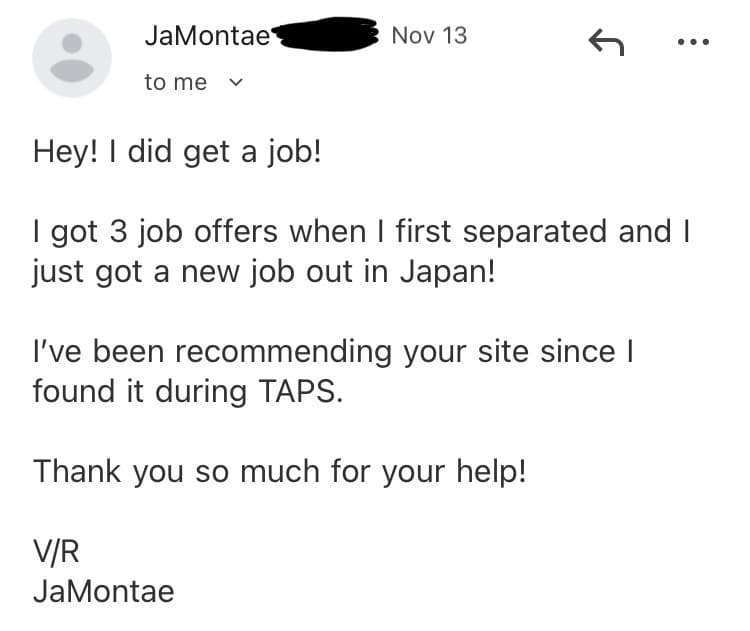
“Hey! I did get a job! I got 3 job offers when I first separated and I just got a new job out in Japan! I’ve been recommending your site since I found it during TAPS. Thank you so much for your help! V/R JaMontae ”
Federal aviation and transportation roles reward mobility aircrew because the government runs its own fleets, regulates the national airspace, and staffs safety and logistics functions that mirror what you already did. The crosswalk below shows the GS series that fit, but here is the context behind them.
The GS-2150 Transportation Operations series and GS-2101 Transportation Specialist series cover movement planning, load coordination, and air mobility functions inside agencies like the Defense Logistics Agency, U.S. Transportation Command, and the Air Mobility Command civilian workforce. Aircrew who ran load planning and mission coordination qualify by experience for these without a degree, typically entering at GS-7 to GS-9 and climbing from there. The GS-1825 Aviation Safety series and GS-1815 Air Safety Investigating series are the FAA and DoD safety lane, where your firsthand knowledge of aircraft systems, crew procedures, and operational risk is the exact qualification standard. GS-0018 Safety and Occupational Health Management and GS-0019 Safety Technician broaden that into installation and program safety work.
On the logistics side, GS-0346 Logistics Management and GS-2003 Supply Program Management fit aircrew who handled cargo accountability and mission materiel. GS-0340 Program Management and GS-0301 Miscellaneous Administration and Program are the broader operations-leadership series for senior aircrew moving into coordination roles. Veterans' Preference applies to all of these, and your Top Secret clearance is a live, transferable asset for the DoD-side positions. To see which other Air Force jobs target the same federal series, the Safety (1S0X1) and Logistics Plans (2G0X1) pages overlap heavily. Our guide to moving into federal employment covers the USAJobs mechanics, and the federal resume builder handles the GS format and qualification narrative.
| GS Series | Federal Job Title | Typical Grades | Match | Explore |
|---|---|---|---|---|
| GS-2150 | Transportation Operations | GS-7, GS-9, GS-11 | View Details → | |
| GS-1825 | Aviation Safety | GS-9, GS-11, GS-12 | View Details → | |
| GS-1815 | Air Safety Investigating | GS-9, GS-11, GS-12 | View Details → | |
| GS-0346 | Logistics Management | GS-7, GS-9, GS-11 | View Details → | |
| GS-2101 | Transportation Specialist | GS-7, GS-9, GS-11 | View Details → | |
| GS-0301 | Miscellaneous Administration and Program | GS-9, GS-11, GS-12 | View Details → | |
| GS-0018 | Safety and Occupational Health Management | GS-9, GS-11, GS-12 | View Details → |
Federal hiring uses keyword-matching and structured experience. BMR builds federal-format resumes (USAJobs-ready) with the right keywords, hours/week, and supervisor info — for any GS series above.
Free · No credit card · Federal + civilian resume formats included
Not everyone wants to stay in a related field. These career paths leverage your transferable skills — leadership, risk management, logistics, project planning — in completely different industries.
Mobility aircrew make live risk decisions around a complex mechanical system every flight. That systems-safety instinct maps directly to designing and auditing safety controls in manufacturing and industrial plants.
The preflight and post-flight inspection rigor and the fuel and systems knowledge that aircrew use every day translate into fire inspection and origin-and-cause investigation, where the same methodical, code-driven mindset is the job.
Aircrew brief, instruct, and evaluate crew on complex procedures constantly. That instructional ability maps to teaching aviation, transportation, or technical trades in high schools and career-technical programs.
Aircrew who flew aeromedical and casualty movement missions already worked patient care in a moving, high-stress environment. That foundation transfers into emergency medical services, where time-critical decision-making is the core skill.
The hazard-spotting and compliance-auditing habits aircrew build through checklist culture and operational risk management are exactly what industrial EHS technician roles require on a plant floor or job site.
Aircrew already understand airspace, mission planning, and aviation safety at a level most new commercial drone operators never reach. That makes the move into UAS survey, inspection, and mapping operations a fast, natural pivot.
The skills that made you a good Marine, Sailor, Airman, or Soldier transfer further than you think. BMR rewrites your bullets for any of the pivot careers above — without making you sound like you've never done the work.
Free · No credit card · Try unlimited career angles
If you are staying inside aviation, aviation operations, or aviation safety, your terminology already translates. Recruiters at airlines, cargo carriers, and MRO shops know what a loadmaster, a boom operator, and weight and balance are. This section is for the roles OUTSIDE aviation, where a hiring manager has never encountered "TOLD," "shred," or "FTU" and your real skills get lost in the jargon.
The fix is to describe the underlying skill in civilian business language while keeping the scale and the stakes. A few examples below show how to do that for non-aviation roles in operations, logistics, safety, and training.
For more on this, our 50 military terms translated to civilian language glossary and the EPR/OPR translation guide for airmen are built for exactly this problem. The hidden military skills civilians do not know you have article is worth a read before you draft bullets. When you are ready, the military resume builder turns aircrew duties into recruiter-ready bullets.
BMR turns your 1A1X2 duties and accomplishments into civilian bullets that match the job you're applying for — no manual translation, no rewriting.
Free · No credit card · Tailored to each job posting
Which certifications you need depends on where you're headed. Find your target career path below.
The wrong placement can sink an otherwise strong application. BMR knows where each cert ranks, what to call it, and how to frame it for ATS keyword matching and hiring manager attention.
Free · No credit card · Built around your real certs and clearance
If you are targeting the direct civilian field, your priorities are credentials and proof of currency. Look at FAA Airframe and Powerplant (A&P) certification through a Part 147 school or military-experience equivalency for the mechanic and avionics path. Air mobility manufacturers and MRO firms run SkillBridge internships that put you inside an aviation employer before you separate. Industry associations like the National Air Transportation Association and the Regional Airline Association are where the aviation-operations and logistics network lives. For movement and supply-chain roles, APICS/ASCM certifications carry weight.
If you are leaving aviation entirely, lean on the transferable signature: load planning under constraints, in-flight risk decisions, crew coordination, and systems monitoring. Project Management (PMP) and Lean Six Sigma open operations and process roles. OSHA and Board of Certified Safety Professionals credentials open the industrial-safety lane. American Corporate Partners (ACP) offers free veteran mentorship that matches you with an industry professional. For federal moves, your Veterans' Preference and clearance are leverage worth using early.
Start with the career crosswalk tool to map your shred to civilian titles, then build your resume now. For federal applications, use the federal resume builder. The SFL-TAP resources cover the broader transition timeline. See also: Navy Naval Aircrewman (Mechanical), Marine Helicopter Crew Chief (6173), and Coast Guard Aviation Survival Technician (AST). For deeper reading, the SkillBridge programs by industry guide and the highest-paying civilian jobs for veterans article are good next stops.
Most veterans do this backwards — they wait until terminal leave to start, then panic. Here's the actual sequence that works.
Print this. Tape it to your monitor. Veterans who treat the transition like a 90-day op get hired faster than the ones who treat it like an emergency.
Stop rewriting from scratch every time you apply. BMR turns your military experience into civilian and federal resumes — tailored to each job.