Loading...
Loading...
The civilian and federal jobs that hire Air Force Logistics Planss — with real salaries and the resume that gets callbacks.
Every 2G0X1 has more options than a Google search will tell you. Below: career paths, BLS salary data, federal GS series, certifications by target career, and how to translate your experience without losing what made you valuable to the Air Force in the first place.
Free · No credit card · Tailored resume in under 5 minutes
After the Navy I got hired into 6 federal career fields and tech sales, and sat on federal hiring panels along the way. I spent the last 2 years rebuilding everything I learned into BMR, tuned for how AI actually screens resumes today. This is the system I wish I'd had on day one.
If you held the 2G0X1 AFSC, you spent your career turning a commander's intent into a movable, sustainable plan. Logistics Plans Airmen build the deployment and distribution piece of operations plans and orders: war reserve materiel (WRM) accounting, base support plans, deployment schedules, and the time-phased force and deployment data (TPFDD) that decides what moves, in what order, on which aircraft. When a wing has 72 hours to push a force package downrange, you are the person who already war-gamed the constraint and wrote the annex that makes it executable.
The pipeline runs through the Logistics Plans technical school at Lackland AFB (JBSA), where you learned the deliberate and crisis-action planning processes, Deliberate and Crisis Action Planning and Execution Segments (DCAPES), Logistics Module (LOGMOD), and the Integrated Deployment System. From there you worked installation deployment readiness cells, ran personnel and cargo deployment functions, conducted installation surveys to size support capability, and coordinated across maintenance, transportation, services, civil engineering, and contracting. The job is cross-functional by design. You do not own the forklift or the aircraft, you own the plan that synchronizes everyone who does.
Civilian employers value this background because it is rare. Most supply-chain hires can run a warehouse or a purchasing desk. Far fewer can sit in a room with eight functional leads, absorb a constraint nobody wants, and produce a sequenced, resourced plan that survives contact with reality. That is contingency planning under pressure, and it maps directly into supply-chain network design, distribution operations, and emergency management. If you are weighing your options, the military career crosswalk tool is a fast way to see where the AFSC points. Two related Air Force career fields worth comparing are 2S0X1 Materiel Management and 2T2X1 Air Transportation.
Logistics Plans is one of the cleanest translations I see. I worked in federal supply, logistics, and property management for years after the Navy, and the work you did on TPFDDs and base support plans is the same planning discipline that runs civilian supply chains and federal logistics shops. The catch is that "wrote the deployment annex" means nothing to a recruiter until you reframe it as network design and operations planning. That reframing is the whole game. — Brad Tachi, Navy Diver veteran & BMR founder
The number that matters when you're deciding what's next: how does civilian pay compare to what you make now?
Military comp is approximate (varies by location/dependents). Civilian is BLS median. Federal includes locality pay. Your real number depends on duty station, family status, GS step, and overtime.
The direct civilian paths for a 2G0X1 sit in logistics, supply-chain planning, and distribution operations. These are roles where your deployment-planning and resource-synchronization experience is the actual job, not a transferable analogy.
Logisticians are the closest 1:1 match. BLS OEWS (May 2024) puts the median annual wage at $80,880, and the occupation is projected to grow faster than average. This role analyzes and coordinates the supply chain end to end, which is what you did across functional areas in a deployment cell. Transportation, storage, and distribution managers earn a median of $102,010 (BLS OEWS, May 2024) and run the movement and warehousing operations that your TPFDD work fed directly. Buyers and purchasing agents ($75,650 median, BLS OEWS May 2024) and purchasing managers ($139,510 median, BLS OEWS May 2024) are the procurement side, a fit if your plans work touched sourcing and contracting coordination.
Be honest with yourself about the market. Supply-chain hiring is cyclical and concentrated near distribution hubs, ports, and manufacturing corridors: Memphis, Louisville, the Inland Empire in California, Dallas, Atlanta, and the Pennsylvania/New Jersey freight belt. Third-party logistics (3PL) providers and e-commerce fulfillment networks hire steadily but compress margins, so titles can outrun pay early. The planning roles (network design, S&OP, distribution planning) pay better and churn less than warehouse-floor supervision, and they are where your annex-writing brain has the most leverage. For the resume itself, a tool like the military resume builder handles the translation step so your DCAPES and LOGMOD experience reads as enterprise planning. When you are ready, you can build your resume now.
For deeper reading on this field, see veterans in logistics and supply chain careers and military to logistics management. The same civilian paths open from Navy Logistics Specialist (LS) and Army 92A Automated Logistical Specialist.
| Civilian Job Title | Industry | BLS Median Salary | Outlook | Match |
|---|---|---|---|---|
Logistician O*NET: 13-1081.00 | Logistics & Supply Chain | $80,880 | Faster than average | strong |
Transportation, Storage, and Distribution Manager O*NET: 11-3071.00 | Logistics & Supply Chain | $102,010 | 6% (Faster than average) | strong |
Supply Chain Analyst O*NET: 13-1081.00 | Logistics & Supply Chain | $80,880 | Faster than average | strong |
Purchasing Agent / Buyer O*NET: 13-1023.00 | Procurement | $75,650 | Little or no change | moderate |
Purchasing Manager O*NET: 11-3061.00 | Procurement | $139,510 | 7% (Faster than average) | moderate |
Industrial Production Manager O*NET: 11-3051.00 | Manufacturing & Operations | $121,440 | Little or no change | moderate |
General and Operations Manager O*NET: 11-1021.00 | Operations | $102,950 | 6% (Faster than average) | moderate |
BMR rewrites your 2G0X1 experience for any of the civilian roles above — keywords, achievements, and language hiring managers actually scan for.
Free · No credit card · 2 tailored resumes included
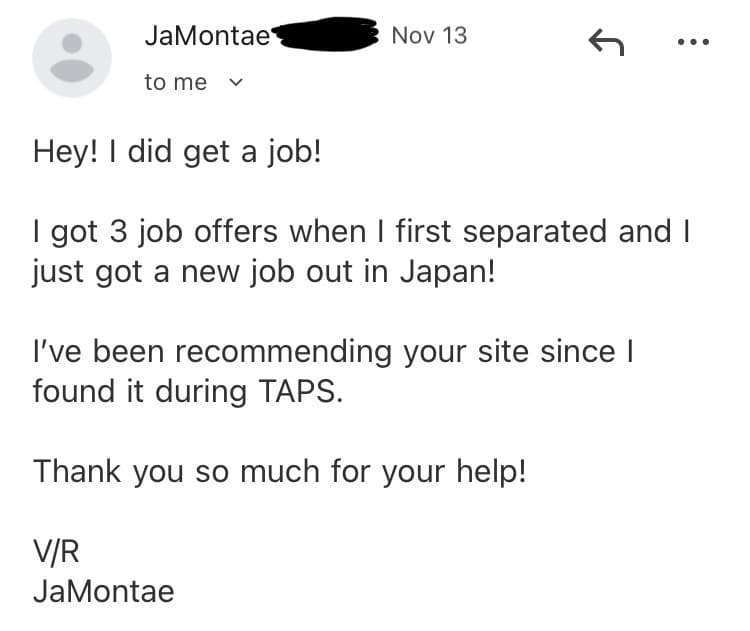
“Hey! I did get a job! I got 3 job offers when I first separated and I just got a new job out in Japan! I’ve been recommending your site since I found it during TAPS. Thank you so much for your help! V/R JaMontae ”
Federal logistics is where the 2G0X1 skill set lines up almost without friction, because the federal government plans and sustains operations the same way the Air Force does. The anchor series is GS-0346 Logistics Management, which covers exactly the integrated planning and sustainment work you did: synchronizing supply, transportation, maintenance, and facilities support against a mission requirement. Most transitioning 2G0X1s with NCO-level planning experience qualify in the GS-9 to GS-12 range depending on grade and time-in-billet, and the qualification standard rewards demonstrated planning and coordination over a specific degree.
Beyond GS-0346, several series fit different slices of the AFSC. GS-2001 General Supply and GS-2003 Supply Program Management cover the WRM and stockage-policy side. GS-2010 Inventory Management and GS-2050 Supply Cataloging fit accountability and item-management work. GS-2030 Distribution Facilities and Storage Management and GS-2130 Traffic Management map to the movement and warehousing piece of your deployment plans. GS-0343 Management and Program Analyst and GS-0340 Program Management reward the cross-functional planning brain directly, and GS-0089 Emergency Management is a strong adjacent fit because base support planning and contingency response share the same DNA. GS-1101 General Business and Industry and GS-1102 Contracting are reachable if your work touched acquisition and agreements.
Veterans' Preference adds 5 or 10 points to your rated score and applies across these series, and many DoD logistics shops actively recruit prior-service planners because the learning curve is short. The big employers are DLA, the Air Force materiel and sustainment commands, Army TACOM and CECOM, and Defense Contract Management Agency. To get the federal resume format right (it is longer and more detailed than a private-sector resume), the federal resume builder is built for it, and these guides help: federal resume format and OPM requirements, how to decode a USAJOBS announcement, and landing a GS-12 after service. The same GS-0346 path is open to Marine 0431 Logistics/Embarkation Specialists.
| GS Series | Federal Job Title | Typical Grades | Match | Explore |
|---|---|---|---|---|
| GS-0346 | Logistics Management | GS-9, GS-11, GS-12 | View Details → | |
| GS-2003 | Supply Program Management | GS-9, GS-11, GS-12 | View Details → | |
| GS-2030 | Distribution Facilities and Storage Management | GS-7, GS-9, GS-11 | View Details → | |
| GS-2130 | Traffic Management | GS-7, GS-9, GS-11 | View Details → | |
| GS-2001 | General Supply | GS-7, GS-9, GS-11 | View Details → | |
| GS-0343 | Management and Program Analyst | GS-9, GS-11, GS-12 | View Details → | |
| GS-0089 | Emergency Management | GS-9, GS-11, GS-12 | View Details → |
Federal hiring uses keyword-matching and structured experience. BMR builds federal-format resumes (USAJobs-ready) with the right keywords, hours/week, and supervisor info — for any GS series above.
Free · No credit card · Federal + civilian resume formats included
Not everyone wants to stay in a related field. These career paths leverage your transferable skills — leadership, risk management, logistics, project planning — in completely different industries.
Base support planning is essentially capacity planning for a site: you surveyed land, facilities, and resources, then wrote a plan that balanced demand against constraint. Urban planners do the same for communities and land use.
Sequencing a TPFDD is sequencing a project: ordered, interdependent tasks against a hard timeline with finite resources. Construction managers run the same logic on a build, juggling trades, materials, and a delivery date.
Your LIMFAC work was structured risk identification: spotting what could break a plan before it executed. Health and safety engineers apply that same hazard-anticipation discipline to industrial systems and worksites.
A large deployment is a complex event: many moving parts, multiple providers, and a no-slip date. Event planners run that same end-to-end coordination, and your deployment-execution experience is directly applicable.
Base support planning is the military version of facilities management: sizing a site's ability to support operations and resourcing it to keep running. The survey-and-sustain pattern carries over almost untouched.
Crisis-action planning and base support planning are first cousins of disaster response: anticipate the scenario, stage resources, coordinate multiple agencies, and write the plan that holds under stress.
The skills that made you a good Marine, Sailor, Airman, or Soldier transfer further than you think. BMR rewrites your bullets for any of the pivot careers above — without making you sound like you've never done the work.
Free · No credit card · Try unlimited career angles
If you are staying in logistics or supply chain, skip this section. Recruiters in those fields already speak TPFDD, WRM, and DCAPES, and translating jargon they use daily only makes you look unsure. This section is for the 2G0X1 targeting roles OUTSIDE supply and logistics, where a hiring manager has never seen a deployment annex and needs your experience in plain business language.
The pattern is the same every time: name the civilian function, quantify it, and drop the acronym. "Built the TPFDD" becomes "designed a sequenced, resourced deployment plan moving X personnel and Y short tons of cargo." "Ran the IDRC" becomes "led a cross-functional readiness cell coordinating eight departments." Below are translations aimed at planning, operations, and program-management roles, not at logistics employers.
For the full vocabulary, see the 50 military terms translated to civilian language glossary and how to explain military experience without jargon. The military resume builder applies these translations automatically, or you can start building now.
BMR turns your 2G0X1 duties and accomplishments into civilian bullets that match the job you're applying for — no manual translation, no rewriting.
Free · No credit card · Tailored to each job posting
Which certifications you need depends on where you're headed. Find your target career path below.
The wrong placement can sink an otherwise strong application. BMR knows where each cert ranks, what to call it, and how to frame it for ATS keyword matching and hiring manager attention.
Free · No credit card · Built around your real certs and clearance
Use these resources based on whether you are staying in logistics or moving out of it. No fluff, just the next concrete step.
The Association for Supply Chain Management (ASCM/APICS) owns the credentials civilian employers recognize: CPIM for planning, CSCP for end-to-end supply chain, and CLTD for logistics and distribution. SOLE (the International Society of Logistics) runs the CPL and Demonstrated Logistician program, which values military logistics experience directly. Use SkillBridge in your last 180 days to land inside a 3PL, distribution network, or manufacturer before you separate. See the SkillBridge guide and top SkillBridge companies hiring.
For program and project management, the PMP (PMI) and Lean Six Sigma credentials carry weight and your planning experience covers most of the eligibility hours. For federal work, study USAJOBS hiring and Veterans' Preference rather than mass-applying. American Corporate Partners (ACP) offers free one-on-one veteran mentorship, useful for breaking into an unfamiliar industry. Your security clearance, if current, is a real asset in cleared planning and emergency-management roles, so keep it active where you can.
Start here: the military resume builder and the federal resume builder for the document, the career crosswalk to explore paths, and SFL-TAP resources for the transition timeline. When your resume is ready, build it and get started here.
See also: Army 92Y Unit Supply Specialist, Marine 3043 Supply Administration, and the informational interviews guide for networking into a new field.
Most veterans do this backwards — they wait until terminal leave to start, then panic. Here's the actual sequence that works.
Print this. Tape it to your monitor. Veterans who treat the transition like a 90-day op get hired faster than the ones who treat it like an emergency.
Stop rewriting from scratch every time you apply. BMR turns your military experience into civilian and federal resumes — tailored to each job.