Air ForceAFSC: 1A8X1

Airborne Cryptologic Linguist

The civilian and federal jobs that hire Air Force Airborne Cryptologic Linguists — with real salaries and the resume that gets callbacks.

Every 1A8X1 has more options than a Google search will tell you. Below: career paths, BLS salary data, federal GS series, certifications by target career, and how to translate your experience without losing what made you valuable to the Air Force in the first place.

Free to start · Tailored resume in under 5 minutes

$59K–$125K
Salary Range
BLS-verified median salaries
14
Career Paths
12
Companies Hiring
8
Resume Examples
10
Federal GS Series
9
Certification Paths
10
FAQs Answered
BT
Brad Tachi
Navy Diver · BMR Founder

After the Navy I got hired into 6 federal career fields and tech sales, and sat on federal hiring panels along the way. I spent the last 2 years rebuilding everything I learned into BMR, tuned for how AI actually screens resumes today. This is the system I wish I'd had on day one.

65,000+ resumes built·Success stories every week
Free Sample · Emailed to You

Get a free 1A8X1 Airborne Cryptologic Linguist sample resume

One page, built in our template, with your military experience translated into civilian terms hiring managers and ATS systems read. Use it as a reference for your own. Drop your email and we'll send you the download link.

Free. We'll also send occasional job-search tips. Unsubscribe anytime.

Military Role Overview

Airborne Cryptologic Linguists (1A8X1) are among the Air Force's most elite intelligence specialists — language-qualified aircrew members who fly on RC-135 Rivet Joint, EC-130H Compass Call, and other ISR (Intelligence, Surveillance, and Reconnaissance) platforms to intercept, analyze, and report foreign communications in real time. They operate at the intersection of linguistics, signals intelligence (SIGINT), and airborne operations, processing intelligence that directly shapes tactical and strategic decision-making.

The training pipeline is demanding. After Basic Military Training, 1A8s attend the Defense Language Institute Foreign Language Center (DLIFLC) at Monterey, CA — one of the most rigorous language programs in the world — where they spend 36 to 64 weeks achieving proficiency in their assigned language. From DLI, they move to Goodfellow AFB, TX for cryptologic fundamentals and mission-specific training before earning their wings as rated aircrew. Maintaining language proficiency through the Defense Language Proficiency Test (DLPT) is an ongoing career requirement.

What makes 1A8s exceptionally valuable in the civilian workforce is the combination of verified language proficiency, a TS/SCI security clearance, real-world intelligence analysis experience, and the discipline of operating in high-pressure airborne environments where accuracy is non-negotiable.

Airborne Cryptologic Linguists carry the most concentrated cleared-language background in the Air Force — language proficiency, SIGINT collection experience, and active TS/SCI. The 1040 Language Specialist series, NSA, and federal contractors actively recruit 1A8s. From the federal hiring side, this combination clears hiring lanes faster than almost any other intel background. — Brad Tachi, Navy Diver veteran & BMR founder

Security ClearanceTS/SCI
ASVAB RequirementG72
TrainingDefense Language Institute Foreign Language Center (DLIFLC), Monterey, CA — 36-64 weeks depending on language category. Then Goodfellow AFB, TX for cryptologic fundamentals and mission qualification training. Initial Qualification Training (IQT) at operational unit.
Certs Earned in ServiceDefense Language Proficiency Test (DLPT) scores, Aircrew qualification, SIGINT mission certification, First Aid/CPR/AED

Pay Reality Check

The number that matters when you're deciding what's next: how does civilian pay compare to what you make now?

Air Force mid-career
$58K–$82K
E-5 to E-7 total comp (base + BAH + BAS + tax advantage)
Civilian Airborne Cryptologic Linguist
$59K–$125K
BLS median across direct-match civilian roles
Federal (GS-9 to GS-13)
$58K–$120K
10 matching GS series + locality pay + step increases
+26% on average
Civilian roles for Airborne Cryptologic Linguists pay ~$18K more than mid-career enlisted total comp.

Military comp is approximate (varies by location/dependents). Civilian is BLS median. Federal includes locality pay. Your real number depends on duty station, family status, GS step, and overtime.

Private Sector Career Paths

The civilian career landscape for former Airborne Cryptologic Linguists divides into two broad categories: roles that directly leverage language and intelligence skills, and roles that capitalize on the analytical rigor and clearance access that come with the AFSC.

For those staying in the intelligence community, government contractors and defense agencies are the primary employers. According to BLS, the median annual wage for information security analysts is $124,910 (May 2024, O*NET 15-1212.00), and the field is projected to grow 33% through 2033 — one of the fastest growth rates of any occupation. Intelligence analysts and management analysts (BLS median $101,190, O*NET 13-1111.00) are also strong matches.

For those leveraging language skills outside intelligence, interpreters and translators earn a BLS median of $59,440 (O*NET 27-3091.00), though cleared linguists working government contracts often command premiums well above this baseline. Political scientists (BLS median $132,350, O*NET 19-3094.00) and international affairs roles are viable paths for 1A8s with advanced education.

The TS/SCI clearance alone carries significant market value — investigations cost employers $10,000-$50,000 and take 6-12 months. Separating with an active clearance opens doors at defense contractors, three-letter agencies, and cleared consulting firms that civilian linguists simply cannot access.

Civilian Job Title Translations

Intelligence Analyst
Government / Defense
strong
$101,190median
Much faster than average (8%)
O*NET: 33-3021.06
Interpreter / Translator
Language Services / Government
strong
$59,440median
Faster than average (4%)
O*NET: 27-3091.00
Information Security Analyst
Cybersecurity / Defense
moderate
$124,910median
Much faster than average (33%)
O*NET: 15-1212.00
Operations Research Analyst
Government / Consulting
moderate
$83,640median
Faster than average (23%)
O*NET: 15-2031.00
Technical Writer
Technology / Defense
moderate
$80,050median
About as fast as average (4%)
O*NET: 27-3042.00
Compliance Officer
Finance / Government
moderate
$78,420median
About as fast as average
O*NET: 13-1041.00
Market Research Analyst
Consulting / Technology
moderate
$74,680median
Much faster than average (13%)
O*NET: 13-1161.00
Management Analyst
Consulting / Government
moderate
$101,190median
Faster than average (10%)
O*NET: 13-1111.00

Companies That Hire This Background

Primary employer for SIGINT professionals. Linguist and cryptanalysis positions directly align with 1A8X1 experience. TS/SCI clearance transfers directly.
Language officers and collection management positions leverage both language proficiency and operational intelligence experience.
All-source and SIGINT analysis positions. Military intelligence experience valued for defense intelligence production roles.
Major intelligence community contractor with extensive linguist and analyst positions. Active SkillBridge partner for transitioning service members.
Intelligence analysis, language services, and cybersecurity positions. One of the largest IC support contractors.
SIGINT support, language analysis, and intelligence production contracts across the IC. Strong military hiring pipeline.
Intelligence analysis and linguist positions supporting IC and DoD customers. Frequently hires from SIGINT career fields.
ISR systems and SIGINT technology development. Former operators provide critical subject matter expertise for system design.
Foreign language specialists, interpreters, and regional analysts. Language proficiency tested via phone interview.
Language specialists and intelligence analysts. FBI actively recruits linguists with security clearances for counterintelligence and counterterrorism.
ISR systems, signals analysis, and intelligence support contracts. Major employer of former SIGINT operators.
Intelligence systems, electronic warfare, and SIGINT platform development. Technical and analytical roles for former operators.

See a salary you want? Build a resume targeting it.

BMR rewrites your 1A8X1 experience for any of the civilian roles above — keywords, achievements, and language hiring managers actually scan for.

Free to start · 2 tailored resumes included

Build My Resume Free
Real Air Force success story
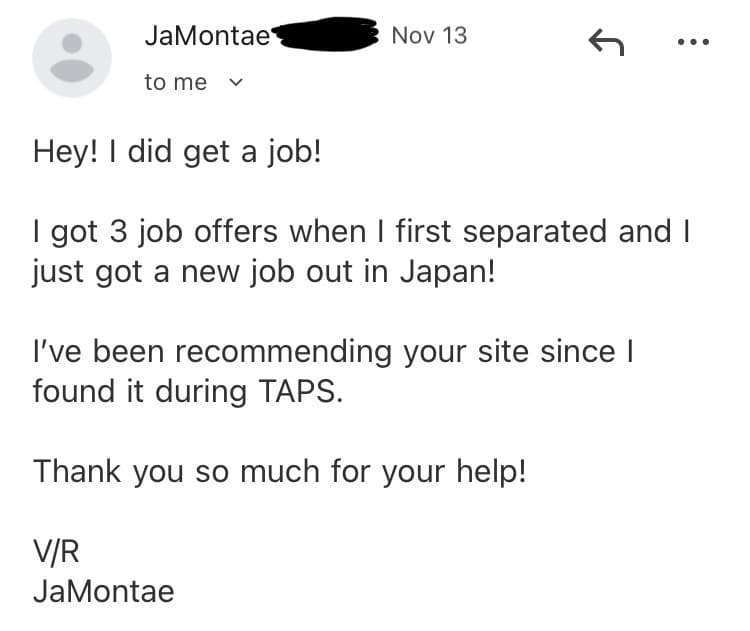
Hey! I did get a job! I got 3 job offers when I first separated and I just got a new job out in Japan! I’ve been recommending your site since I found it during TAPS. Thank you so much for your help! V/R JaMontae
JaMontae· Staff Sergeant (E-5)· Air Force
Information Technology and Computer Science
Read the full story

Federal Career Paths

Federal employment is a natural continuation for 1A8s, and the pathways extend far beyond intelligence agencies. The GS-1550 (Computer Science), GS-0132 (Intelligence), and GS-0301 (Miscellaneous Administration) series all offer direct matches. NSA, NGA, DIA, CIA, and the service intelligence centers are obvious targets, but agencies like the State Department, FBI, DEA, and CBP also need language-qualified analysts.

The GS-0132 Intelligence series is the most direct federal match — your SIGINT analysis experience maps directly to the qualification standards. GS-2210 (Information Technology Management) positions are strong fits for 1A8s who also developed technical skills on mission systems. GS-0343 (Management and Program Analysis) roles value the analytical methodology you applied to intelligence products.

Veterans' Preference gives you 5 or 10 additional points on federal hiring assessments. If you have a service-connected disability rating, you may qualify for 10-point preference or Schedule A hiring authority, which can bypass competitive processes entirely. Start your USAJobs profile at least 6 months before separation — federal hiring timelines are long.

GS Series & Position Matches

GS-0132
Intelligence
Typical grades: GS-9, GS-11, GS-12, GS-13
View Details
GS-1040
Language Specialist
Typical grades: GS-9, GS-11, GS-12, GS-13
View Details
GS-1560
Data Science
Typical grades: GS-11, GS-12, GS-13
View Details
GS-0343
Management and Program Analyst
Typical grades: GS-9, GS-11, GS-12, GS-13
View Details
GS-1035
Public Affairs
Typical grades: GS-9, GS-11, GS-12
View Details
GS-1082
Writing and Editing
Typical grades: GS-9, GS-11, GS-12
View Details
GS-1515
Operations Research
Typical grades: GS-9, GS-11, GS-12
View Details
GS-1550
Computer Science
Typical grades: GS-9, GS-11, GS-12
View Details
GS-0301
Miscellaneous Administration and Program
Typical grades: GS-7, GS-9, GS-11
View Details
GS-0391
Telecommunications
Typical grades: GS-9, GS-11, GS-12
View Details

Federal resumes follow different rules. We know them.

Federal hiring uses keyword-matching and structured experience. BMR builds federal-format resumes (USAJobs-ready) with the right keywords, hours/week, and supervisor info — for any GS series above.

Free to start · Federal + civilian resume formats included

Build My Federal Resume Free

Want to Change Careers Entirely?

Not everyone wants to stay in a related field. These career paths leverage your transferable skills — leadership, risk management, logistics, project planning — in completely different industries.

Court Reporters and Simultaneous Captioners

$67,310
Legal and Media(O*NET: 27-3092.00)BLS OEWS May 2024Little or no change
Real-time transcription of live speechCapturing fast speech accurately under pressureHolding intense auditory focus for long stretchesProducing a clean, verbatim record

A cryptologic linguist transcribes live speech in real time, accurately, while it is still happening. Court reporting and captioning is that exact skill in English: capture every word as it is spoken, keep up, get it right. The auditory endurance and live-capture speed are unusual and they transfer directly.

How to get there: Complete a court reporting or captioning program (stenography or voice writing, GI Bill eligible at many schools) and pass state or national certification.

Financial Examiners

$90,400
Finance and Government(O*NET: 13-2061.00)BLS OEWS May 2024Much faster than average (7% or higher)
Finding the meaningful signal in a flood of dataDisciplined attention to anomalies and detailMethodical review against rules and standardsClear written findings from messy source material

The core of airborne SIGINT work is pulling the one thing that matters out of a flood of traffic. Financial examiners do the same with transactions and records: spot the anomaly, follow it, document it. The pattern-recognition and detail discipline are the real transferable assets, and the field is growing fast.

How to get there: A bachelor degree in finance, accounting, or a related field is the usual requirement; some enter with an analytical degree plus on-the-job training. Your clearance and analytic record help with federal examiner roles.

Speech-Language Pathologists

$95,410
Healthcare(O*NET: 29-1127.00)BLS OEWS May 2024Much faster than average (7% or higher)
Deep understanding of language, sound, and speechDiscriminating fine differences in spoken languagePatient, precise one-on-one communicationAssessing and building structured plans

Few careers reward a trained ear for the mechanics of language the way cryptologic work does. Speech-language pathology runs on exactly that: how sound and language are produced, heard, and corrected. It is a high-paying, fast-growing healthcare field where your linguistic depth is a genuine foundation.

How to get there: Earn a master degree in speech-language pathology (GI Bill eligible), complete a clinical fellowship, and obtain ASHA certification plus state licensure.

Foreign Language and Literature Teachers, Postsecondary

$77,010
Higher Education(O*NET: 25-1124.00)BLS OEWS May 2024Little or no change
Near-native fluency in a foreign languageExplaining language structure and usage clearlyCultural fluency and contextDesigning and delivering instruction

A linguist who reached operational fluency in a hard language has the exact asset colleges hire for. Teaching the language at the postsecondary level turns your skill into a career on the other side of the desk. Your real-world, in-country usage is something most academic instructors never get.

How to get there: A master degree in the language or applied linguistics is the typical entry; community colleges and language programs sometimes hire on demonstrated fluency plus a teaching credential.

Adult Basic Education, Adult Secondary Education, and English as a Second Language Instructors

$59,950
Education(O*NET: 25-3011.00)BLS OEWS May 2024Decline (1% or lower)
Teaching language to non-native speakersCross-cultural communication and patienceBreaking complex language into learnable stepsWorking with adult learners from many backgrounds

Having learned a hard language as an adult yourself, you understand the exact struggle adult ESL students face. That lived experience, plus your own bilingual ability, makes you unusually effective teaching English to immigrant and refugee adults. The work is mission-driven and found in every community.

How to get there: A bachelor degree plus a TESOL or adult-education certificate is the common path (GI Bill eligible); many community programs hire on demonstrated language ability and a short certification.

Editors

$75,260
Publishing and Media(O*NET: 27-3041.00)BLS OEWS May 2024Slower than average (1% to 2%)
Rapidly distilling source material into a clear summaryStrong written English from non-native source contentJudgment about what matters and what to cutAccuracy and consistency under deadline

Airborne linguists do not just translate; they gist, summarizing fast-moving foreign content into clean, decision-ready English. That is editing at its core: take raw material, find what matters, render it clearly. The summarizing speed and writing judgment carry straight into editorial work.

How to get there: Build a portfolio and start as an assistant or copy editor. A communications, journalism, or English background helps, but demonstrated writing and editing skill matters most.

Pivoting industries? You don't need to start from scratch.

The skills that made you a good Marine, Sailor, Airman, or Soldier transfer further than you think. BMR rewrites your bullets for any of the pivot careers above — without making you sound like you've never done the work.

Free to start · Try as many career angles as you want

Tailor My Resume to a New Career

Skills Translation Guide

If you're applying to intelligence community positions or cleared defense contractor roles, skip this section — those hiring managers know exactly what SIGINT collection, DLPT scores, and mission qualification mean.

This section is for 1A8s targeting careers outside of intelligence: corporate roles in analytics, consulting, project management, compliance, or international business. In those worlds, nobody knows what "RC-135 mission crew" or "Goodfellow-trained cryptologic linguist" means. The translations below reframe your experience into language that resonates with hiring managers who have never held a clearance or seen a mission debrief.

Resume Bullet Examples

Before (Military)
Conducted SIGINT collection operations on 150+ airborne missions targeting priority intelligence requirements
After (Civilian)
Collected and analyzed complex data across 150+ field operations, delivering actionable insights to senior decision-makers
Before (Military)
Served as Mission Crew Commander directing 8-person airborne collection team during 12-hour ISR missions
After (Civilian)
Led 8-person cross-functional team through 12-hour operational shifts, coordinating real-time priorities and task allocation
Before (Military)
Authored 200+ SIGINT reports disseminated to COCOM-level consumers supporting operational planning
After (Civilian)
Produced 200+ analytical reports for executive stakeholders, synthesizing complex data into actionable recommendations
Before (Military)
Maintained DLPT 3/3 proficiency in Mandarin Chinese with annual recertification
After (Civilian)
Maintained professional working proficiency in Mandarin Chinese (ILR Level 3/3), certified through annual standardized assessment
Before (Military)
Conducted threat assessments integrating multi-source intelligence to identify emerging patterns of activity
After (Civilian)
Performed risk analysis by integrating multiple data sources to identify emerging trends and potential business impacts
Before (Military)
Maintained TS/SCI with CI Poly access for 6 years supporting national intelligence priorities
After (Civilian)
Hold active Top Secret/SCI security clearance with polygraph, maintained continuously for 6 years
Before (Military)
Managed collection requirements from 5 supported commands, prioritizing assets against competing intelligence needs
After (Civilian)
Gathered and prioritized requirements from 5 stakeholder groups, allocating resources to meet competing business needs
Before (Military)
Coordinated with pilots, EWOs, and ground stations during airborne collection missions in contested environments
After (Civilian)
Coordinated across 3 functional teams during time-critical operations, ensuring seamless handoffs and real-time communication under pressure

Get bullets like these auto-generated for your resume.

BMR turns your 1A8X1 duties and accomplishments into civilian bullets that match the job you're applying for — no manual translation, no rewriting.

Free to start · Tailored to each job posting

Generate My Resume Bullets

Certifications by Career Path

Which certifications you need depends on where you're headed. Find your target career path below.

Compliance & Regulatory

Certified Fraud Examiner (CFE)
Valued for compliance, investigation, and financial analysis roles
Association of Certified Fraud Examiners
Cost: $450-$550Time: 6-12 monthsGI Bill Eligible
Analytical methodology from intelligence analysis transfers to fraud detection. Valued for compliance and investigation roles in financial services.

Cybersecurity

CompTIA Security+
Required for DoD IAT Level II positions per DoD 8570/8140
CompTIA
Cost: $400-$450Time: 3-6 months studyGI Bill Eligible
Required baseline certification for any DoD information security role. Many IC contractor positions also require it. GI Bill covers training and exam costs.
Certified Information Systems Security Professional (CISSP)
Gold standard for cybersecurity management. Required for many senior IC security positions.
ISC2
Cost: $749 exam feeTime: 6-12 months preparationGI Bill Eligible
Requires 5 years experience in 2+ security domains. SIGINT experience may count toward qualifying experience. High value for IC contractor roles.

Data Analytics

Certified Analytics Professional (CAP)
Valued for data analysis and operations research positions
INFORMS
Cost: $500-$700Time: 3-6 months preparationGI Bill Eligible
Validates analytical methodology skills. Intelligence analysis experience provides strong foundation for CAP exam content areas.

Federal Employment

Federal Resume Certification (USAJOBS)
Understanding federal resume format is critical for GS positions
OPM / Self-Study
Cost: FreeTime: 1-2 weeks self-study
Federal resumes differ significantly from private sector. Understanding KSAs, specialized experience, and the USAJOBS application system is essential for GS-0132 positions.

Intelligence & Analysis

Certified SIGINT Professional (Various Agency Certifications)
Direct career credential for intelligence community positions
NSA / DIA
Cost: Free (government)Time: Earned during service
Agency-specific certifications earned during SIGINT training. Not commercially recognized but valued by IC employers and contractors.

Legal & Paralegal

ATA (American Translators Association) Certification
Standard certification for professional translators and interpreters
American Translators Association
Cost: $300-$600Time: Exam-based, preparation varies
Validates commercial translation proficiency. DLPT scores do not substitute but language skills transfer directly. Check ATA for language pair availability.

Operations Management

Lean Six Sigma Green Belt
Process improvement credential valued across industries
ASQ / IASSC
Cost: $200-$500Time: 2-4 monthsGI Bill Eligible
Analytical methodology from intelligence production transfers to process improvement. Valued for management consulting and operations roles.

Project Management

Project Management Professional (PMP)
Industry-standard PM credential valued across all industries
Project Management Institute (PMI)
Cost: $400-$555 exam feeTime: 3-6 months preparationGI Bill Eligible
Military mission coordination experience satisfies 36-month PM experience requirement. Strong credential for transitioning to program management roles.

Security Management

Certified Protection Professional (CPP)
Premier credential for security management professionals
ASIS International
Cost: $200-$500 exam feeTime: 6-12 months preparationGI Bill Eligible
Comprehensive security management certification. Intelligence background provides strong foundation in threat assessment domain.

Got a cert? Don't bury it. List it the right way.

The wrong placement can sink an otherwise strong application. BMR knows where each cert ranks, what to call it, and how to frame it for ATS keyword matching and hiring manager attention.

Free to start · Built around your real certs and clearance

Build My Resume the Right Way

Transition Resources

For Staying in Intelligence / Language Careers

SkillBridge Programs: Several defense contractors and intelligence agencies participate in DOD SkillBridge, allowing 1A8s to work in cleared facilities during their last 180 days of service. Check the SkillBridge database and coordinate with your unit's transition office. Booz Allen Hamilton, CACI, and Leidos have historically participated.

Intelligence Community Careers: The IC uses IntelligenceCareers.gov as a centralized job portal for NSA, CIA, NGA, DIA, and NRO. Apply early — background investigations for civilian IC positions can take 6-12 months even with an existing TS/SCI.

Language Certification: The American Translators Association (ATA) certification is the civilian gold standard for professional translators. Your DLPT scores demonstrate proficiency, but ATA certification opens doors outside the cleared space.

Professional Associations: Join the AFCEA (Armed Forces Communications and Electronics Association) for intelligence and cyber networking. The ATA is essential if targeting translation careers.

For Careers Outside of Intelligence

Data Analytics: Your pattern recognition and analytical skills transfer to data analytics roles. Google Data Analytics Certificate and IBM Data Analyst Professional Certificate are available through Coursera and many are GI Bill approved through partner institutions.

Cybersecurity: With your SIGINT background and clearance, cybersecurity is a high-value pivot. Start with CompTIA Security+ (often already earned in service), then target CISSP for senior roles. BLS median for information security analysts is $124,910 with 33% projected growth.

Federal Employment (USAJobs): Create your USAJobs profile immediately. Use the "Veterans" filter. Key agencies beyond the IC: State Department, FBI Language Services, DEA, CBP, and DHS. Federal resumes are 2 pages max — not the 4-6 page myth you'll see online. Build yours here.

Veteran Networking: American Corporate Partners (ACP) provides free mentorship from corporate executives. You'll get paired with someone in your target industry. ACP is legitimate and completely free for veterans.

Clearance Leverage: Your TS/SCI clearance has real market value — defense contractors, consulting firms, and government agencies will pay premiums for cleared professionals. ClearanceJobs.com lists positions that require active clearances. Don't let yours lapse during transition.

Education Benefits: Your GI Bill covers degree programs, professional certifications, and some prep courses. Degrees in international relations, cybersecurity, or data science complement your background. Use the GI Bill Comparison Tool to verify program approval before enrolling.

BMR Career Resources

Air Force Resume Guide: AFSC Translation | Complete Military Resume Guide | Top Companies Hiring Veterans | Build Your Resume Free
Your 30 / 60 / 90-Day Transition Plan

Most people do this backwards. They wait until terminal leave to start, then panic. Here's the sequence that works. Already out? Same plan, start at day one today.

1Days 0–30

Set the foundation

  • Pull your DD-214 (request from Milconnect if separated)
  • List your top 3 civilian roles AND top 3 GS series
  • Build your tailored 1A8X1 resume — BMR does it free
  • Write 1 strong LinkedIn headline (not "veteran seeking opportunities")
  • Pull together your evals/performance reports for accomplishments
Build my resume free
2Days 30–60

Apply with intent

  • Apply to 5–10 jobs/week — quality over quantity
  • Tailor every resume to the job description (BMR auto-tailors)
  • Connect with 5 people/week on LinkedIn (not a spray)
  • Set up a USAJobs profile and a saved-search alert for your GS series
  • Practice translating your military bullets out loud — explain to a civilian friend
Tailor my next resume
3Days 60–90

Close the offer

  • Track every application — date, status, contact, notes
  • Follow up 7–10 days after each application
  • Prep for behavioral interviews using the STAR method
  • Negotiate salary — don't take the first offer (BLS median is your floor)
  • Stay applying even after one offer — leverage = options
Track my applications

Print this. Tape it to your monitor. Veterans who treat the job search like a 90-day op get hired faster than the ones who treat it like an emergency.

Frequently Asked Questions

What is the median salary for interpreters and translators?
According to BLS May 2024 data, the median annual wage for interpreters and translators is $59,440 (O*NET 27-3091.00). However, cleared linguists working government contracts or in intelligence community positions typically earn well above this baseline due to the TS/SCI requirement and specialized subject matter. BLS does not track cleared linguist salaries separately.
How valuable is my TS/SCI clearance after separation?
A TS/SCI clearance is one of the most valuable assets you carry out of the military. Investigations cost employers $10,000-$50,000 and take 6-12 months. Defense contractors and cleared consulting firms actively seek candidates with active clearances. Your clearance stays active for up to 24 months after separation if not renewed — start your job search before it lapses. Sites like ClearanceJobs.com list positions requiring active clearances.
Do I need to maintain my DLPT scores after separating?
For intelligence community and government contract linguist positions, yes — agencies and contractors may require current DLPT scores or equivalent proficiency testing. For civilian translation careers, ATA certification carries more weight than military proficiency tests. For non-language careers, your DLPT history demonstrates cognitive ability and discipline but ongoing testing is not required.
What if I want to leave the intelligence field entirely?
Many former 1A8s transition successfully into completely different fields. The analytical rigor, attention to detail, and pattern recognition skills developed in SIGINT work transfer to data analytics (BLS median $106,310), cybersecurity (BLS median $124,910), management consulting (BLS median $101,190), and compliance. See the Career Change Paths section for specific entry paths, transferable skills, and BLS-verified salary data.
Should I use my GI Bill for a degree or certifications?
It depends on your target career. For intelligence community positions — experience and clearance often matter more than degrees. For cybersecurity — certifications (Security+, CISSP) give faster ROI than a 4-year degree. For international relations, political science, or data science — a degree may be required and positions you for higher GS grades in federal service. Many employers accept military experience plus certifications in lieu of a degree for analyst and management roles. Use the VA GI Bill Comparison Tool to verify program approval before enrolling.
How do I explain cryptologic linguist experience in a non-intelligence job interview?
Focus on the transferable skills, not the classified details. Instead of describing specific missions, emphasize: real-time analysis under pressure (you processed information in live, high-stakes environments), multilingual communication (you operated across language barriers professionally), attention to detail (accuracy in your work had direct operational consequences), and team coordination (you worked as part of mission crews where every member's contribution was critical). Practice describing your experience at the unclassified level — what you did matters more than where you did it.
How does Veterans Preference work for federal jobs?
Veterans' Preference gives you 5 or 10 extra points on federal hiring assessments. Disabled veterans get 10 points. You need your DD-214 (Member 4 copy) and SF-15 form for 10-point preference. For 1A8s, the intelligence community often uses excepted service hiring (not competitive service), where Veterans' Preference works differently — check each agency's specific hiring authorities. Start your federal resume at bestmilitaryresume.com — federal resumes follow different rules than private sector.
Which defense contractors hire former 1A8s?
The major defense and intelligence contractors actively recruit cleared linguists: Booz Allen Hamilton, CACI International, Leidos, Northrop Grumman, Raytheon (RTX), General Dynamics IT, ManTech International, and SAIC. Smaller specialized firms like Amentum and KGS Group also hire for language-specific contracts. Many offer SkillBridge internships so you can start before separation. Check ClearanceJobs.com and IntelligenceCareers.gov for current openings.
Where are the best job markets for former 1A8s?
The DC Metro area (Northern Virginia, Maryland, DC) dominates intelligence community and defense contractor employment — this is where NSA, NGA, CIA, and their contractors are concentrated. San Antonio (NSA Texas, 25th Air Force), Augusta (NSA Georgia/Fort Eisenhower), and Colorado Springs also have significant intelligence presence. For non-intelligence careers, any major metro works, but cleared professionals get the best leverage in the DC corridor. Remote work is increasingly available for analyst and consulting roles.
Can I start job searching while still on active duty?
Yes — and you should. Start 12 months before your DOS. At 180 days out, you may be eligible for DOD SkillBridge to work full-time at a civilian company while still receiving military pay. At minimum: have your resume ready 6 months out, start networking on LinkedIn and through AFCEA 6 months out, apply to federal positions 6 months out (federal and IC hiring is slow), and attend intelligence community career fairs. Use terminal leave strategically — it's your transition runway.
Free for every veteran

Translate your 1A8X1 Airborne Cryptologic Linguist experience into a resume that gets callbacks

Stop rewriting from scratch every time you apply. BMR turns your military experience into civilian and federal resumes — tailored to each job.

What you get — all free:
2
Tailored resumes
AI-rewritten for each job posting
2
Cover letters
Matched to the role
LinkedIn optimization
Profile rewrite for civilian recruiters
Elevator pitch generator
For interviews and networking
2
Company research reports
Know who you're applying to
Job tracker
Manage every application in one place
Start My Free Resume
Free to start · 90 seconds to sign upBuilt by a Navy Diver veteran. More than 65,000 resumes built for the military community.