How Much Is a Top Secret Clearance Worth in Salary?
Corey landed a federal security specialist role.
Corey, E-7, Air Force, translated military security experience that actually got read
Your Clearance Is Worth Real Money. Do You Know How Much?
You spent months filling out the SF-86. You sat through interviews with investigators who asked your neighbors about your finances. You waited. And waited. Then one day, your security clearance came through.
That clearance is one of the most valuable things you carry out of the military. Not your rank. Not your awards. Your clearance. Because employers will pay a premium for it. A big one.
But how much, exactly? The answer depends on your clearance level, your job field, your location, and whether you work for a defense contractor or go federal. This article breaks down the real salary numbers by clearance level so you know what your clearance is actually worth in dollars.
If you are still figuring out who pays for a top secret clearance, that is a different question. This is about what that clearance puts in your pocket once you have it.
What Does Each Clearance Level Pay?
Not all clearances are created equal. The higher your clearance, the more you can earn. Here is a breakdown of average salary premiums by clearance level based on 2025-2026 data from ClearanceJobs and industry salary surveys.
Confidential clearance: This is the lowest level. It adds roughly $5,000 to $10,000 per year over non-cleared positions in the same field. Many entry-level military roles carry Confidential. It helps, but the premium is small.
Secret clearance: A Secret clearance bumps salary by about $10,000 to $15,000 per year. This is the most common clearance level. About 80% of cleared workers hold Secret. The premium is solid because employers skip the 3 to 6 month wait for a new investigation.
Top Secret (TS): This is where the money gets real. A Top Secret clearance adds $15,000 to $30,000 per year on average. Defense contractors in the DC area regularly pay $90,000 to $130,000 for mid-level roles that require TS.
TS/SCI: Top Secret with Sensitive Compartmented Information access is the top tier for most veterans. TS/SCI holders see salary premiums of $20,000 to $40,000 or more. Senior analysts and cybersecurity professionals with TS/SCI can earn $140,000 to $180,000 in major metro areas.
- •Confidential: +$5K–$10K/yr
- •Secret: +$10K–$15K/yr
- •Top Secret: +$15K–$30K/yr
- •TS/SCI: +$20K–$40K+/yr
- •Investigation takes 4–18 months
- •TS investigation costs $5,596+
- •Employer skips the wait with you
- •Cleared candidate pool is limited
These are premiums on top of what the role would pay without a clearance. A systems administrator making $85,000 without a clearance might make $110,000 with a TS. Same job. Same skills. The clearance is the difference.

Why Do Employers Pay More for Cleared Workers?
The salary premium exists because clearances are expensive, slow, and hard to get. Employers cannot just hand one out. The government runs the investigation. And it takes time.
A Secret clearance investigation takes 3 to 6 months on average. A Top Secret investigation runs 6 to 18 months. During that time, the employer has a seat they cannot fill. They lose revenue on contracts that require cleared staff.
The investigation itself costs money too. According to DCSA (Defense Counterintelligence and Security Agency) pricing, a Tier 3 investigation for Secret costs about $433. A Tier 5 investigation for Top Secret costs $5,596. The employer or the government pays this. Not you.
So when you walk in with an active clearance, you save them time and money. They will pay extra for that. Some defense contractors have told me they value an active TS at $50,000 or more in savings when you factor in the wait time, investigation cost, and lost contract revenue.
"When I separated as a Navy Diver, I had no idea my clearance was worth anything. I let it lapse. That was a $20,000+ mistake I made so you do not have to."
How Much Does a Top Secret Clearance Add to Salary by Job Type?
The clearance premium varies by what you actually do. A cleared project manager earns a different premium than a cleared software engineer. Here are real salary ranges for common cleared roles in 2026.
Cybersecurity and IT
This is where clearances pay the most. Cybersecurity roles with TS/SCI regularly pay $120,000 to $170,000. The same role without a clearance pays $85,000 to $120,000. That is a $35,000 to $50,000 gap.
Information security analysts with TS clearance earn a median of $120,370 per year according to BLS data. Add SCI access and you push past $140,000 in the DC metro area.
If you are a veteran with cybersecurity certifications and an active clearance, you are in one of the highest-demand categories in the cleared job market.
Intelligence and Analysis
Intelligence analysts with TS/SCI earn $95,000 to $145,000 at defense contractors. Federal GS positions for the same work pay $75,000 to $115,000 depending on grade and location. The clearance is mandatory for these roles. No clearance, no job.
Program and Project Management
Cleared program managers earn $110,000 to $160,000 at defense contractors. Without a clearance, similar program management roles pay $85,000 to $125,000. The premium runs $20,000 to $35,000.
Engineering
Systems engineers, electrical engineers, and aerospace engineers with TS clearance earn $100,000 to $150,000. Their non-cleared peers in commercial industries earn $80,000 to $120,000. The gap is $20,000 to $30,000 in most cases.
Administrative and Support
Even administrative roles get a bump. A cleared administrative specialist earns $55,000 to $75,000. The same role without a clearance pays $40,000 to $55,000. The premium is smaller but still meaningful.
Key Takeaway
The clearance premium scales with the technical difficulty of the role. Cybersecurity and intelligence jobs see the biggest bumps. Administrative roles still get a lift, but it is smaller. Your clearance level and your skill set work together to set your salary.
Does Location Change What Your Clearance Is Worth?
Yes. A lot. Where you work matters almost as much as what clearance you hold.
The Washington DC metro area pays the highest cleared salaries in the country. Northern Virginia, Maryland, and DC itself are home to the Pentagon, NSA, CIA, NGA, and hundreds of defense contractors. Cleared workers in this area earn 15% to 25% more than the national average for cleared roles.
Other high-paying cleared job markets include:
- San Antonio, TX: Home to NSA Texas, JBSA, and a growing cyber hub. TS/SCI roles pay $95,000 to $135,000.
- Colorado Springs, CO: NORAD, Space Command, and Schriever SFB drive demand. TS roles pay $90,000 to $130,000.
- Huntsville, AL: Redstone Arsenal and the missile defense community pay $85,000 to $125,000 for cleared engineers.
- San Diego, CA: Navy presence and defense tech companies. TS roles pay $95,000 to $140,000.
- Tampa, FL: CENTCOM and SOCOM at MacDill AFB. Intelligence roles with TS/SCI pay $90,000 to $130,000.
Remote cleared work exists but is limited. Most TS and TS/SCI roles require you to be on-site at a SCIF (Sensitive Compartmented Information Facility). Secret-level roles have more remote flexibility.
Defense Contractor vs Federal: Where Is the Bigger Paycheck?
You have two main paths as a cleared veteran. Federal government or defense contractor. The pay difference is real.
Defense contractors almost always pay more in base salary. A GS-12 information security specialist earns about $82,000 to $107,000 depending on locality. The same role at a defense contractor pays $110,000 to $140,000. That is a $25,000 to $35,000 difference.
But federal jobs come with benefits that close the gap. Federal employees get the FERS retirement system, TSP matching, health insurance subsidies, and more leave. When you add up total compensation, the gap shrinks to about $10,000 to $15,000 in many cases.
If you want to learn more about military to civilian salary conversion, we break down the full picture including benefits, BAH equivalents, and tax differences.
Comparing only base salary between federal and contractor jobs. Federal benefits (FERS, TSP match, leave, health insurance) add 30% to 40% to total compensation.
Calculate total compensation including retirement, health insurance, leave, and job stability. Use OPM pay tables and the BMR federal resume builder to target the right GS grade.
For GS pay scale details and how to figure out your target grade, check out our GS pay scale calculator for veterans.
How Long Does Your Clearance Stay Active After You Separate?
This is the question that costs veterans the most money. Your clearance does not last forever after separation. The clock starts ticking the day you leave active duty.
An active clearance stays current for up to 24 months after separation. During this window, an employer can "pick up" your clearance without a new investigation. After 24 months, it lapses. You would need a new investigation, which means the employer loses that time and cost advantage.
That 24-month window is when your clearance is worth the most. Employers know they can hire you and put you on a contract immediately. No waiting. No investigation backlog. After the window closes, you lose most of the salary premium.
For a complete breakdown of clearance timelines after separation, read our guide on how long a secret clearance stays active after military separation.
Do Not Let Your Clearance Lapse
Start your job search 6 to 12 months before separation. The 24-month window after separation feels long but goes fast. Every month you wait reduces your leverage and your earning power. Apply to cleared roles early.
How to Make Your Clearance Work Harder on Your Resume
Having a clearance is one thing. Getting credit for it on your resume is another. Many veterans bury their clearance in the middle of their resume or leave it off entirely. That is money left on the table.
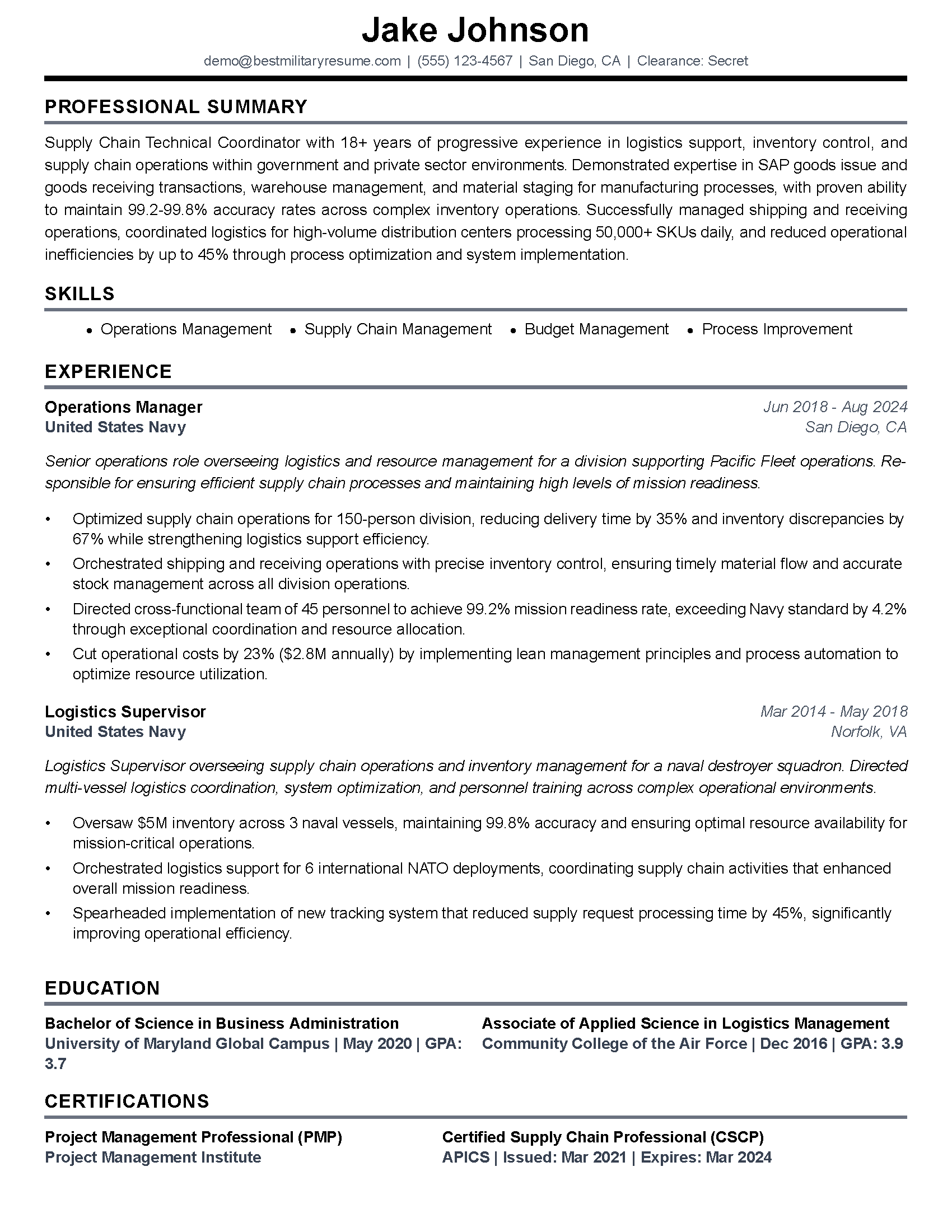
Put your clearance in your professional summary at the top. State it clearly. "Active Top Secret/SCI clearance" or "Current TS clearance, last adjudicated [month/year]." Recruiters for cleared roles scan for this in the first few seconds.
You should also list it on LinkedIn. Many cleared job recruiters use LinkedIn to search for candidates with active clearances. If yours is not listed, you are invisible to them. We have a full guide on how to list security clearance on LinkedIn.
For resume-specific advice on phrasing your clearance correctly, including what you can and cannot disclose, check our guide on security clearance resume phrasing.
If your clearance has expired, you can still list it. Just be honest about the status. "Previously held TS/SCI, last active [year]" tells employers you have been through the process and can likely be re-investigated faster. Our guide on expired clearance on resume walks through exactly how to phrase it.
How to Negotiate a Higher Salary With Your Clearance
Knowing what your clearance is worth is step one. Getting paid what it is worth is step two. Many veterans take the first offer because they do not realize they have leverage.
You do. Here is how to use it.
Know the market rate. Check ClearanceJobs.com, Indeed, and LinkedIn for similar roles in your area. Look at posted salary ranges for jobs that match your clearance level and skill set. This gives you a real number to bring to the negotiation.
Name your clearance early. In interviews and conversations with recruiters, mention your clearance level and that it is active. This signals immediate value. The recruiter knows they do not have to wait for an investigation.
Ask for the premium explicitly. When an offer comes in, you can say something like: "Based on market data for TS-cleared professionals in this role, I expected the offer to be in the $X to $Y range. Can we revisit the base salary?" This is direct and backed by data.
Consider the full package. If the base salary will not budge, negotiate on other fronts. Sign-on bonus, relocation assistance, additional PTO, or tuition reimbursement. Defense contractors often have room in these areas even when base salary is fixed by contract ceilings.
For more on salary negotiation tactics specific to cleared roles, read our detailed guide on clearance jobs salary negotiation.
What If You Do Not Have a Clearance Yet?
Some veterans never held a clearance during service. Others held Confidential or Secret but want to upgrade. Can you still benefit from the clearance salary premium?
Yes, but the path is different. You cannot apply for a clearance on your own. An employer must sponsor you. That means you need to get hired first by a company that works on classified contracts. They will submit you for investigation.
The good news is that veterans with honorable discharge, clean financial records, and no major red flags are strong candidates for clearance sponsorship. Your military background is a plus because investigators already have your service record.
Roles that commonly sponsor clearances include entry-level positions at defense contractors, federal contractor IT help desk roles, and security guard positions at cleared facilities. Once you hold the clearance, you can move to higher-paying roles that require it.
If you are looking for high-paying careers for veterans, defense contractor roles that require or sponsor clearances are some of the best options available.
What to Do Next
Your clearance is a financial asset. Treat it like one. If it is active, use the 24-month window after separation to lock in a cleared role at the right salary. If it is expired, list it on your resume and LinkedIn correctly so employers know you can be re-investigated.
Start by building a resume that puts your clearance front and center. The BMR Resume Builder helps veterans translate military experience into civilian language and formats your clearance, skills, and experience so recruiters find you. It is free for two tailored resumes, including clearance-specific formatting.
After helping 24,538 veterans through BMR, I have seen the difference a well-built cleared resume makes. Veterans who list their clearance correctly and target the right roles consistently land offers $15,000 to $30,000 above non-cleared peers. Your clearance earned you nothing sitting in a database. Put it to work.
Frequently Asked Questions
How much does a top secret clearance add to your salary?
How much is a secret clearance worth in salary?
How long does a security clearance last after military separation?
Do defense contractors pay more than federal jobs for cleared workers?
Can I get a security clearance after leaving the military?
Where do cleared jobs pay the most?
Should I list an expired security clearance on my resume?
How do I negotiate a higher salary with a security clearance?
About the Author
Brad Tachi is the CEO and founder of Best Military Resume and a 2025 Military Friendly Vetrepreneur of the Year award recipient for overseas excellence. A former U.S. Navy Diver with over 20 years of combined military, private sector, and federal government experience, Brad brings unparalleled expertise to help veterans and military service members successfully transition to rewarding civilian careers. Having personally navigated the military-to-civilian transition, Brad deeply understands the challenges veterans face and specializes in translating military experience into compelling resumes that capture the attention of civilian employers. Through Best Military Resume, Brad has helped thousands of service members land their dream jobs by providing expert resume writing, career coaching, and job search strategies tailored specifically for the veteran community.
