Cybersecurity Certifications for Veterans (2026)
Michael got only rejections. Then a $100K facilities manager role.
Michael, E-7, Navy, tried a ton of outside help before BMR
Veterans are walking into one of the strongest hiring markets in cybersecurity right now, and most don't realize how well-positioned they already are. If you held a clearance, worked in a SCIF, touched classified networks, or had any role in signal, intelligence, or communications, you've already done work that maps directly to cybersecurity job descriptions. The missing piece for most veterans is the certification that proves it to civilian hiring managers.
I built BMR after going through my own rough transition, and one pattern I see constantly on the platform is veterans with strong technical backgrounds who undersell themselves because they don't have the right civilian credential next to their name. Cybersecurity is one of those fields where certifications carry real weight. Employers use them as a shorthand for verified skill, and the DOD 8140 framework requires specific certs for most federal cyber positions.
This guide covers the certifications that matter most for veterans in 2026, organized from entry-level to advanced. For each one, I'll break down what it proves, exam details, cost, study time, and which military backgrounds map best. If you're building your transition plan, pair this with a strong defense contractor resume to make the most of your clearance and experience.
Why Do Veterans Have an Edge in Cybersecurity?
The cybersecurity industry has a massive workforce gap. There aren't enough qualified people to fill the open positions, and that gap has been growing for years. Veterans with security clearances, hands-on experience with classified systems, and a mission-focused work ethic are exactly what employers are looking for.
Here's what gives veterans a real advantage. An active or recent security clearance is worth tens of thousands of dollars and months of time to an employer. They don't have to sponsor you for one. That alone moves you past a huge chunk of the applicant pool for defense, intelligence, and federal IT positions.
Why Employers Want Veterans in Cyber
Active Security Clearance
Saves the employer $5,000-$15,000+ and 6-18 months in processing time
Experience on Classified Networks
Real-world experience with SIPR, JWICS, or classified systems that civilians can't get
DOD 8570/8140 Familiarity
Many veterans already hold baseline certs or know the framework cold
Mission-Driven Work Ethic
Cybersecurity requires the same precision and accountability veterans bring from service
Many veterans already hold DOD 8570 baseline certifications from their time in service. If you earned Security+ or CEH while active duty, those don't expire just because you separated. They're still valid and still count. You may just need to maintain your continuing education credits to keep them current.
The military backgrounds that translate most directly: Signal Corps and communications MOSs map to network security and INFOSEC roles. Intelligence analysts translate well to threat analysis and security operations center (SOC) work. Cyber operations specialists (like Army 17C or Navy CTN) are already doing the job in uniform. But even combat arms veterans with clearances and a willingness to study can break into this field with the right certifications.
There is also the discipline factor. Cybersecurity operations require attention to detail, following procedures exactly, and staying alert during long monitoring shifts. These are habits veterans already have. Civilian candidates often need to develop them on the job. You walk in with them built in. That matters to hiring managers, especially in SOC environments where one missed alert can mean a breach.
What Certifications Should You Start With?
The entry point for most veterans is CompTIA Security+. There's a reason for that. Security+ is the DOD 8140 baseline certification for IAT Level II positions, which covers a huge swath of federal and defense contractor IT security jobs. If you want to work in government cybersecurity, you'll almost certainly need this one.
CompTIA Security+ (SY0-701) proves you understand core security concepts: threats, vulnerabilities, network security architecture, identity management, risk management, and cryptography. The exam is 90 questions, 90 minutes, and costs about $400. Most veterans with some IT background can study for 4-8 weeks and pass. If you've already worked with classified systems or done any kind of IA (Information Assurance) work, you know more than you think.
DOD 8140 and Why It Matters
DOD 8140 (replacing 8570) is the framework that mandates specific certifications for military and civilian cybersecurity positions within the Department of Defense. Federal contractors must also comply. If you want any DOD cyber role, your certifications need to align with 8140 work role requirements.
CompTIA CySA+ (CS0-003) is the logical next step after Security+. While Security+ covers broad security concepts, CySA+ focuses specifically on security analytics, threat detection, and incident response. Think of it as the cert that proves you can monitor a network and spot the bad guys. Exam fee is about $400, and study time runs 6-10 weeks if you already have Security+. This cert maps well to SOC analyst roles, which are plentiful and pay well.
For veterans without any IT background, CompTIA A+ and CompTIA Network+ are worth considering as stepping stones. A+ covers hardware and basic IT troubleshooting. Network+ covers networking fundamentals. They're not cybersecurity-specific, but they build the foundation you need before tackling Security+. Some veterans skip them if they have enough hands-on IT experience from their MOS.

Which Advanced Certifications Pay the Most?
Once you have your entry-level certs and some work experience, advanced certifications are where salary jumps happen. These are the credentials that move you from analyst-level roles into senior positions, management, and specialized technical work.
CISSP (Certified Information Systems Security Professional) is the gold standard for senior cybersecurity roles. It requires five years of paid work experience in at least two of eight security domains, so it's not an entry-level cert. But it's the one that opens doors to CISO positions, security architecture roles, and senior consulting gigs. The exam is 125-175 adaptive questions over four hours, costs $749, and has a reputation for being brutal. Study time: 8-16 weeks of serious preparation.
"One of our Army Signal NCOs went from E-6 to a $115K SOC analyst role in eight months. Security+ got him in the door. CySA+ got him the offer over other candidates. The clearance sealed it."
CEH (Certified Ethical Hacker) from EC-Council is popular with veterans who want to do offensive security work: penetration testing, vulnerability assessment, and red team operations. The exam costs $1,199 through EC-Council (though prices vary with training bundles). It's a knowledge-based test rather than a hands-on practical. Study time: 6-10 weeks. Military intel and cyber operations veterans tend to do well on this one because the mindset maps directly.
CCSP (Certified Cloud Security Professional) from ISC2 focuses on cloud security architecture, design, operations, and compliance. As organizations move more infrastructure to the cloud, CCSP holders are in high demand. It requires five years of IT experience with at least one year in cloud security. Exam cost: $599. This pairs well with AWS or Azure cloud certifications for a strong cloud security profile.
OSCP (Offensive Security Certified Professional) is the hands-on penetration testing cert that carries the most weight with technical hiring managers. Unlike CEH, OSCP requires you to actually hack into target systems in a 24-hour practical exam. It's hard. The course and exam bundle starts around $1,599. But OSCP holders are in serious demand, and the cert alone can command a significant salary premium. Best for veterans who want to be technical practitioners, not managers.
What Free or Discounted Training Is Available for Veterans?
You don't have to pay full price for certification training. Several programs exist specifically to help veterans get cybersecurity credentials at reduced cost or free. Here are the ones worth your time.
VET TEC is a VA program that covers tuition for high-tech training programs, including cybersecurity bootcamps and certification prep courses. The key benefit: it doesn't use your GI Bill entitlement. You need at least one day of remaining GI Bill eligibility to qualify, but the program itself is funded separately. It also pays a housing allowance while you're in training.
Onward to Opportunity (O2O) through Syracuse University's Institute for Veterans and Military Families (IVMF) offers free certification training and exam vouchers for transitioning service members and veterans. They cover CompTIA, Cisco, AWS, and other industry certifications. The program is well-structured and includes career coaching alongside the technical training.
1 VET TEC (VA Program)
2 Onward to Opportunity (Syracuse IVMF)
3 Hire Heroes USA
4 CompTIA Exam Funding
Hire Heroes USA provides free career coaching and can connect veterans with scholarship funds and training programs in cybersecurity. They don't run their own certification courses, but they'll point you to the right programs and help with the job search side once you're certified.
CompTIA does offer a military and veteran discount, but not as a coupon code, whatever the coupon sites say. You email their government sales team and the amount depends on the product. Our guide to the CompTIA military discount walks through it. When you're stacking multiple CompTIA certs, the rest of the money comes from your service credentialing program or GI Bill test reimbursement, which is filed once per exam.
There are also free study resources online that can supplement formal training. Professor Messer offers free video courses covering CompTIA Security+, Network+, and A+ material. CyberDefenders and TryHackMe have free tiers with hands-on labs where you can practice real security scenarios. The Department of Labor also sponsors cybersecurity apprenticeship programs that pair veterans with employers while they earn certifications on the job. These apprenticeships are paid positions, so you earn a salary while building your credentials.
How Should You Build Your Cybersecurity Resume?
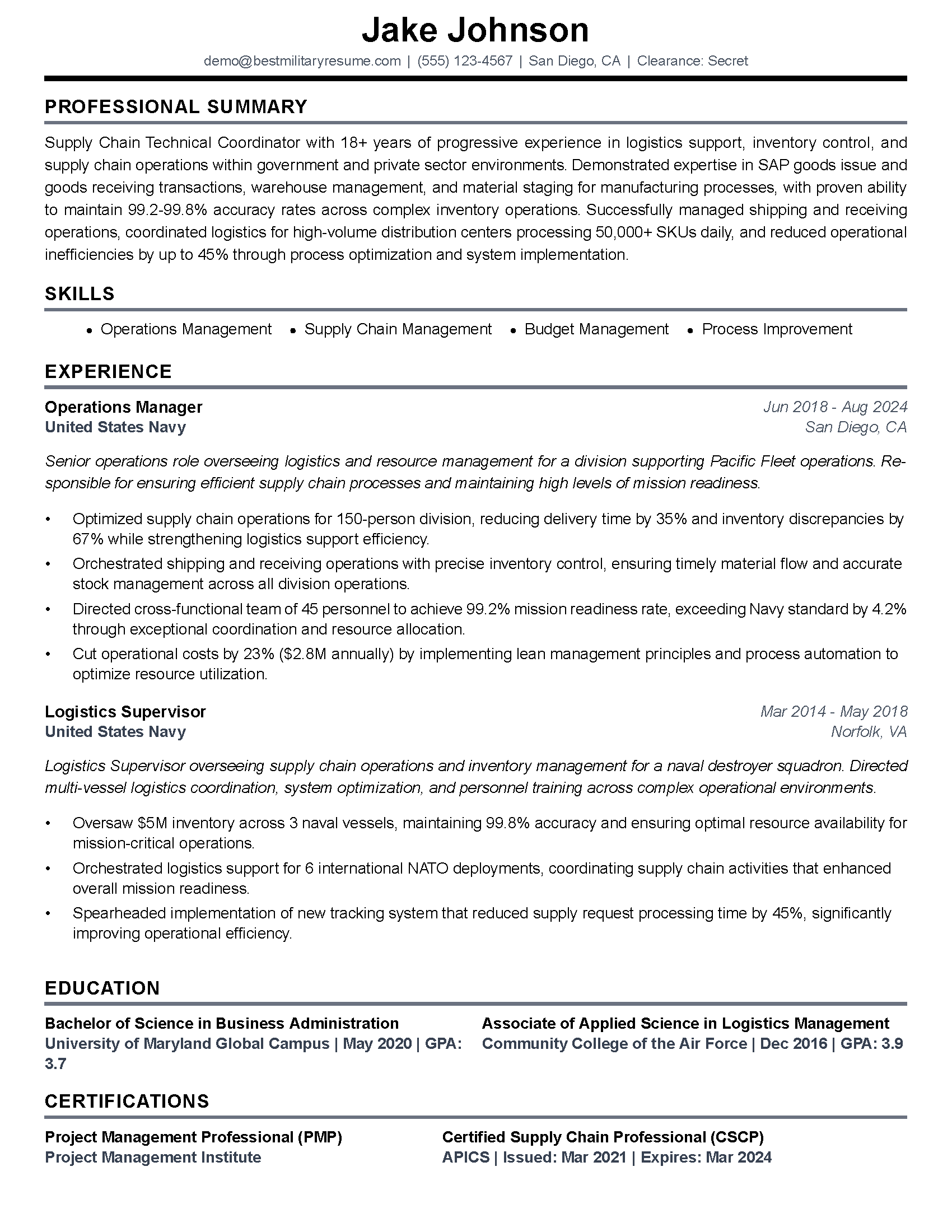
Getting certified is step one. Getting hired requires a resume that translates your military cyber experience into language civilian hiring managers understand. This is where veterans with strong technical backgrounds still stumble. The skills you put on your resume need to match what's in the job posting.
Your certifications go in a dedicated section near the top of the resume, not buried at the bottom. For cybersecurity roles, hiring managers scan for specific certs first. If the job posting requires Security+ and CISSP, those should be visible within the first few seconds of reading your resume.
"Responsible for maintaining network security and ensuring compliance with DOD regulations for 200+ users in a tactical environment."
"Monitored and defended enterprise network (200+ endpoints) using SIEM tools and IDS/IPS. Conducted vulnerability assessments, enforced NIST 800-53 controls, and reduced security incidents by 40% over 12 months."
Translate your military acronyms into civilian and industry equivalents. "IA compliance" becomes "NIST 800-53 compliance" or "FISMA compliance." "COMSEC" becomes "cryptographic key management." "EKMS" becomes "encryption key management." The hiring manager needs to see the civilian framework, not the military one.
For veterans making the move into cybersecurity, BMR's Resume Builder handles this translation automatically. You paste the job posting, and it maps your military experience to the specific language that posting uses. That matters in cybersecurity because every company uses slightly different terminology even for the same roles.
Don't forget to include specific tools and platforms you've used. Splunk, Wireshark, Nessus, Tenable, CrowdStrike, Carbon Black, Palo Alto firewalls. If you touched it in the military, and the job posting mentions it, put it on the resume. Cybersecurity hiring managers care about hands-on tool experience almost as much as they care about certifications.
One more thing: tailor every application. A SOC analyst resume should emphasize monitoring, log analysis, and incident response. A penetration testing resume should emphasize vulnerability assessment, exploit development, and red team experience. A security architect resume should emphasize design, frameworks, and risk management. Same veteran, same experience, different emphasis based on the target role. That's what gets you past ATS filters and into the interview. Your LinkedIn profile should mirror the same language.
Related: Free certification programs for veterans in 2026 and how to land your first tech job after the military.
Frequently Asked Questions
What is the best first cybersecurity certification for veterans?
Does my military security clearance help in cybersecurity jobs?
What is DOD 8140 and why does it matter?
How much does the CISSP certification cost?
Can I get free cybersecurity training as a veteran?
Which military jobs translate best to cybersecurity?
Is CEH or OSCP better for penetration testing careers?
How should I list cybersecurity certifications on my resume?
About the Author
Brad Tachi is the CEO and founder of Best Military Resume and a 2025 Military Friendly Vetrepreneur of the Year award recipient for overseas excellence. A former U.S. Navy Diver with over 20 years of combined military, private sector, and federal government experience, Brad brings unparalleled expertise to help veterans and military service members successfully transition to rewarding civilian careers. Having personally navigated the military-to-civilian transition, Brad deeply understands the challenges veterans face and specializes in translating military experience into compelling resumes that capture the attention of civilian employers. Through Best Military Resume, Brad has helped thousands of service members land their dream jobs by providing expert resume writing, career coaching, and job search strategies tailored specifically for the veteran community.
