Veterans in Tech: Land Your First Job After Service
Michael got only rejections. Then a $100K facilities manager role.
Michael, E-7, Navy, tried a ton of outside help before BMR
The tech industry is one of the best career destinations for transitioning military members — and not just for the veterans who worked in IT during their service. Tech companies need project managers, operations specialists, sales professionals, analysts, and leaders just as much as they need software engineers. The discipline, problem-solving skills, and work ethic you developed in the military translate directly to tech roles.
But the tech industry has its own language, its own hiring culture, and its own expectations for resumes and interviews. Veterans who understand these differences land jobs faster. Here's your complete guide to breaking into tech after the military.
Why Tech Wants Veterans (And Not Just for PR)
The veteran hiring push in tech isn't charity — it's good business. Companies have figured out that military veterans bring capabilities that are hard to find in traditional tech hiring pipelines.
Leadership under pressure. Tech moves fast, deadlines are aggressive, and things break. Veterans don't panic when a production server goes down at 2 AM any more than they panicked during an actual crisis. That calm-under-fire mentality is valuable and rare in the civilian workforce.
Mission focus. The military trains you to identify the objective, build a plan, and execute. In tech, this translates directly to product delivery, project management, and operations. While other employees are debating the perfect approach, veterans are already shipping.
Security mindset. Every veteran has some baseline understanding of operations security, access control, and information protection. In an era where data breaches make headlines weekly, that mindset is an asset across every department — not just cybersecurity.
Adaptability and learning speed. You've been dropped into unfamiliar environments throughout your military career and figured it out. Tech roles require constant learning as technologies evolve, and veterans are already conditioned for that pace.
Tech Roles That Match Military Experience
Many veterans assume tech means coding. It doesn't. The tech industry has hundreds of roles that don't require writing a single line of code. Here's where military experience maps most directly.
Military-to-Tech Role Mapping
Military Background
- Operations Officer/NCO
- Intelligence Analyst
- Logistics/Supply
- Communications/Signal
- Training NCO/Officer
- Recruiter/Career Counselor
- Any leadership role (E-6+, O-3+)
Tech Roles
- Technical Program/Project Manager
- Data/Business Analyst
- Supply Chain/Operations Analyst
- Network/Systems Engineer
- Technical Trainer / Solutions Engineer
- Tech Sales / Account Executive
- Engineering Manager / Scrum Master
Technical Program Manager (TPM)
This is one of the best-paying non-engineering roles in tech, and military officers and senior NCOs are natural fits. TPMs coordinate complex projects across multiple teams, manage timelines, mitigate risks, and ensure delivery. Sound familiar? It's basically what you did as an operations officer or platoon sergeant, but for software products.
Salary range: $100,000-$180,000+ at major tech companies.
Tech Sales / Account Executive
Veterans with strong communication skills and a competitive drive thrive in tech sales. Companies like Salesforce, Oracle, Amazon Web Services, and hundreds of SaaS companies actively recruit veterans into sales roles. The military taught you discipline, resilience to rejection, and how to build rapport quickly — all critical sales skills.
Salary range: $70,000 base + $50,000-$150,000+ in commission (top performers earn significantly more).
Data Analyst / Business Intelligence
Intelligence analysts, operations planners, and anyone who built briefings from raw data has a head start here. Data analysts collect, clean, and interpret data to help companies make decisions. The transition from military intelligence analysis to business intelligence analysis is one of the most natural career pivots for veterans.
Salary range: $65,000-$110,000.
Cloud / IT Infrastructure
Signal, communications, and IT MOSs translate directly here. Cloud infrastructure roles involve managing the servers, networks, and platforms that tech companies run on. Amazon Web Services, Microsoft Azure, and Google Cloud certifications open doors quickly.
Salary range: $80,000-$140,000+.
Product Management
Product managers define what gets built and why. They gather requirements (like writing an operations order), prioritize features (like triaging tasks), and coordinate between engineering, design, and business teams. Officers who managed cross-functional teams adapt quickly to this role.
Salary range: $110,000-$180,000+ at established companies.

Getting Tech-Ready: What You Actually Need
Forget the myth that you need a computer science degree to work in tech. Here's what actually gets you hired for non-engineering roles.
Most non-engineering tech roles require skills you can learn in 2-3 months, not a 4-year degree. Focus on: basic data skills (Excel/Google Sheets, SQL basics), project management fundamentals (Agile/Scrum), and the ability to communicate technical concepts clearly.
For Program/Project Management
- PMP or CAPM certification — Project Management Professional certification shows you understand formal project management. Your military experience covers most of the required hours.
- Scrum Master certification (CSM or PSM) — Most tech teams use Agile methodology. A 2-day Scrum Master course plus certification makes you immediately relevant.
- Tools to learn: Jira, Confluence, Asana, or Monday.com — pick one and learn it well.
For Data/Analytics Roles
- SQL basics — Free courses on Khan Academy, Codecademy, or DataCamp. You need to be able to pull data from databases.
- Excel/Google Sheets mastery — Pivot tables, VLOOKUP, basic formulas. Most data analysis starts here.
- Visualization tools: Tableau or Power BI — learn one. Free versions available for practice.
- Google Data Analytics Certificate — A structured program that covers fundamentals and looks good on a resume.
For Tech Sales
- Salesforce Administration certification — Understanding CRM tools is the baseline.
- Product knowledge — Deep-dive into whatever the company sells. Tech sales is about understanding the product well enough to match it to customer problems.
- Veteran-specific programs: Salesforce Military, Microsoft MSSA, and Hiring Our Heroes tech tracks specifically prepare veterans for tech sales roles.
Veteran-Specific Tech Hiring Programs
These programs exist specifically to help veterans break into tech. They're free or funded by the VA.
- Microsoft Software & Systems Academy (MSSA) — 17-week program for transitioning service members. Covers cloud development, server/cloud admin, or cybersecurity. Microsoft reports 96% of graduates who seek a job find employment.
- Amazon Military Programs — Multiple pathways including Military Apprenticeship, Operations Manager roles, and AWS training programs. Amazon is one of the largest employers of veterans in tech.
- Salesforce Military — Free Salesforce training and certification for veterans and military spouses. Salesforce administrators earn $65,000-$100,000 and the ecosystem has massive demand.
- Hiring Our Heroes Corporate Fellowship — 12-week fellowships at major tech companies while still on active duty (similar to SkillBridge). Companies include Google, Apple, Amazon, and Microsoft.
- VET TEC 2.0 — VA-funded program covering tech bootcamps. Includes housing allowance. If you have GI Bill or other VA education entitlement left, VA charges one month per full-time month. No entitlement left? You can still enroll. You need at least 36 months of active duty and must be under 62 when approved. The original VET TEC pilot ended April 1, 2024.
- SkillBridge — Intern at tech companies near the end of active duty while collecting military pay. DoD allows up to 180 days, but your service may approve less. In the Army, E-1 to E-5 can get up to 120 days. Army E-6 to E-7, WO1 to CW3, and O-1 to O-3 get up to 90. Army E-8 to E-9, CW4 to CW5, and O-4 and above get up to 60. Many of the companies listed above participate.
Building Your Tech Resume
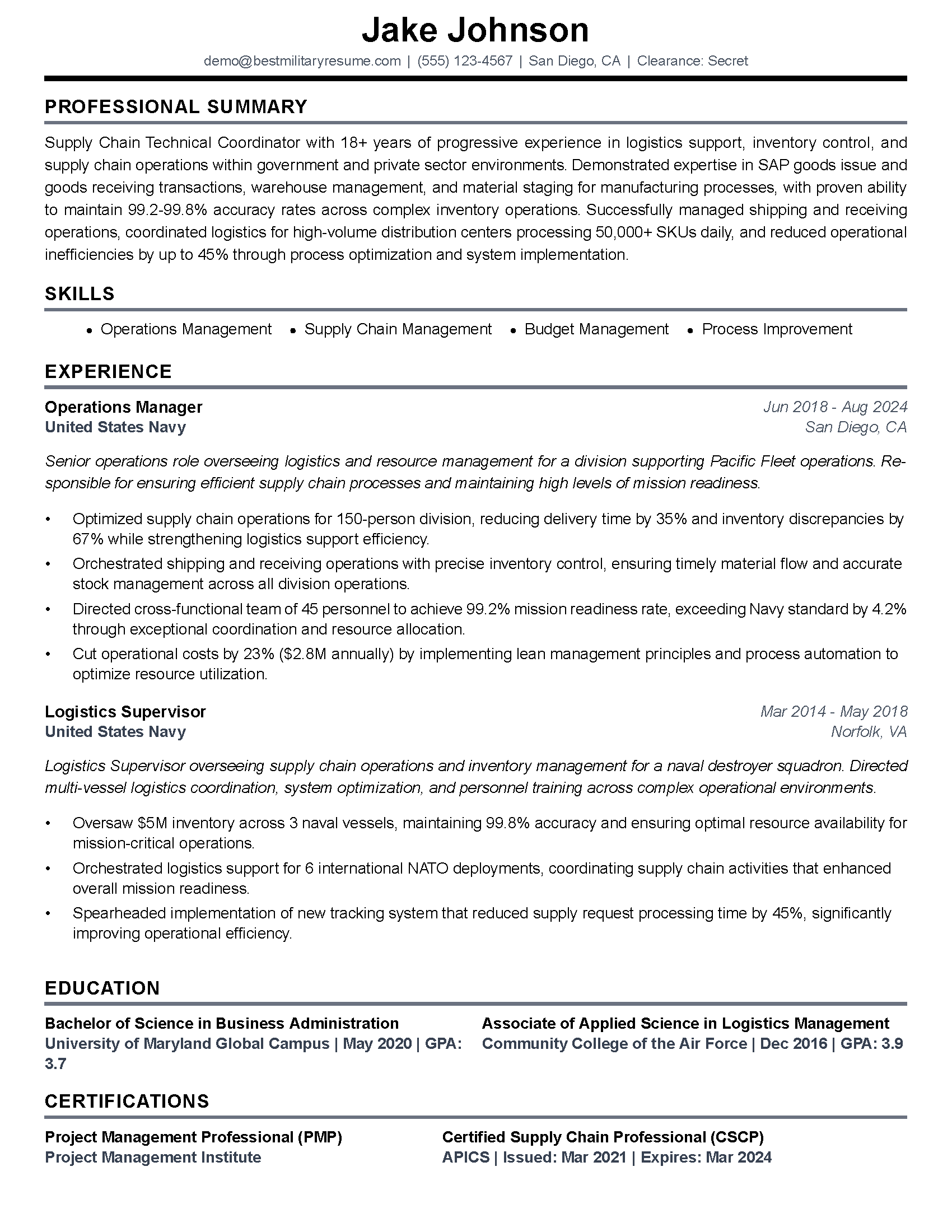
Tech resumes are different from military resumes and federal resumes. Here's what tech hiring managers and recruiters actually look for.
One page, maximum. Two pages if you have 15+ years of experience. Tech recruiters spend less time per resume than almost any other industry — get to the point fast.
Lead with impact, not duties. "Led a 12-person team" tells them nothing. "Led 12-person cross-functional team that delivered $2.4M infrastructure upgrade 3 weeks ahead of schedule and 15% under budget" tells them you drive results. Every bullet should have a measurable outcome.
Use tech vocabulary. Your resume needs to speak the language of tech. Translate your military terminology — "mission planning" becomes "strategic planning and execution," "OPORD" becomes "project plan," "battle rhythm" becomes "operational cadence." The BMR Resume Builder handles this translation automatically and tailors your resume to specific tech positions.
Don't list your military rank or use military formatting conventions on a tech resume. Tech companies don't have a rank structure, and listing "E-7/Sergeant First Class" in your header can make your resume feel foreign to tech recruiters. Your rank belongs in the job title line of your experience section, translated appropriately — e.g., "Senior Operations Manager (equivalent to E-7, U.S. Army)."
Include a skills section with specific technologies. List tools, platforms, and certifications relevant to the role. If you're applying for a project management role: Jira, Agile/Scrum, MS Project, risk management frameworks. For data roles: SQL, Excel, Tableau, Python. For cloud/IT: AWS, Azure, networking protocols, security frameworks.
Top Tech Companies Hiring Veterans
These companies have dedicated veteran hiring programs, military-friendly cultures, and track records of promoting veteran employees:
- Amazon — Largest private employer of veterans. Military Affairs team actively recruits for operations, cloud, and corporate roles.
- Microsoft — MSSA program, dedicated veteran recruiters, and strong veteran employee resource group.
- Google — Veterans and military spouses hiring program, plus SkillBridge partnerships.
- Salesforce — Free training and certification, Vetforce community, and dedicated military recruiter team.
- Apple — Military hiring initiatives and strong veteran employee community.
- Booz Allen Hamilton — Largest employer of veterans in tech consulting. Defense and commercial tech roles.
- Cisco — Military veteran program with networking certifications and direct hiring pipelines.
Use the BMR career crosswalk tool to find which specific tech roles match your MOS, rating, or AFSC. The tool maps your military job code to civilian positions with salary ranges, growth projections, and the certifications employers look for.
The 90-Day Tech Transition Playbook
Whether you're still on active duty or recently separated, this timeline gets you interview-ready for tech roles.
Days 1-30: Foundation and direction. Decide which tech path interests you most (PM, sales, data, cloud). Start one foundational course — Google Project Management Certificate, Google Data Analytics Certificate, or Salesforce Trailhead depending on your path. Update your LinkedIn profile to reflect your target tech role, not your current military title. Connect with 20+ veteran tech professionals on LinkedIn.
Days 31-60: Skills and credentials. Complete your foundational certification. If targeting PM roles, get your CSM (Certified Scrum Master — 2-day course). If targeting data, complete a SQL basics course. If targeting sales, start learning the product landscape of companies you want to join. Build your tech resume using civilian terminology. Start attending virtual tech meetups and veteran networking events.
Days 61-90: Application blitz. Apply to 10+ positions per week. Tailor each resume to the specific job description. Leverage veteran hiring programs — apply directly through MSSA, Salesforce Military, Amazon Military, or Hiring Our Heroes rather than just the company's general career page. Prepare for behavioral interviews using STAR format with tech-translated military examples. Follow up with every recruiter and connection.
When you apply through a veteran-specific hiring program, your resume goes through a dedicated pipeline — not the general applicant pool. This dramatically increases your chances of getting an interview. Always check if a company has a military hiring program before applying through their standard career page.
The tech industry isn't a backup plan — for many veterans, it's the best career move they'll ever make. The pay is excellent, the growth potential is massive, and the skills you built in the military are more valuable in tech than you realize. The key is translating those skills into language tech companies understand, and getting yourself in front of the right opportunities through veteran-specific programs that are designed exactly for this transition.
Also see best coding bootcamps for veterans and AI-resistant careers for veterans.
Related: Top companies hiring veterans in 2026 and the complete military resume guide for 2026.
Frequently Asked Questions
Do veterans need a computer science degree to work in tech?
What are the best non-coding tech jobs for veterans?
What free or VA-funded tech training programs exist for veterans?
How much do veterans make in tech?
What is the best entry-level tech role for veterans?
Can I use SkillBridge to get into tech?
How should veterans format a tech resume?
Which tech companies hire the most veterans?
About the Author
Brad Tachi is the CEO and founder of Best Military Resume and a 2025 Military Friendly Vetrepreneur of the Year award recipient for overseas excellence. A former U.S. Navy Diver with over 20 years of combined military, private sector, and federal government experience, Brad brings unparalleled expertise to help veterans and military service members successfully transition to rewarding civilian careers. Having personally navigated the military-to-civilian transition, Brad deeply understands the challenges veterans face and specializes in translating military experience into compelling resumes that capture the attention of civilian employers. Through Best Military Resume, Brad has helped thousands of service members land their dream jobs by providing expert resume writing, career coaching, and job search strategies tailored specifically for the veteran community.
