Expired Security Clearance on Resume: How to Phrase It Right
Corey landed a federal security specialist role.
Corey, E-7, Air Force, translated military security experience that actually got read
You separated two years ago. Your TS/SCI expired six months back. And now you are staring at the security clearance line on your resume wondering what the hell to write.
Write "Active TS/SCI" and you are lying. Leave it blank and you are throwing away one of the strongest differentiators you have as a veteran. Somewhere between those two bad options is the right answer, and it is simpler than you think.
I went through this exact problem after I left the Navy. My clearance lapsed, I was applying for defense contractor roles, and every job posting said "active clearance preferred." I had to figure out how to communicate that I had been investigated, adjudicated, and trusted with classified information without overstating my current status. This article is the playbook I wish someone had given me.
What "Expired" Actually Means for a Security Clearance
A security clearance does not vanish the day you separate. It has a defined lifecycle, and understanding that lifecycle matters because it directly affects what you can honestly put on your resume.
When you hold an active clearance on active duty, your investigation has a validity period. Secret clearances are reinvestigated every 10 years. Top Secret clearances are reinvestigated every 5 years under the legacy system (though Continuous Evaluation and Trusted Workforce 2.0 are changing this). The clearance itself stays "active" as long as you are in a position that requires access to classified information and your investigation is current.
When you separate from the military, your clearance status changes. You no longer have a need to access classified information through your military role. At that point, your clearance typically goes into an "inactive" or "current but not accessed" status. After a period without being used or renewed, it expires entirely.
Here is the critical distinction for your resume. An expired clearance means your investigation period has lapsed and you would need a new investigation to regain access. But the fact that you were previously investigated, adjudicated favorably, and granted access is still meaningful to employers. A company sponsoring you for a new clearance has a candidate with a proven track record of passing the investigation process. That is worth real money and real time savings to them.
Expired vs. Inactive vs. Active
Active means you currently have access. Inactive means your clearance is on file but not being used (common right after separation). Expired means the investigation period has lapsed entirely. Each status calls for different resume language. This article covers expired specifically.
Why an Expired Clearance Still Has Value to Employers
Defense contractors and federal agencies spend significant money and time getting employees cleared. A Secret clearance investigation can take several months. A Top Secret with SCI access can take over a year. During that waiting period, the employee cannot access classified programs, which means the company is paying someone who cannot fully do the job yet.
When you show up with a previously adjudicated clearance, even if it has expired, you are a lower-risk bet. You have already gone through the background investigation. You have already been adjudicated favorably. You have a track record of handling classified information responsibly. For the employer, sponsoring a reinvestigation on someone who has already passed is far less risky than starting from scratch with a candidate who has never held a clearance.
After helping over 15,000 veterans through BMR, I can tell you that clearance status, even when expired, consistently shows up as a deciding factor in hiring for defense and intelligence sector roles. Companies know what reinvestigation costs and how long it takes. Your expired clearance tells them you are a shortcut, not a gamble.
Some federal positions listed on USAJOBS will say "must be able to obtain" a specific clearance level. That language is aimed directly at people like you. They do not need your clearance to be active right now. They need confidence that you can pass the investigation again. Your previous clearance history gives them that confidence.

How to Phrase an Expired Clearance on Your Resume
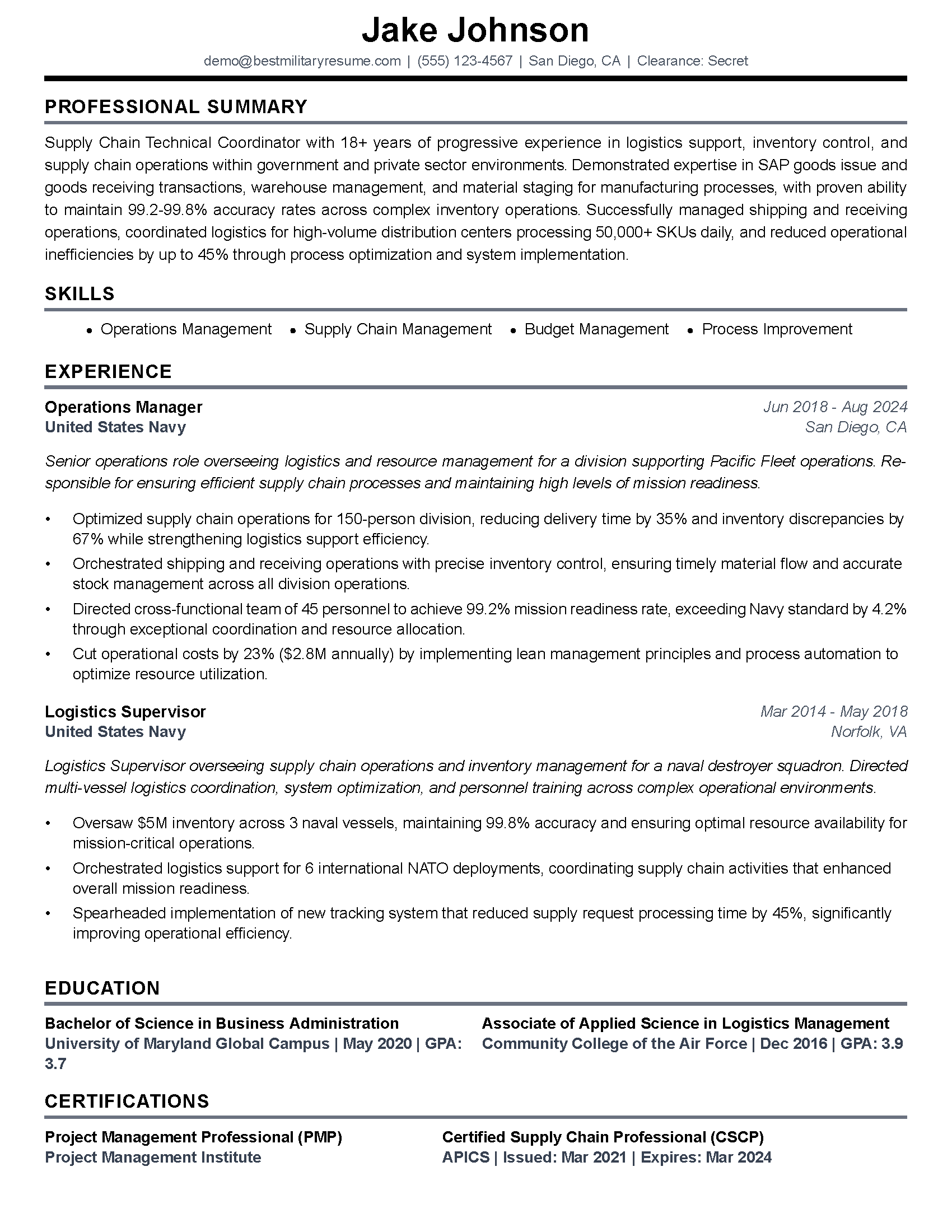
The phrasing matters more than you might expect. Get it wrong and a recruiter either thinks you are being dishonest or passes over you because they assume you have no clearance history at all. Get it right and you communicate exactly what they need to know in one line.
The Clearance Line Format
Place your clearance information in the header area of your resume, right below your contact information. This is where recruiters and hiring managers look for it first. Do not bury it in a job description or a skills section.
"Security Clearance: TS/SCI"
This implies active status, which is dishonest if your clearance has expired.
"Security Clearance: TS/SCI (expired 2024, eligible for reinvestigation)"
Honest, specific, and tells the employer you are reinvestigation-ready.
Phrasing Options by Situation
Your exact wording depends on how long ago your clearance expired and what level you held. Here are specific examples you can adapt.
Expired within the last 2 years:
- "Security Clearance: Top Secret/SCI (expired [month/year], previously adjudicated, eligible for reinvestigation)"
- "Clearance: Secret (expired [month/year], reinvestigation eligible)"
Expired more than 2 years ago:
- "Security Clearance: Previously held Top Secret/SCI (last active [year]). Favorably adjudicated. Eligible for new investigation."
- "Clearance History: Secret clearance held [year-year]. No adverse actions. Available for reinvestigation."
Expired 5+ years ago:
- "Prior Clearance: Top Secret (held during military service, [year-year]). Clean record. Willing to undergo new investigation."
Notice the pattern. Every version includes four pieces of information: the clearance level, the time frame, the fact that there were no issues, and your willingness to be reinvestigated. That is all an employer needs from the clearance line.
Where to Put Clearance Information on Your Resume
Placement depends on how central the clearance is to the role you are targeting. For defense contractor and intelligence community positions, clearance status belongs in the top quarter of your resume. For civilian roles where a clearance is a bonus but not required, it can go lower.
Defense and Intelligence Roles
Put it directly in your header block, right after your name, location, and contact info. Many defense contractors use keyword searches in their applicant tracking systems, and clearance level is one of the first things they scan for. If it is buried on page two, it might not surface to the top of their rankings.
Format it as a standalone line:
JOHN DOE
Tampa, FL | [email protected] | (555) 123-4567
Security Clearance: TS/SCI (expired March 2024, eligible for reinvestigation)
Federal Government Positions
For USAJOBS applications, there is often a specific field in the application form for clearance information. Fill that out accurately. But also include your clearance history on the resume itself, because the resume gets reviewed by a human who may not cross-reference every application field.
On a federal resume, include it in the same header area. Federal resumes have more structured information than civilian resumes (hours per week, supervisor contact, detailed duties), so your clearance line fits naturally with that level of detail.
Civilian Private Sector Roles
If you are applying to a tech company, a logistics firm, or any role that does not require a clearance, you can still include it. Move it to a "Certifications and Clearances" section near the bottom of your resume, or include it as a line item under your military experience. A prior clearance tells any employer that you passed an extensive background check, which signals reliability and trustworthiness even outside the defense world.
Key Takeaway
For defense jobs, clearance goes in the header. For federal jobs, header plus the USAJOBS form field. For civilian jobs, it goes in a lower section. Match the prominence to how much the role cares about clearance status.
How Long After Separation Can You Claim a Clearance?
This is one of the most common questions I see from veterans building resumes on BMR, and the answer depends on which system applies to your situation.
Under the legacy periodic reinvestigation system, here is how the timelines generally work. Your clearance remains in the system for up to 24 months after you leave a position that required it. During that 24-month window, a new employer with a facility clearance can "pick up" your existing clearance without starting a brand new investigation. After that window closes, your clearance is considered expired, and a new investigation would be required.
The Trusted Workforce 2.0 initiative is changing some of these timelines. Under TW 2.0, the government is moving toward Continuous Vetting rather than periodic reinvestigations. This means clearance holders are monitored on an ongoing basis rather than reinvestigated every 5 or 10 years. For veterans who separated before TW 2.0 was fully implemented, the legacy timelines still apply. For those separating now or in the near future, the system may look different.
Regardless of which system applies, the key point for your resume stays the same. You can always claim that you previously held a clearance, no matter how long ago. What changes is the language you use. A clearance that expired six months ago gets "expired, eligible for reinvestigation." A clearance from 2012 gets "previously held during military service." Both are honest. Both have value. The recency just affects how much value.
If you are not sure about your current status, you can check through the Defense Counterintelligence and Security Agency (DCSA). Your former security manager or the DCSA customer service line can confirm whether your investigation is still on file and what its current status is.
What Not to Write on Your Resume About an Expired Clearance
I have seen every version of this mistake. Some of them will get your resume ignored. A few could get you in actual trouble.
Do Not Claim Active Status
If your clearance is expired, do not write "Active TS/SCI" or "Current Secret Clearance." This is a misrepresentation. If your clearance is inactive rather than expired, the rules and phrasing are different — see our guide on listing an inactive clearance on your resume. Defense recruiters know how to verify clearance status through JPAS or its successor DISS (Defense Information System for Security). If you claim active and they check, you are done. Not just for that role, but potentially with that company entirely.
Do Not Omit the Clearance Entirely
Some veterans leave clearance information off their resume because they think an expired clearance has no value. That is wrong. As covered above, your clearance history saves employers time and money. Omitting it is leaving one of your strongest selling points on the table.
Do Not Include Classified Details
Your resume should state the clearance level and the time frame. For detailed guidance on what you can and cannot disclose about classified work, see our security clearance resume phrasing guide. It should never include details about specific programs you accessed, facility names associated with classified work, or the content of what you worked on. "Held TS/SCI with CI Polygraph" is fine. Describing the specific compartmented programs you were read into is not.
Do Not Use Vague Language
Phrases like "held a clearance" or "had government clearance" are too vague to be useful. Recruiters need to know the specific level (Confidential, Secret, Top Secret, TS/SCI) and roughly when you held it. Vague language makes it look like you are either hiding something or do not understand how clearances work, neither of which helps your application.
Expired Clearance Resume Mistakes to Avoid
Claiming "Active" when it is expired
Verifiable through DISS. Misrepresentation can blacklist you with the employer.
Leaving clearance off entirely
You are throwing away a major differentiator that saves employers time and money.
Describing classified programs or content
State the level and timeframe only. Never reference specific compartmented programs.
Using vague language like "held a clearance"
Specify the exact level (Secret, TS, TS/SCI) and approximate dates.
How an Expired Clearance Affects Different Job Applications
The value of your expired clearance varies by sector. Knowing where it carries the most weight helps you decide how prominently to feature it.
Defense Contractors (Highest Value)
Companies like Lockheed Martin, Raytheon, Northrop Grumman, Booz Allen Hamilton, and SAIC build their entire business model around cleared work. Many of their job postings require an active clearance or the ability to obtain one. Your expired clearance puts you in the "able to obtain" category, which is exactly what they are looking for. For these roles, your clearance line should be the second thing on your resume after your name.
Federal Government (High Value)
Federal positions that require a clearance will state it in the job announcement. Positions listed as "Public Trust" or "Non-Sensitive" do not need one. But for roles in defense agencies (DoD, DHS, NSA, CIA, NGA), intelligence positions, or law enforcement (FBI, DEA, ATF), your prior clearance history tells the hiring manager you are a known quantity in the investigation process.
When you are adding military experience to your resume for federal applications, include the clearance both in the header and as context within the job description where you used it.
Private Sector Tech and Consulting (Moderate Value)
Some tech companies and consulting firms do classified government contract work. Amazon Web Services (GovCloud), Microsoft (Azure Government), Deloitte, and Accenture Federal Services all have divisions that require cleared employees. Your expired clearance matters for those specific divisions, even if the parent company primarily does commercial work.
Civilian Roles With No Clearance Requirement (Low but Real Value)
Even in purely civilian roles, a prior clearance tells the employer you have passed a thorough background investigation. It signals that you can be trusted with sensitive information, that you have a clean financial and legal history, and that you take responsibility seriously. Include it, but do not make it the focal point of your resume. A line in a credentials section is sufficient.
How to Talk About an Expired Clearance in Interviews
Your resume gets you the interview. The interview is where you address the expired status directly if it comes up. And for defense roles, it will come up.
The best approach is straightforward and confident. Something like: "My TS/SCI expired in 2024 after I separated from the Navy. I was favorably adjudicated with no issues, and I am ready to go through reinvestigation whenever the company is ready to sponsor me." That covers everything a hiring manager needs to hear. You are not defensive about the expiration. You are not making excuses. You are telling them the facts and making it easy for them to picture the next step.
If the interviewer asks how long reinvestigation takes, be honest. A Secret reinvestigation typically takes 2 to 4 months. A Top Secret reinvestigation can take 4 to 12 months depending on complexity. If you have lived or traveled abroad since separation, or if there have been significant life changes, those factors can extend the timeline. Do not promise something you cannot control, but do emphasize that your prior favorable adjudication is a strong indicator of a smooth reinvestigation.
"Your clearance expired. That is a fact, not an apology. Own the timeline, state your willingness to reinvestigate, and move on to what you bring to the role."
Can You Get an Expired Clearance Reinstated?
Technically, a clearance is not "reinstated" in the way most people think. What actually happens is a new investigation, or a reinvestigation if your previous one is recent enough. The distinction matters because it sets realistic expectations.
If your clearance expired within the last 2 years and you are being sponsored by an employer with a facility clearance, the process is generally faster. Your previous investigation is still on file, and the adjudicator can reference it. You may go through an abbreviated investigation rather than starting from zero.
If your clearance expired more than 2 years ago, expect a full investigation. That means a new SF-86 (the Standard Form that collects your background information), new interviews with references, and the full adjudication process. It is the same process you went through the first time, but your clean track record from the prior clearance works in your favor.
Under Trusted Workforce 2.0, the concept of periodic reinvestigation is being replaced by Continuous Vetting for many positions. If your new employer falls under TW 2.0 guidelines, the process may look different from what you experienced during military service. The important thing for your resume is this: you are stating your clearance history accurately. The reinvestigation process is the employer's concern, not a resume issue.
If you want to understand how clearance validity works after separation, we have a detailed breakdown of those timelines. That article covers the active-to-inactive transition. This article picks up where that one leaves off, once the clearance has fully expired.
How to Build the Rest of Your Resume Around an Expired Clearance
Your clearance line is one element. The rest of your resume needs to reinforce why you are worth the reinvestigation investment. Employers who hire candidates with expired clearances are making a bet that the time and cost of getting you re-cleared will pay off. Your resume needs to make that bet look smart.
Highlight Relevant Classified-Adjacent Experience
You cannot describe classified work. But you can describe the skills you used and the environments you operated in. Managed secure communications networks. Operated in a SCIF environment. Coordinated multi-agency intelligence products. Conducted vulnerability assessments for classified systems. These descriptions tell the employer you know how to work in a cleared environment without revealing anything you should not.
Emphasize Continuity and Reliability
A clean clearance history is a character reference in itself. If you held a clearance for 6, 10, or 20 years with no adverse actions, that says something about your judgment, your financial stability, and your ability to follow rules. Work that narrative into your resume through your job descriptions. Phrases like "maintained continuous eligibility for TS/SCI access throughout 8-year military career" communicate a lot without saying anything classified.
Tailor to the Specific Role
A military resume for civilian roles needs to translate your experience into language the hiring manager understands. That applies to your clearance-related experience too. If you are applying for a cybersecurity analyst role at a defense contractor, your resume should emphasize the security protocols, risk assessments, and compliance work you did. If you are applying for a program management role, emphasize the coordination, stakeholder management, and reporting that happened within your cleared environment.
BMR's Resume Builder handles a lot of this translation automatically. You paste the job posting, and it tailors your military experience to match the language the employer is actually using. For cleared roles, that means pulling out the right keywords around security protocols, classified environments, and the specific technical skills the job posting asks for.
What to Do Next
If you are sitting on an expired clearance and a blank resume, here is the move. Start with your clearance line. Use one of the phrasing templates from this article that matches your situation. Put it in the right spot on your resume based on the type of role you are targeting. Then build the rest of your resume to reinforce why you are worth the reinvestigation.
If you want the clearance phrasing and the rest of your resume handled in one shot, BMR's Resume Builder will tailor your entire resume to the specific job posting, including the clearance language. Paste the job, get a resume that speaks the employer's language. Two free tailored resumes included.
Your clearance expired. Your value did not. Put the right words on paper and let the employers figure out the reinvestigation timeline. That is their job. Yours is to show them you are worth it.
Frequently Asked Questions
Should I put an expired security clearance on my resume?
How do I phrase an expired TS/SCI on a resume?
How long is a security clearance good for after military separation?
Can an expired security clearance be reinstated?
Where should I put my expired clearance on my resume?
Does an expired clearance help with federal government jobs?
What should I NOT write about my expired clearance on a resume?
About the Author
Brad Tachi is the CEO and founder of Best Military Resume and a 2025 Military Friendly Vetrepreneur of the Year award recipient for overseas excellence. A former U.S. Navy Diver with over 20 years of combined military, private sector, and federal government experience, Brad brings unparalleled expertise to help veterans and military service members successfully transition to rewarding civilian careers. Having personally navigated the military-to-civilian transition, Brad deeply understands the challenges veterans face and specializes in translating military experience into compelling resumes that capture the attention of civilian employers. Through Best Military Resume, Brad has helped thousands of service members land their dream jobs by providing expert resume writing, career coaching, and job search strategies tailored specifically for the veteran community.
