Air ForceAFSC: 1A1X8

Executive Mission Aviator

The civilian and federal jobs that hire Air Force Executive Mission Aviators — with real salaries and the resume that gets callbacks.

Every 1A1X8 has more options than a Google search will tell you. Below: career paths, BLS salary data, federal GS series, certifications by target career, and how to translate your experience without losing what made you valuable to the Air Force in the first place.

Free to start · Tailored resume in under 5 minutes

$37K–$108K
Salary Range
BLS-verified median salaries
14
Career Paths
14
Companies Hiring
9
Resume Examples
7
Federal GS Series
9
Certification Paths
10
FAQs Answered
BT
Brad Tachi
Navy Diver · BMR Founder

After the Navy I got hired into 6 federal career fields and tech sales, and sat on federal hiring panels along the way. I spent the last 2 years rebuilding everything I learned into BMR, tuned for how AI actually screens resumes today. This is the system I wish I'd had on day one.

65,000+ resumes built·Success stories every week
Free Sample · Emailed to You

Get a free 1A1X8 Executive Mission Aviator sample resume

One page, built in our template, with your military experience translated into civilian terms hiring managers and ATS systems read. Use it as a reference for your own. Drop your email and we'll send you the download link.

Free. We'll also send occasional job-search tips. Unsubscribe anytime.

Military Role Overview

Of the more than 60,000 resumes BMR has built, the executive airlift records are some of the hardest to translate, because the calmest line on the page hides the most pressure behind it. As a 1A1X8 Executive Mission Aviator you flew the cabin and the comms on aircraft carrying the President, the Vice President, the Secretary of Defense, the First Lady, combatant commanders, and congressional delegations. You ran in-flight meal and passenger service to a protocol standard with cameras and senior staff watching, kept a classified communications suite live from gate to gate, and worked engine, hydraulic, fuel, and pressurization checklists while a head of state slept thirty feet behind you. That is white-glove service, secure communications, and aircraft-systems judgment in the same shift. The resume problem is that "flight attendant" or "communications systems operator" reads like an entry-level job title to a civilian recruiter, and none of the protocol, the clearance, or the systems work shows through.

The 1A1X8 specialty is the enlisted aircrew career field for executive airlift, flown out of the 89th Airlift Wing at Joint Base Andrews and the wider Special Air Mission community, with assignments at Scott AFB, Joint Base Pearl Harbor-Hickam, and Ramstein. It is a prior-service-only field. Airmen come in from other Career Enlisted Aviator specialties, requalify through the executive airlift pipeline, and hold a flying-status AF Form 8 qualification on aircraft like the C-32A, the C-37A and C-37B Gulfstream, and the C-40. The work splits into a few shreds. Flight attendants plan and execute in-flight meals, passenger comfort, luggage and loading, and serve as the direct face of the Air Force to the principal, holding the line on etiquette and protocol. Communications systems operators run the in-flight voice, data, and secure information systems that keep the National Command Authority connected in the air. Flight engineers manage performance data, takeoff and landing computations, and systems monitoring and troubleshooting in flight.

The clearance is the part most recruiters never see on the page. The specialty requires routine access to Tier 5 information systems, the same investigation tier behind a Top Secret clearance, with a clean record across emotional stability, substance use, and conduct. Civilian employers value this background because it is rare: you delivered premium, discreet service to the most scrutinized passengers in the world while staying current on aircraft systems and classified communications, and you did it without a single public mistake being an option. If you flew with other enlisted aircrew, the related Flight Engineer (1A1X1) and Mobility Force Aviator (1A1X2) pages cover adjacent paths, and the career crosswalk tool helps you map your exact shred.

I have seen executive airlift resumes come through BMR that bury the whole career under the word "flight attendant," and it costs people interviews they should have walked into. The work was protocol-grade service for heads of state, a live classified comms suite, and aircraft systems you were trusted to monitor in flight. Put that on the page, not the job title. — Brad Tachi, Navy Diver veteran & BMR founder

Security ClearanceTop Secret (Tier 5 investigation)
ASVAB RequirementPrior-service CEA requalification; no entry ASVAB line score (field is prior-service only)
TrainingPrior-service entry from another CEA specialty, then the executive airlift requalification pipeline including aircrew fundamentals, survival training, and airframe-specific qualification at the formal training unit for the assigned aircraft (C-32A, C-37A/B, or C-40).
Certs Earned in ServiceAF Form 8 aircrew flight qualification, Aircrew fundamentals and survival training, Aircraft-specific executive airlift qualification (C-32A, C-37A/B, C-40)
Pay Reality Check

The number that matters when you're deciding what's next: how does civilian pay compare to what you make now?

Air Force mid-career
$58K–$82K
E-5 to E-7 total comp (base + BAH + BAS + tax advantage)
Civilian Executive Mission Aviator
$64K–$108K
BLS median across direct-match civilian roles
Federal (GS-9 to GS-13)
$58K–$120K
7 matching GS series + locality pay + step increases
+14% on average
Civilian roles for Executive Mission Aviators pay ~$10K more than mid-career enlisted total comp.

Military comp is approximate (varies by location/dependents). Civilian is BLS median. Federal includes locality pay. Your real number depends on duty station, family status, GS step, and overtime.

Private Sector Career Paths

The strongest civilian paths for an Executive Mission Aviator are not in cargo aviation. They sit where premium service, secure communications, and crew-level systems discipline are paid for directly, which is a different market than the mobility side of the house.

Corporate and charter aviation is the most direct fit. Flight Attendants earned a median of $67,130 in May 2024 (BLS OEWS), and the business-aviation and VIP-charter end of that field, flying for corporate flight departments and private operators, is exactly where executive airlift experience commands a premium over the airline cabin. The service standard you already met is the one those operators sell. On the communications side, Telecommunications Equipment Installers and Repairers earned a median of $64,310, the lane for communications systems operators moving into corporate and broadcast communications, secure conferencing, and in-flight connectivity work. If you flew an engineer shred, the load and movement experience maps to Aircraft Cargo Handling Supervisors at a median of $66,190 and to Transportation, Storage, and Distribution Managers at $102,010, the senior coordination roles for aircrew who ran mission logistics.

The hospitality and operations market also values this background more than the title suggests. Lodging Managers earned a median of $68,130 and Administrative Services Managers earned $108,390 in May 2024 data, both realistic for aircrew who ran the full passenger experience and the protocol around it. Be honest with yourself about geography and cycle. Corporate flight departments cluster around major business hubs and large-jet maintenance centers, and the work tracks corporate travel budgets, so timing matters. If you are weighing a move toward pure logistics instead, the Air Force Air Transportation (2T2X1) and Logistics Plans (2G0X1) pages cover adjacent civilian paths. Our guide to civilian aviation careers walks the corporate side honestly, and the military resume builder structures executive airlift experience for civilian recruiters. When you are ready to apply, build your resume now.

Civilian Job Title Translations

Corporate / Business-Aviation Flight Attendant
Aviation
strong
$67,130median
8% (Faster than average)
O*NET: 53-2031.00
Telecommunications Equipment Installer and Repairer
Telecommunications
strong
$64,310median
2% (Little change)
O*NET: 49-2022.00
Aircraft Cargo Handling Supervisor
Aviation
moderate
$66,190median
4% (As fast as average)
O*NET: 53-1041.00
Lodging Manager
Hospitality
moderate
$68,130median
7% (Faster than average)
O*NET: 11-9081.00
Administrative Services Manager
Business Operations
moderate
$108,390median
5% (Faster than average)
O*NET: 11-3012.00
Transportation, Storage, and Distribution Manager
Logistics
moderate
$102,010median
8% (Faster than average)
O*NET: 11-3071.00
Logistician
Logistics
moderate
$80,880median
19% (Much faster than average)
O*NET: 13-1081.00

Companies That Hire This Background

Largest private jet operator; corporate flight attendant and cabin crew roles that mirror executive airlift service standards.
Private jet operator hiring cabin and flight crew for VIP charter and fractional ownership flights.
Builder of the C-37/G-V family; completions, flight operations, and customer-support roles where airframe familiarity is an advantage.
Flight attendant and in-flight service roles plus a structured veteran hiring program.
Luxury and full-service hospitality operations roles for premium-service backgrounds.
Luxury hospitality operator where protocol-grade guest service experience is directly relevant.
Builder of the C-32A and C-40; flight operations, logistics, and program roles with veteran hiring support.
Defense contractor staffing cleared operations, logistics, and communications roles where a Tier 5 background is an advantage.
Consulting and government-services roles in operations, protocol, and program support for cleared veterans.
Federal agency hiring for transportation operations and logistics management series (GS-2150, GS-0346).
Protocol, logistics, and distinguished-visitor support functions that mirror executive airlift cabin and coordination work.
Aviation safety series (GS-1825) roles where crew procedure and aircraft-systems knowledge is the qualification standard.
Corporate and executive-protection security operations where discretion and service-under-scrutiny transfer.
Largest network of private aviation terminals (FBOs); customer experience, operations, and concierge roles for VIP flight crews.

See a salary you want? Build a resume targeting it.

BMR rewrites your 1A1X8 experience for any of the civilian roles above — keywords, achievements, and language hiring managers actually scan for.

Free to start · 2 tailored resumes included

Build My Resume Free
Real Air Force success story
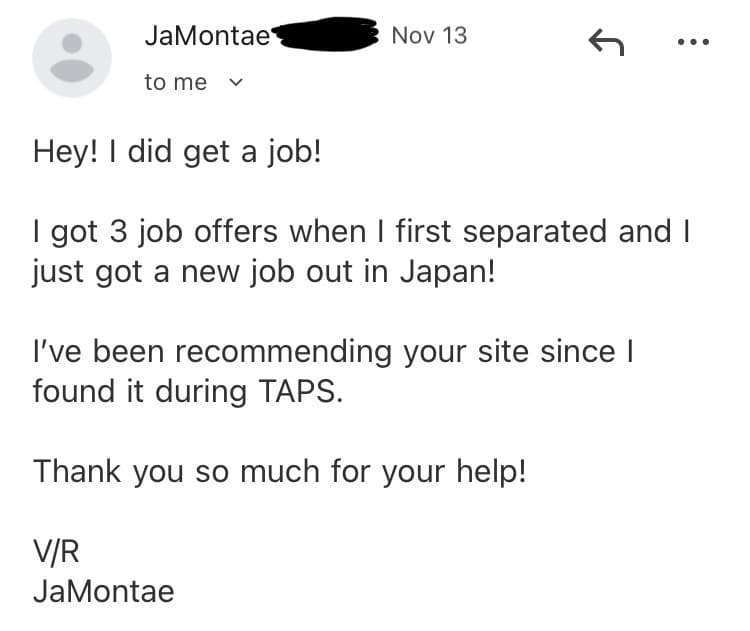
Hey! I did get a job! I got 3 job offers when I first separated and I just got a new job out in Japan! I’ve been recommending your site since I found it during TAPS. Thank you so much for your help! V/R JaMontae
JaMontae· Staff Sergeant (E-5)· Air Force
Information Technology and Computer Science
Read the full story

Federal Career Paths

Federal hiring rewards executive airlift aircrew in two distinct directions: the operations and protocol side that mirrors what you did in the cabin, and the safety and aviation side that comes from your time on a flight-status crew. The crosswalk below lists the GS series that fit; here is the reasoning behind them.

The GS-0301 Miscellaneous Administration and Program series and GS-0341 Administrative Officer series are the home for protocol, executive support, and senior-leader operations work inside agencies that run their own VIP and distinguished-visitor functions. Aircrew who managed principal movement, schedules, and protocol qualify by experience, typically entering at GS-7 to GS-9 and climbing. The GS-2150 Transportation Operations and GS-2101 Transportation Specialist series cover movement planning and air mobility coordination across the civilian workforce at U.S. Transportation Command, Air Mobility Command, and the Defense Logistics Agency. On the aviation side, the GS-1825 Aviation Safety series is the FAA and DoD lane where your firsthand knowledge of crew procedures, cabin safety, and aircraft systems is the qualification standard, and GS-0018 Safety and Occupational Health Management broadens that into program and installation safety.

Two more fit the communications and instruction sides of the field. GS-1701 General Education and Training suits aircrew who ran qualification training and standardization, and the broader GS-0340 Program Management series fits senior aviators moving into coordination and oversight. Veterans' Preference applies to all of these, and your Tier 5 background and Top Secret eligibility are a live, transferable asset for the DoD-side positions, where a current investigation saves an agency months. To compare which other Air Force jobs target these same series, the Safety (1S0X1) and Services (3F1X1) pages overlap. Our guide to moving into federal employment covers the USAJobs mechanics, and the federal resume builder handles the GS format and the qualification narrative.

GS Series & Position Matches

GS-1825
Aviation Safety
Typical grades: GS-9, GS-11, GS-12
View Details
GS-0301
Miscellaneous Administration and Program
Typical grades: GS-7, GS-9, GS-11
View Details
GS-0341
Administrative Officer
Typical grades: GS-9, GS-11, GS-12
View Details
GS-2150
Transportation Operations
Typical grades: GS-7, GS-9, GS-11
View Details
GS-1701
General Education and Training
Typical grades: GS-7, GS-9, GS-11
View Details
GS-0018
Safety and Occupational Health Management
Typical grades: GS-9, GS-11
View Details
GS-2101
Transportation Specialist
Typical grades: GS-7, GS-9
View Details

Federal resumes follow different rules. We know them.

Federal hiring uses keyword-matching and structured experience. BMR builds federal-format resumes (USAJobs-ready) with the right keywords, hours/week, and supervisor info — for any GS series above.

Free to start · Federal + civilian resume formats included

Build My Federal Resume Free

Want to Change Careers Entirely?

Not everyone wants to stay in a related field. These career paths leverage your transferable skills — leadership, risk management, logistics, project planning — in completely different industries.

Meeting, Convention, and Event Planner

$59,440
Events and Hospitality(O*NET: 13-1121.00)BLS OEWS May 20248% (Faster than average)
Protocol and etiquette for senior principalsEnd-to-end mission and service planningCatering and on-site logistics coordinationComposure managing high-profile guests

Executive airlift cabin work is protocol and event execution for the highest-scrutiny guests in the world. Corporate and high-end event planning rewards exactly that combination of logistics, etiquette, and calm under pressure.

How to get there: Start as an event coordinator or assistant planner. The Certified Meeting Professional (CMP) from the Events Industry Council accelerates the move into senior planning roles.

Public Relations Specialist

$69,780
Corporate Communications(O*NET: 27-3031.00)BLS OEWS May 20246% (Faster than average)
Representing an organization to high-stakes audiencesDiscretion handling sensitive informationComposure as the public face under scrutinyClear communication in pressured settings

As the direct contact between the Air Force and its most prominent passengers, you already managed image, discretion, and message in real time. Corporate communications turns that into a career of representing organizations to the public and the press.

How to get there: Pair your background with a communications portfolio or degree. The Accredited in Public Relations (APR) credential from PRSA strengthens a transition into corporate or agency PR.

First-Line Supervisor of Protective Service Workers

$67,660
Corporate Security(O*NET: 33-1099.00)BLS OEWS May 20245% (Faster than average)
Security-conscious operations around principalsSituational awareness and threat-calm judgmentDiscretion and confidentialityCoordinating protection and movement details

Working in close proximity to protected principals under a Tier 5 clearance builds the discretion and situational awareness corporate and executive protection teams hire for. The instinct to keep a principal safe and a schedule running is the job.

How to get there: Enter through corporate security or executive-protection operations. Industry credentials like the ASIS Certified Protection Professional (CPP) move you toward supervisory roles.

Computer Network Support Specialist

$73,340
Information Technology(O*NET: 15-1231.00)BLS OEWS May 20247% (Faster than average)
Secure executive in-flight communications and SATCOM link managementTroubleshooting radio, data, and network equipment in a no-fail VIP missionConfiguring and verifying connectivity for principals on short noticeDisciplined documentation of system faults and resolutions

Executive Mission Aviators keep secure voice, data, and SATCOM links up for senior leaders where an outage is not an option. That same calm, methodical network troubleshooting is exactly what enterprise help desks and network operations centers hire for, and the security mindset is a real differentiator.

How to get there: CompTIA Network+ plus Security+ qualifies you for tier-1/tier-2 network support roles. A Cisco CCNA accelerates the move into network operations. The GI Bill covers all three.

Cost Estimator

$77,070
Construction and Manufacturing(O*NET: 13-1051.00)BLS OEWS May 20243% (As fast as average)
Building detailed VIP-airlift mission cost and resource plansForecasting fuel, crew, lodging, and ground-support requirements per legReconciling actuals against planned figures across complex itinerariesVendor and contract coordination under fixed budgets

Planning an executive airlift means pricing out every leg before wheels-up: fuel, crew duty, ground services, contingencies. Cost estimators do the same disciplined quantity-and-price modeling for construction and manufacturing bids, where the ability to scope an unfamiliar job accurately is the whole skill.

How to get there: Entry estimator roles take an associate degree in construction management or a blueprint-reading and estimating-software (Bluebeam, ProEst) certificate. The AACE Certified Estimating Professional (CEP) credential raises earning potential once you have field exposure.

Training and Development Specialist

$65,850
Corporate Learning(O*NET: 13-1151.00)BLS OEWS May 20247% (Faster than average)
Standardization and qualification trainingEvaluating performance against a standardBriefing and instructing under pressureDocumenting procedures clearly

Aircrew who ran qualification and standardization training already know how to build people to a measurable standard and evaluate them honestly. Corporate learning and development turns that into designing and delivering training programs.

How to get there: Start in a corporate trainer or onboarding role. The ATD Certified Professional in Talent Development (CPTD) formalizes the path into instructional design and L&D leadership.

Hotel / Resort Concierge

$37,320
Luxury Hospitality(O*NET: 39-6012.00)BLS OEWS May 20248% (Faster than average)
Anticipating and fulfilling high-end requestsDiscretion with notable guestsResourcefulness solving unusual problems fastPolished, protocol-aware interaction

The concierge job is making the impossible happen quietly for demanding guests, which is what executive airlift service already was. The instinct to solve a problem before the principal knows it exists is the differentiator.

How to get there: Enter at a luxury property concierge desk. Membership benchmarks like Les Clefs d Or set the professional standard for top-tier concierge careers.

Pivoting industries? You don't need to start from scratch.

The skills that made you a good Marine, Sailor, Airman, or Soldier transfer further than you think. BMR rewrites your bullets for any of the pivot careers above — without making you sound like you've never done the work.

Free to start · Try as many career angles as you want

Tailor My Resume to a New Career

Skills Translation Guide

If you are staying in aviation or hospitality, your terminology already lands. Corporate flight departments and luxury operators know what a flight-status aircrew member does. This section is for Executive Mission Aviators targeting careers OUTSIDE aviation and premium service, where "communications systems operator" or "executive airlift flight attendant" tells a hiring manager nothing about what you actually ran.

The fix is to translate the work, not the title. Below are the patterns that move executive airlift experience onto a civilian resume a recruiter outside the field can read. Our EPR/OPR translation guide and the 50 military terms glossary go deeper, and the military resume builder applies these automatically.

  • Distinguished visitor airlift becomes executive client service and protocol management. The point is principal-facing service under scrutiny, not the aircraft.
  • In-flight communications systems operation becomes secure communications and connectivity management. You ran live voice and data, not a desk phone.
  • Cabin and passenger service to protocol standard becomes premium guest experience and event execution.
  • AF Form 8 flight qualification and recurring evaluations becomes standards-based certification maintained under recurring evaluation.

A before bullet reads: "Served as executive airlift flight attendant on C-37 distinguished visitor missions." The after, aimed at a corporate hospitality or events role: "Delivered protocol-grade service and event execution for senior principals across 80+ missions, coordinating catering, scheduling, and on-site logistics with zero service failures under continuous executive scrutiny." Same work, language a non-aviation hiring manager can act on.

Resume Bullet Examples

Before (Military)
Provided in-flight service and protocol support for distinguished visitor airlift missions.
After (Civilian)
Managed protocol-grade service for senior executives and dignitaries across high-visibility engagements, with zero service failures under continuous scrutiny.
Before (Military)
Operated in-flight voice, data, and secure information systems throughout all phases of flight.
After (Civilian)
Managed secure voice and data communications for executive operations, maintaining uninterrupted connectivity across mission-critical events.
Before (Military)
Planned and executed in-flight meals, passenger comfort, and cabin service to protocol standard.
After (Civilian)
Designed and delivered premium guest experiences and catered events for high-profile clientele, coordinating menus, scheduling, and on-site logistics.
Before (Military)
Maintained AF Form 8 flight qualification through recurring standardization and evaluation.
After (Civilian)
Maintained role certification through recurring competency evaluations, consistently meeting or exceeding standards.
Before (Military)
Executed normal and emergency procedure checklists across ground and flight operations.
After (Civilian)
Executed standard operating procedures and contingency plans under time pressure, maintaining accuracy in high-stakes situations.
Before (Military)
Operated and monitored engine, hydraulic, fuel, and pressurization systems throughout flight.
After (Civilian)
Monitored and troubleshot complex technical systems in real time, diagnosing and resolving faults without disrupting operations.
Before (Military)
Held routine access to Tier 5 information systems supporting the National Command Authority.
After (Civilian)
Held active Top Secret clearance eligibility (Tier 5 investigation), a hiring advantage that saves cleared employers months of processing.
Before (Military)
Executed mission planning and coordination of meals, passenger service, and comfort requirements.
After (Civilian)
Planned operations end to end and coordinated across stakeholders, aligning catering, scheduling, and logistics for flawless execution.
Before (Military)
Managed passenger loading, luggage, and movement during ground operations.
After (Civilian)
Coordinated movement logistics and material handling for time-sensitive operations, sequencing people and equipment under tight schedules.

Get bullets like these auto-generated for your resume.

BMR turns your 1A1X8 duties and accomplishments into civilian bullets that match the job you're applying for — no manual translation, no rewriting.

Free to start · Tailored to each job posting

Generate My Resume Bullets

Certifications by Career Path

Which certifications you need depends on where you're headed. Find your target career path below.

Aviation Maintenance

FAA Airframe and Powerplant (A&P)
Optional
FAA
Cost: Varies by programTime: 18-24 monthsGI Bill Eligible
For engineer-shred aircrew moving toward aircraft systems and maintenance roles.

Aviation Operations

Flight Attendant Certificate of Demonstrated Proficiency
Recommended
FAA
Cost: Varies by operatorTime: 1-2 months
The FAA credential corporate and charter operators look for; some employers sponsor it.
NBAA Certified Aviation Manager (CAM)
Recommended
National Business Aviation Association
Cost: Check current pricingTime: 6-12 months prep
Professional standard for business-aviation operations leadership.

Communications & Marketing

Certified Meeting Professional (CMP)
Recommended
Events Industry Council
Cost: Check current pricingTime: 6-12 monthsGI Bill Eligible
Industry standard for events and protocol planning; fits the cabin-to-events pivot.
Accredited in Public Relations (APR)
Optional
Public Relations Society of America (PRSA)
Cost: Check current pricingTime: 6-12 months
Professional PR credential for the corporate-communications pivot.

Federal Employment

USAJobs Federal Application Readiness
Optional
OPM / USAJobs
Cost: Free resourcesTime: Self-paced
Not a certification but the federal application skill set; pair Veterans Preference paperwork with a GS-format resume.

Hospitality Management

Certified Hospitality Supervisor (CHS)
Recommended
American Hotel & Lodging Educational Institute
Cost: Check current pricingTime: 2-4 monthsGI Bill Eligible
Entry credential for premium hospitality operations leadership.
Certified Hotel Administrator (CHA)
Recommended
American Hotel & Lodging Educational Institute
Cost: Check current pricingTime: 6-12 monthsGI Bill Eligible
Senior luxury-hospitality management credential.

Project Management

Project Management Professional (PMP)
Recommended
Project Management Institute (PMI)
Cost: $555-$760 examTime: 3-6 monthsGI Bill Eligible
Broadly recognized for operations, events, and program coordination roles.

Safety & EHS

Associate Safety Professional (ASP)
Optional
Board of Certified Safety Professionals (BCSP)
Cost: Check current pricingTime: 3-6 monthsGI Bill Eligible
Entry safety credential supporting GS-1825 Aviation Safety and GS-0018 federal safety paths.

Security Management

Certified Protection Professional (CPP)
Optional
ASIS International
Cost: Check current pricingTime: 3-6 monthsGI Bill Eligible
Security-management credential for executive-protection-adjacent corporate roles.

Telecommunications & RF

CompTIA Network+
Recommended
CompTIA
Cost: $300-$400 examTime: 2-3 monthsGI Bill Eligible
Foundational networking credential for communications systems operators entering corporate IT/comms.
AVIXA CTS (Certified Technology Specialist)
Recommended
AVIXA
Cost: Check current pricingTime: 3-6 months
Audiovisual and conferencing systems credential for secure communications and corporate AV roles.

Got a cert? Don't bury it. List it the right way.

The wrong placement can sink an otherwise strong application. BMR knows where each cert ranks, what to call it, and how to frame it for ATS keyword matching and hiring manager attention.

Free to start · Built around your real certs and clearance

Build My Resume the Right Way

Transition Resources

Use these by the path you are actually chasing. The split matters because staying in aviation or premium service is a different set of moves than leaving the field entirely.

Staying in Aviation or Premium Service

For corporate and charter aviation, the National Business Aviation Association (NBAA) runs the professional standards, training, and job network for business-aviation cabin and crew roles, which is the exact end of the market that values executive airlift experience. The Flight Attendant Certification of Demonstrated Proficiency from the FAA is the credential corporate operators look for. For luxury hospitality, Les Clefs d'Or and the American Hotel and Lodging Educational Institute set the professional benchmarks. SkillBridge can place you with a corporate flight department or hospitality group during your final months. Related aircrew paths are on the Flight Engineer (1A1X1) and Aircrew Flight Equipment (1P0X1) pages.

Careers Outside the Field

For protocol, events, and corporate communications, the Project Management Institute (PMP) and the certifications from the Events Industry Council carry weight. American Corporate Partners (ACP) provides free veteran mentorship and is the networking resource to use. Your Tier 5 background is leverage in cleared corporate roles, so explain it correctly. For the federal route, USAJobs and the federal resume builder handle the GS application, and the SFL-TAP resources cover transition timing. Our interview guide for explaining military experience is worth reading before you walk in.

See also: Public Affairs (3N0X6) for the communications path and Air Transportation (2T2X1) for logistics. To start, explore the full career crosswalk, use the military resume builder, or build your resume now.

Your 30 / 60 / 90-Day Transition Plan

Most people do this backwards. They wait until terminal leave to start, then panic. Here's the sequence that works. Already out? Same plan, start at day one today.

1Days 0–30

Set the foundation

  • Pull your DD-214 (request from Milconnect if separated)
  • List your top 3 civilian roles AND top 3 GS series
  • Build your tailored 1A1X8 resume — BMR does it free
  • Write 1 strong LinkedIn headline (not "veteran seeking opportunities")
  • Pull together your evals/performance reports for accomplishments
Build my resume free
2Days 30–60

Apply with intent

  • Apply to 5–10 jobs/week — quality over quantity
  • Tailor every resume to the job description (BMR auto-tailors)
  • Connect with 5 people/week on LinkedIn (not a spray)
  • Set up a USAJobs profile and a saved-search alert for your GS series
  • Practice translating your military bullets out loud — explain to a civilian friend
Tailor my next resume
3Days 60–90

Close the offer

  • Track every application — date, status, contact, notes
  • Follow up 7–10 days after each application
  • Prep for behavioral interviews using the STAR method
  • Negotiate salary — don't take the first offer (BLS median is your floor)
  • Stay applying even after one offer — leverage = options
Track my applications

Print this. Tape it to your monitor. Veterans who treat the job search like a 90-day op get hired faster than the ones who treat it like an emergency.

Frequently Asked Questions

What civilian jobs hire Executive Mission Aviators?
The most direct fit is corporate and VIP charter aviation, where executive airlift cabin and crew experience commands a premium over the airline cabin. Flight Attendants earned a median of $67,130 in May 2024 (BLS OEWS), with the business-aviation end paying above that. Communications systems operators move into corporate and secure communications work, where Telecommunications Equipment Installers and Repairers earned a median of $64,310. Hospitality operations, events, and protocol roles also value the background. See the Private Sector Career Paths section above for the full list with salary data.
How much do corporate flight attendants make compared to my old job?
BLS reports a median of $67,130 for flight attendants in May 2024, but that figure blends the airlines with business aviation. Corporate flight departments and private operators, which is where executive airlift experience fits, generally pay above the median because they sell the premium service standard you already met. BLS does not break out business-aviation cabin crew separately, so treat the $67,130 as a floor for that niche rather than the going rate.
What if I want to leave aviation entirely?
Your experience maps to several different industries. Event and protocol planning, corporate communications and public relations, luxury hospitality management, executive-protection-adjacent operations, and corporate communications-systems roles all draw on the service-under-scrutiny, secure-communications, and crisis-calm hospitality you already practiced. See the Want to Change Careers Entirely section above for specific titles, BLS salary data, and the retraining each one takes.
Is my Top Secret clearance worth anything as a civilian?
Yes. The 1A1X8 field requires a Tier 5 investigation, the tier behind a Top Secret clearance. A current investigation saves a cleared employer months of waiting and is a direct hiring advantage for defense contractors and federal agencies. Our guide on what a Top Secret clearance is worth in salary covers how to value and present it. Learn the difference between investigation tiers in our Tier 3 vs Tier 5 guide so you describe yours accurately.
How does Veterans' Preference help me get a federal job?
Veterans' Preference adds points to your federal application rating and can move you ahead of non-veteran candidates with the same score. It applies across the GS series listed in the Federal Career Paths section, including GS-0301, GS-0341, and GS-2150. It does not guarantee a job, but combined with a current Tier 5 background it makes you a strong candidate for DoD-side roles. The federal resume builder handles the qualification narrative that preference alone will not.
Can I use my GI Bill to retrain for a career change?
Yes. If you are moving into events, hospitality management, or corporate communications, the GI Bill can fund a degree or certificate that opens those doors. For the protocol and events path, certifications from the Events Industry Council and a PMP are common targets. Check current eligibility and benefit levels through the VA, since coverage and housing allowances change.
How do I write a resume that does not read as just 'flight attendant'?
Lead with the scope, not the title. Executive airlift cabin work was protocol-grade service for heads of state, alongside secure communications and aircraft-systems duties depending on your shred. Translate distinguished visitor airlift into executive client service and protocol management, and cabin service into premium guest experience and event execution. The Skills Translation section above has before-and-after examples, and the military resume builder applies these patterns automatically.
What interview questions should I prepare for outside aviation?
Expect questions about handling pressure, discretion, and difficult people, because that is what your background signals. Have specific examples ready: a protocol situation you managed cleanly, a comms or systems problem you solved in flight, a service standard you held when it would have been easier to drop it. Our guide to explaining military experience in a civilian interview covers how to tell these stories without jargon a civilian panel will not follow.
Where are the jobs for this background concentrated?
Corporate flight departments cluster around major business hubs and large-jet maintenance and completion centers. Luxury hospitality and events concentrate in major metro and resort markets. Federal protocol, transportation, and aviation-safety roles concentrate around DoD installations and agency headquarters. The market tracks corporate travel and federal budgets, so it is cyclical. Be ready to go where the flight departments and agencies are rather than expecting them everywhere.
Should I start my job search before I separate?
Yes. SkillBridge lets you spend your final months working with a corporate flight department, hospitality group, or agency, which often converts to an offer. Start the resume and the clearance paperwork early, since a current investigation is most valuable while it is still active. The SFL-TAP resources cover transition timing, and you can build your resume now to be ready when a posting opens.
Free for every veteran

Translate your 1A1X8 Executive Mission Aviator experience into a resume that gets callbacks

Stop rewriting from scratch every time you apply. BMR turns your military experience into civilian and federal resumes — tailored to each job.

What you get — all free:
2
Tailored resumes
AI-rewritten for each job posting
2
Cover letters
Matched to the role
LinkedIn optimization
Profile rewrite for civilian recruiters
Elevator pitch generator
For interviews and networking
2
Company research reports
Know who you're applying to
Job tracker
Manage every application in one place
Start My Free Resume
Free to start · 90 seconds to sign upBuilt by a Navy Diver veteran. More than 65,000 resumes built for the military community.