Loading...
Loading...
The civilian and federal jobs that hire Air Force Tactical Air Control Party (TACP)s — with real salaries and the resume that gets callbacks.
Every 1Z3X1 has more options than a Google search will tell you. Below: career paths, BLS salary data, federal GS series, certifications by target career, and how to translate your experience without losing what made you valuable to the Air Force in the first place.
Free · No credit card · Tailored resume in under 5 minutes
After the Navy I got hired into 6 federal career fields and tech sales, and sat on federal hiring panels along the way. I spent the last 2 years rebuilding everything I learned into BMR, tuned for how AI actually screens resumes today. This is the system I wish I'd had on day one.
One page, built in our template, with your military experience translated into civilian terms hiring managers and ATS systems read. Use it as a reference for your own. Drop your email and we'll send you the download link.
Free. We'll also send occasional job-search tips. Unsubscribe anytime.
If you held AFSC 1Z3X1, you embedded with Army and Special Operations ground units as the Air Force's link to airpower. You ran the joint terminal attack control (JTAC) mission: positioning forward with a maneuver element, talking to aircraft on multiple radio nets, building the picture, and clearing fires onto targets while rounds were still landing around you. The work meant controlling close air support from A-10s, F-16s, F-15Es, AC-130 gunships, and bombers, coordinating artillery and naval gunfire, and keeping a common operating picture across air and ground commanders who could not see each other.
The career field carries the 1Z special warfare prefix the Air Force adopted on 31 October 2019, when TACP moved from the legacy 1C4X1 code into the unified 1Z enlisted special warfare structure alongside Pararescue and Combat Control. The pipeline runs through the TACP Schoolhouse at JBSA-Lackland, then assignments at Air Support Operations Squadrons tied to Army divisions and brigades at installations like Fort Cavazos, Fort Liberty, Fort Carson, and overseas. Many also qualified through the Joint Terminal Attack Controller certification, which is the credential civilian and contractor air-ground integration roles recognize.
Civilian employers value this background because it is proof of judgment under extreme pressure. You made irreversible decisions with incomplete information, on a clock, with lives at stake, while running four conversations at once. That is the exact profile emergency operations centers, public safety dispatch floors, air traffic facilities, and high-consequence training programs are built around. The challenge is never the experience. It is getting a hiring manager who has never heard "JTAC" to understand it. Start by exploring how your skills map across the military career crosswalk tool, and see how related Air Force special warfare paths translate on the Pararescue (1Z1X1) and Combat Control (1C2X1) pages.
When I separated from the Navy I spent 18 months applying with no callbacks, and combat and special warfare backgrounds carry that problem worse than anyone. "Controlled airstrikes for ground commanders" reads to a civilian recruiter as "no transferable skills," which is exactly backwards. The translation is what costs the callbacks, not the work. A TACP who learns to write multi-radio coordination, clearance authority, and decision-making under fire in language an emergency-management or operations hiring manager actually scores is one of the strongest candidates in the stack. — Brad Tachi, Navy Diver veteran & BMR founder
The number that matters when you're deciding what's next: how does civilian pay compare to what you make now?
Military comp is approximate (varies by location/dependents). Civilian is BLS median. Federal includes locality pay. Your real number depends on duty station, family status, GS step, and overtime.
The most direct civilian path is air-ground coordination work, but the higher-volume hiring is in public safety, emergency operations, and the protective fields where your decision-making translates cleanly. Salary figures below are BLS Occupational Employment and Wage Statistics (OEWS) medians, May 2024.
Emergency management is the closest functional match. Emergency Management Directors earned a median of $86,130 (BLS, May 2024), running emergency operations centers that look and feel like a tactical operations center: multiple feeds, multiple agencies, decisions on a clock. Air traffic control is a strong fit for the radio and airspace-picture side of the job, with a median of $144,580 (BLS, May 2024), though entry runs through FAA Academy hiring and an age cutoff. Public safety telecommunicator (911 dispatch) work pays a median of $50,730 (BLS, May 2024) and rewards the same calm multi-channel coordination you ran on the nets.
Law enforcement is a common landing spot. Police and Sheriff's Patrol Officers earned a median of $77,270 (BLS, May 2024), and many departments give veterans' points. Unmanned aircraft / drone operations is an emerging field. BLS does not track commercial drone pilots as a separate occupation, so the closest tracked benchmark is Commercial Pilots at a median of $122,670 (BLS, May 2024); most civilian UAS roles sit below that and require an FAA Part 107 certificate. Training and operations roles round it out: Training and Development Specialists earned a median of $65,850 (BLS, May 2024), and General and Operations Managers a median of $102,950 (BLS, May 2024).
Be honest about the market. Air traffic control and federal dispatch hiring run in cycles and have hard age and medical gates. Law enforcement is local-budget dependent. Emergency management is growing but concentrated near state capitals, large metros, and federal facilities. The fields that hire fastest for this background reward how clearly you describe the work, which is where the military resume builder earns its keep. Veterans coming from adjacent combat-arms fire control fields face the same translation, so the Army 13F Fire Support Specialist and Marine 0861 Fire Support Marine paths overlap closely. For the broader landscape, our guide to military-to-civilian highest paying jobs is worth a read.
| Civilian Job Title | Industry | BLS Median Salary | Outlook | Match |
|---|---|---|---|---|
Emergency Management Director O*NET: 11-9161.00 | Public Safety & Government | $86,130 | 4% (As fast as average) | strong |
Police / Sheriff's Patrol Officer O*NET: 33-3051.00 | Law Enforcement | $77,270 | 4% (As fast as average) | strong |
Air Traffic Controller O*NET: 53-2021.00 | Aviation Operations | $144,580 | 3% (As fast as average) | moderate |
Public Safety Telecommunicator (911 Dispatcher) O*NET: 43-5031.00 | Public Safety | $50,730 | 4% (As fast as average) | strong |
Training and Development Specialist O*NET: 13-1151.00 | Training & Instruction | $65,850 | 7% (Faster than average) | strong |
UAS / Drone Operations Specialist O*NET: 53-2012.00 | Unmanned Aircraft Systems | $122,670 | 5% (Faster than average) | emerging |
Operations Coordinator / Manager O*NET: 11-1021.00 | Operations Management | $102,950 | 6% (Faster than average) | moderate |
BMR rewrites your 1Z3X1 experience for any of the civilian roles above — keywords, achievements, and language hiring managers actually scan for.
Free · No credit card · 2 tailored resumes included
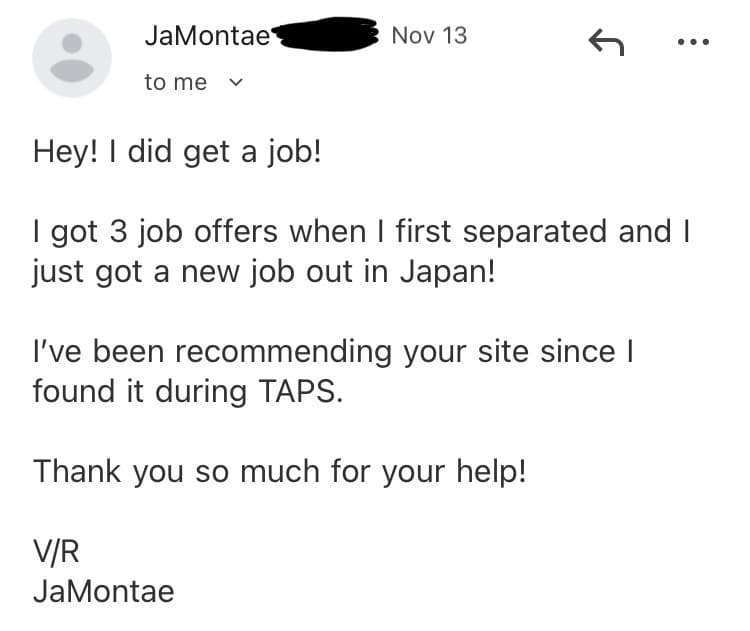
“Hey! I did get a job! I got 3 job offers when I first separated and I just got a new job out in Japan! I’ve been recommending your site since I found it during TAPS. Thank you so much for your help! V/R JaMontae ”
Federal service rewards the TACP skill set in ways the private sector often misses, because the federal government runs the same emergency operations centers, airspace systems, and security programs you supported in uniform. These are the General Schedule series where 1Z3X1 experience qualifies, with the grade levels veterans most often enter.
GS-0089 Emergency Management. The cleanest match. FEMA, DHS, installation emergency management offices, and component agencies hire across GS-7 through GS-12 for people who can run an EOC, coordinate across agencies, and make decisions under pressure. Your TOC and JTAC experience is direct qualifying experience here.
GS-2152 Air Traffic Control. The FAA and DoD airfield operations hire into this series. Your airspace-picture and aircraft-control experience qualifies, though ATC has its own training pipeline and medical standards. Entry is typically GS-7 to GS-9 with progression as you certify on facilities.
GS-0301 Miscellaneous Administration and Program. The catch-all for operations, plans, and coordination roles across DoD and DHS, commonly GS-7 through GS-11. This is where "ran air-ground integration for a brigade" becomes "coordinated multi-agency operations" on a federal resume.
GS-0018 Safety and Occupational Health Management and GS-0080 Security Administration round out the strong matches. Range operations, risk management, and force-protection experience qualify for both, typically GS-7 through GS-11. Veterans' Preference adds 5 or 10 points to your numerical rating and can move you into a higher selection category. Note that for federal hiring your DD-214 is the document that verifies preference eligibility, which is a separate use from resume content. For the mechanics, read our military-to-federal transition roadmap and the breakdown of 10 federal job series every veteran should search. When you are ready to draft one, the federal resume builder formats to OPM standards. Veterans from the Air Force 3E9X1 Emergency Management field target the same GS-0089 announcements.
| GS Series | Federal Job Title | Typical Grades | Match | Explore |
|---|---|---|---|---|
| GS-0089 | Emergency Management | GS-7, GS-9, GS-11, GS-12 | View Details → | |
| GS-0301 | Miscellaneous Administration and Program | GS-7, GS-9, GS-11 | View Details → | |
| GS-2152 | Air Traffic Control | GS-7, GS-9, GS-11 | View Details → | |
| GS-0018 | Safety and Occupational Health Management | GS-7, GS-9, GS-11 | View Details → | |
| GS-0080 | Security Administration | GS-7, GS-9, GS-11 | View Details → | |
| GS-0340 | Program Management | GS-9, GS-11, GS-12 | View Details → |
Federal hiring uses keyword-matching and structured experience. BMR builds federal-format resumes (USAJobs-ready) with the right keywords, hours/week, and supervisor info — for any GS series above.
Free · No credit card · Federal + civilian resume formats included
Not everyone wants to stay in a related field. These career paths leverage your transferable skills — leadership, risk management, logistics, project planning — in completely different industries.
TACPs explain complex technical capability to people who must act on it, fast. That is exactly what a sales engineer does for buyers of comms, networking, and defense-adjacent technology, where the radio and systems background is a rare credibility edge.
Running the TACP schoolhouse mission and unit upgrade training is corporate L&D in everything but name. The ability to take a complex, high-consequence task and teach it to a repeatable standard is what training managers are hired to do.
Range and live-fire safety is operational risk management with lives on the line. That hazard-and-controls mindset transfers directly to industrial, construction, and energy EHS roles that have nothing to do with aviation.
TACPs spend years teaching demanding technical skills to a hard standard. Community colleges and trade programs hire that instructional ability to run aviation, public-safety, and skilled-trade programs.
Air-ground procedures and brevity-code precision train you to write instructions that cannot be misread. That skill maps to technical writing for software, hardware, and operations documentation.
Coordinating air, ground, and fires elements toward one objective is operations management at its most demanding. The planning, sequencing, and accountability translate to running civilian operations across industries.
Mission planning is project management under fire: scope, stakeholders, timeline, contingencies. That discipline transfers to coordinating projects in construction, technology, and corporate programs.
The skills that made you a good Marine, Sailor, Airman, or Soldier transfer further than you think. BMR rewrites your bullets for any of the pivot careers above — without making you sound like you've never done the work.
Free · No credit card · Try unlimited career angles
If you are staying in air-ground coordination, JTAC operations, or contractor air support, your terminology already lands. The people hiring you use it daily. This section is for TACP veterans targeting careers OUTSIDE special warfare, where a hiring manager has never heard "nine-line" and will skip a resume full of acronyms.
The goal is to keep the substance and drop the jargon. Here are translations that hold up in front of a civilian hiring manager.
Before and after, for a non-field operations or emergency-management resume:
Before: "Served as JTAC for an ABCT, controlled CAS from A-10 and AC-130, deconflicted fires across the brigade AO."
After: "Directed real-time coordination of aviation and ground assets across a 4,000-person organization, maintaining final clearance authority on time-critical decisions with zero coordination errors across multiple deployments."
For the full vocabulary, our 50 military terms translated to civilian language glossary and the guide to hidden military skills civilians don't know you have are the fastest way to build a translated draft. The military resume builder does this conversion automatically. When you want it done, you can build your resume now.
BMR turns your 1Z3X1 duties and accomplishments into civilian bullets that match the job you're applying for — no manual translation, no rewriting.
Free · No credit card · Tailored to each job posting
Which certifications you need depends on where you're headed. Find your target career path below.
The wrong placement can sink an otherwise strong application. BMR knows where each cert ranks, what to call it, and how to frame it for ATS keyword matching and hiring manager attention.
Free · No credit card · Built around your real certs and clearance
Use these resources by direction: staying in the air-ground and special warfare world, or pivoting out entirely.
Staying in the field. The JTAC credential and your security clearance are your leverage for contractor air-ground integration, range control, and joint fires training roles. Defense primes and training companies hire former TACPs to run combat training centers and exercise control. Keep your clearance status current and document your JTAC certifications precisely. American Corporate Partners (ACP) offers free veteran mentorship that can connect you to people already in these roles.
Careers outside the field. If you are moving into emergency management, public safety, or operations, target the credentials those fields score: FEMA's Emergency Management Institute independent-study courses (ICS-100, 200, 700, 800) are free and signal seriousness; a Project Management Professional (PMP) or an OSHA safety certification opens operations and EHS roles; an FAA Part 107 certificate opens commercial UAS work. For federal moves, learn the USAJobs system and Veterans' Preference before you apply, covered in our federal transition roadmap. The SFL-TAP transition resources are worth using while you still have access.
Build the resume. Start with the military resume builder for private-sector roles or the federal resume builder for GS positions, and explore options across the military career crosswalk. When you are ready, get started here.
See also. Related paths for combat and special warfare veterans: Navy SO Special Warfare Operator, Army 13F Fire Support Specialist, and Air Force 3P0X1 Security Forces. For interviews, our guide on explaining military experience without jargon is built for exactly this background.
Most veterans do this backwards — they wait until terminal leave to start, then panic. Here's the actual sequence that works.
Print this. Tape it to your monitor. Veterans who treat the transition like a 90-day op get hired faster than the ones who treat it like an emergency.
Stop rewriting from scratch every time you apply. BMR turns your military experience into civilian and federal resumes — tailored to each job.