Home / Military resume examples / Avionics Technician
Avionics technician resume example (military to civilian)
This is an avionics technician resume for someone leaving the military with about ten years on aircraft electronics. Curtis is a fictional Air Force 2A0X1, a Staff Sergeant who ran a back-shop test station. Every line on his page came from real 2A0X1 work. If you fixed radios, radar, navigation, or electronic warfare gear in any branch, this is the shape your resume can take. Under it you get the lines that changed, the words the job posts use, and a free score on your own resume.
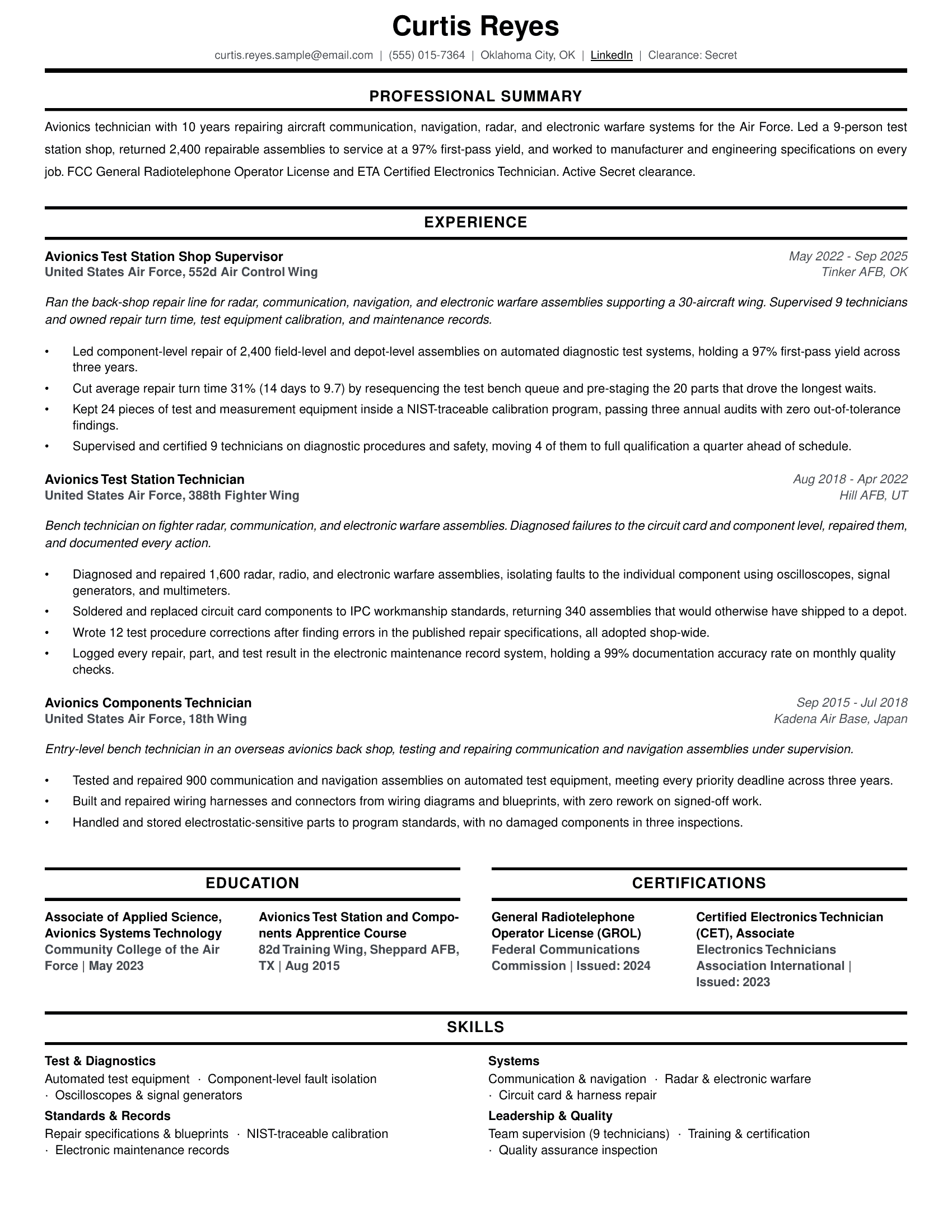
The example
Fictional sample. The person, the units, and the numbers are illustrative. Rendered by BMR's Classic template, the same one a user's resume prints on.
Avionics technician with 10 years repairing aircraft communication, navigation, radar, and electronic warfare systems for the Air Force. Led a 9-person test station shop, returned 2,400 repairable assemblies to service at a 97% first-pass yield, and worked to manufacturer and engineering specifications on every job. FCC General Radiotelephone Operator License and ETA Certified Electronics Technician. Active Secret clearance.
Ran the back-shop repair line for radar, communication, navigation, and electronic warfare assemblies supporting a 30-aircraft wing. Supervised 9 technicians and owned repair turn time, test equipment calibration, and maintenance records.
Led component-level repair of 2,400 field-level and depot-level assemblies on automated diagnostic test systems, holding a 97% first-pass yield across three years.
Cut average repair turn time 31% (14 days to 9.7) by resequencing the test bench queue and pre-staging the 20 parts that drove the longest waits.
Kept 24 pieces of test and measurement equipment inside a NIST-traceable calibration program, passing three annual audits with zero out-of-tolerance findings.
Supervised and certified 9 technicians on diagnostic procedures and safety, moving 4 of them to full qualification a quarter ahead of schedule.
Bench technician on fighter radar, communication, and electronic warfare assemblies. Diagnosed failures to the circuit card and component level, repaired them, and documented every action.
Diagnosed and repaired 1,600 radar, radio, and electronic warfare assemblies, isolating faults to the individual component using oscilloscopes, signal generators, and multimeters.
Soldered and replaced circuit card components to IPC workmanship standards, returning 340 assemblies that would otherwise have shipped to a depot.
Wrote 12 test procedure corrections after finding errors in the published repair specifications, all adopted shop-wide.
Logged every repair, part, and test result in the electronic maintenance record system, holding a 99% documentation accuracy rate on monthly quality checks.
Entry-level bench technician in an overseas avionics back shop, testing and repairing communication and navigation assemblies under supervision.
Tested and repaired 900 communication and navigation assemblies on automated test equipment, meeting every priority deadline across three years.
Built and repaired wiring harnesses and connectors from wiring diagrams and blueprints, with zero rework on signed-off work.
Handled and stored electrostatic-sensitive parts to program standards, with no damaged components in three inspections.
Associate of Applied Science, Avionics Systems TechnologyCommunity College of the Air Force | May 2023
Avionics Test Station and Components Apprentice Course82d Training Wing, Sheppard AFB, TX | Aug 2015
General Radiotelephone Operator License (GROL)Federal Communications Commission | Issued: 2024
Certified Electronics Technician (CET), AssociateElectronics Technicians Association International | Issued: 2023
Test & DiagnosticsAutomated test equipment · Component-level fault isolation · Oscilloscopes & signal generators
SystemsCommunication & navigation · Radar & electronic warfare · Circuit card & harness repair
Standards & RecordsRepair specifications & blueprints · NIST-traceable calibration · Electronic maintenance records
Leadership & QualityTeam supervision (9 technicians) · Training & certification · Quality assurance inspection
Open the PDF (1 page, as the engine prints it).
Already have a resume? Get it graded straight.
Upload it and get a number in about a minute, plus the avionics technician lines a civilian hiring manager will not follow. No account. Sign up and tailor it like they did.
Free. We keep it 30 days so you never upload it twice.
Why this example works
- The summary says the civilian job in the first two words.
"Avionics technician." A hiring manager at a repair station or an airline knows in one second that this page is for them. Rank and Air Force code come later, where they belong.
- The acronyms are gone, and nothing was lost.
ATE reads as "automated diagnostic test systems." LRU and SRU read as "repairable assemblies." A technical order reads as "repair spec." Same work. Now a civilian shop lead can follow it.
- Every bullet has a number a manager can picture.
2,400 assemblies. 97% first-pass yield. 14 days to 9.7. 24 pieces of test equipment. 9 direct reports. Nobody has to guess how big the job was.
- The first bullet of each job is the one the post cares about most.
Repair volume and yield under the top job, fault isolation under the second, bench throughput under the third. Read only the first bullet of each block and you still get the story.
- Calibration is written as a program, not a chore.
"Kept 24 pieces of test and measurement equipment inside a NIST-traceable calibration program." Civilian shops run on NIST traceability. PMEL means nothing outside the Air Force. NIST-traceable means everything.
- Quality shows up as a result, not a duty.
"Passed three annual audits with zero out-of-tolerance findings" tells the reader what happened. "Responsible for TMDE compliance" tells them nothing.
- The skills block is grouped, not a pile.
Four short headings, three skills each. A recruiter can scan it in a few seconds, and a keyword scan finds "automated test equipment," "calibration," and "fault isolation" without hunting.
- One page, on purpose.
Ten years, three jobs, twelve skills, two certs, two schools, and it still fits. A civilian resume for a mid-career NCO rarely needs page two.
The translation, line by line
| How most 2A0X1s write it | What an avionics hiring manager reads |
|---|---|
| Operated ATE / VTAS test stations | Operated automated diagnostic test systems for component-level troubleshooting |
| Repaired LRUs and SRUs | Repaired field-level and depot-level repairable assemblies |
| Performed maintenance IAW the T.O. | Worked to published repair specifications and engineering standards |
| Fault isolation to the chip level | Component-level diagnostic troubleshooting to the individual part |
| PMEL / TMDE calibration program | NIST-traceable instrument calibration program, zero out-of-tolerance findings |
| Documented actions on AFTO 350 / 781 | Maintained electronic maintenance records and discrepancy logs |
| Depot-level repair on radar LRUs | Off-equipment overhaul and component-level repair of radar assemblies |
| Improved MC rate for the wing | Raised equipment availability and cut repair turn time 31% |
| Section 7-level, supervised 9 Airmen | Shop supervisor; trained and certified a 9-technician repair team |
| 2A0X1 apprentice course, Sheppard AFB | Avionics Test Station and Components Apprentice Course, 82d Training Wing |
The words the job posts use
The words avionics technician job posts use, and what the numbers look like right now.
Titles you will see
- Avionics Technician
- Avionics Line Technician
- Aviation Electronics Technician
- Avionics Installer
- Aircraft Electrical Systems Specialist
Work the posts describe
- Test and troubleshoot instruments, components, and assemblies, using circuit testers, oscilloscopes, or voltmeters
- Adjust, repair, or replace malfunctioning components or assemblies, using hand tools or soldering irons
- Install electrical and electronic components, assemblies, and systems in aircraft
- Lay out installation of aircraft assemblies and systems, following blueprints, manuals, and wiring diagrams
- Set up and operate ground support and test equipment to perform functional flight tests
- Keep records of maintenance and repair work
Credentials that get named
- FCC General Radiotelephone Operator License (GROL)
- FAA Airframe and Powerplant (A&P) certificate
- ETA or ISCET electronics certification
- IPC soldering workmanship standards
BLS Occupational Outlook Handbook, May 2025 data: median pay for avionics technicians $82,280 a year. Overall employment of aircraft and avionics equipment mechanics and technicians is projected to grow 6 percent from 2025 to 2035. Typical entry-level education is a postsecondary nondegree award, not a bachelor's degree.
Sources: O*NET 49-2091.00 Avionics Technicians (tasks, reported job titles) and the BLS Occupational Outlook Handbook, Aircraft and Avionics Equipment Mechanics and Technicians. Both read 2026-09-09.
Backgrounds that lead here
Avionics technician sits on 66 of BMR's military job guides. These are the closest matches; each guide shows the civilian titles, pay, and federal paths for that code.
- Air Force 2A0X1 Avionics Test Station and ComponentsThis example
- Navy AT Aviation Electronics Technician
- Air Force 2A9X4 Heavy Aircraft Integrated Avionics
- Air Force 2A3X4 Fighter Aircraft Integrated Avionics
- Coast Guard AET Avionics Electrical Technician
- Army 15N Avionic Mechanic
- Army 15F Aircraft Electrician
- Navy AWV Naval Aircrewman (Avionics)
- Air Force 2A6X6 Aircraft Electrical and Environmental Systems
Frequently asked questions
Do I need an FAA A&P certificate to work in avionics?
Not for most bench jobs. A&P covers the airframe and the engines. Most avionics shops, plants, and defense contractors ask for the FCC General Radiotelephone Operator License, or for nothing but your work history. A&P does open more doors, and your military time can count toward the hours the FAA wants. Apply now with what you hold. Work on A&P once you are hired.
Should I write ATE and LRU on my resume, or spell them out?
Spell them out, then use them. "Automated test equipment (ATE)" works for both readers: the shop lead who says ATE all day, and the recruiter who has never heard it. At a defense contractor or an FAA repair station, the acronyms are safe on their own. Anywhere else, the plain words get you the call.
How long should a military-to-civilian resume be?
For about ten years of service, one page usually does it. That is what this example is. If you have 20 years and several very different jobs, two pages can be fine. Length matters less than this: the top third of page one says the civilian job you want and proves it with numbers.
Build your avionics technician resume the same way
BMR writes your avionics experience the way this page reads, tailored to the job you pick. Free to start, 2 tailored resumes included.