Military Retiree Consulting Rates: What Should You Charge
Michael got only rejections. Then a $100K facilities manager role.
Michael, E-7, Navy, tried a ton of outside help before BMR
You retired after 22 years. A former colleague calls. He needs help for a few months. Then he asks the question.
"What's your rate?"
You freeze. You have never priced yourself before. The military handed you a pay chart. Rank and time in service set the number. Nobody negotiated it.
So you guess. You guess low, because low feels safe. That number then follows you for years. Every renewal starts from it. Every referral quotes it.
This post gives you a number you can say out loud. Military retiree consulting rates start with your own targets. Then you check the number against what the government actually pays for that kind of work.
I have written PWS and SOW language on federal contracts. I have sat on source-selection panels. I have approved contractor staff before they billed an hour. Your rate has to get past a desk like that one.
Still deciding whether to consult at all? Start with careers after the military for retirees under 50. That post runs the five year and ten year path math. This one assumes you already decided.
Why do retirees quote a number that is too low?
Habit drives this more than nerve does.
For 20 or more years your pay was published. You could look it up. So could everyone else. You never once had to invent a price for your own time.
Now you have to. And four things push the number down.
You price hours, not outcomes. Hours were the unit of a military career. Duty days, watch bills, deployment length. A client is buying a result, and results do not scale with hours.
The first client is usually a friend. It is a former boss, an old deputy, someone from your last command. Friendship discounts feel polite. They set your public price.
Your retirement pay lands every month. The pressure is off, so the first offer looks fine. More on that later, because this one is a trap.
You are guessing against a number you cannot see. Nobody publishes what your peer charged last quarter. So you aim low to avoid looking greedy.
The first number you say usually becomes your ceiling. Clients anchor to it. So do referrals. So do you.
Your first rate is sticky.
Raising a rate on an existing client is hard. Setting it right the first time is easy. Do the math before the call, not during it.
Retired O-5s and O-6s hit this hardest. The resume is heavy and the price is light. If that is you, non-contractor second careers for retired O-5s and O-6s covers the wider set of options.
What are the four ways to price consulting work?
Pick the model before you pick the number. The model changes what the number even means.
Four pricing models, and when each one fits.
Hourly.
Best for small tasks and fuzzy scope. Worst for anyone who works fast.
Day rate.
Best for onsite work, assessments, and workshops. Easy for a client to schedule and approve.
Fixed project fee.
Best when the scope is written down. You keep the upside when you finish early.
Monthly retainer.
Best for standing advice and on-call access. Steadiest cash flow of the four.
Most retirees should lead with a day rate. It reads as senior. It is simple to explain. And it maps to how a client budgets a project.
Keep the hourly number in your pocket for short calls and reviews. Quote it as a fraction of your day, so the two never contradict each other.
Move to fixed fee once you know the work. If a two week assessment always takes you six days, sell the assessment, not the days.

How do you build a day rate from your own numbers?
Do not start with what other people charge. Military retiree consulting rates work backward from what you need. Then check the market after.
The build-up runs in five steps. Swap my example numbers for yours.
Pick a target.
Name what you want the business to pay you this year. My example uses $150,000.
Count the working days.
A year holds about 260 weekdays. That is the ceiling, and nobody hits it.
Take out your time off.
Holidays, vacation, sick days. Cut 20 days and you are down to 240.
Cut again for unpaid work.
Selling, proposals, invoicing, admin, and training all eat days. Plan on billing about half.
Divide.
Target income divided by billable days. That is your starting day rate.
Run the example. Start at 260 weekdays. Cut 20 for time off and you have 240.
Now the step most people get wrong. Billable days are not working days.
You still have to find the next job while you do this one. You write proposals. You chase invoices. You update your own skills. None of that bills.
Cut 240 in half. Call it 120 billable days for planning. Track your real number for a year, then adjust.
So $150,000 divided by 120 days lands at $1,250 a day. On an eight hour day that is about $156 an hour.
Hold that number. The build is not finished. Two things still have to move it.
Before you go further, sanity-check the neighborhood. The Bureau of Labor Statistics puts the median wage for management analysts at $101,860 as of May 2025. That is the occupation most independent consultants map to. Spread over 2,080 hours it works out near $48.97 an hour.
That BLS figure counts employees, not self-employed consultants. Your $156 looks like triple the market. The two numbers do not measure the same thing. The gap has a name, and the next section is about it. For a wider look at market anchoring, read how to find your market salary as a veteran.
Why is a billed rate not your rate?
This is the most expensive misunderstanding a retiree can carry into a pricing call.
You hear a number on a contract. Maybe a program manager mentions $185 an hour for a labor category. You file it away as what people like you get paid.
They do not. That is a billed rate, and a lot of it never reaches a person.
The government publishes this. GSA runs a pricing tool called CALC+ on buy.gsa.gov. Its Quick Rate search shows awarded hourly rates by labor category, education level, and years of experience.
GSA is plain about what those numbers contain. Those awarded schedule rates are fully burdened. They include the direct labor rate plus indirect costs like overhead and G&A, plus profit. GSA also calls schedule prices not-to-exceed ceiling prices, so the actual task order can land lower.
The contract bills $185 an hour for my labor category. So I should quote $185 and take it home.
A burdened rate carries the salary plus overhead, G&A, fringe benefits, and profit. A salaried employee sees only a slice of it.
Think about what sits inside that wrap on a prime contractor's side. Facilities, tools, recruiters, HR. Accounting, legal, contracts staff, business development. Health insurance, retirement match, employer payroll taxes, paid leave. Then profit on top.
A salaried employee under that labor category may take home well under the billed rate. So quoting a billed rate as your salary equivalent overstates what you would clear.
Now flip it, because this is the part that works in your favor.
You are solo. You are the overhead. You are the G&A. You pay your own fringe. There is no company above you taking fee.
So your quote should sit closer to a burdened rate than to a salary. When you price like an employee, you are handing the client a discount they did not ask for.
What does going 1099 actually cost you?
A 1099 dollar and a W-2 dollar are not worth the same. You have to gross up to break even.
Start with payroll taxes. The IRS self-employment tax rate is 15.3 percent. That splits into 12.4 percent for Social Security and 2.9 percent for Medicare. The Social Security piece stops at $184,500 of earnings in 2026. Medicare has no cap.
As an employee, your employer paid half of those taxes. Now both halves are yours. You do get to deduct the employer-equivalent half against your income tax, which softens it.
Then there is everything an employer used to buy for you. The Bureau of Labor Statistics tracks this. Look at its Employer Costs for Employee Compensation data for March 2026. Private industry benefits made up 30.1 percent of employer costs. Wages and salaries made up the other 69.9 percent.
Run that against the example. Say wages are 69.9 percent of the cost of a job. Then a $150,000 salary sits inside about $215,000 of total employer cost.
Roughly $65,000 of that was benefits. Health plan, retirement match, employer payroll taxes, paid leave. Most of that is now your bill.
So the honest revenue target is closer to $215,000 than $150,000. That is before you pay a single business expense.
Redo the division. $215,000 over 120 billable days is about $1,790 a day. On an eight hour day that is about $224 an hour.
Round it to $1,800 a day and $225 an hour. Now it sounds like a rate, not a calculation.
One caveat that matters. Retirees carry TRICARE. So the health insurance piece of that benefits load may be much smaller for you. Adjust the number down if that fits you. Keep the rest.
Does your pension lower your rate?
No. And this is where a lot of good retirees give away money.
The logic sounds reasonable. Retirement pay covers the mortgage, so you can afford to charge less. Then you quote $900 a day for work worth $1,800.
Your pension changes your risk tolerance. It does not change what the work is worth.
Your pension is your runway, not your price tag. It buys you the power to say no. It does not tell a client what your work is worth.
Here is what the pension actually buys you, and it is a lot.
You can wait out a bad offer. You can take a slower ramp in year one. You can turn down a client who treats you like staff. You can fire a client who pays late.
That is real power. Most new consultants do not have it. Use it to hold your price, not to cut it.
There is a second cost to undercutting, and it is not yours alone. Quote low once and that client expects it forever. They also learn that retired veterans are cheap. The next veteran bidding that same work pays for your discount.
Your finances are your business, not the client's. We said the same thing in second careers after military retirement, and it holds here too.
Want to see how retirement pay and civilian income stack on paper? Work through military retirement pay plus civilian salary. Do that math for your own planning. Keep it out of the pricing call.
What federal rules can bite a retiree consultant?
Consulting near your old lane is normal. It is also where retirees get in trouble without meaning to.
The main statute is 18 U.S.C. 207. It restricts representing someone else back to the government after you leave.
Three pieces matter most. Subsection (a)(1) is a lifetime bar on particular matters you worked on personally and substantially. Subsection (a)(2) runs two years on matters that sat under your official responsibility in your last year. Subsection (c) is a one year cooling-off period for senior personnel. It reaches officers serving in pay grade O-7 or above.
Read what that covers. It limits communicating with intent to influence on behalf of a client. Doing the analysis is different. So is writing the study, coaching the team, or teaching the course. None of that is automatically off limits.
Call an ethics counselor first.
I am not your lawyer and neither is a blog post. Your former command has an ethics office. Ask them before you sign the first engagement letter, not after.
Our fuller walkthrough sits in post-government ethics rules veterans must know. Read it before you build a client list.
One more, and people mix it up with the ethics rules. If you are chasing a DoD civilian job rather than a contract, a separate waiting period may apply. That one lives in the 180-day rule for military retirees and DoD civilian jobs. Different rule, different lane, same habit of catching people late.
How do you say the number without flinching?
You did the math. Now you have to open your mouth.
Say it flat and stop talking. "My day rate is $1,800." Then silence.
The pause will feel long. It is not rejection. Let them answer first.
Do not explain the number. Do not walk it back before they respond. Nobody talks themselves out of a rate faster than the person who just said it.
Rehearse it. Write the number on a sticky note. Say it out loud five times before the call. That sounds silly and it works.
When they push back, do not cut the rate. Cut the scope.
- Shorter engagement: Six days, not ten, at the same rate.
- Fewer deliverables: The assessment without the briefing tour.
- Remote over onsite: Drops their travel cost, not your price.
- Phased work: Sell phase one now, decide on phase two later.
If you do discount, get something back. A longer term, payment up front, a named case study, or two warm referrals. A discount for nothing teaches the client your first number was soft.
Ask a question when the pushback is vague. Ask what budget they were working with. Their answer tells you whether this is a real gap or a reflex.
Key Takeaway
Build the rate from your target income and your real billable days. Gross it up for taxes and benefits you now buy yourself. Then say it plainly and let the client speak next.
The muscles here are the same ones you use in any offer talk. Salary negotiation for veterans drills the pattern if you want more reps.
What should you do this week?
Five steps to lock in your consulting rate. None of them take long.
Run the math on paper. Target income, working days, time off, billable days, divide. Then gross it up. Write the final number down.
Look up your labor category. Open CALC+ Quick Rate and search the category that matches your work. You are not copying the ceiling rate. You are learning the shape of the market.
Set up the business side. Pick a structure, get an EIN, open a separate bank account. The SBA guide to business structures covers the choices. Our guide to starting a business after the military covers the veteran-specific parts.
Plan for quarterly taxes. Nobody withholds for you now. Set money aside from the first invoice. Tax tips for military retirement pay plus civilian salary is the starting point.
Fix your one-page bio. Clients ask for it. So do primes, who paste it straight into proposals. From the government review side, that page decides whether your name gets approved onto a contract.
That last one is where most retirees are weakest. Twenty-two years of accomplishment, written in language a contracting officer cannot score.
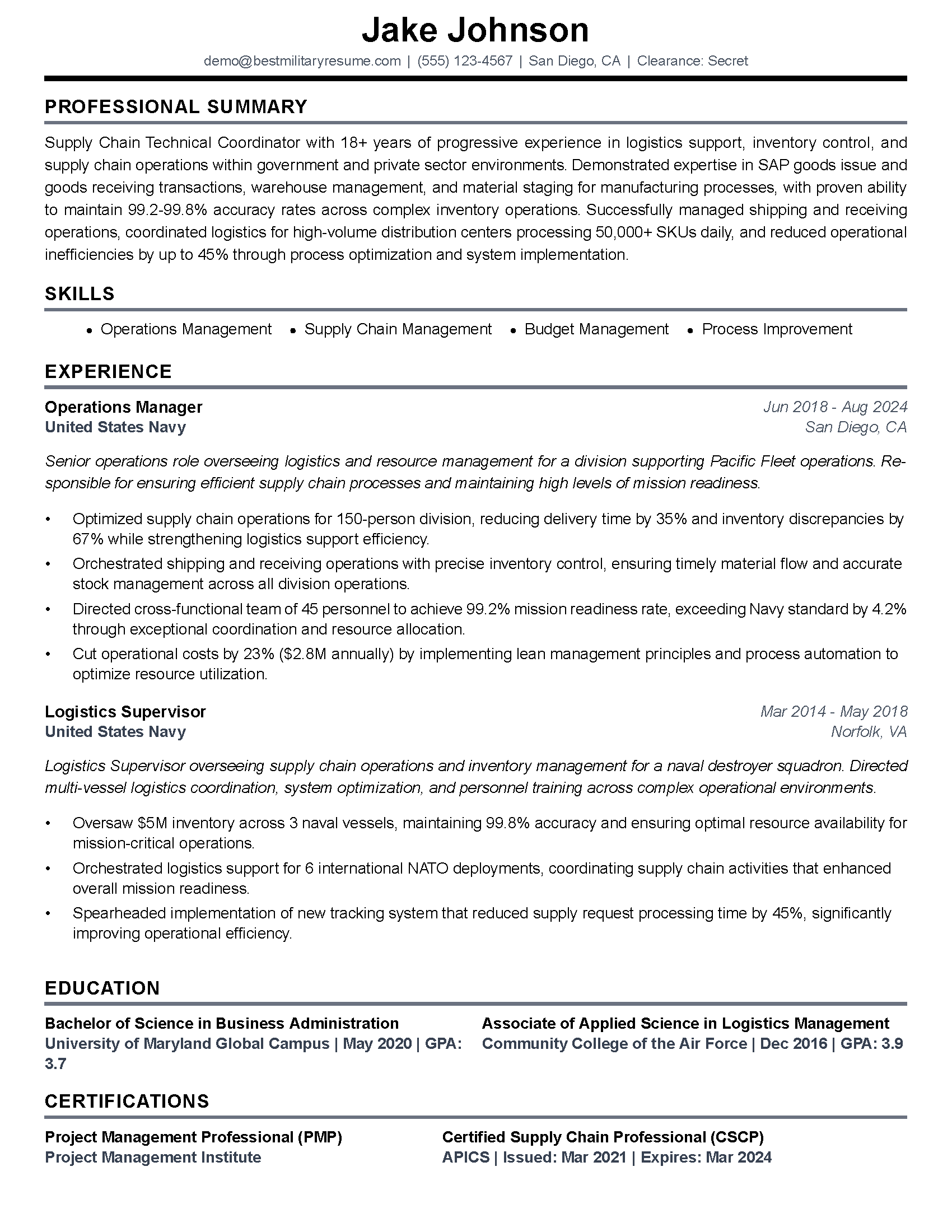
BMR's military resume builder handles the translation and the formatting. It is free to start. Build the bio once, then keep pricing yourself like the work is worth something.
Because it is.
-Brad
Frequently Asked Questions
What should a military retiree charge for consulting?
How many billable days are in a consulting year?
Does a military pension mean I should charge less?
Is a contract billed rate the same as my consulting rate?
How much more do I need to charge as a 1099 consultant?
Can I consult with my old command after I retire?
Should I charge hourly or use a day rate?
What do I do when a client says my rate is too high?
About the Author
Brad Tachi is the CEO and founder of Best Military Resume and a 2025 Military Friendly Vetrepreneur of the Year award recipient for overseas excellence. A former U.S. Navy Diver with over 20 years of combined military, private sector, and federal government experience, Brad brings unparalleled expertise to help veterans and military service members successfully transition to rewarding civilian careers. Having personally navigated the military-to-civilian transition, Brad deeply understands the challenges veterans face and specializes in translating military experience into compelling resumes that capture the attention of civilian employers. Through Best Military Resume, Brad has helped thousands of service members land their dream jobs by providing expert resume writing, career coaching, and job search strategies tailored specifically for the veteran community.
