Military to Plumbing: Apprenticeships for Vets
Michael got only rejections. Then a $100K facilities manager role.
Michael, E-7, Navy, tried a ton of outside help before BMR
Why Are Veterans a Good Fit for Plumbing Careers?
Plumbing is one of those trades where military experience actually transfers well, and not just for the obvious MOS codes. If you spent time in the military working with water systems, HVAC, or facilities maintenance, you already have hands-on mechanical skills that most civilian apprentices spend their first year building. But even if your military job had nothing to do with pipes, you still bring discipline, physical endurance, and the ability to follow technical procedures under pressure.
The Bureau of Labor Statistics projects plumber employment to grow 6% through 2032, which is faster than average. That growth is driven by aging infrastructure, new construction, and a wave of retirements in the trade. According to BLS, the median annual wage for plumbers, pipefitters, and steamfitters was $61,550 as of May 2023. Journeyman plumbers in high-demand areas regularly earn $75,000 to $90,000 or more, especially with overtime and emergency call work.
The biggest advantage veterans have in this field is readiness to work. Plumbing apprenticeships involve crawling through tight spaces, working in extreme weather, and handling physically demanding tasks for 8 to 10 hours a day. That filters out a lot of civilian applicants fast. If you made it through boot camp and did your time, you already have the work ethic that plumbing contractors are looking for.
What Plumbing Apprenticeship Programs Accept Veterans?
Several apprenticeship programs specifically recruit veterans, and some offer accelerated tracks based on prior military training. Here are the main ones worth knowing about.
UA VIP (Veterans in Piping)
The United Association Veterans in Piping program is the gold standard for military-to-plumbing transitions. It is a free 18-week accelerated training program available to active-duty service members during their last six months before separation. The program runs on select military installations and covers plumbing, HVAC, welding, and fire suppression. Graduates enter directly into a UA local union apprenticeship with full benefits, and the 18 weeks of training count toward your apprenticeship hours.
UA VIP is run by the United Association of Journeymen and Apprentices, one of the largest piping trade unions in North America. The program covers tuition, tools, and materials at no cost. You graduate with industry certifications and a guaranteed placement into a five-year apprenticeship where you earn while you learn. Starting apprentice wages vary by region but typically range from $18 to $28 per hour, with full health insurance and a pension from day one.
Helmets to Hardhats
The Helmets to Hardhats program connects veterans with registered apprenticeships across all building trades, including plumbing. It is a free referral service that matches your military experience with union apprenticeship openings in your area. You create a profile, list your skills and location preferences, and the program connects you with participating contractors and union locals.
State and Local Apprenticeship Programs
Beyond the national programs, many state apprenticeship agencies run their own veteran-priority plumbing apprenticeships. Check your state Department of Labor apprenticeship office. Many states offer veterans priority enrollment, credit for military training hours, and tuition assistance through GI Bill-approved programs. The Department of Labor maintains a searchable apprenticeship database at apprenticeship.gov where you can filter by trade, location, and veteran-friendly status.
GI Bill and Apprenticeships
Many registered apprenticeship programs are GI Bill approved. That means you can collect your GI Bill housing allowance ON TOP of your apprentice wages while you train. Contact your VA education office or check the VA WEAMS database to verify a specific program qualifies before enrolling.

Can You Use the GI Bill for Plumbing Training?
Yes, and this is one of the most underused veteran benefits for trades training. The GI Bill covers registered apprenticeships and on-the-job training programs. During an apprenticeship, you receive a monthly housing allowance from the VA that decreases incrementally over time as your apprentice wages increase. The idea is that as you earn more from your employer, you need less from the VA.
For a typical five-year plumbing apprenticeship, your GI Bill housing allowance starts at 100% of the applicable rate during the first six months. It drops to 80% for the second six months, then 60%, and so on. Combined with your apprentice wages, many veteran apprentices earn $50,000 to $65,000 annually during training. That is significantly more than what most four-year college students earn while in school.
Some community colleges and trade schools also offer plumbing certificate programs that accept GI Bill tuition payments directly. These programs typically run 6 to 12 months and prepare you for apprenticeship entry. They do not replace an apprenticeship, but they can give you a head start and make you a stronger candidate when applying to competitive programs. If you are weighing your options, BMR has a career crosswalk tool that shows civilian salary ranges and job outlook data for specific career paths based on your military background.
How Long Does a Plumbing Apprenticeship Take?
A standard plumbing apprenticeship runs four to five years, combining paid on-the-job training with classroom instruction. Most programs require 8,000 to 10,000 hours of supervised work and 576 or more hours of related technical instruction. That breaks down to roughly 2,000 hours of work per year plus evening or weekend classes.
Year 1: Foundation Skills
Learn basic plumbing codes, pipe cutting and joining, fixture installation, and safety protocols. Apprentice wages typically start at 40-50% of journeyman rate.
Years 2-4: Advancing Skills
Progress to commercial systems, blueprint reading, gas piping, backflow prevention, and more complex installations. Wages increase with each completed year.
Year 5: Journeyman Exam
Complete remaining hours, pass the journeyman licensing exam, and earn full journeyman wages. Many states require a separate master plumber license to run your own business.
Veterans with relevant military experience (utilities, facilities maintenance, civil engineering) can often receive credit for prior training. The UA VIP program, for example, counts its 18 weeks toward your apprenticeship hours. Some state programs will evaluate your military transcripts and award credit for equivalent training, potentially shaving six months to a year off the total apprenticeship time.
During the apprenticeship, you are a paid employee. You work full days on job sites and attend classes in the evenings or on weekends. Your pay increases at set intervals, usually every six months or after completing a certain number of hours. By year four, most apprentices are earning 80 to 90 percent of full journeyman wages.
What Should a Veteran Plumbing Resume Look Like?
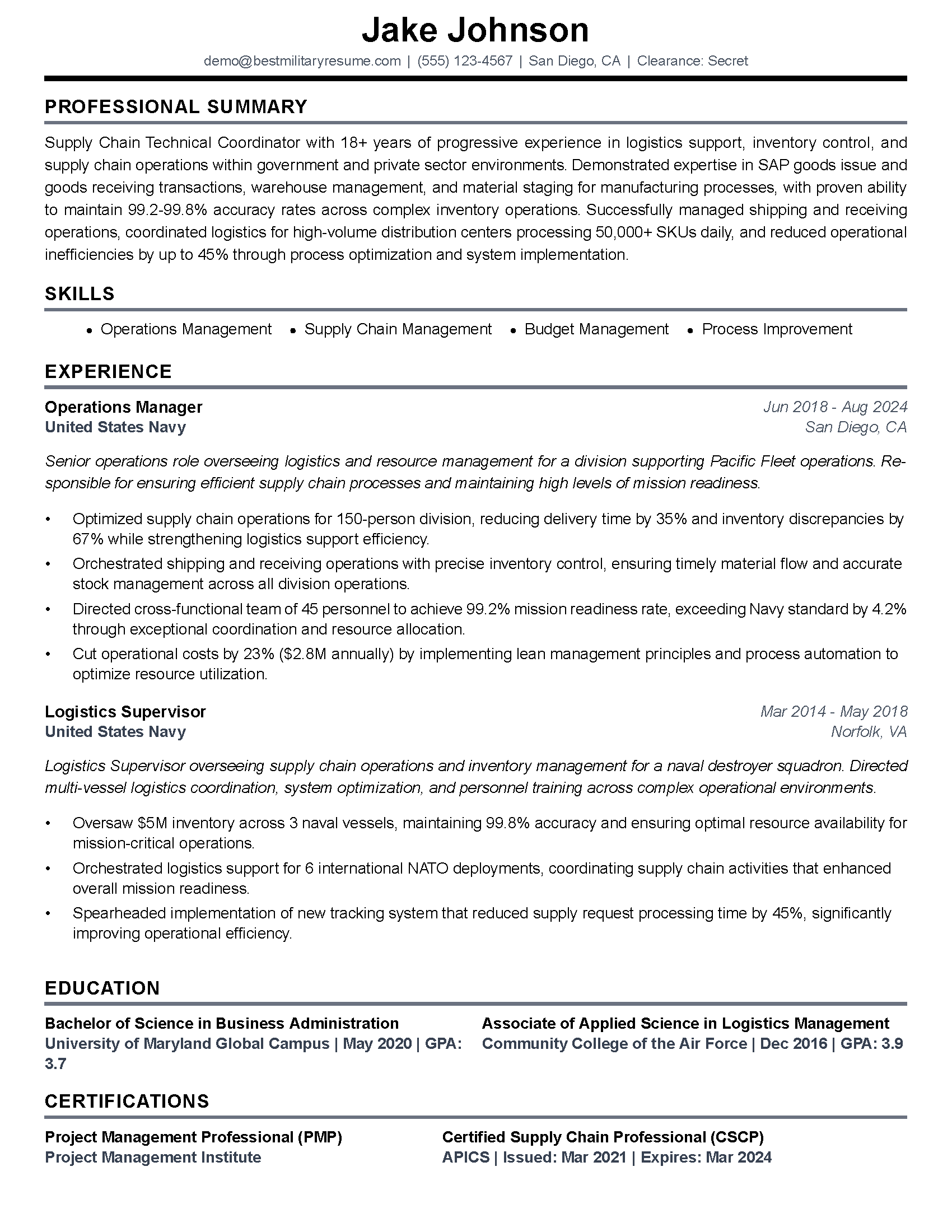
When you apply for a plumbing apprenticeship, your resume needs to translate your military experience into language that a plumbing contractor or apprenticeship committee will understand. This does not mean dumbing down your experience. It means showing how what you did in the military connects to what plumbers actually do on the job.
Performed PMCS on water purification systems IAW TM 5-4610-215-13. Maintained accountability of all CBRN equipment and Class IV supplies for 200-person FOB.
Operated and maintained industrial water purification systems serving 200+ personnel. Performed scheduled and corrective maintenance following manufacturer technical manuals. Managed inventory of construction materials and specialized equipment.
Focus on mechanical aptitude, safety compliance, physical capability, and any experience with water systems, pipe fitting, welding, or construction. Apprenticeship committees also want to see reliability, so highlight your attendance record, leadership roles, and ability to follow instruction. If you need help translating military experience to a civilian resume, BMR handles that translation automatically. Paste in the apprenticeship requirements, upload your military experience, and the system builds a tailored resume that speaks the right language.
When I separated as a Navy Diver in 2015, my own resume was full of military acronyms that meant nothing to civilian employers. The skills were there, but the language was wrong. That is the same problem veterans face when applying for trade apprenticeships. The experience counts, but only if the people reading your application can actually understand what you did.
How Much Do Plumbers Earn After Completing an Apprenticeship?
Once you finish your apprenticeship and earn your journeyman license, your earning potential jumps significantly. According to BLS, the top 10% of plumbers earned more than $102,700 annually as of May 2023. Your actual earnings depend on your location, specialization, union status, and willingness to work overtime or take emergency calls.
Union plumbers generally earn more than non-union, with stronger benefits packages including health insurance, retirement pensions, and annuity funds. In major metro areas like New York, San Francisco, Chicago, and Boston, union journeyman plumbers can earn $100,000 or more in total compensation. Even in lower-cost areas, experienced plumbers consistently earn above the national median household income.
Key Takeaway
A plumbing apprenticeship is a paid career path, not an expense. Between apprentice wages and GI Bill benefits, many veterans earn more during trade training than they would attending a four-year university. And you graduate with zero student debt and a license that is in demand everywhere.
Beyond journeyman status, many plumbers go on to earn a master plumber license, which allows you to pull permits, run your own business, and bid on commercial and government contracts. Master plumbers who own their own shops routinely earn six figures. Plumbing is also one of the most recession-resistant trades. People always need water and drainage, regardless of the economy.
What Steps Should You Take Before Separating?
If you are still on active duty and considering plumbing as a career, your timeline matters. The best programs fill up fast, and some require you to apply months in advance. Here is a realistic sequence of what to do and when.
Start researching apprenticeship programs at least 12 months before your separation date. If you qualify for UA VIP, applications open well before each cohort starts. Helmets to Hardhats enrollment is ongoing, but getting matched to a local program takes time. Check when to start your job search before separation for a broader timeline that applies to trades too.
Talk to your command about permissive TDY or SkillBridge participation if a training program aligns with your separation timeline. Some commands will authorize 180 days of SkillBridge, which can overlap with UA VIP or other pre-apprenticeship programs. Get your military transcripts (JST for Army/Marines, SMART for Navy/Marines, CCAF for Air Force) since apprenticeship programs will want to evaluate your prior training for credit.
Finally, get your resume ready before you apply. Apprenticeship applications are competitive, and your resume is usually the first thing the selection committee sees. After helping 15,000+ veterans through BMR, I have seen too many strong candidates get passed over because their application materials did not reflect their actual capabilities. Do not let paperwork be the thing that holds you back from a career that pays well and is in demand across the country.
Is Plumbing a Good Long-Term Career for Veterans?
Plumbing offers something that many white-collar careers do not: you cannot outsource it, automate it, or offshore it. Someone has to physically show up and do the work. That job security, combined with strong wages, benefits, and business ownership potential, makes plumbing one of the most practical career paths for veterans who want to work with their hands and earn well doing it.
The work is physical. You will crawl under houses, dig trenches, carry heavy pipe, and work in conditions that are not always comfortable. But if you served in the military, none of that is new. The physical demands filter out a lot of people who cannot handle the work, which keeps wages high and demand strong for those who can.
Plumbing also offers real upward mobility. You can specialize in commercial, industrial, fire suppression, medical gas, or green plumbing systems. You can move into project management, inspection, or estimating. Or you can start your own company and build something of your own. A college degree is not required to build a successful plumbing career. What matters is your license, your skills, and your reputation.
The bottom line: plumbing apprenticeships give veterans a clear, paid path from military service to a high-demand civilian career. Between programs like UA VIP, Helmets to Hardhats, GI Bill apprenticeship benefits, and state-level veteran priority enrollment, there are more doors open to you than most veterans realize. The trade needs people, the pay is strong, and the work is the kind of hands-on problem solving that many veterans already know how to do.
Related: Helmets to Hardhats trade apprenticeships for veterans and MOS to civilian job chart for all branches.
Frequently Asked Questions
Can veterans get plumbing apprenticeships for free?
Does the GI Bill cover plumbing apprenticeships?
How long does a plumbing apprenticeship take?
What is the UA VIP program?
How much do plumbers earn?
Do I need prior plumbing experience to start an apprenticeship?
What military jobs transfer best to plumbing?
Can I start my own plumbing business after apprenticeship?
About the Author
Brad Tachi is the CEO and founder of Best Military Resume and a 2025 Military Friendly Vetrepreneur of the Year award recipient for overseas excellence. A former U.S. Navy Diver with over 20 years of combined military, private sector, and federal government experience, Brad brings unparalleled expertise to help veterans and military service members successfully transition to rewarding civilian careers. Having personally navigated the military-to-civilian transition, Brad deeply understands the challenges veterans face and specializes in translating military experience into compelling resumes that capture the attention of civilian employers. Through Best Military Resume, Brad has helped thousands of service members land their dream jobs by providing expert resume writing, career coaching, and job search strategies tailored specifically for the veteran community.
