How Veterans Use Stretch Assignments to Earn a Promotion
Michael got only rejections. Then a $100K facilities manager role.
Michael, E-7, Navy, tried a ton of outside help before BMR
BMR's advice: ask for one stretch assignment tied to the next job, then log it for promotion time. The Center for Creative Leadership says "challenging assignments are the primary source of key learning experiences in managerial careers."
Its 70-20-10 rule says leaders learn from "70% challenging experiences and assignments", "20% developmental relationships" and "10% coursework and training." No study we found measures how much faster a stretch gets you promoted.
Pick the stretch that proves the next job
| Stretch | What it proves to the person who decides (BMR advice) | How to ask (BMR advice) | What to write down as you go (BMR advice) |
|---|---|---|---|
| Lead a project | You can run a whole piece of work from start to finish. | Ask to lead the next project your team starts. | Start and end dates, team size, budget, and the result. |
| Cover a vacant role or take a detail | You can carry the next job's duties alone. | Ask to cover the open seat for a set period. | The dates you covered, the duties you took on, and who you reported to. |
| Own a process or a vendor | You can be the one person who answers for the outcome. | Ask to own one process and report on it monthly. | What you changed, plus the numbers before and after. |
| Train or mentor | You can grow people, which lead jobs often ask for. | Ask to train the next new hire on your team. | Who you trained, how long it took, and what they can do now. |
| A cross-team assignment | You can get work done past your own team's walls. | Ask to join the other team's project for one quarter. | The teams involved, your part, and what shipped. |
Pick the row that matches the biggest gap between your job and the next one. Read the next job's duties first. One stretch that hits a real gap beats three that don't.
Many veterans did these in uniform already. Maybe you covered for an absent supervisor or held a billet above your rank. Say it in civilian words, like acting supervisor or interim lead.
How do I ask my manager for a stretch assignment?
Ask in a planned one-on-one. Name the next job, name the gap, and offer a fix. Give it an end date so your manager can say yes with less risk.
I want to be ready for the [next job title] role. My biggest gap is [duty from that job]. Can I take on [stretch assignment] for the next [00] months? I'll send you a short update each month on scope and results.
In a federal job, ask to write it into your performance plan as a stretch goal. Then it shows up in your rating.
How do I document the stretch so it counts?
OPM's career development page describes a developmental assignment as one "designed to stretch a learner beyond existing skills." OPM says an individual development plan (IDP) "serves as record for professional developmental activities."
OPM says an effective IDP should list activities "with estimated and actual completion dates." Those can include "rotational assignments, shadowing assignments, on-the-job training." OPM notes "Many agencies require IDPs for new and current employees, and encourage employees to update them annually." It also says "There are no regulatory requirements mandating employees complete IDPs within the Federal Government".
BMR's advice: keep your own dated record either way. Write the start date, the scope, who you reported to, and each result. Add a line every week while it's fresh. Outside federal work, your own record may be the only proof. The win log in the 12-month promotion plan works well for this.
What are the federal rules on details and temporary promotions?
OPM's 2024 memo to agency HR chiefs says "a non-competitive temporary promotion is limited to 120 days." Under 5 CFR 335.103, noncompetitive higher-grade time "during the preceding 12 months" counts toward that total. So a second higher-grade stint within 12 months may need competition past 120 days. Part 335's competition rule skips excepted service jobs. Ask HR what already counts.
A detail's own time limit is a separate rule. Under 5 U.S.C. 3341, a detail "may be for not more than 120 days" per written order, and it can be renewed. That cap is about how long a detail lasts. The 335.103 line is about when higher-grade work needs competition. The temporary promotion guide covers the rest.
How do I turn the stretch into the promotion ask?
BMR's advice: raise it near the end of the stretch, while the results are fresh. Your review is another good time. So is the week the next-level job is posted.
Bring your dated record, each result in numbers, and a short note from the person you covered for. Then ask what it would take for you to move into the next-level job.
If the job is posted, you still apply like everyone else. Your record turns into resume bullets. It also turns into the stories you tell a promotion panel.
How do I write the stretch as resume bullets?
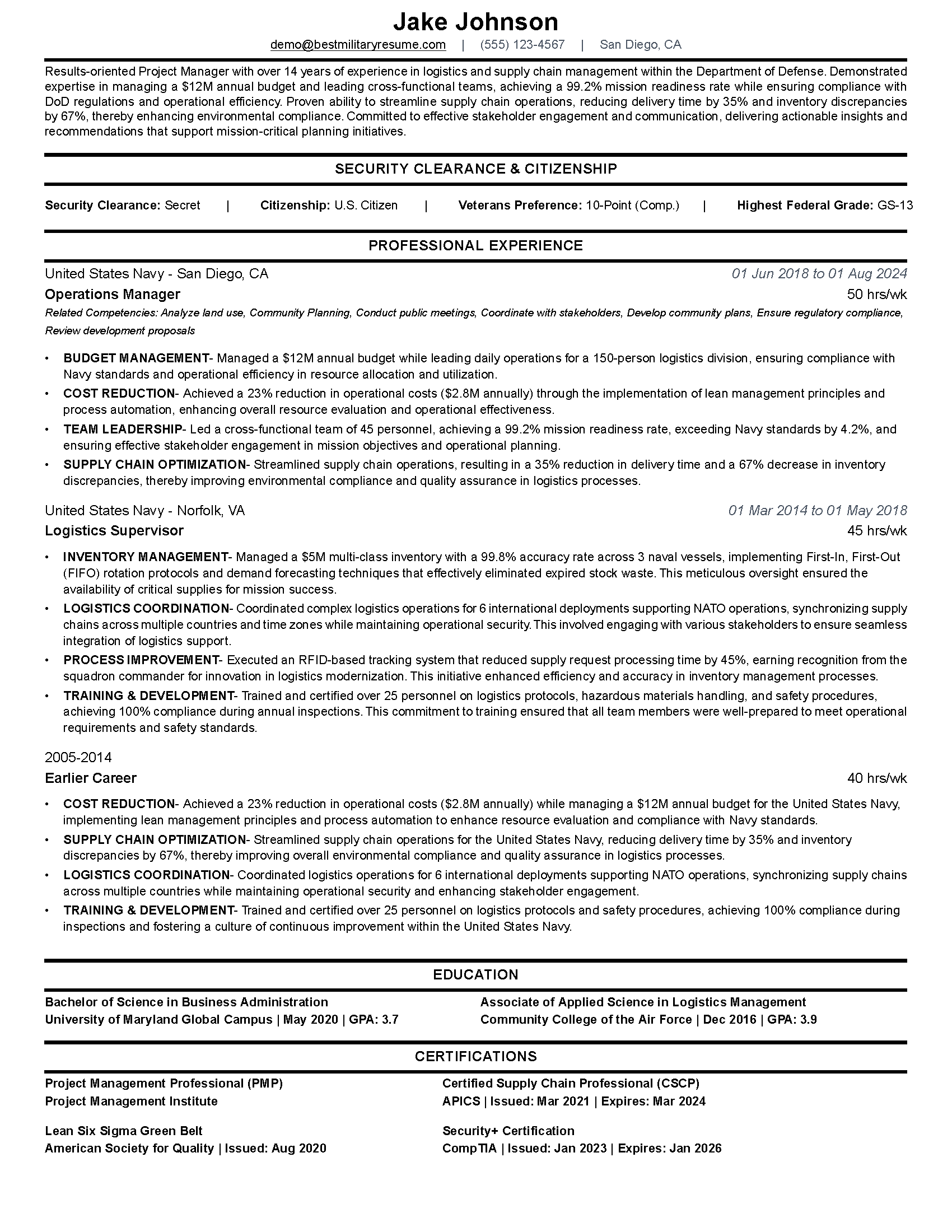
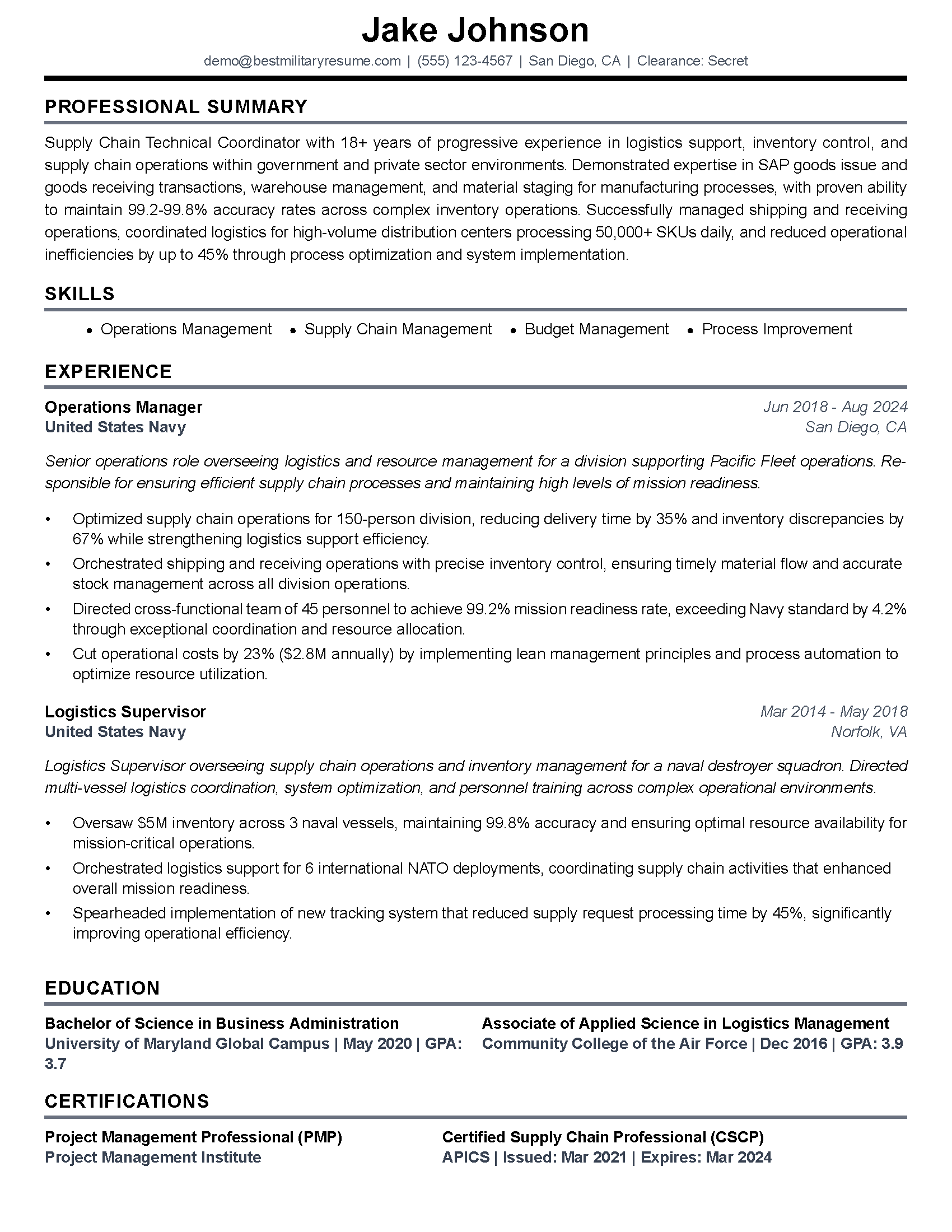
Write the stretch as work you delivered. Fill each [00] with your real number. Put the bullet under the job where you did the work.
- Directed [00] staff as acting supervisor for [00] days and closed [00] open work orders.
- Negotiated [00] vendor contracts worth $[00] and reduced late deliveries to [00] a month.
- Trained [00] new hires on [system] in [00] weeks, so all [00] passed solo sign-off [00] days sooner.
For where these go on the page, see the internal promotion resume guide.
Rules checked November 2026 on OPM's pages and the eCFR.
Where does the stretch work go when the internal job posts?
"...an internal interview at work, which ended up with a promotion to a Manager position"
Andrew, Technical Sergeant (E-6), Air Force, on the resume he built in BMR
Get your stretch bullets in before the internal job closes. Add that job ad to your BMR Resume Builder for a fresh version. The AI rewords the summary, each job's bullet list and your skills for it. Next, a check deletes any line claiming the ad's job for a role that did not do it. Nothing in your base changes.
Frequently Asked Questions
Does a detail change my official federal position?
Do I need to qualify for the higher grade before a temporary promotion?
Does higher-grade detail work always come with a temporary promotion?
Is an IDP part of my performance rating?
About the author
Brad Tachi is the CEO and founder of Best Military Resume and a 2025 Military Friendly Vetrepreneur of the Year award recipient for overseas excellence. A former U.S. Navy Diver with over 20 years of combined military, private sector, and federal government experience, Brad brings unparalleled expertise to help veterans and military service members successfully transition to rewarding civilian careers. Having personally navigated the military-to-civilian transition, Brad deeply understands the challenges veterans face and specializes in translating military experience into compelling resumes that capture the attention of civilian employers. Through Best Military Resume, Brad has helped thousands of service members land their dream jobs by providing expert resume writing, career coaching, and job search strategies tailored specifically for the veteran community.
