Military Leave for Federal Employees in the Guard or Reserve
Christopher was selected for GS-13 on his first-ever USAJOBS application.
Christopher, E-7, Coast Guard, now writes policy for the work he did on active duty
BMR's advice in most cases: use military leave first for drill and annual training, tracked by the hour. The Office of Personnel Management (OPM) military leave fact sheet says: "5 U.S.C. 6323(a) provides 20 days per fiscal year for active duty, active duty training, inactive duty training, or other duty or training listed in section 6323(a)."
Which leave covers which duty?
Each row comes from OPM or the statute. The quotes are their words.
| Leave type | When it applies | How it is charged | What you are paid |
|---|---|---|---|
| Military leave, 5 U.S.C. 6323(a) | Drill, annual training and the other duty the law lists. OPM says you are credited "on October 1 of each year." Unused days carry over, up to the cap. | By the hour. "The minimum charge to leave is 1 hour." Reserve and Guard members are "not charged military leave for weekends and holidays that occur within the period of military service." | OPM: "full civilian salary, as well as military pay." |
| Military leave, 5 U.S.C. 6323(b) | Only the duty the law names. It covers military aid to enforce the law, aid to civil authorities, or a contingency operation. The statute says it "shall not exceed 22 workdays in a calendar year." | As military leave, or as annual leave or comp time if you ask. The statute says it "may not be charged to sick leave." | OPM: "the greater of his civilian or military pay, not both." |
| Annual leave | Any active duty. OPM: "Employees also are entitled to use any accrued annual leave for periods of active military duty." | Against your own annual leave balance. On active duty, OPM's annual leave fact sheet says unused annual leave can "remain to their credit for use upon their return to civilian duty." | OPM: "full civilian pay, as well as compensation for their military service." |
| Leave without pay (LWOP-US) | Service in the uniformed services. OPM's leave without pay fact sheet calls it an "entitlement" under USERRA. | No leave is charged. OPM says your agency records it on an SF 50 coded LWOP-US. | No civilian pay. OPM: "the reservist receives full military pay and may receive a reservist differential". |
| Reservist differential, 5 U.S.C. 5538 | Not a leave type. It applies only to active duty under the orders the statute names, such as "section 12304b of title 10". | Reduced for any hours you get civilian pay or paid leave. OPM: "A reservist may not receive the reservist differential for periods during which he or she uses paid time off." | OPM: the differential is "the amount by which civilian basic pay exceeds military pay and allowances." |
For a full-time employee, OPM says the 20 days equal "160 hours (20 days x 8 hours)".
Older pages, even some on OPM's own site, still show 15 days. OPM's fact sheet explains the change: "Section 1109 of Public Law 118-159 amended 5 U.S.C. 6323(a)(1) by increasing the number of days of military leave accrual and maximum carryover amount from 15 to 20, effective December 23, 2024."
Rules checked November 2026 on OPM's fact sheets, OPM memo CPM 2025-09 and 5 U.S.C. 6323 on govinfo.
How does a drill weekend count against the 20 days?
This is BMR's illustration, not OPM's. It uses only OPM's charging rules.
OPM's rule: "An employee may be charged military leave only for hours that the employee would otherwise have worked and received pay." Inactive duty training is charged "only the amount of military leave necessary to cover the period of training and necessary travel."
A drill weekend
Say you work Monday to Friday, 8 hours a day. Drill falls on Saturday and Sunday. You would not have worked those hours, so no military leave is charged.
Now say you must leave Friday afternoon to travel to drill. The work hours you miss are charged, in whole hours. Your 160 hours drop by that many.
A two-week annual training
Say annual training runs two full weeks, Monday of week one through Friday of week two. The weekend inside it is "within the period of military service," so it is not charged. Only your workdays are charged.
That is two weeks of workdays, or one 80-hour pay period. OPM calls the year's 160 hours "the equivalent of two 80-hour biweekly pay periods." So the annual training uses half of the new hours. The rest stays for drill travel or other duty.
Your schedule may differ. Confirm the hours with your agency HR office before you go.
Should I use military leave or annual leave?
BMR's advice: use military leave first if you want to keep your annual leave. OPM gives the reason: "Employees benefit from taking military leave because they continue to accrue annual and sick leave while in a pay status."
Carryover has a limit. OPM's CPM 2025-09 memo says you "could potentially have as many as 40 days of section 6323(a) military leave during a fiscal year." It also warns that carried-over leave "will be forfeited if not used in that succeeding fiscal year."
BMR's advice: ask HR to charge carried-over days first. Keep the new days as your cushion.
What happens when the 20 days run out?
You still have choices. OPM says: "An employee is entitled to use annual leave, military leave, earned compensatory time off for travel, or sick leave intermittently with leave without pay while on active duty or active/inactive duty training."
Leave without pay (LWOP) is an entitlement during service. OPM: USERRA gives "an entitlement to LWOP when employment with an employer is interrupted by a period of service in the uniformed service." The USERRA return deadlines guide covers how long you have to come back. After long orders, the demobilizing reservist guide covers the first weeks home.
The reservist differential is tied to the order type. Do not assume a drill weekend alone qualifies. Check the authority on your orders, then ask agency HR.
Private employers follow other rules. The private employer military pay guide covers that side.
What should I do before each drill or order?
These steps are BMR's advice, not OPM rules.
- On October 1, check your military leave balance on your leave statement. Note any days carried over.
- Tell your supervisor and your timekeeper before each drill or order. Give them a copy of your orders. The drill and annual training notice guide has the wording.
- Ask HR which leave type to code before you leave, not after you return.
- If you want to keep your annual leave, use military leave before annual leave.
- Ask HR how the days line up with the fiscal year before a long order starts.
Still job hunting? The federal jobs while in the Guard or Reserve guide covers getting hired. If you hold an offer, the drill pay offer guide covers what to ask.
What goes on the resume for your next federal posting?
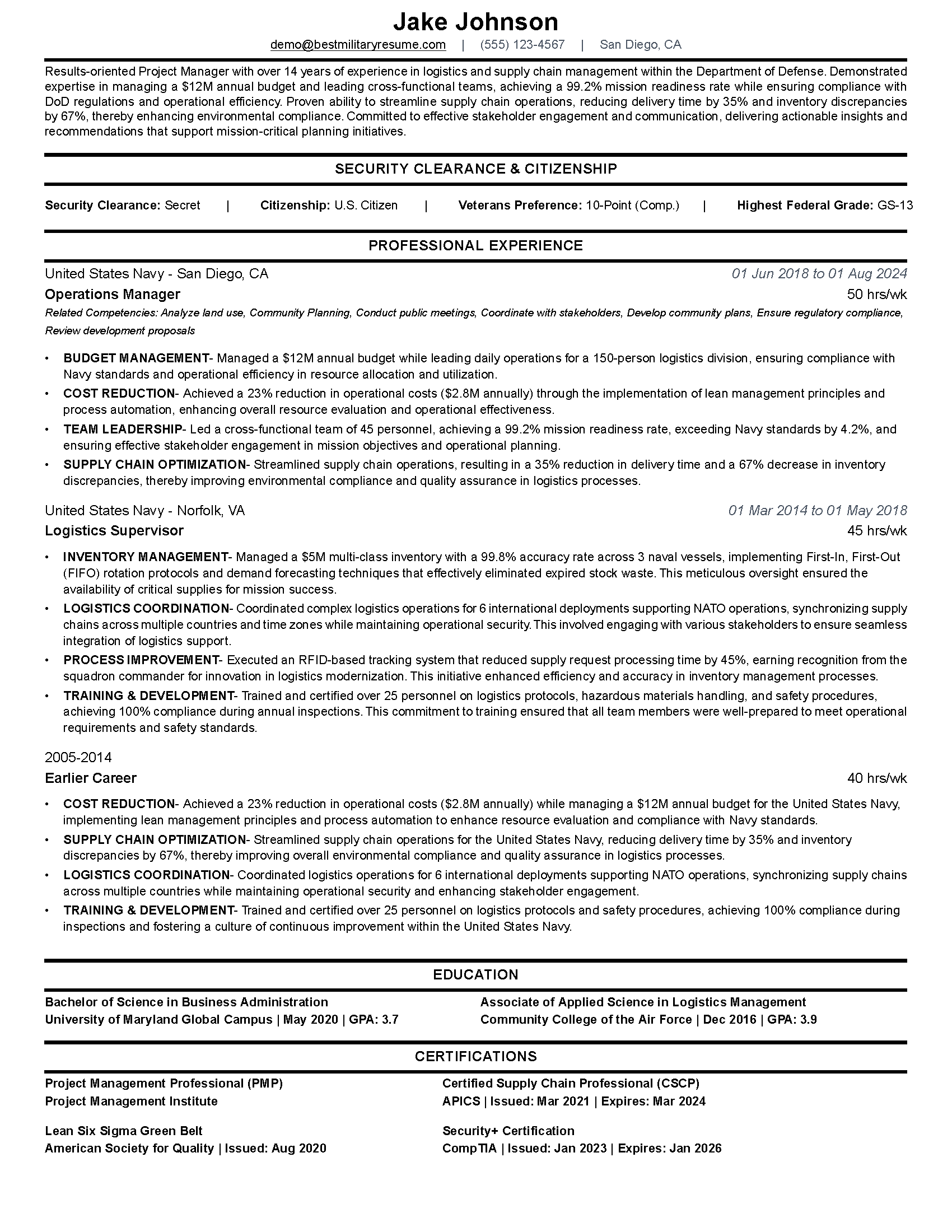
List both jobs on your federal resume, civilian and drill. Draft it once with the Resume Builder. Point it at an announcement. Its AI recasts the opening summary, duty bullets and skill terms to fit that language. After that, a check strikes lines that give an old role duties it never held. Your source draft is not changed.
Frequently Asked Questions
Do part-time federal employees get military leave?
Can I keep working my federal job while on active duty orders?
Do I get paid days off when I come back from a deployment?
Does military leave cover Space Force members?
About the author
Brad Tachi is the CEO and founder of Best Military Resume and a 2025 Military Friendly Vetrepreneur of the Year award recipient for overseas excellence. A former U.S. Navy Diver with over 20 years of combined military, private sector, and federal government experience, Brad brings unparalleled expertise to help veterans and military service members successfully transition to rewarding civilian careers. Having personally navigated the military-to-civilian transition, Brad deeply understands the challenges veterans face and specializes in translating military experience into compelling resumes that capture the attention of civilian employers. Through Best Military Resume, Brad has helped thousands of service members land their dream jobs by providing expert resume writing, career coaching, and job search strategies tailored specifically for the veteran community.