GS-0602 Medical Officer: Federal Resume Guide for Veterans
Christopher was selected for GS-13 on his first-ever USAJOBS application.
Christopher, E-7, Coast Guard, now writes policy for the work he did on active duty
The Office of Personnel Management (OPM) Physician Series 0602 standard requires a medical degree from an accredited school. It accepts a Doctor of Medicine (MD), Doctor of Osteopathic Medicine (DO) or equivalent. You also need a current, active, full and unrestricted physician license. One year of supervised graduate training then qualifies you for GS-11 on the General Schedule (GS).
Each grade above adds a year of specialty training or equivalent experience, up to five at GS-15. The Department of Veterans Affairs (VA) hires most of its doctors under its own Title 38 rules instead. So check which path your posting uses first.
You spent years in residency and on staff at a military hospital. Now a posting wants it all in a few blocks of text. This guide gives you a credentials block to copy and a training-years table. It also gives two sample bullets in BMR's federal format.
Rules here come from OPM's 0602 page and two USAJOBS postings, checked November 22, 2026.
Example: a 0602 credentials block
Put this at the top of page one, under your contact lines. Brackets are yours to fill. Everything in them is an example.
- Degree: Doctor of Medicine (M.D.), [School], accredited by the Liaison Committee on Medical Education, [MM/YYYY]
- Internship: Transitional Year, [Program], accredited by the Accreditation Council for Graduate Medical Education (ACGME), [MM/YYYY] to [MM/YYYY]
- Residency: Family Medicine, [Army medical center], ACGME-accredited, [MM/YYYY] to [MM/YYYY]
- License: Physician and Surgeon, State of [State], current, active, full and unrestricted, expires [MM/YYYY]
- Board status: [Board name], Family Medicine, certified [YYYY], valid through [YYYY]
- Clinical privileges: Full privileges in family medicine, [military hospital], [MM/YYYY] to [MM/YYYY]
The first four lines answer OPM's standard. Board status matters most on VA postings. The degree line names the accrediting body because OPM names it. The license line repeats OPM's own words: current, active, full and unrestricted. The training lines carry start and end dates. Your grade depends on how many years they add up to.
Which path does your 0602 posting use: Defense Health Agency or VA?
Most open 0602 jobs sit at two employers. The Defense Health Agency (DHA) runs military hospitals and clinics. The Department of Veterans Affairs runs VA medical centers. They hire doctors under different laws, and the resume rules differ.
| What to check | DHA posting | VA posting |
|---|---|---|
| Example posting | Physician (Psychiatry), job 886584600, open on November 22, 2026, closes November 30, 2026 | Physician (Primary Care), Knoxville, job 888105300, open on November 22, 2026, closes September 30, 2027 |
| Pay plan on the posting | GP (GS Physicians and Dentists) | VM (Medical and Dental) |
| Qualification rule | OPM's 0602 standard, restated in the posting | VA's own physician standard |
| Resume length | "Your resume must be two pages or less" | A curriculum vitae (C.V.) or resume: "You must submit a C.V. and/or resume" |
| Residency rule | Completed residency in the specialty, plus years by grade | Residency "leading to eligibility for board certification" |
The DHA posting is blunt about length. It says, "Resumes exceeding two pages will be removed from consideration." That matches the wider rule. A federal resume is two pages for most federal jobs, so check the announcement for exceptions.
VA physicians are one of those exceptions. Title 38 of the United States Code, section 7401(1), lets VA appoint physicians. VA's careers page covers the new resume rules. It says they "do not apply to applications for Title 38 or Hybrid Title 38 positions." So a VA physician posting can take your full C.V.
Read the pay plan line before you write a word. GP is the physician pay plan DHA uses, under OPM's standard. VM means a VA posting under Title 38. The DHA posting sets pay from physician tiers, not the GS table. For VA pay, see our Title 38 pay scale breakdown.
How many years of graduate training do you need for each grade?
OPM counts your graduate training after medical school. Internship, residency and fellowship all count if a recognized body accredited them. The standard sets this ladder.
| Grade | Graduate training OPM requires |
|---|---|
| GS-11 | 1 year: an internship or first residency year |
| GS-12 | 2 years in the specialty, or equivalent experience and training |
| GS-13 | 3 years in the specialty, or equivalent |
| GS-14 | 4 years in the specialty, or equivalent |
| GS-15 | 5 years in the specialty, or equivalent |
DHA's psychiatry posting above matches at GP-14: a completed psychiatry residency and at least 4 years.
Can staff time replace residency years?
Usually not. OPM says experience "may not be substituted for residency training that is essential" to the specialty. Surgeons and psychiatrists must finish the residency years their specialty requires. There’s one narrow exception. A peer panel of physicians can document that your practice equals the same years of training. That’s the panel's call, not yours. So your job is to make the years easy to add up.
How do you show the years on the page?
- Every program gets its own line: name, specialty, accrediting body, start and end month.
- Fellowships go on separate lines: they add specialty years beyond residency.
- Staff years go in your job blocks: each with dates and hours per week.
- Military training programs count if accredited: name the ACGME or American Osteopathic Association (AOA) accreditation on the line.
What job title goes on a military physician's resume?
Army, Navy and Air Force physicians each carry a service code for their specialty.
None of those codes means much on a federal resume. Use the clinical title instead. Write "Physician (Family Medicine)" or "Staff Emergency Physician," the way the posting names the job. Then add your service and facility. A job block header looks like this:
- Title line: Physician (Family Medicine), U.S. Army
- Where: [Army medical center], [City, State]
- When: [MM/YYYY] to [MM/YYYY], [40] hours per week
Translate military clinic words as you go. "MTF" (military treatment facility) becomes military hospital or clinic. "PCM" (primary care manager) becomes primary care physician. "Credentialed and privileged" stays, because civilian hospitals use the same words. Leave evaluation report names off entirely.
How do you write the clinical work in BMR's federal format?
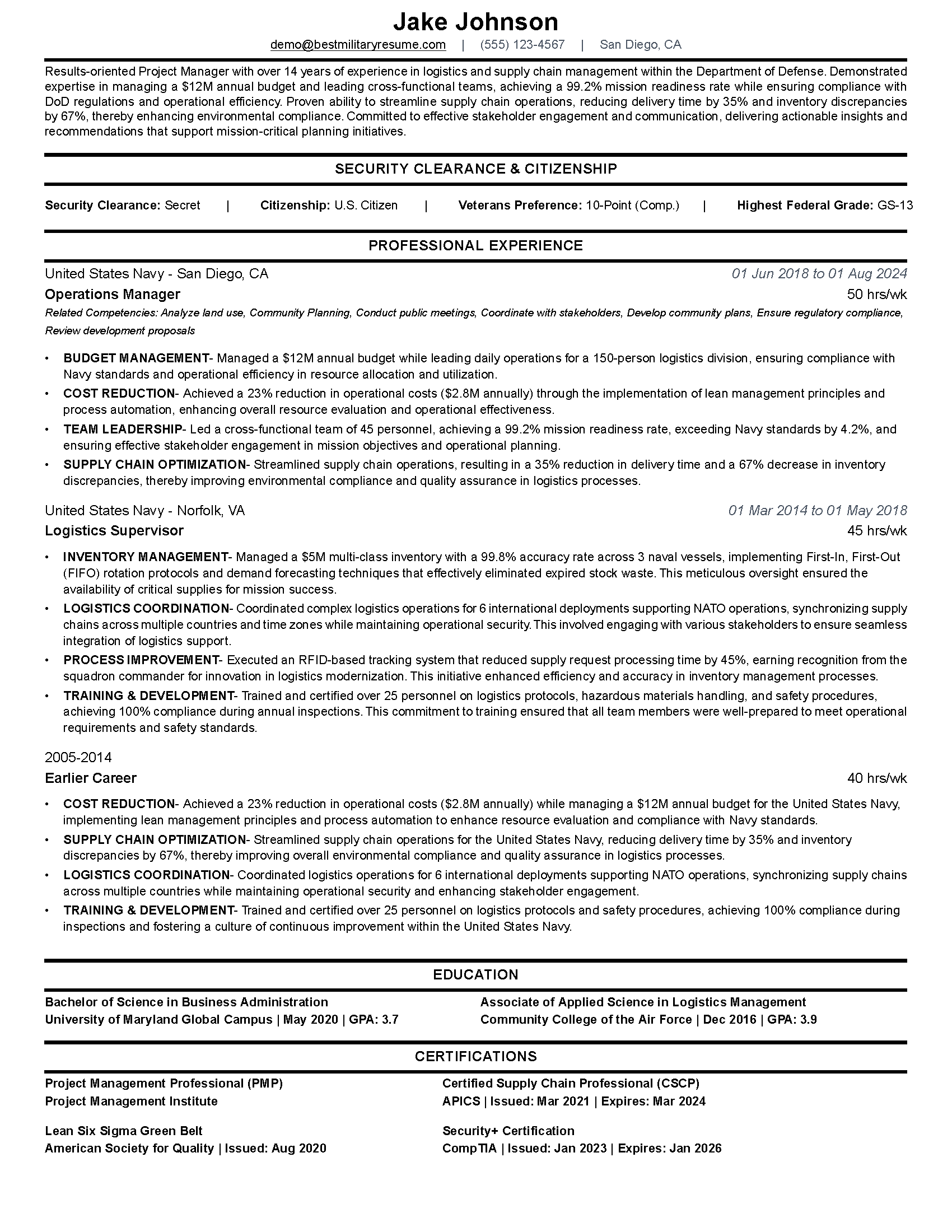
BMR writes each federal bullet as a capital-letter header, a dash, then one or two sentences. Those sentences run 40 to 60 words. They say what you did, its scope and its result. The header is five words or fewer. Every word in it must appear in that bullet's own sentences. Use only the figures your records state. Never add a number you cannot back up.
Example bullet: Army family physician
Figures in brackets are illustrative. Replace them with your own.
- FAMILY MEDICINE CARE- Delivered outpatient family medicine care to [0,000] enrolled soldiers and family members at an Army medical center clinic, seeing [00] patients a day under full clinical privileges. Built a weekly chart review with [0] nurses that closed [00] percent of overdue referrals within [0] months.
Example bullet: Navy emergency physician
- EMERGENCY DEPARTMENT- Cut median time to antibiotics from [00] to [00] minutes in a [00]-bed emergency department at a naval hospital by writing the sepsis order set with the pharmacy and nursing chiefs. Covered [00,000] visits a year as one of [0] attending physicians treating adult and pediatric patients.
Each bullet carries a patient load, its scope and one result with a number. Deployed work follows the same shape. Name the type of unit and the cases you treated, in plain words.
What changes when the posting is a VA Title 38 job?
Three things change on a VM posting. Check each one against the announcement you are applying to.
- Length: the Knoxville posting asks for "a C.V. and/or resume." Your full C.V., with publications and teaching, can go in.
- Residency wording: VA wants residency "leading to eligibility for board certification." Put your board status on its own line, as in the block above.
- Training-year routes: VA also accepts one year of training plus two years of licensed U.S. practice. List that practice with dates.
The credentials block and the bullets work on both paths. On a DHA posting, they keep you inside two pages. On a VA posting, they sit on top of the C.V. and make the basics easy to find.
What to Do Next
Pull your training certificates and your license card. Write the credentials block first, with every start and end month. Then build one job block for your current staff role.
Paul, an Army Captain in healthcare, used BMR's resume tool. He got a federal job offer and three private-sector offers. You can start the same way.
Build the block in the BMR federal resume builder. When you tailor, it rewrites your summary, bullets and skills in the posting's words. For federal, it grades you against the minimum qualification and says so when you don't meet it. With 3+ roles on a tailored resume, Condense to 2 Pages folds older ones into Earlier Career.
For the series overview, see the GS-0602 Medical Officer career page. Clinical staff outside medicine can use our GS-0601 health science guide.
Frequently Asked Questions
Is the GS-0602 Medical Officer series the same as the Physician Series?
Can I apply for a VA physician job before my license or residency is finished?
Do research GS-0602 jobs need a medical license?
I went to a foreign medical school. Can I still qualify for GS-0602?
Does teaching at a medical school count toward a GS-0602 grade?
About the author
Brad Tachi is the CEO and founder of Best Military Resume and a 2025 Military Friendly Vetrepreneur of the Year award recipient for overseas excellence. A former U.S. Navy Diver with over 20 years of combined military, private sector, and federal government experience, Brad brings unparalleled expertise to help veterans and military service members successfully transition to rewarding civilian careers. Having personally navigated the military-to-civilian transition, Brad deeply understands the challenges veterans face and specializes in translating military experience into compelling resumes that capture the attention of civilian employers. Through Best Military Resume, Brad has helped thousands of service members land their dream jobs by providing expert resume writing, career coaching, and job search strategies tailored specifically for the veteran community.
