GS-0601 General Health Science: Federal Resume Guide for Veterans
Christopher was selected for GS-13 on his first-ever USAJOBS application.
Christopher, E-7, Coast Guard, now writes policy for the work he did on active duty
An OPM GS-0601 job needs a bachelor's or higher degree in a health or allied science field. OPM's 0601 standard has no way to qualify on experience alone. Your service sets your grade once you have the degree.
That's the part that stings for a lot of medics and corpsmen. Years of patient care can't stand in for the degree on the OPM side. But many VA 0601 jobs run on a different rulebook. That one asks for a school, a license and a credential.
By the end, you'll know which rulebook your job uses and what grade your service can reach. You'll also have a worked job block for each path to fill in with your own numbers. This page covers how to write the resume. For pay and the series overview, use the GS-0601 career page.
GS-0601 at a glance: two rulebooks, one series
USAJOBS still lists the series as "General Health Science." OPM renamed it the General Medical and Healthcare Series in a standard issued September 27, 2017. Its Handbook of Occupational Groups and Families (December 2018) uses the new name. Both names mean the same 0601 code, so search USAJOBS for either one.
| What to check | OPM path | VA path |
|---|---|---|
| Who posts it. | CDC, NIH, FDA, Indian Health Service, Defense Health Agency clinics. | Veterans Health Administration medical centers. |
| Rulebook. | OPM's 0601 standard plus its group standard. | VA's own standard for each job. |
| What gets you in. | A health or allied science degree from an accredited program. | The school, license or credential VA names, such as an RRT. |
| What sets your grade. | Graduate school or 1 year of specialized experience. | Experience and the skills listed for each grade. |
| Titles you'll see. | Health Scientist, Epidemiologist, Communicable Disease Specialist. | Registered Respiratory Therapist, Nuclear Medicine Technologist, Blind Rehabilitation Specialist. |
| Resume length. | Two pages for most jobs. Check the announcement. | Follow the announcement. VA exempts these jobs from the new rule. |
Checked November 2026 against OPM's 0601 standard, its group standard and the live postings linked below.
Which 0601 rulebook does your announcement use?
Open the announcement and go straight to the Qualifications section. The first few lines tell you which side you're on.
- OPM path: it quotes OPM's degree line about "major study" in a health field. Then it lists specialized experience by grade.
- VA path: it names a VA standard, a license, a credential or a "Grandfathering Provision." Many also say the job is covered by Title 38.
The VA jobs are hybrid Title 38. Congress lists them by name in 38 U.S.C. 7401(3). The list includes respiratory therapists, nuclear medicine technologists and blind rehabilitation specialists. VA sets their rules, not OPM. Look at a current VA Registered Respiratory Therapist posting. It asks for an accredited program, a state license and the RRT credential.
Resume length splits the same way. Two pages for most federal jobs, so check the announcement for exceptions. But VA Careers says the new rules don't apply to "Hybrid Title 38 positions." On the OPM path, the two-page federal resume format guide shows how to fit it. The Title 38 vs Title 5 application guide covers the VA side.
Write one resume per path.
An OPM resume leads with the degree and the work that matches the grade. A VA clinical resume leads with the license and credential. One resume that tries to do both usually does neither well.
Does your degree meet the OPM 0601 basic requirement?
On the OPM path, the degree is the gate. The standard asks for a bachelor's or higher with "major study" in a health or allied science field. The major must fit the work of the job. The school must hold accreditation the U.S. Department of Education recognizes.
OPM's group standard explains why experience can't replace it. It says some series "make no provision for combining experience and education," so they have no paragraph B. The 0601 standard has only the education block. So a 20-year corpsman with no degree can't qualify for an OPM 0601 job. That holds no matter how strong the record is.
Here's what to check on your own record:
- Major: health science, public health, biology, nursing and respiratory care majors often fit. The major still has to match the job's work.
- School: confirm the school's accreditor on the Department of Education list the standard links to.
- Transcript: One recent CDC posting asks for "College transcripts, if qualifying all or in part based on education." On 0601, that's you.
- Military credit: Joint Services Transcript courses usually count only once a college applies them to your degree. The JST resume guide shows where that training goes on a resume.
Put the degree near the top of the resume. List the school, the degree, the major and the year it was conferred. That one line decides if you qualify.
What grade can your military health work reach?
The degree alone usually qualifies you for GS-5. Above that, OPM's Professional and Scientific group standard sets the ladder. You need graduate school or one year of specialized experience at the next lower level.
| Grade | Education that qualifies | Or specialized experience |
|---|---|---|
| GS-5. | The basic degree. | Not needed. |
| GS-7. | 1 year of graduate study, or superior academic achievement. | 1 year at the GS-5 level. |
| GS-9. | A master's, or 2 years of graduate study toward one. | 1 year at the GS-7 level. |
| GS-11. | A Ph.D., or 3 years of graduate study toward one. | 1 year at the GS-9 level. |
| GS-12 and up. | No education option. | 1 year at the next lower grade. |
Research jobs run one step different. A GS-11 research job accepts a master's, and a GS-12 research job accepts a Ph.D. You can also mix graduate school and experience. Together they must reach 100 percent of the grade.
Outside research jobs, GS-12 is the wall, and from there only experience counts. A Defense Health Agency GS-13 Epidemiologist posting says it plainly. "No substitution of education for experience is permitted." Grants jobs at GS-12 and up add one more rule. Your grants work must be in science, medical or health care fields.
Military time counts when the work matches. "Equivalent to GS-9" means the kind of work, not your pay grade. Running a clinic's disease reporting program may show GS-9 level work. Logging cases for that program usually shows a lower level.
Which military health jobs feed which 0601 path?
BMR's crosswalk maps several medical jobs to 0601. The path depends on what you hold now: a degree, a credential, or both.
| Your background | Best 0601 path | What you need | Titles in current posts |
|---|---|---|---|
| Army 68V, Air Force 4H0X1 (respiratory care). | VA, hybrid Title 38. | An accredited respiratory care program, a state license, the RRT. | Registered Respiratory Therapist. |
| Army 68S, Air Force 4E0X1, Navy corpsmen with preventive medicine work. | OPM, at DHA clinics and CDC. | A health or allied science degree, then the grade's specialized experience. | Communicable Disease Specialist, Epidemiologist. |
| Navy HM, Army 68W, with a health science degree. | OPM, at NIH, CDC and similar. | The degree, plus research or program support work. | Health Scientist, Health Science Specialist. |
For more on each job, see the 68V Respiratory Specialist career guide and the 4H0X1 respiratory care guide. Preventive medicine techs can read the 68S Preventive Medicine Specialist guide, and corpsmen the Navy Hospital Corpsman guide.
Respiratory techs have one question to answer first. Was your school accredited by the Commission on Accreditation for Respiratory Care (CoARC)? Do you hold the RRT from the National Board for Respiratory Care? Check both before you write a word. The VA posting accepts nothing less at GS-7 and up.
If a 0601 job isn't a fit yet, other medical series may be. A licensed nurse belongs in the GS-0610 nurse guide. A medic without a degree may start in VA scheduling through the GS-0679 medical support assistant guide.
How do you write an OPM 0601 job block?
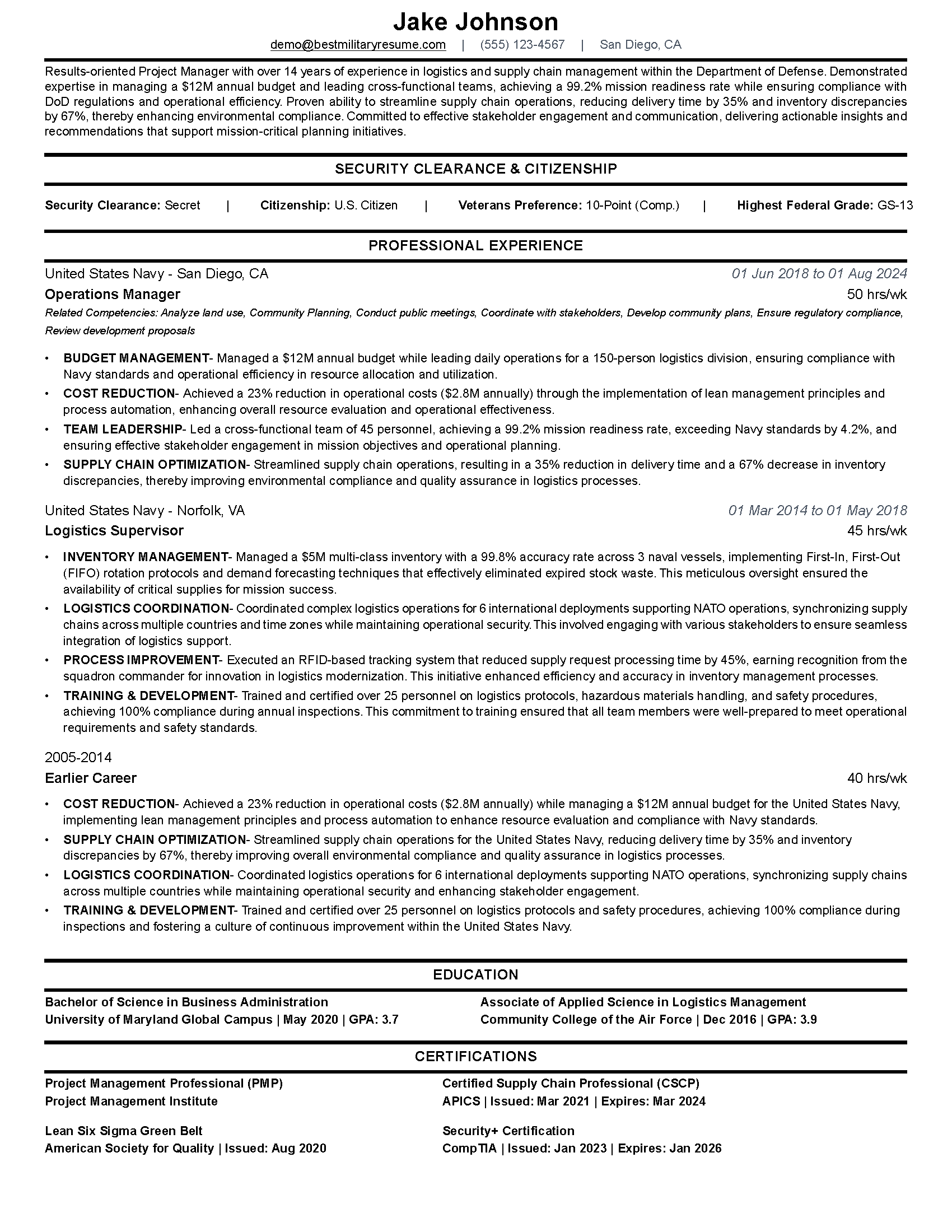
The announcement's specialized experience line sets what counts. So each bullet has to show that work in plain words, with scope and a result. Here's how BMR builds the bullet itself.
- Start with a header in capitals: five words or fewer, then a dash. Every word in it must show up in that bullet.
- Write one or two sentences after it: 40 to 60 words in all. Say what you did, the scope (people, sites, cases, dollars) and the result.
- Spell out military terms: say "public health officer," not a billet code. Drop rank titles and describe the role.
- Use your own numbers only: no figure in your record means no figure in the bullet.
- Add the job facts: start and end dates and hours per week on every job.
Don't copy the announcement. A recent CDC GS-12 Epidemiologist posting, now closed, warned against pasting its duties. It said that "will not be considered a demonstration" of your skills. Use the posting to pick which of your stories to tell, then tell them in your own words.
Here's a worked example aimed at a DHA GS-11 Communicable Disease Specialist posting. It asks for work on "communicable disease programs," "epidemiology investigations," disease monitoring and educational activities. The numbers are illustrative. Swap in yours.
Example job block, OPM path (illustrative figures)
Preventive Medicine Specialist (Army 68S), U.S. Army, [installation], [city, state]
[MM/YYYY] to [MM/YYYY]. 40 hours per week.
DISEASE REPORTING- Tracked reportable disease cases for a clinic that served 12,000 soldiers and family members, entering each case in the reporting system within 24 hours. Spotted a rise in stomach illness across 3 dining halls, traced it to one serving line, and briefed the public health officer, who closed that line within 2 days.
OUTBREAK CASE INTERVIEWS- Led case interviews with 45 ill trainees during a 10-day outbreak, using a standard case form to build the count by day and unit and to map where each person ate. Delivered a written summary that pointed to one water source, and the unit switched to bottled water within 6 hours, which cut new cases to zero by day 12.
SAFETY CLASSES- Designed and taught 18 classes on heat injury and food safety to 900 soldiers before summer field training, using unit injury data to pick the topics. Tracked heat cases after each class and reduced them from 14 the prior summer to 5, and the command used those numbers to set the next year's training plan.
Each header names the work in the bullet below it. Together, the bullets hit each piece of the posting's line: disease programs, investigations, monitoring and education.
How do you write a VA respiratory therapist job block?
The VA side asks a different first question: are you licensed and credentialed? So lead with that, then show the clinical work.
- Licenses and credentials: put the RRT and its board near the top. Add your state license and its expiration date.
- Education: name the respiratory care program and the school. Add "CoARC-accredited" so the reader sees it meets the rule.
- Bullets: show patient load, equipment, emergencies and teaching. Those map to the skills VA lists for each grade.
Maybe you finished the program and hold the CRT and a state license, but not yet the RRT. Read the exception in the posting. VA may give you a temporary RT job at GS-5 for up to one year while you finish. You can't move up until you earn the RRT.
Here's a worked example for that VA posting. The numbers are illustrative.
Example job block, VA path (illustrative figures)
Respiratory Specialist (Army 68V), U.S. Army, [hospital], [city, state]
[MM/YYYY] to [MM/YYYY]. 40 hours per week.
Registered Respiratory Therapist (RRT), National Board for Respiratory Care, [year]. State license: [state], [expiration date].
VENTILATOR CARE- Directed mechanical ventilator care for up to 6 intensive care patients per 12-hour shift in a 20-bed unit, adjusting settings from physician orders and arterial blood gas results. Built a shared bedside checklist with nursing staff that cut the average alarm response time from 4 minutes to under 2 over 3 months.
AIRWAY EMERGENCY CALLS- Secured airways as the respiratory member of the rapid response team on 60 code and emergency calls a year, giving bag-valve breaths and oxygen until each patient was stable or moved to a higher level of care. Trained 8 new technicians on code cart and airway kit checks, and the unit passed all 4 quarterly cart inspections.
The credential line sits right under the job title. The bullets show scope a VA clinic would know. That means patients per shift, unit size, code calls and techs trained.
What to Do Next
Pick one live 0601 announcement. Read its Qualifications section and decide which rulebook it uses. Then write one job block for your strongest military role, using the matching example above as your pattern.
Joe, a Navy Lieutenant, landed a federal science and technology job with help from BMR's resume builder. A hiring official told him they "reviewed my resume and selected me based on it."
The BMR Federal Resume Builder does this step for you. Paste the 0601 announcement. It writes your work in the capitals-header format, with dates and hours on every job. Your first federal tailored resume is free. With 3+ roles on a tailored resume, Condense to 2 Pages folds older ones into Earlier Career.
Frequently Asked Questions
Is GS-0601 the same as GS-0685 Public Health Program Specialist?
Can an associate degree or a CCAF degree qualify me for an OPM GS-0601 job?
Do VA nuclear medicine technologist jobs need a bachelor's degree?
What do VA blind rehabilitation specialist jobs require?
Can I apply to a VA 0601 job before I finish my degree or credential?
About the author
Brad Tachi is the CEO and founder of Best Military Resume and a 2025 Military Friendly Vetrepreneur of the Year award recipient for overseas excellence. A former U.S. Navy Diver with over 20 years of combined military, private sector, and federal government experience, Brad brings unparalleled expertise to help veterans and military service members successfully transition to rewarding civilian careers. Having personally navigated the military-to-civilian transition, Brad deeply understands the challenges veterans face and specializes in translating military experience into compelling resumes that capture the attention of civilian employers. Through Best Military Resume, Brad has helped thousands of service members land their dream jobs by providing expert resume writing, career coaching, and job search strategies tailored specifically for the veteran community.
