Loading...
Loading...
The civilian and federal jobs that hire Air Force Respiratory Care Practitioners — with real salaries and the resume that gets callbacks.
Every 4H0X1 has more options than a Google search will tell you. Below: career paths, BLS salary data, federal GS series, certifications by target career, and how to translate your experience without losing what made you valuable to the Air Force in the first place.
Free · No credit card · Tailored resume in under 5 minutes
After the Navy I got hired into 6 federal career fields and tech sales, and sat on federal hiring panels along the way. I spent the last 2 years rebuilding everything I learned into BMR, tuned for how AI actually screens resumes today. This is the system I wish I'd had on day one.
One page, built in our template, with your military experience translated into civilian terms hiring managers and ATS systems read. Use it as a reference for your own. Drop your email and we'll send you the download link.
Free. We'll also send occasional job-search tips. Unsubscribe anytime.
If you held AFSC 4H0X1, you ran ventilators on real patients, drew and interpreted arterial blood gases, supported intubations, and kept critically ill airmen and dependents breathing in ICUs and on aeromedical evacuation flights. You did not assist a respiratory therapist. You were one. The Air Force trains 4H0X1 at the Cardiopulmonary Laboratory program at Fort Sam Houston, and graduates leave with an Associate of Science in Respiratory Care, eligibility for the Registered Respiratory Therapist (RRT) credential through the NBRC, and a Certified Cardiology Technologist background built on ECGs, stress tests, and pulmonary function testing.
That is the part most transitioning airmen underrate. Your AFSC maps almost one-to-one onto a licensed civilian profession that the Bureau of Labor Statistics reports paid a median of $80,450 in May 2024. The clinical hours are real, the credential is portable, and hospitals are short-staffed. The friction is never your competence. It is a resume that reads like an enlisted performance report instead of a clinical resume a hospital recruiter can scan in ten seconds.
Across the more than 60,000 resumes BMR has built, the pattern on cardiopulmonary AFSCs is consistent. The airmen who land staff-RT and ICU offers fastest are the ones whose resume leads with the credential and the patient volume, not the duty title. We see it on the related 4N0X1 Aerospace Medical Technician and 4T0X1 Medical Laboratory Specialist pages too. If you want to see where your AFSC points on the civilian side, start with the military to civilian career crosswalk, then translate the experience with our military terms glossary.
The 4H0X1 is one of the cleanest transitions in the medical AFSC field, because you walk out with an actual RRT credential and ICU ventilator hours, not a title that needs explaining. The only thing standing between you and a staff respiratory therapist offer is a resume that puts the credential and the patient numbers up top. Get that right and the interviews come fast. — Brad Tachi, Navy Diver veteran & BMR founder
The number that matters when you're deciding what's next: how does civilian pay compare to what you make now?
Military comp is approximate (varies by location/dependents). Civilian is BLS median. Federal includes locality pay. Your real number depends on duty station, family status, GS step, and overtime.
Respiratory care is one of the few medical AFSCs where the direct civilian job is a licensed, well-paid clinical role, not a downgrade. According to the Bureau of Labor Statistics Occupational Employment and Wage Statistics (OEWS, May 2024), respiratory therapists earned a median annual wage of $80,450, with the top 10 percent above $108,820. BLS projects strong growth driven by an aging population and rising rates of chronic respiratory conditions. Hospitals run respiratory therapy departments around the clock, so night and weekend differentials push effective pay higher than the median suggests.
The most direct path is Respiratory Therapist (O*NET 29-1126.00). To practice you need RRT certification through the NBRC and a state license, both of which your AFSC training already positions you for. Acute-care hospitals, long-term acute care (LTAC) facilities, and skilled nursing facilities hire the bulk of RTs. Within the field there is real specialization room: neonatal and pediatric ICU, adult critical care, pulmonary function testing, sleep diagnostics, and ECMO programs.
Adjacent direct roles use the cardiopulmonary half of your training. Cardiovascular Technologists and Technicians (O*NET 29-2031.00) earned a BLS median of $67,260 in May 2024 and run the ECG, stress-test, and cath-lab work you already did. Pulmonary Function Technologists sit inside that same SOC group and run the spirometry and lung-volume testing 4H0X1 airmen perform daily. Sleep diagnostics is a growing niche for polysomnographic technologists, often reachable with a short bridge credential on top of your RT background.
Geography matters. Respiratory therapist demand is highest where hospital density is high and where the population skews older, so the Southeast, Texas, and the Rust Belt hospital systems tend to hire aggressively. Travel-RT contracts pay a premium if you are willing to relocate for 13-week assignments. The honest caveat: civilian licensure is state-by-state, so confirm your target state's board accepts NBRC credentials and plan the application timeline before you separate. Many 4H0X1 airmen who want a different lane entirely should read the Army 68W Combat Medic and Navy Hospital Corpsman pages, which share several of the same civilian destinations. When you are ready to translate your clinical hours into a resume hospital recruiters scan fast, our military resume builder is built for exactly this, or you can build your resume now.
| Civilian Job Title | Industry | BLS Median Salary | Outlook | Match |
|---|---|---|---|---|
Respiratory Therapist O*NET: 29-1126.00 | Healthcare | $80,450 | 13% (Much faster than average) | strong |
Critical Care / ICU Respiratory Therapist O*NET: 29-1126.00 | Healthcare | $80,450 | 13% (Much faster than average) | strong |
Pulmonary Function Technologist O*NET: 29-2031.00 | Healthcare | $67,260 | 4% (As fast as average) | strong |
Cardiovascular Technologist O*NET: 29-2031.00 | Healthcare | $67,260 | 4% (As fast as average) | strong |
Polysomnographic (Sleep) Technologist O*NET: 29-2031.00 | Healthcare | $67,260 | 4% (As fast as average) | moderate |
Travel Respiratory Therapist O*NET: 29-1126.00 | Healthcare | $80,450 | 13% (Much faster than average) | strong |
Neonatal/Pediatric Respiratory Therapist O*NET: 29-1126.00 | Healthcare | $80,450 | 13% (Much faster than average) | moderate |
Respiratory Care Educator / Clinical Instructor O*NET: 29-1126.00 | Education & Healthcare | $80,450 | 13% (Much faster than average) | moderate |
BMR rewrites your 4H0X1 experience for any of the civilian roles above — keywords, achievements, and language hiring managers actually scan for.
Free · No credit card · 2 tailored resumes included
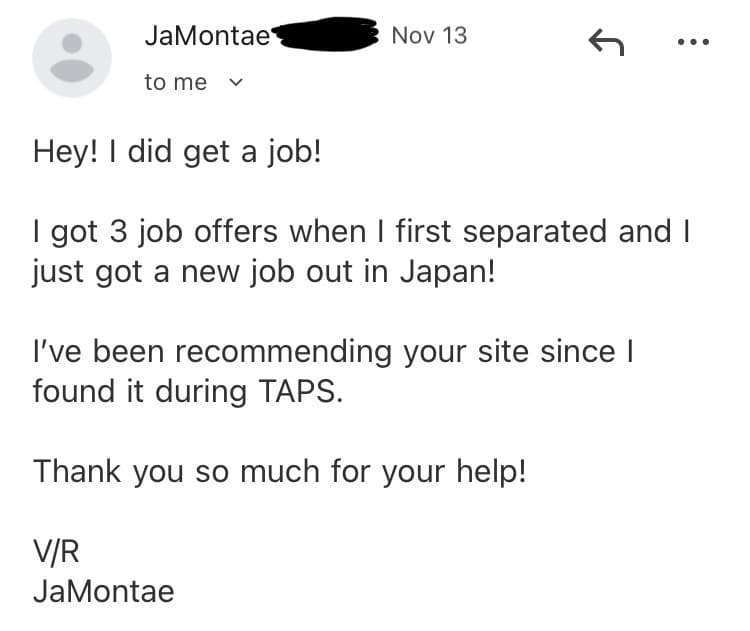
“Hey! I did get a job! I got 3 job offers when I first separated and I just got a new job out in Japan! I’ve been recommending your site since I found it during TAPS. Thank you so much for your help! V/R JaMontae ”
Federal respiratory care work runs almost entirely through the Department of Veterans Affairs and the Defense Health Agency, and both hire respiratory therapists directly. The VA operates the largest integrated hospital system in the country, and respiratory therapy is staffed across nearly every VA medical center. Your military clinical hours count as qualifying experience under OPM standards, and your RRT credential is the same one VA hiring authorities look for.
The most relevant series is GS-0640 (Health Aid and Technician), which the VA and DHA use to classify respiratory therapists and pulmonary technicians. With RRT and your AFSC clinical experience, most transitioning 4H0X1 airmen qualify around the GS-7 to GS-9 range, with GS-11 reachable as you accrue specialty experience. GS-0601 (General Health Science) covers broader clinical and health-program roles for those moving toward coordination or quality work. GS-0644 (Medical Technologist) and GS-0645 (Medical Technician) are adjacent options for the diagnostic and laboratory-leaning side of your training.
If you continue your education, GS-0610 (Nurse) opens after an RN, a common bridge for RTs who pursue a nursing degree on the GI Bill, and GS-0671 (Health System Specialist) targets the administrative and program-management track inside military and VA hospitals. Equipment-leaning airmen who maintained and calibrated ventilators may also qualify for GS-4805 (Medical Equipment Repair).
Two things move federal applications. First, your service connects you to Veterans' Preference, which adds 5 or 10 points to your rated score. Read the 5 vs 10 point breakdown so you claim it correctly. Second, federal resumes are their own format, far longer and more detailed than a hospital resume, with month-and-year dates and hours per week. Our OPM format guide and the federal resume builder handle the structure, and you can start your federal resume here. The Coast Guard Health Services Technician page targets several of the same GS series if you are comparing medical paths.
| GS Series | Federal Job Title | Typical Grades | Match | Explore |
|---|---|---|---|---|
| GS-0645 | Medical Technician | GS-5, GS-6, GS-7, GS-8 | View Details → | |
| GS-0640 | Health Aid and Technician | GS-7, GS-9, GS-11 | View Details → | |
| GS-0601 | General Health Science | GS-7, GS-9, GS-11 | View Details → | |
| GS-4805 | Medical Equipment Repair | GS-7, GS-9, GS-11 | View Details → | |
| GS-0644 | Medical Technologist | GS-7, GS-9 | View Details → | |
| GS-0610 | Nurse | GS-9, GS-11 | View Details → | |
| GS-0671 | Health System Specialist | GS-9, GS-11, GS-12 | View Details → |
Federal hiring uses keyword-matching and structured experience. BMR builds federal-format resumes (USAJobs-ready) with the right keywords, hours/week, and supervisor info — for any GS series above.
Free · No credit card · Federal + civilian resume formats included
Not everyone wants to stay in a related field. These career paths leverage your transferable skills — leadership, risk management, logistics, project planning — in completely different industries.
Ventilator and respiratory-device manufacturers hire clinical specialists who have actually run their equipment on patients. As a 4H0X1 you bring the bedside credibility their sales and support teams lack, which makes you the person hospitals trust during a device evaluation.
Respiratory and cardiology drug lines want reps who can speak the clinical language credibly. Your RT background lets you talk to pulmonologists and intensivists as a peer, which most reps without a clinical background cannot.
Emergency dispatch runs on the exact composure you built running codes and managing crashing patients. You already triage acuity and relay critical information fast, which is the core of the job.
You spent your career teaching patients and families to manage respiratory devices and conditions. Public-health programs need that same ability to turn complex medical guidance into instructions people actually follow.
Your respiratory and infection-control background maps directly to industrial settings where airborne hazards, respirator-fit programs, and safety compliance matter. Few safety techs understand respiratory protection at the level you already do.
You did not just operate ventilators, you calibrated and maintained them to manufacturer specs. Biomedical equipment work pays for that combination of technical maintenance skill and clinical understanding of how the device is used.
The skills that made you a good Marine, Sailor, Airman, or Soldier transfer further than you think. BMR rewrites your bullets for any of the pivot careers above — without making you sound like you've never done the work.
Free · No credit card · Try unlimited career angles
If you are staying in respiratory or cardiopulmonary care, you do not need this section. Hospital recruiters know what RRT, ABG, and ventilator management mean, and the jargon is the credential. This section is for 4H0X1 airmen targeting careers OUTSIDE clinical respiratory therapy, where a hiring manager has never read an EPR and does not know what a Cardiopulmonary Laboratory technician does.
The skill underneath your AFSC is what translates: managing life-support equipment, making fast clinical decisions under acute stress, teaching patients and families to use medical devices, and following strict protocol in a high-consequence environment. Stated in business language, that is exactly what medical-device companies, clinical-education roles, and safety-driven industries are buying.
| Military Term | Civilian Translation |
|---|---|
| Cardiopulmonary Laboratory technician | Clinical Respiratory and Cardiac Diagnostics Specialist |
| Mechanical ventilator management | Life-support equipment operation and patient monitoring |
| Arterial blood gas (ABG) analysis | Point-of-care diagnostic testing and clinical interpretation |
| Aeromedical evacuation respiratory support | Critical-care patient transport under austere conditions |
| Equipment calibration to manufacturer specs | Medical-device quality assurance and compliance verification |
| Infection-control protocol adherence | Regulatory and safety protocol compliance |
Before: "Performed respiratory therapy and operated ventilators for ICU patients during 12-hour shifts."
After (medical-device clinical specialist): "Operated and troubleshot complex life-support equipment for 20+ critical-care patients per shift, trained clinical staff on device protocols, and verified equipment calibration against manufacturer specifications with zero safety incidents."
Before: "Educated patients on home oxygen and inhaler use."
After (clinical educator or pharma trainer): "Delivered device-use training to 300+ patients and caregivers annually, simplifying complex respiratory equipment instructions into clear, retainable steps that improved adherence and reduced follow-up incidents."
For more before-and-after examples across non-clinical roles, see our 50 military terms translated guide, then load your experience into the military resume builder or build your resume now.
BMR turns your 4H0X1 duties and accomplishments into civilian bullets that match the job you're applying for — no manual translation, no rewriting.
Free · No credit card · Tailored to each job posting
Which certifications you need depends on where you're headed. Find your target career path below.
The wrong placement can sink an otherwise strong application. BMR knows where each cert ranks, what to call it, and how to frame it for ATS keyword matching and hiring manager attention.
Free · No credit card · Built around your real certs and clearance
Two tracks, depending on whether you stay clinical or leave the field.
Most veterans do this backwards — they wait until terminal leave to start, then panic. Here's the actual sequence that works.
Print this. Tape it to your monitor. Veterans who treat the transition like a 90-day op get hired faster than the ones who treat it like an emergency.
Stop rewriting from scratch every time you apply. BMR turns your military experience into civilian and federal resumes — tailored to each job.