GS-1560 Data Science Federal Resume Guide for Veterans
Christopher was selected for GS-13 on his first-ever USAJOBS application.
Christopher, E-7, Coast Guard, now writes policy for the work he did on active duty
Every GS-1560 data science job needs a qualifying degree, or 30 semester hours plus more school or work. The degree must be a bachelor's or higher. The major can be math, stats, computer science or data science. A field directly related to the job also works. That's OPM's rule, dated December 20, 2021.
There's no route on experience alone. So ten years of SQL in a SCIF won't open the door without the transcript. But once you meet that rule, your military work is what moves you up the grades.
By the end of this page you'll have four things. First is a grade table. Next is a map from intel and cyber work to real posting lines. Then a full sample experience block you can copy. Last is an education block that shows your credit hours. This page covers how to build the resume. For pay and the series overview, see our GS-1560 Data Science series page.
Rules from OPM's December 20, 2021 Data Science Series 1560 standard and two 2026 USAJOBS postings. Checked November 2026.
Which GS grade can your degree or work reach?
Start here, because the grade decides what proof you need. The basic rule comes from the OPM Data Science Series 1560 standard. It says the degree must be "in a major field of study (at least at the baccalaureate level)". OPM put it out in a December 20, 2021 memo to HR directors. Agencies had to use it for new jobs right away.
The grade steps come from OPM's group standard for professional and scientific jobs. Meeting the basic rule gets you in at "generally grade GS-5". Each grade above that takes more school or a year of the right work.
| Grade | School route | Work route |
|---|---|---|
| GS-5. | The degree or the 30 semester hours. | None. You still need the degree or the hours. |
| GS-7. | 1 year of graduate school, or superior academic achievement. | 1 year of specialized experience at the GS-5 level. |
| GS-9. | 2 years of graduate school toward a master's, or a master's. | 1 year of specialized experience at the GS-7 level. |
| GS-11. | 3 years of graduate school toward a Ph.D., or a Ph.D. | 1 year of specialized experience at the GS-9 level. |
| GS-12 and up. | No school route. | 1 year of specialized experience at the next lower grade. |
Two things in that table matter most for a career vet. First, the work route stacks on top of the degree. Second, outside research jobs, a degree won't replace the year of work at GS-12 and up. Only the work counts there.
You can also mix school and work. OPM says they "may be combined for all grade levels for which both education and experience are acceptable." So some grad school plus some of the right work may add up to a grade. Research jobs follow their own steps, so read the posting for those.
Federal employees may also face time in grade rules on top of all this. Our guide to time in grade for veterans covers that check.
One more check. OPM wrote a November 16, 2026 memo on new standards. It says most series get new ones in cycles, starting in fiscal year 2027. The 2021 rule is the one in force today. Read the posting you apply to, in case a new one has landed.
Do your college credits count toward the 30 hours?
If your degree is in math, stats, computer science or data science, you're done with this step. If not, open your transcript and count. You need 30 semester hours in those fields.
Some postings read "related field" wide. Take this OPM HR Solutions Data Scientist GS-1560-13 posting (26-ELS-13020559-DHA). It was open August 7 to 13, 2026. It lists these: "Majors that provide a theoretical basis in mathematics, statistics, computer science, or data science, including science, technology, engineering, and math (STEM), finance, economics, and other fields."
So an economics or engineering degree may count for that job. Another agency may read it tighter. The posting is the authority.
What about military training?
Your schoolhouse time counts only when it shows up as college credit. A line on your Joint Services Transcript is a credit recommendation. It counts when an accredited U.S. college accepts it for credit on its transcript. Community College of the Air Force credit is already on a college transcript. So it counts as college work. Our Joint Services Transcript guide shows how to read yours.
Run the count now. List every course in math, stats, computer science and data science. Write the semester hours next to each one. Add them up. Quarter hours convert to fewer semester hours, so check how your school counts them. If you hit 30, you have the hours. If you're at 24, six more hours of stats or programming may close the gap.
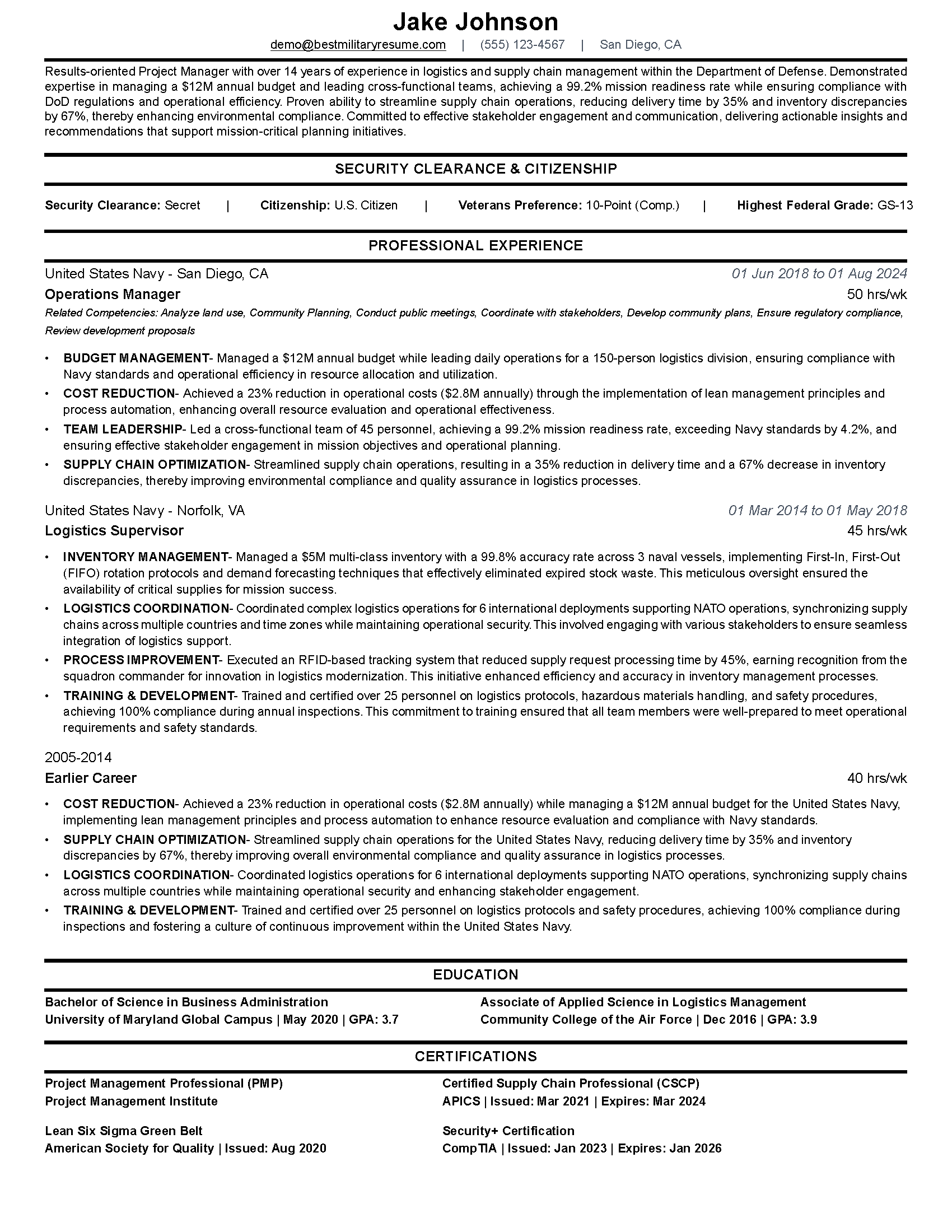
What does a 1560 posting make you prove?
Read the specialized experience lines word for word. They're the test. The OPM HR Solutions GS-13 posting asks for one full year (52 weeks) at the GS-12 level. It wants all three of these:
- "Conducting analyses using advanced statistical methods to answer a business or research question."
- "Using SQL and programming languages (e.g., Python, R) to collect and transform data for analytical purposes."
- "Applying AI tools (e.g., generative AI, large language models, agentic AI) to support data analysis or develop analytical applications"
The posting puts "AND" before the last item. Two out of three won't do. Your resume has to show all three in the same year of work.
Postings change by grade, too. An NIH Data Scientist GS-1560-12/13/14 posting shows the ladder. It's NIH-GR-DH-26-12897375, open March 23 to 27, 2026.
- GS-12: Data collection, prep and analysis in R or Python, including feature engineering. Advanced stats such as MANOVA or Bayesian methods. ML and AI tools. Charts in tools like Tableau for stakeholders.
- GS-13: Writing and adapting code. ML and AI on unstructured data. Explaining findings with tools like Tableau. Explaining data science ideas to stakeholders such as researchers and leaders to build consensus on data plans.
- GS-14: Designing the code and tools, and leading the design and method of whole projects.
That's the climb. GS-12 runs the analysis. GS-13 explains it and builds agreement on the data plan. GS-14 designs the work for others. Your bullets need to show the level you're applying for.
Our guide to writing specialized experience covers the general method. The NIH posting also warns you. "Do not copy and paste the duties or specialized experience from this announcement into your resume." Use the posting's words only where they describe work you really did.
How does intel or cyber work match each posting line?
Many intel and cyber analysts already do data work. The trouble is the resume calls it "analysis" and stops there. Name the parts. Each bullet should say the tool, the data, the method, who used the result and what changed.
| Military work | Posting line it can prove | What to write |
|---|---|---|
| All-source trend work on incident reports. | Advanced statistical methods. | The method (regression, time series, clustering), the question, and the size of the data. |
| SIGINT target development across large collection. | SQL and programming to collect and transform data. | The language, the tables or feeds you pulled, and what you cleaned or joined. |
| Cyber threat hunting with query languages. | SQL and programming, plus stats for anomaly work. | The query language (SQL, KQL or SPL), the log volume, and the baseline you built. |
| Readiness or ops dashboards. | Charts for stakeholders (NIH GS-12). | The tool (Tableau, Power BI), the audience, and the decision it fed. |
| Approved generative AI tools on the network. | Applying AI tools. | The task, the tool type (LLM, generative AI), and the time or error it cut. |
This fits several jobs. A 35F Intelligence Analyst or an Air Force 1N0X1 All Source Intelligence Analyst often fits the stats row. A 35N Signals Intelligence Analyst fits the SQL row. A 17C Cyber Operations Specialist or a Navy CTN fits the hunting row. Marine 0231s land in the stats and dashboard rows.
How do you show the grade level without a GS grade?
Military jobs don't carry a GS grade. So the scope has to show the level. Say who used your product and what they decided with it. A chart for your section chief shows a lower level. A model a brigade commander used to move assets shows a higher one.
When I sat on hiring panels, the bullets I could score named that user and that decision. Skip "GS-12 equivalent" lines. Show the scope instead.
If you didn't use AI tools on the job, don't write that you did. Find a posting that doesn't ask for it, or build that year of work first.
What does a finished 1560 experience block look like?
Here's a full sample, aimed at the OPM HR Solutions GS-13 posting. Jane Sample is made up. She's a former Army 35F, and every number below is made up to show the shape. Swap in your own facts and your own figures.
Intelligence Analyst (35F), Sergeant First Class (E-7)
U.S. Army, [Unit name], [City, State]
05/2022 to 08/2026, 50 hours per week
- STATISTICAL ANALYSIS- Built a time series model in Python on 14,000 incident reports to forecast where attacks would rise next quarter for a brigade staff. The model cut forecast error from 30% to 12% against actual trends, and the commander used it to move 3 patrol bases.
- DATA COLLECTION AND TRANSFORMATION- Designed SQL queries and Python scripts to pull, clean and join 6 report feeds into one analysis table used by 9 analysts on the brigade intelligence staff. The daily pipeline cut weekly data prep from 20 hours to 4 and removed 2,300 duplicate records.
- GENERATIVE AI TOOLS- Launched an approved large language model workflow to sort and summarize 1,800 field reports a week for a 9-person analysis cell. Built a review check against source reports that cut triage time 40% and held summary errors under 2% in weekly audits.
- BRIEFING SENIOR LEADERS- Delivered 24 weekly briefings on model findings, methods, error rates and limits to a colonel and 6 staff leads, using Tableau dashboards built from the shared analysis table. The staff adopted the forecast as the agreed start point for monthly collection plans across 4 battalions.
Now check it against the posting. The first bullet answers item 1: a named stats method, a real question and a decision. The second answers item 2: SQL and Python used to collect and transform data. The third answers item 3: an AI tool applied to analysis. The fourth shows the GS-13 step NIH describes. Findings and data science ideas get explained to build consensus on the data plan.
The method behind each bullet
This is how BMR writes federal bullets. Each one opens with a short header in capitals, five words or fewer. A hyphen follows, then one or two sentences of 40 to 60 words. The header names only what the bullet proves.
- What you did: Open with a verb that shows the work, like built, designed, launched or delivered.
- Scope: Give the people, records, sites or dollars involved.
- Result: Give what changed, with the number copied exactly from your records.
- Tense: Use past tense for every job, even the current one.
- Cut: Drop "responsible for", "assisted with", "helped", "oversaw" and "utilized". Drop "I" too.
How do you write the education block and send the transcript?
Put the education right where a reader can check it. List the degree, the school, the date and the major. If you're using the 30-hour route, add a line with the hours. Here's a sample for the same made-up Jane Sample:
Bachelor of Science, Information Technology
[University name], [City, State], completed 12/2021
Relevant course work: 33 semester hours in math, statistics and computer science. Courses: Statistics I and II (6), Probability (3), Calculus I (4), Linear Algebra (3), Discrete Math (2), Intro to Computer Science (3), Data Structures (3), Python Programming (3), Database Systems with SQL (3) and Machine Learning (3).
Then send the transcript, every time. Rules vary by posting. OPM HR Solutions sets a firm rule. "All applicants must provide official or unofficial transcripts." The NIH posting calls them "highly encouraged." It takes unofficial ones with the application and requires official ones from selectees before an official offer. Upload yours anyway, and make sure the 30 hours are easy to see.
Keep it all on two pages. Two pages is the rule for most federal jobs, but check the announcement, because some are exceptions.
These two postings are clear. OPM HR Solutions writes this. "Only the first 2 pages of the resume/application will be used to verify minimum qualifications." NIH writes this. "If your resume exceeds two pages, only the first two will be reviewed."
NIH also says it won't open web links on your resume. So a GitHub link won't count as proof. Put the work in the bullets. Our two-page federal resume examples show how to fit a long career.
Should you apply under 1560 or a nearby series?
Intel and cyber analysts with data skills often qualify for more than one series. Pick by what the job does day to day and what your transcript holds.
- GS-1560 Data Science: The work is modeling, stats and code. You have the degree or the 30 hours.
- GS-0132 Intelligence: The work is the intel product itself. Our GS-0132 intelligence resume guide covers it.
- GS-1550 Computer Science: The work is software and system design. It has its own math rule, set out in our computer science series guide.
- GS-2210 IT Management: The work is networks, systems and cyber defense. See our GS-2210 IT specialist guide.
- GS-1530 Statistics: The work is statistics itself, like sampling and analyzing statistical data. Check its OPM standard before you build for it.
Can't meet the 1560 education rule yet? Then 0132 or 2210 may get you in the door now. You can apply to 1560 jobs once the hours are done.
What to Do Next
Pull one open GS-1560 posting on USAJOBS. Copy its specialized experience lines. Write one bullet for each line, the way Jane Sample's block does. Then add your education block with the hours.
Daniel is a retired Air Force Master Sergeant. He built his resume on BMR for an Intelligence Community job he'd long wanted. He got it, and he wrote in that it came "complete with a six-figure salary increase."
The BMR federal resume builder does this next step with you. Paste the posting. It rewrites your summary, bullets and skills in the posting's words, using only work you did. For federal jobs, it also tells you when you don't meet the minimum qualification.
Frequently Asked Questions
Do bootcamps or certificates count toward the GS-1560 30 semester hours?
Can I get a GS-1560 job through direct hire?
Do I need a security clearance for a GS-1560 job?
Should I list Python, SQL and R in a skills section?
Can a GS-0132 intelligence specialist move to GS-1560 later?
About the author
Brad Tachi is the CEO and founder of Best Military Resume and a 2025 Military Friendly Vetrepreneur of the Year award recipient for overseas excellence. A former U.S. Navy Diver with over 20 years of combined military, private sector, and federal government experience, Brad brings unparalleled expertise to help veterans and military service members successfully transition to rewarding civilian careers. Having personally navigated the military-to-civilian transition, Brad deeply understands the challenges veterans face and specializes in translating military experience into compelling resumes that capture the attention of civilian employers. Through Best Military Resume, Brad has helped thousands of service members land their dream jobs by providing expert resume writing, career coaching, and job search strategies tailored specifically for the veteran community.
