GS-0806 Resume Guide: Materials Engineering Federal Jobs
Christopher was selected for GS-13 on his first-ever USAJOBS application.
Christopher, E-7, Coast Guard, now writes policy for the work he did on active duty
You find a GS-0806 announcement at an Air Force depot. The title says Materials Engineer. You scroll down to the duties and it reads like your last four years.
Failure analysis on cracked components. Corrosion investigation. Nondestructive inspection. Coating evaluation. Metallurgical testing.
Then you hit the section called Basic Requirements. It says degree in engineering. You close the tab.
I hear this one every month from metals techs, NDI airmen, hull techs and machinists. Fifteen years with hands on the material. No engineering degree. So why bother applying.
This guide walks the actual OPM rule for GS-0806. In about five minutes you will know if you clear the gate. If you clear it, you will know what your resume has to show.
Six times I have gone through federal hiring into a brand new career field. Environmental Management. Supply. Logistics. Property Management. Engineering. Contracting. The engineering move is the one that taught me how strict this gate really is.
So let me be straight with you up front. The GS-0806 education gate is real and it is strict. But it has more doors than most people ever hear about.
What Does a GS-0806 Materials Engineer Actually Do?
OPM writes a definition for every job series. The one for materials engineering is worth reading slowly.
The series covers work that determines a material's composition, structure and processing. It ties that composition to properties, end use and performance. It also covers testing and evaluating substances for new applications.
OPM goes further than that. The classification standard for the 0800 group lists parenthetical titles for 0806. Read them and see how much you already do.
- Metals: metals and alloys picked by testing for compatibility with an end use.
- Nondestructive Evaluation: methods for finding flaws and discontinuities in materials.
- Failure Analysis: investigating failed materials and surfaces to find the cause.
- Coatings: coatings for corrosion protection, wear, lubrication and environmental exposure.
- Composites: materials built by combining two or more distinct materials.
- Structural Analysis: mechanical properties under load, plus models that predict service life.
- Manufacturing: improving or developing fabrication and processing techniques.
- Polymers, Ceramics, Fluids and Textiles: four separate titles covering plastics, adhesives, glass, lubricants and fibers.
Look at the first four again. Metals. Nondestructive evaluation. Failure analysis. Coatings. That is the daily work of a lot of aviation and hull maintenance shops.
So the work matches. The qualification gate sits on a separate track, and that is the part that trips people.
Two different questions
Can I do the work is one question. Do I meet the basic requirement is another. HR answers the second one first, and it is a yes or no.
Do You Need an Engineering Degree for GS-0806?
GS-0806 sits inside the 0800 group of professional engineering series. Every series in that group shares one basic requirement.
OPM calls this a positive education requirement. Education is baked into the minimum bar. Experience by itself cannot replace it.
There are two paths through. Most people only ever hear about the first one.
Path A: the engineering degree
Path A is a degree, and it can be met two ways.
The first way is a bachelor's degree from a school of engineering. That school needs at least one ABET accredited program. ABET accredits individual programs, not whole institutions.
The second way is still a degree, judged on its courses. Your engineering program must include differential and integral calculus. It must also include courses beyond first year physics and chemistry in five of seven areas.
OPM names those seven areas:
- Statics and dynamics
- Strength of materials, meaning stress and strain relationships
- Fluid mechanics and hydraulics
- Thermodynamics
- Electrical fields and circuits
- Nature and properties of materials
- Any comparable area, such as optics, heat transfer, soil mechanics or electronics
Notice the sixth one. Nature and properties of materials is the core of this whole job series.
Path B: the combination route
Path B is where the doors open up. OPM allows college level education, training and technical experience in combination.
That background has to give you two things. A thorough knowledge of the physical and mathematical sciences under engineering. And a solid grasp of engineering science in theory and in practice.
You prove it with any one of four things. The full text sits in the OPM individual occupational requirements for professional engineering positions.
Four ways to meet Path B
Registration or licensure
Current registration as an Engineer Intern or Engineer in Training. A Professional Engineer license also works, from any state, DC, Guam or Puerto Rico. Watch one limit. A registration earned without a written test only counts in the specialty field of that registration.
A written test
Proof that you passed the Fundamentals of Engineering exam. Another written test that a state engineering licensure board sets for professional registration also counts.
Specified academic courses
At least 60 semester hours in the physical, mathematical and engineering sciences. Those hours must include the Path A courses and count toward an engineering program.
A related curriculum
A bachelor's in a related scientific field, such as engineering technology, physics, chemistry, math or computer science. Add at least 1 year of professional engineering experience under professional engineering supervision.
Door four is the one people miss. An engineering technology degree counts here. So do physics, chemistry and math degrees.
You still need that year of professional engineering experience under an engineer. OPM also expects either a real training plan or several years of prior engineering type work behind it.
Door two deserves a hard look too. The Fundamentals of Engineering exam is a test, not a degree program. Check your state licensing board first. Each board sets who may sit for it. NCEES designs it for students and recent graduates of ABET accredited engineering programs.
No transcript, no credit
Coursework only counts if the rater can see it. Upload transcripts with the application. Many announcements accept unofficial copies at the application stage. Read each announcement closely.
What If You Have the Experience but No Degree?
Say none of the four doors fit. No degree, no license, no exam, no 60 hours. Then GS-0806 is closed to you today.
I am not going to sell you a workaround that does not exist. But you still have real moves, and some are faster than people expect.
1 Look at GS-0802 first
2 Run the quality assurance lane
3 Take the wage grade door in
4 Buy the gate with the GI Bill
Two of those lanes have their own guides on this site. Start with our GS-1910 quality assurance resume guide and the wage grade trades application guide.
If the degree is your whole blocker, read how to get a federal job without a degree. It covers the series that never had this gate.
How Is GS-0806 Different from GS-0801 General Engineering?
Veterans apply to the wrong one of these all the time. The split comes down to what the work centers on.
GS-0801 covers engineering work that spans two or more engineering series with no single discipline in charge. It also catches engineering work that has no established series of its own.
GS-0806 centers on the material itself. Composition. Structure. Properties. Performance in service.
Both series share the exact same 0800 basic requirement. Clear it once and you may qualify in any branch of engineering. Two limits apply. Selective factors on the announcement can narrow that range. A registration earned without a written test only counts in its own specialty.
One more wrinkle matters if you came up in a weld shop. OPM canceled the Welding Engineering series, 0894, back in 2008.
Welding engineering work now gets classified to whatever engineering series fits the job. If none fits, it lands in 0801. Agencies may still use the title Welding Engineer inside that series.
So set your saved search on both codes. Our GS-0801 general engineering federal resume guide covers that side in full detail.
Which GS Grade Should You Apply For?
Grade is where people leave money on the table. They aim low because the announcement looks intimidating.
Two OPM documents set your grade. The 0800 standard adds provisions for engineering graduates. The group standard for professional positions sets the rest. Know both before you pick a grade.
- GS-7: superior academic achievement on a bachelor's degree in an engineering program.
- GS-9: superior academic achievement plus 1 year of appropriate professional experience.
- GS-7, five year route: a 5 year engineering program of at least 160 semester hours.
- GS-9, five year route: that same program plus 1 year of appropriate professional experience.
- GS-11: 1 year of experience equal to GS-9, or a Ph.D. Three years of graduate study leading to a Ph.D. also works.
- GS-12 and above: 1 year of specialized experience equal to the next lower grade.
- Research positions: They run their own ladder. A master's alone reaches GS-11 there, and a Ph.D. reaches GS-12.
- The plain routes: These sit on top of the basic requirement, not instead of it. GS-7 also opens with 1 year equal to GS-5. GS-9 also opens with 1 year equal to GS-7 or a master's degree.
There is another provision that was practically written for this audience. It rarely gets mentioned anywhere.
Hold an engineering bachelor's degree and have technician experience equal to GS-5 or higher. That technician experience can be credited toward GS-7, month for month, up to 12 months.
Read that again if you spent years in a metals shop and later finished a degree. Your shop time is not decoration. It can pull your entry grade up.
Graduate school changes the math too. A master's or higher degree in engineering is fully qualifying for the grade it supports. Your undergraduate field does not matter. OPM adds one condition. Your total record must show knowledge close to the Path A coursework.
For the wider grade picture across series, read how to pick the right GS grade.
How Do You Write the GS-0806 Resume So It Ranks?
Once you clear the gate, the resume does the rest of the work. Federal resumes run 2 pages max under current OPM guidance.
Two pages is tight for this kind of record. So spend them on purpose.
Where should the education go?
The HR specialist screening your package has one first question. Does this person meet the basic requirement.
Put an education block near the top of page one. List the degree, major, school, graduation date and your qualifying semester hours.
If you qualify under Path B, name the route in a single line. Something like passed the FE exam in a given month and year. Or 60 semester hours in the physical, mathematical and engineering sciences.
Then upload the transcripts. Coursework you cannot prove does not get counted.
How should the experience be worded?
Write your bullets in the language OPM uses for this series. Same work you already did, described with the words the rater is scanning for.
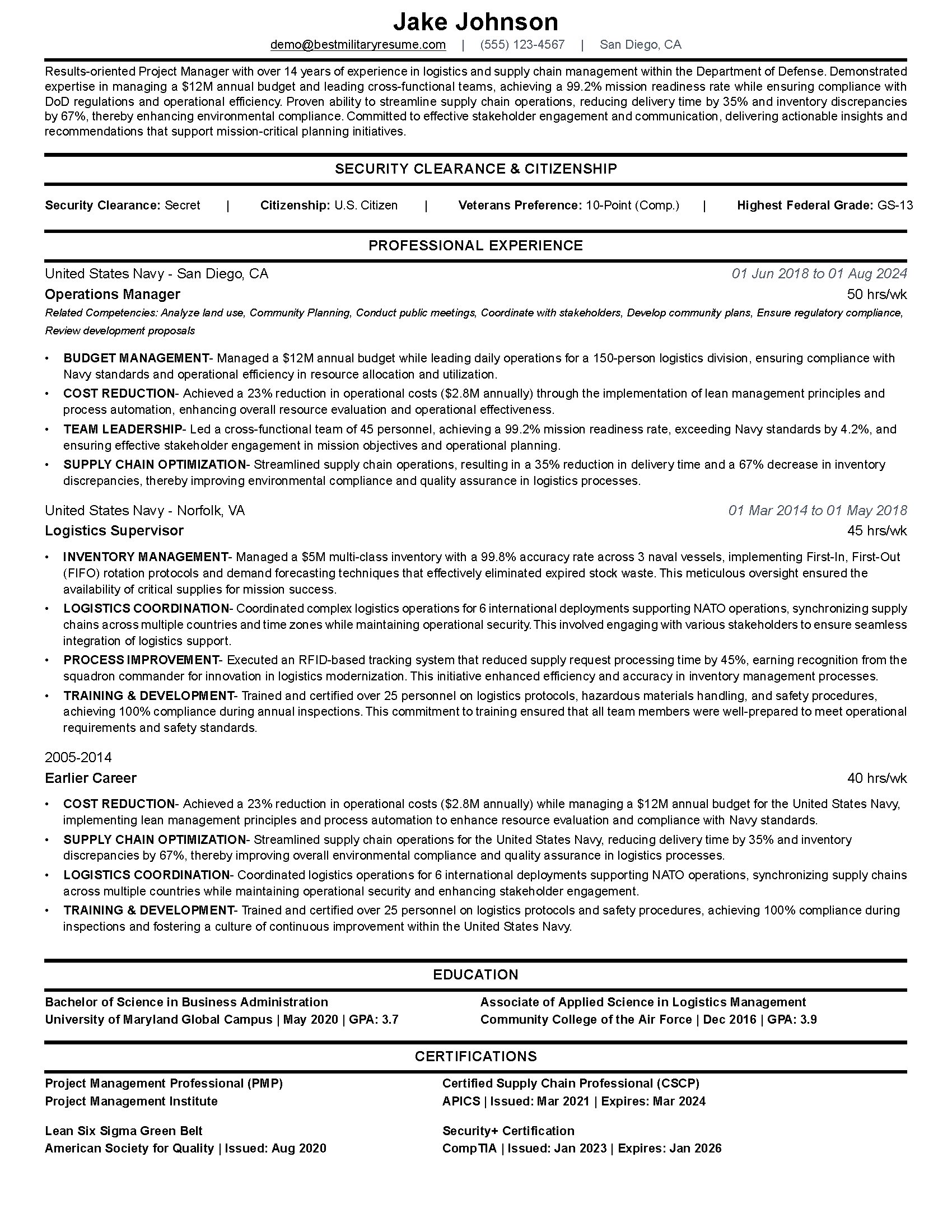
Performed NDI on aircraft parts using eddy current, ultrasonic and penetrant methods. Wrote up findings in the maintenance system.
Performed nondestructive evaluation of aluminum and titanium aircraft structures using eddy current, ultrasonic and fluorescent penetrant methods. Analyzed crack indications on wing spar fittings and determined probable failure mechanism. Wrote the engineering disposition driving repair or scrap decisions. 40 hours per week.
The second version uses the words OPM put in the series definition. Nondestructive evaluation. Failure mechanism. Materials named by alloy family.
It also lists hours per week. Federal resumes need that on every job. Leave it off and the rater cannot count your qualifying year.
Our federal resume work experience format guide walks the full block layout. The 2 page limit guide covers what to cut when you run long.
Should you tailor to the announcement or the series?
Tailor to the announcement, every time. Each posting carries its own specialized experience paragraph.
Read that paragraph twice and mirror its nouns in your bullets. A research lab announcement and a depot failure analysis announcement want very different words.
Two guides help here. Read how to decode a USAJOBS announcement, then how to prove specialized experience.
Who Hires GS-0806 in DoD?
OPM lists where most federal materials engineers work. The list covers agriculture, defense, aviation, space, health, nuclear energy and transportation agencies. OPM does not rank it. In practice, most open 0806 postings on USAJOBS are defense jobs.
Point a saved search at these:
- Air Force Research Laboratory: its Materials and Manufacturing Directorate sits at Wright-Patterson AFB.
- Navy Fleet Readiness Centers: their materials labs analyze failed components, evaluate materials and investigate corrosion.
- DEVCOM Army Research Laboratory: one of its eleven research competencies is Sciences of Extreme Materials. That work covers materials and manufacturing methods for performance extremes.
- DLA Strategic Materials: has posted GS-0806 Materials Engineer roles at Fort Belvoir on USAJOBS.
Depots, shipyards and air logistics complexes run materials labs of their own. Those labs sit much closer to your shop experience than a research lab does.
Veterans preference generally applies here like it does elsewhere in the competitive service. One limit matters at GS-9 and above. Under 5 U.S.C. 3319, a 10 percent disability no longer moves you into the top category. That applies to professional positions like GS-0806. The USAJOBS veterans hiring paths page lays out the authorities you may be able to use.
Some of the jobs feeding this series show up again and again. If you served in one of these, the material side of GS-0806 is already familiar ground:
- Air Force 2A7X1 Aircraft Metals Technology
- Air Force 2A7X2 Nondestructive Inspection
- Navy AM Aviation Structural Mechanic
- Navy HT Hull Maintenance Technician
What Should You Do This Week?
Four moves. None of them take long.
Pull every transcript you have
Count the semester hours in calculus, physics, chemistry, statics, thermodynamics and materials courses. Include community college and service school credit.
Test yourself against the four doors
Licensure, written test, 60 semester hours, related degree plus a year of engineering work. You only need one of them to clear.
Save a search on 0806 and 0801
Set an email alert on both series. Add 0802 and 1910 if the education gate still blocks you.
Rebuild the top of page one
The basic requirement should be readable in five seconds. Education block, qualifying route, then the specialized experience that matches the announcement.
Key Takeaway
GS-0806 has an education gate that experience alone cannot open. An engineering degree opens it. Four other routes open it too. A license and a passed FE exam are two of those four. State boards decide who may sit for that exam.
Where Does This Leave You?
The metals techs and NDI airmen I talk to almost never fail on the work. They fail on the paperwork around the work.
They bury the degree on page two. They skip the transcript upload. They describe a materials job in shop slang. The series has its own words and the rater scans for those.
Those are all fixable in an afternoon. The gate itself takes longer, and for some of you it means a semester or an exam.
Either way, check the four doors before you write off GS-0806. A lot of veterans in this lane already hold one and never knew it counted.
When you are ready to build it, our federal resume builder handles the format and series language. It is free to start. It also holds your file inside the 2 page federal limit.
Then go find the announcement and apply. The work already matches. Now make the paperwork match too.
Frequently Asked Questions
Do I need an ABET accredited degree to apply for GS-0806?
Can military experience alone qualify me for GS-0806?
Does passing the FE exam qualify me for GS-0806?
What grade can I apply for with a new engineering degree and years as a metals tech?
What is the difference between GS-0806 and GS-0801?
What happened to the GS-0894 Welding Engineering series?
How long should my GS-0806 federal resume be?
About the Author
Brad Tachi is the CEO and founder of Best Military Resume and a 2025 Military Friendly Vetrepreneur of the Year award recipient for overseas excellence. A former U.S. Navy Diver with over 20 years of combined military, private sector, and federal government experience, Brad brings unparalleled expertise to help veterans and military service members successfully transition to rewarding civilian careers. Having personally navigated the military-to-civilian transition, Brad deeply understands the challenges veterans face and specializes in translating military experience into compelling resumes that capture the attention of civilian employers. Through Best Military Resume, Brad has helped thousands of service members land their dream jobs by providing expert resume writing, career coaching, and job search strategies tailored specifically for the veteran community.
