GS-0685 Public Health Program Specialist Federal Resume
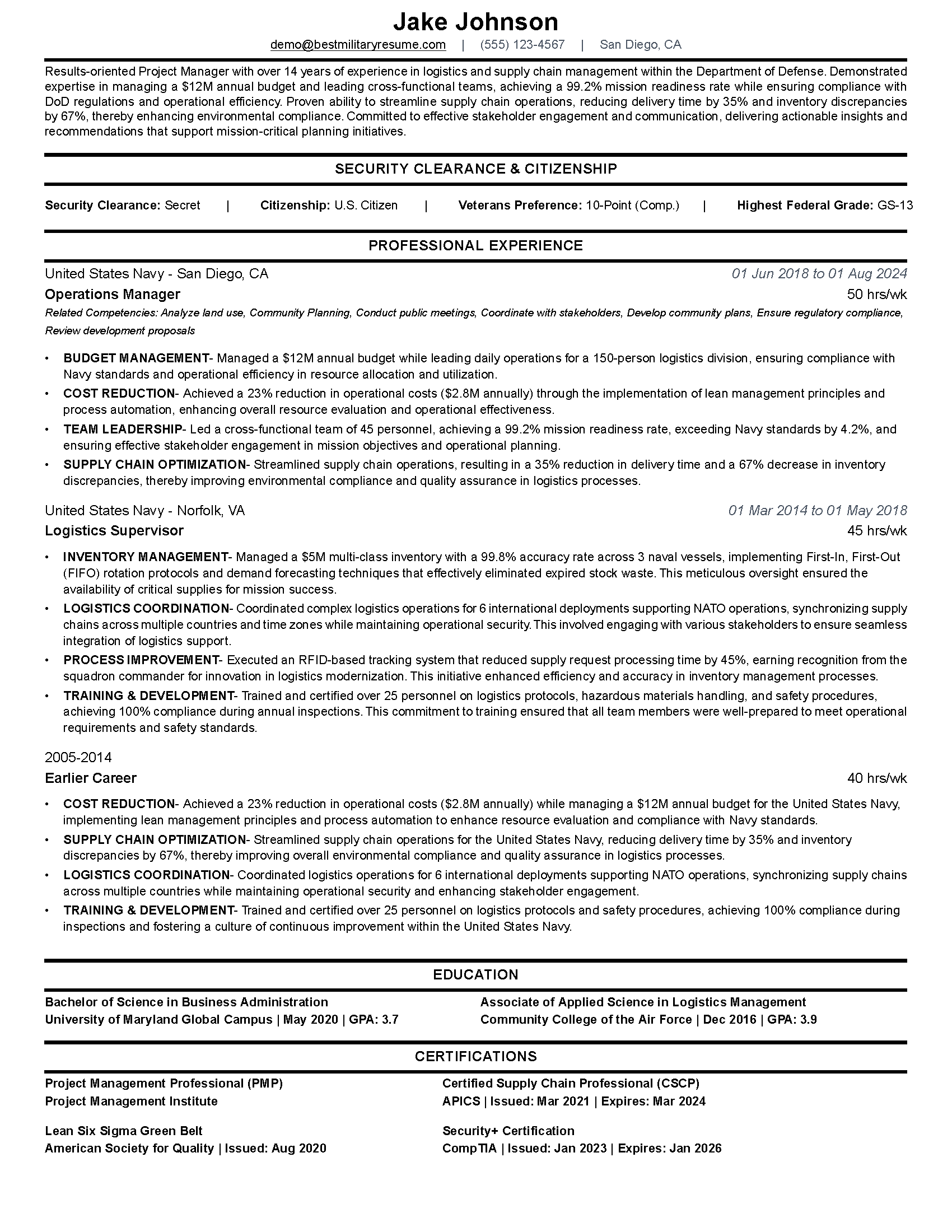
Christopher was selected for GS-13 on his first-ever USAJOBS application.
Christopher, E-7, Coast Guard, now writes policy for the work he did on active duty
OPM's 0685 standard takes "Major study -- any field" at GS-5/7 but public health or related study at GS-9/11. For GS-11, work counts: a closed 04/26/2026 HRSA posting wanted a year "equivalent to at least the GS-09 grade level" doing four tasks, including "Analyzing public health data from surveys, studies, or surveillance systems to identify trends and inform program decisions."
This GS-0685 public health program specialist federal resume guide shows where your grade starts. It also shows how preventive medicine work maps to those words. It includes a table and one full job block aimed at that GS-11 line.
OPM is the Office of Personnel Management. HRSA is the Health Resources and Services Administration, part of the Department of Health and Human Services (HHS). The series is called Public Health Program Specialist. HRSA titles these jobs Public Health Analyst.
The guide is for an Army 68S Preventive Medicine Specialist or an Air Force 4E0X1 Public Health airman. It also fits a Navy Preventive Medicine Technician (PMT). Those are the job titles the O*NET military crosswalk lists for 68S and 4E0X1.
What does OPM mean by Advisor work and Analyst work?
OPM's standard gives two examples of qualifying experience. They name two kinds of 0685 work:
- "Public Health Advisor positions -- providing advice and assistance to State and local governments, and to various public, nonprofit, and private agencies and organizations on matters relating to the improvement of their public health activities."
- "Public Health Analyst positions -- conducting studies and performing other analytical work related to the planning, development, organization, administration, evaluation, and delivery of public health programs."
BMR advice: pick one before you write a word. Analyst work is studies, data and program reviews. Advisor work is guidance to other groups that run public health programs.
Military preventive medicine has some of both. A Navy Environmental Health Officer (EHO) in a 2026 DVIDS story from Naval Hospital Pensacola said, "We act as program advisors to the command triad on public health matters."
BMR advice: that advice went to commanders, not State or local governments. Write it as advice to a group, and name the group. Then let the rater judge the fit.
Your 0685 entry grade comes from school, work or both
The grade you can claim depends on one of two routes. One is school. The other is work: general experience at GS-5, and a year at the grade below from GS-9 up.
| Grade | School route | Work route |
|---|---|---|
| GS-5 | OPM, under "Undergraduate and Graduate Education": "Major study -- any field." | OPM general experience, such as the ability to "Collect and evaluate facts." |
| GS-9 | HRSA: "a master's or equivalent graduate degree or 2 full years of progressively higher level graduate education" | One year "equivalent to at least the GS-7 grade level" |
| GS-11 | HRSA: "a Ph.D. or equivalent doctoral degree or 3 full years of progressively higher level graduate education" | One year "equivalent to at least the GS-09 grade level" |
| GS-12 | None listed | "one full year of the minimum qualifying experience comparable in difficulty and responsibility to at least the GS-11 level" |
The table has no GS-7 row because none of the postings used here was open at GS-7. The GS-9 and GS-11 rows come from the closed 04/26/2026 posting. The GS-12 row comes from a closed 12/13/2024 HRSA posting. That GS-9 and GS-11 posting paid $85,447 - $111,087 at GS-11 in Rockville, MD.
The posting names the study fields: "Public Health or other field of study with course work directly related to the work of the position to be filled." It also allows a mix of both routes.
The GS-9 work route lists four tasks. One is "Collecting public health data from surveys, studies, or surveillance systems according to established protocols."
BMR advice: if you collected the data but someone else analyzed it, aim at GS-9. If you ran the numbers and suggested changes for a full year, aim at GS-11.
See how raters read specialized experience on a federal resume.
How does preventive medicine work stack up against OPM's five competencies?
An HRSA posting says 0685 jobs "require that you demonstrate specialized experience in each of the following five competencies." The left column lists them, shortened. The middle column shows close matches from preventive medicine. Most come from the DVIDS story. The right column is BMR advice.
| OPM competency | Preventive medicine work | Fit for the federal job |
|---|---|---|
| "organizational, operational, and programmatic concepts and practices" | A command's public health program at branch clinics | Direct, if you helped run it |
| "develop and deliver public health or health-related programs in State and local settings" | Base programs, no State or local partner | Weak, unless a State office took part |
| "Knowledge of a specialized public health program" | Vector surveillance, potable water monitoring, food service sanitation | Direct. Name the program. |
| "administrative or analytical methods and techniques" | Trap data and water test records | Direct, if you analyzed them |
| "Skill in oral and written communications" | Inspection reports and briefs to leaders | Direct. Say who read them. |
BMR advice: be honest here. The federal job is program reviews, rule checks and help for grantees. The GS-12 posting lists this as an example of GS-11-level work: "Providing public health technical assistance and guidance to internal and external stakeholders at the State and local level."
Field checks sit next to that work. They are not the same work. Write up the numbers, the records check and the advice. Keep the field steps short.
The same story shows the data side. Data from mosquito trapping and species identification "guides targeted control measures across military installations," it says. That is data steering a program choice. It is the GS-11 task in plain words.
If you mostly did field checks, compare our environmental protection guide and our food inspection guide. If you hold a health science degree, read our general health science guide.
What should a rater see named in your bullets?
A rater cannot credit work they cannot picture. BMR advice: name five things in each tour.
- The program. Say "vector surveillance program," not "prev med."
- The data. Say which records you pulled, how many and how often.
- The system. Navy PMTs log findings in the Defense Occupational and Environmental Health Readiness System (DOEHRS), the DVIDS story says. Spell out any system you used.
- The standard. Name the policy or regulation you checked a program against.
- The reader. Say who got your report and what they decided.
List your training by name too. Navy PMTs attend "approximately six months" of Preventive Medicine Technician "C" School, per the story. It covers "microbiology, parasitology, entomology, food sanitation, water quality, environmental sampling and public health investigations."
BMR advice: drop unit slang and spell out each acronym once. A rater outside the military may read "PM" as a time of day.
HRSA's GS-11 tasks, answered from a 68S surveillance record
This is BMR's sample, not an HRSA form. Swap every [00] and bracket for your own facts. If you can't back a number, cut the bullet.
PREVENTIVE MEDICINE SPECIALIST (MOS 68S), U.S. Army
[Unit], [Installation, State]
MM/YYYY - MM/YYYY | [00] hours per week | [Rank]
- SURVEILLANCE DATA ANALYSIS - Cut vector-borne disease cases by [00]% at [00] clinics by analyzing [00] mosquito and tick surveillance records a month to spot trends.
- COMPLIANCE EVALUATION - Raised compliance with [policy name] to [00]% at [00] facilities by evaluating [00] food service, water and sanitation programs a quarter.
- PROGRAM ADMINISTRATION - Delivered [00] of [00] annual objectives in the [program name] for [00] personnel across [00] sites under the [unit] public health plan.
- OUTCOME ASSESSMENT - Secured approval of [00] program changes from [00] commanders by assessing results from [00] inspections and recommending fixes in [00] reports.
- BRIEFINGS AND WRITTEN REPORTS - Shortened leader response to [00] public health risks to [00] days by briefing [00] leaders a month and writing [00] memos after [00] inspections.
Which posting phrase each bullet answers:
- Surveillance bullet: "Analyzing public health data from surveys, studies, or surveillance systems to identify trends and inform program decisions."
- Compliance bullet: "Evaluating program operations to determine compliance with policies or legislative requirements."
- Program bullet: "Administering public health program activities to achieve defined objectives."
- Outcome bullet: "Assessing program outcomes and recommending improvements based on analysis findings."
- Briefings bullet: OPM's "Skill in oral and written communications" competency.
The GS-11 posting says you must perform "ALL of the following."
BMR advice: give each task at least one bullet, or the rater may stop at the gap.
A 4E0X1 airman uses the same block with the Air Force title. Hours matter because part-time work gets partial credit. See how to list hours per week.
How do HRSA's page limit and no-copy rule change what you write?
OPM's guidance applies the two-page limit to "all competitive service and excepted service announcements under Title 5." The closed 04/26/2026 posting says: "Your resume must not exceed two (2) pages in length."
That covers Title 5 jobs. Always check the announcement. The full rule is in our guide to the two-page federal resume limit.
The closed 12/13/2024 posting adds a warning: "Do not cut and paste the duties, specialized experience, or occupational assessment questionnaire from this announcement into your resume as that will not be considered a demonstration of your qualifications for this position."
BMR advice: use each task as a checklist, not as text. Keep its key nouns, like "surveillance systems." Write the rest in your own words with your own counts.
The 04/26/2026 posting also asks for "start and end dates (month/day/year) for each position."
BMR advice: if your posting asks for that, change the MM/YYYY in the sample to the full date.
Veterans lines on HRSA postings, and the 10 percent exception
The closed 04/26/2026 posting was open to "Veterans of the U.S. Armed Forces or a spouse, widow, widower or parent of a veteran, who may be eligible for derived preference."
It also listed "individuals eligible for VEOA or VRA appointments" and "30% disabled veterans." VEOA is the Veterans Employment Opportunities Act. USAJOBS explains each path on its veterans hiring paths page.
A closed 07/08/2024 HRSA posting spelled out how category rating treats you:
"The Category Rating Process does not add veterans' preference points but protects the rights of veterans by placing them ahead of non-preference eligibles within each category."
This paragraph moves preference eligibles "who meet the minimum qualification requirements" and have a "compensable service-connected disability of at least 10 percent" to the top category. It has an exception "in the case of scientific or professional positions at the GS-9 level or higher."
OPM's 0685 page pairs the series with its standard for administrative and management positions. BMR advice: rated 10 percent or more? Ask the posting's human resources (HR) contact if the exception applies. Then see how category rating ranks veterans.
For proof, the closed 12/13/2024 posting asked for "a DD-214 Member 4 copy, which shows type of discharge." Still serving? It asked for "an official Statement of Service." See using your DD-214 on a federal application.
Rules checked November 2026 against OPM's 0685 standard and three closed HRSA postings on USAJOBS. Check the posting you pick for changes.
What to Do Next
Pick a 0685 posting on USAJOBS. Mark each task in its grade line. Then write one bullet for each task from your own records.
Build it in the BMR federal resume builder and tailor it to the USAJOBS posting you picked. 79,061 resumes have been built on BMR.
Frequently Asked Questions
Will an HRSA public health analyst visit health centers in person?
How long does HRSA's online assessment take, and where is the link?
Are U.S. Public Health Service officers in the pool for HRSA analyst jobs?
About the author
Brad Tachi is the CEO and founder of Best Military Resume and a 2025 Military Friendly Vetrepreneur of the Year award recipient for overseas excellence. A former U.S. Navy Diver with over 20 years of combined military, private sector, and federal government experience, Brad brings unparalleled expertise to help veterans and military service members successfully transition to rewarding civilian careers. Having personally navigated the military-to-civilian transition, Brad deeply understands the challenges veterans face and specializes in translating military experience into compelling resumes that capture the attention of civilian employers. Through Best Military Resume, Brad has helped thousands of service members land their dream jobs by providing expert resume writing, career coaching, and job search strategies tailored specifically for the veteran community.
