GS-2003 Supply Program Management Federal Resume: A Guide for Senior Supply NCOs and Logistics Officers
Christopher was selected for GS-13 on his first-ever USAJOBS application.
Christopher, E-7, Coast Guard, now writes policy for the work he did on active duty
Senior GS-2003 jobs need a year of running or improving a supply program at the grade below. A closed June 2023 General Services Administration (GSA) GS-14 posting wanted GS-13 work "to evaluate and promote program improvements and develop policies, plans and methods to improve supply operations and resolve supply problems."
On the U.S. Geological Survey (USGS) ladder, a GS-12 needs a year at GS-11. GS-11 is the exception: it needs a year at GS-9 or 3 years of graduate school.
By the end you will have three real grade lines mapped to senior supply duties. You will also have a GS-14 job block to copy.
You signed for the property book for years. The posting wants proof you ran the program around it.
This GS-2003 supply program management federal resume guide is for senior supply NCOs (noncommissioned officers) and logistics officers. That covers Army 92Y and 92A, Navy Logistics Specialist (LS) chiefs, Marine 3043 and Air Force 2S0X1. The GS-2003 career page holds the series facts and pay tables.
Did you run the supply program, or work inside it?
That's the first call, because it picks your series. OPM (the Office of Personnel Management) defines the 2003 series in two parts in its GS-2003 classification flysheet:
- "management, direction, or administration of a supply program that includes a mixture of technical supply functions"
- "staff managerial, or administrative work primarily concerned with analyzing, developing, evaluating, or promoting improvements in the policies, plans, methods, procedures, systems, or techniques of a supply program"
Did you supervise supply work across several lines without running the program? Then start with the GS-2001 General Supply Specialist guide.
The supply group has other series too. Two of them are GS-2010 Inventory Management and GS-2030 Distribution Facilities and Storage Management.
Mixed jobs get split. The USGS GS-2003 page says "experience credit is given for the percentage of time that you spent on qualifying duties."
BMR advice: estimate the share of your year spent running the program. Put your program bullets first in each job block.
Which program line can your senior tour answer: GS-11, GS-12 or GS-14?
The OPM 2003 qualification page says: "There are no Individual Occupational Requirements for this series."
It sends you to the group standard for administrative and management jobs. So the posting's own line is what you write to.
Three real lines follow. The USGS lines come from its GS-2003 page. The GS-14 line is the closed 2023 GSA posting.
At GS-11, USGS also takes a Ph.D. or 3 years of graduate school. This guide covers the experience route.
| Job grade | Year needed at | Words you have to answer |
|---|---|---|
| GS-11 (USGS) | GS-9 | "a sound working knowledge of supply program principles and methods and the ability to independently perform moderately difficult and responsible supply work" |
| GS-12 (USGS) | GS-11 | "developing and/or implementing procedures and practices to cover multiple supply objectives, including inventory management of a supply stock fund for expendable and non-expendable items" |
| GS-14 (GSA, closed 2023) | GS-13 | "customer relationship management for complex commodity management; and performing in-depth analysis of large and/or complex supply operations" |
The USGS GS-12 line has more examples. One is "serving on inter-agency or inter-organization committees to identify and resolve, or to assign responsibility for resolving supply issues."
BMR advice: rank does not pick the grade for you. Put your duties next to each line. Aim at the highest line your duties fully answer.
Where do CSDP, property book and inventory duties land in those lines?
CSDP is the Army's Command Supply Discipline Program. A May 2026 DVIDS story on the Supply Excellence Award lists "enforcing the Command Supply Discipline Program (CSDP)" as a goal. DVIDS is the Defense Visual Information Distribution Service.
A 2014 DVIDS story on a brigade CSDP seminar named the work. It said the brigade's CSDP covered property accountability, "establishing CSDP monitors, conducting focus driven visits."
Watch one trap. USGS lists "maintaining property book of nonexpendable property" as a GS-5 example. A bullet that only says you kept the book reads at that level.
| Your senior duty | Line it can answer | BMR advice |
|---|---|---|
| CSDP oversight | USGS GS-12: "procedures and practices to cover multiple supply objectives" | Name units, visits and changes |
| Property book oversight | GSA GS-14: "in-depth analysis of large and/or complex supply operations" | Show records checked and fixes made |
| Inventory program | USGS GS-12: "inventory management of a supply stock fund" | Give item types, value and count |
| Supply policy and SOPs | GSA GS-14: "develop policies, plans and methods to improve supply operations" | List policies and who followed them |
| Supply boards | USGS GS-12: "inter-agency or inter-organization committees" | Name the group and issue closed |
| Supply metrics | GSA GS-14 duty: "directs actions to improve performance" | Show the goal, miss and action |
SOP means standard operating procedure. The GSA duty line in the last row comes from the same closed 2023 posting.
Will the posting count program years you served in uniform?
Read the line before you write. The closed 2023 GSA posting asked for GS-13 work "in the Federal service."
That posting was open only to GSA staff and listed career transition groups. Outside veterans could not apply at all.
Other postings spell out military work. A closed April 2026 Defense Logistics Agency (DLA) posting is a GS-13 program job in the 0301 series. It counts work "equivalent under other pay systems in the Federal service, military, or private sector."
BMR advice: "in the Federal service" sets the level, not where you did the work. OPM's qualification policies judge military experience "on the basis of the duties performed, rather than on the basis of the military rank".
Your tours can carry the year either way. First check who the posting is open to.
Hours count too. USGS defines a year as "twelve months working full-time (at least 35-40 hours per week)." See how to list hours per week.
For how raters weigh a year, see specialized experience on a federal resume.
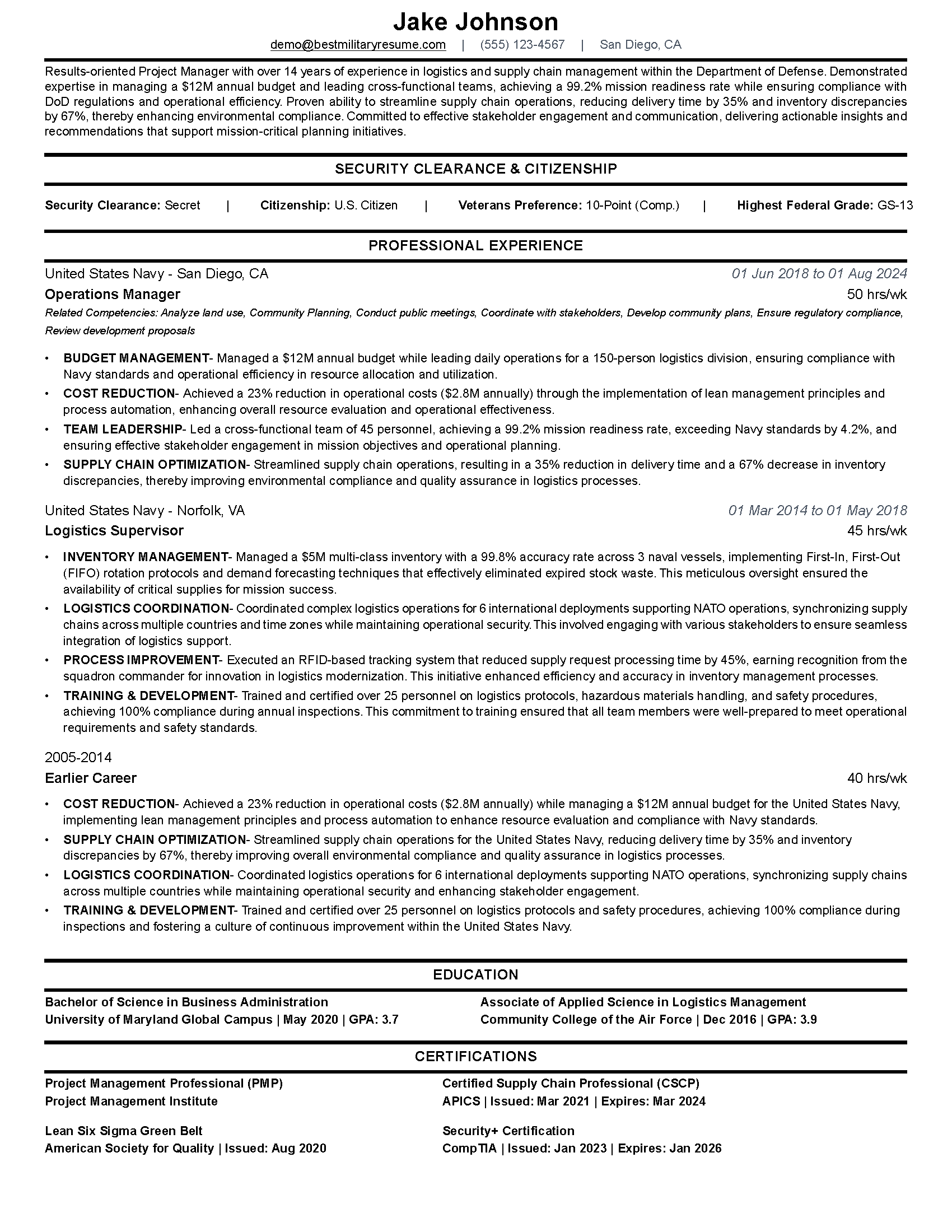
BMR's sample: a senior supply NCO tour written for the GSA GS-14 line
This is BMR's sample, aimed at the closed 2023 GSA GS-14 line. Use its words as a model for an open 2003 posting. Swap every [00] and bracket for your own facts. Cut any line you can't back up.
SENIOR SUPPLY NONCOMMISSIONED OFFICER (MOS 92Y), U.S. Army
[Unit], [Installation, State]
MM/YYYY - MM/YYYY | [00] hours per week | [Rank]
- SUPPLY PROGRAM POLICY - Cut supply discrepancies [00]% across [00] units by writing and issuing [00] supply policies and standard operating procedures for a $[00]M property program.
- COMMAND SUPPLY DISCIPLINE PROGRAM - Raised inspection pass rates to [00]% across [00] companies by directing [00] program evaluations a year and tracking each corrective action to closure.
- SUPPLY OPERATIONS ANALYSIS - Reduced excess on hand by $[00]K by analyzing [00] property book and stock records a quarter and recommending [00] turn-ins and transfers.
- PERFORMANCE GOALS - Improved supply readiness reporting accuracy by [00]% over [00] months by setting [00] performance goals and directing fixes when units missed them.
- CUSTOMER AND COMMODITY SUPPORT - Shortened requisition wait times by [00] days for [00] customer units by managing [00] commodity lines and resolving [00] supply problems a month.
Which posting phrase each bullet answers:
- Policy bullet: "develop policies, plans and methods to improve supply operations".
- CSDP bullet: "evaluate and promote program improvements".
- Analysis bullet: "in-depth analysis of large and/or complex supply operations."
- Goals bullet: the duty line "Monitors program performance against established goals."
- Customer bullet: "customer relationship management for complex commodity management" and "resolve supply problems."
A Navy LS chief or a logistics officer keeps the same five headers. Change the title line and the unit words.
Which posting rules can drop a 2003 resume before a rater reads it?
Page count comes first. OPM's guidance applies the two-page limit to "all competitive service and excepted service announcements under Title 5." The closed DLA 0301 posting puts it plainly: "Your resume must not exceed two (2) pages."
Two pages covers most federal jobs. Always check the announcement. The full rule is in our guide to the two-page federal resume limit.
Three more lines from the closed postings matter:
- Dates: GSA wants "the exact dates you held each job (from month/year to month/year)."
- Questions: GSA says your answers "must be supported by your resume or your score may be lowered."
- Retirees: the DLA 0301 posting says retirees "require a waiver if they would be appointed within 180 days" of retiring. That line covers Department of Defense (DoD) jobs.
Rules checked November 2026 against OPM, the USGS page and three closed USAJOBS postings. Check your own posting for changes.
What to Do Next
Pick an open GS-2003 posting on USAJOBS. Copy its specialized experience line and match one bullet to each phrase.
Build it in the BMR federal resume builder and tailor it to the USAJOBS posting you picked. 79,061 resumes have been built on BMR.
Frequently Asked Questions
What background check came with the GSA GS-2003 supply management job?
Should a GS-2003 resume list performance appraisals and awards?
Are there GS-2003 jobs built around supply IT systems?
About the author
Brad Tachi is the CEO and founder of Best Military Resume and a 2025 Military Friendly Vetrepreneur of the Year award recipient for overseas excellence. A former U.S. Navy Diver with over 20 years of combined military, private sector, and federal government experience, Brad brings unparalleled expertise to help veterans and military service members successfully transition to rewarding civilian careers. Having personally navigated the military-to-civilian transition, Brad deeply understands the challenges veterans face and specializes in translating military experience into compelling resumes that capture the attention of civilian employers. Through Best Military Resume, Brad has helped thousands of service members land their dream jobs by providing expert resume writing, career coaching, and job search strategies tailored specifically for the veteran community.
