Salary Negotiation for Veterans: What to Say
Christopher was selected for GS-13 on his first-ever USAJOBS application.
Christopher, E-7, Coast Guard, now writes policy for the work he did on active duty
Why Do Veterans Struggle With Salary Negotiation?
Military pay is structured. You know your base pay, BAH, BAS, and special duty pay before you ever report. There is zero negotiation involved. E-5 with 6 years gets the same base pay whether stationed at Fort Liberty or Pearl Harbor. That system is predictable, fair, and completely unlike how civilian compensation works.
When a civilian employer asks "What are your salary expectations?" most veterans freeze. Some throw out a number that is way too low because they are comparing to military base pay without factoring in the value of housing, healthcare, and retirement they just lost. Others refuse to answer because it feels uncomfortable, which can signal a lack of confidence to the hiring manager.
The good news: salary negotiation follows a pattern. Once you understand the structure, you can prepare specific responses that feel natural and get you paid what you are worth. This is not about being aggressive or playing games. It is about knowing your market value and communicating it clearly.
After helping 15,000+ veterans through BMR, I have seen the same salary mistakes repeated constantly. Veterans who prepare scripts and practice them out loud consistently land offers $5,000 to $15,000 higher than those who wing it. That gap compounds every year of your career.
"The biggest salary mistake I see veterans make is anchoring to their military base pay. They forget that their total military compensation included housing, healthcare, retirement matching, and tax advantages worth $20,000 to $40,000 per year."
How Do You Calculate Your True Military Compensation?
Before you can negotiate a civilian salary, you need to know what your military compensation was actually worth. Most veterans dramatically underestimate this number because they only think about base pay.
Breaking Down Total Military Compensation
Your military compensation included several components that civilians pay for out of pocket. Base pay was only part of the picture. BAH covered your housing costs tax-free. BAS covered food. TRICARE provided healthcare for your entire family at minimal cost. The military retirement system contributed to your future. And none of your allowances were taxed.
An E-7 with 14 years earning $4,200/month in base pay might think their civilian equivalent is $50,000. But add BAH ($2,100), BAS ($450), TRICARE value ($800/month for a family), retirement contributions, and the tax advantage on allowances, and the real number is closer to $85,000 to $95,000. That is the baseline you should be negotiating from, not $50,000.
Using the Military Compensation Calculator
The Department of Defense maintains a Regular Military Compensation calculator at militarypay.defense.gov. Use it. Input your rank, years of service, and duty station to get your actual total compensation figure. Print it out and bring it to your job search as a reference point. This is not something you show to the employer. It is your internal benchmark so you know your floor.
Do Not Forget Benefits
A civilian salary of $75,000 with no retirement match, $600/month health insurance premiums, and no housing allowance could net you LESS than an E-6 with BAH. Always compare total compensation packages, not just the salary number.

What Should You Say When Asked About Salary Expectations?
This question comes up in almost every interview process, sometimes on the application itself. How you handle it can mean a difference of thousands of dollars. Here are four specific scripts for different situations.
Script 1: Early in the Process (Phone Screen)
When a recruiter asks about salary expectations during an initial call, you want to gather information without committing to a number. Try this response:
"I am focused on finding the right fit for my skills and the team. I would love to learn more about the full scope of the role before discussing compensation. Can you share the budgeted range for this position?"
This works because it redirects the question back to them. Most companies have a range approved for the role. Getting them to share it first gives you an anchor point to work from. If they push back and insist you go first, move to Script 2.
Script 2: When You Must Give a Number
If the employer will not share their range and requires your input, give a range based on your research. Always make the bottom of your range the number you would actually accept.
"Based on my research into this role in [city], the market range for someone with my experience level appears to be $X to $Y. I am comfortable within that range depending on the full benefits package."
The phrase "depending on the full benefits package" is critical. It keeps the door open for negotiation on healthcare, retirement, PTO, and other components that affect your total compensation.
Script 3: After Receiving an Offer
You got the offer. The number is lower than expected. Do not accept on the spot, and do not reject it either. Use this response:
"Thank you for the offer. I am excited about this opportunity and the team. I would like to take 48 hours to review the full package. Could you send me the details in writing?"
Then, when you call back to negotiate:
"I have reviewed the offer and I am very interested in joining the team. Based on my [specific skill/certification/clearance] and the market rate for this role, I was hoping we could discuss adjusting the base salary to $X. Is there flexibility there?"
Script 4: When They Cannot Move on Salary
Sometimes the salary is fixed, especially in government contracting or positions tied to contract labor rates. If the base pay cannot move, negotiate other components:
"I understand the salary is set for this position. Would it be possible to discuss [signing bonus / additional PTO / remote work days / professional development budget / earlier performance review]?"
"I was making about $50,000 in the military so anything around there would work."
"Based on my project management certification, security clearance, and 8 years of logistics experience, the market range for this role is $72,000 to $85,000."
How Do You Research Salary Ranges Before the Interview?
Walking into a negotiation without data is like walking into a briefing without reading the OPORD. You need specific numbers for your target role, location, and experience level. Here is where to find them.
The Bureau of Labor Statistics (bls.gov) publishes median wages by occupation and metro area. Start there for a baseline. Then cross-reference with the specific job posting. Many states now require salary ranges on job postings, and even where it is not required, companies on platforms like LinkedIn and Glassdoor increasingly post ranges voluntarily.
For federal positions, salary negotiation works differently. GS positions have set pay scales, but you can negotiate your step within a grade. If you are offered a GS-12 Step 1, you can request a GS-12 Step 5 or higher by demonstrating superior qualifications. OPM allows agencies to set pay at a higher step when justified. The key phrase to use is "superior qualifications appointment" when making your case to HR.
For government contractor roles, ask the recruiter directly what labor category the position falls under. Contract labor rates are often fixed by the contract, but companies sometimes have flexibility in how they map candidates to labor categories. A candidate who qualifies for a Senior Analyst category versus a Mid-Level Analyst category could see a $15,000 to $25,000 difference.
Salary Research Sources
Bureau of Labor Statistics (bls.gov)
Median wages by occupation and metro area, updated annually
OPM.gov Pay Tables
GS pay scales by grade, step, and locality adjustment
Job Posting Salary Ranges
Many states now require posted ranges on job listings
DoD Military Compensation Calculator
Your true total military compensation for baseline comparison
What Negotiation Mistakes Should Veterans Avoid?
Some negotiation errors are unique to veterans because of how military culture shapes our thinking about pay. Knowing these pitfalls helps you avoid leaving money on the table.
Mistake 1: Accepting the first offer immediately. In the military, when you get orders, you execute. But a job offer is not an order. Employers expect negotiation. Taking 24 to 48 hours to review an offer is standard practice and shows professionalism, not indecision. I have never seen an employer rescind an offer because a candidate asked for time to review it.
Mistake 2: Comparing civilian salary to military base pay only. We covered this above, but it bears repeating. Your military base pay was only 55 to 65 percent of your total compensation. If you anchor to base pay, you will accept offers that actually represent a pay cut.
Mistake 4: Saying "I will take whatever you offer." This sounds humble and team-oriented, which are great military values. In a salary negotiation, it signals that you do not know your worth. Employers may respect the attitude but they will pay you less for it.
Mistake 5: Negotiating only salary. Total compensation includes base pay, bonuses, equity, retirement matching, healthcare premiums, PTO, remote work flexibility, relocation assistance, and professional development budgets. If salary is fixed, there is almost always room to move on one of these other components.
How Does Negotiation Differ for Federal vs Private Sector Jobs?
The negotiation process varies significantly depending on whether you are pursuing a federal government position or a private sector role. Understanding the differences keeps you from wasting effort on the wrong tactics.
Federal Government (GS Positions)
Federal pay is structured by the General Schedule, with grades (GS-1 through GS-15) and steps (1 through 10) within each grade. The grade is typically set by the job posting and your qualifications. Your negotiation leverage is on the step. Each step represents roughly a 3 percent increase in pay.
To negotiate a higher step, you need to demonstrate superior qualifications or match a current higher salary. Prepare a written justification memo that outlines your specific qualifications, certifications, and experience that exceed the minimum requirements for the position. Submit this to the HR specialist handling your hiring action. Reference the OPM guidance on superior qualifications appointments.
If you have an active security clearance, that is a significant bargaining chip for federal positions that require one. The cost and timeline of processing a new clearance gives you real leverage.
Private Sector
Private sector negotiation has more flexibility but also more variability. The hiring manager often has a budget range, and where you land in that range depends on how well you make your case. Come prepared with market data, specific examples of your value, and a clear number. Be ready to explain why you are worth more than the midpoint of their range.
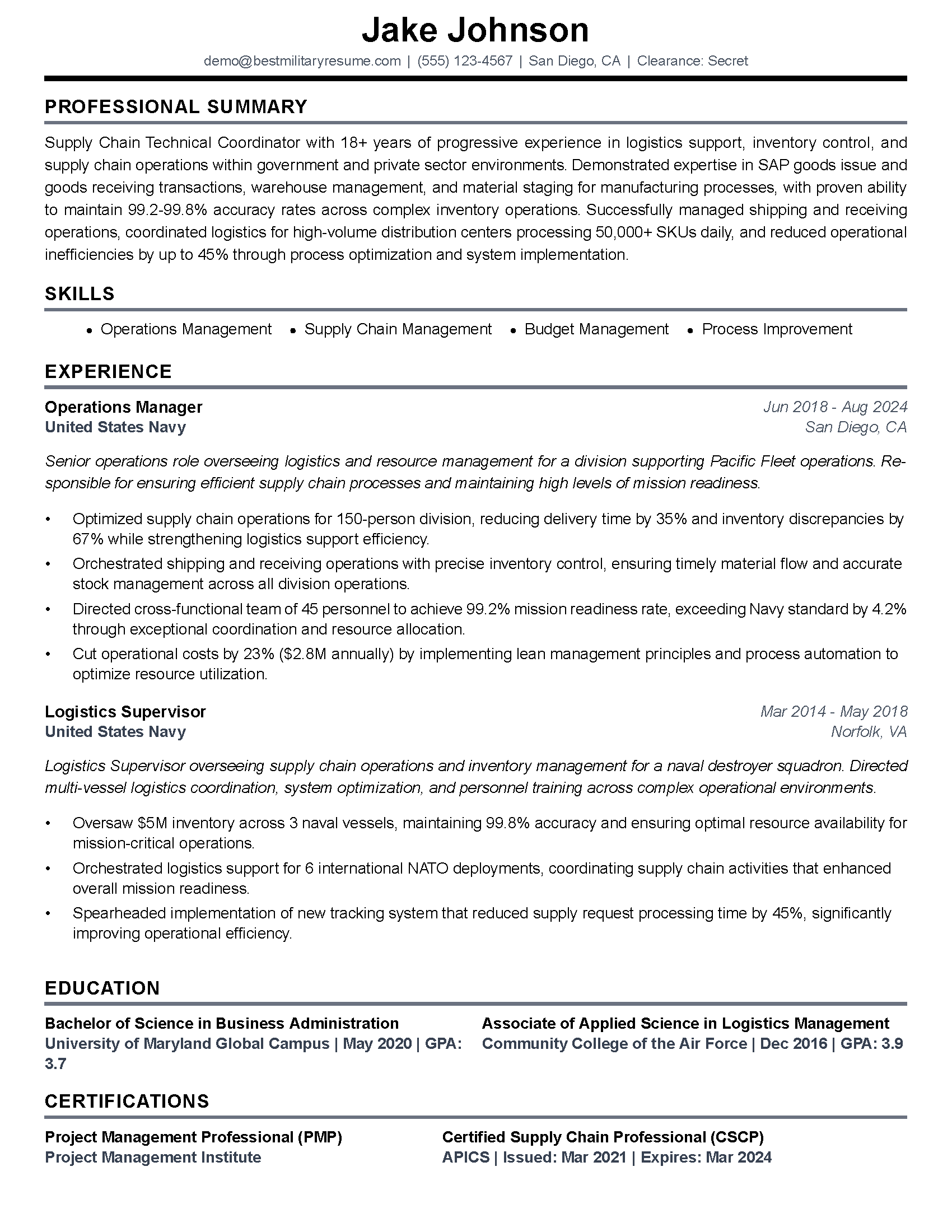
When transitioning from military to civilian roles, your translated military experience needs to be framed in terms of business impact. "Managed a $2.3M equipment inventory with zero losses over 4 years" hits differently than "was responsible for supply management." The more specific your value statements, the stronger your negotiation position.
- •Negotiate step within grade
- •Submit written justification to HR
- •Reference OPM superior qualifications policy
- •Clearance is strong leverage
- •More flexibility on base salary
- •Negotiate verbally with hiring manager
- •Use market data from BLS and job postings
- •Quantified impact statements strengthen your case
How Should You Practice Before the Conversation?
Reading scripts on a screen is not enough. You need to say these words out loud until they feel natural. Salary negotiation is uncomfortable for most people, and veterans especially are not trained for it. Practice removes the discomfort.
Record yourself on your phone delivering your salary response. Play it back. Listen for filler words like "um," "uh," and "you know." Listen for your tone. You want to sound confident and matter-of-fact, not apologetic or aggressive. Practice until you can deliver your number without your voice going up at the end like a question.
Find a friend or spouse to role-play the conversation. Have them push back. "That is above our budget." "We were thinking more in the range of $X." "Other candidates are willing to accept less." Practice responding to each pushback calmly and with data. The more you rehearse objections, the less they will rattle you in the real conversation.
Before any interview where compensation might come up, review your elevator pitch and tie it to your value proposition. Your pitch and your salary justification should tell the same story about the value you bring.
What Comes After You Agree on a Number?
Once you reach a verbal agreement on compensation, the work is not done. Get everything in writing before you give notice at your current job or stop your job search.
Request a formal offer letter that includes base salary, start date, bonus structure (if applicable), benefits enrollment dates, and any special terms you negotiated like remote work days or a signing bonus. Review every line. If something you discussed is missing from the written offer, ask for it to be added before you sign.
Keep your job search active until you have a signed offer letter in hand. Verbal offers can fall through. Budget changes, hiring freezes, and organizational restructuring happen. Do not stop interviewing or turn down other opportunities until the written offer is confirmed.
Once you have the signed offer, send a professional thank-you email to everyone involved in your interview process. Express genuine enthusiasm for joining the team. This sets the tone for your working relationship before day one. The people who interviewed you will be your colleagues, and starting on a positive note matters.
BMR's Resume Builder helps you build the kind of resume that gets you to the offer stage in the first place. It handles the military-to-civilian translation and ATS formatting so you can focus your energy on preparing for interviews and negotiations. The free tier includes two tailored resumes, cover letters, and LinkedIn optimization.
Key Takeaway
Salary negotiation is a skill, not a talent. Prepare your scripts, research your market value, practice out loud, and remember that your total military compensation was worth far more than your base pay. Know your number, say it with confidence, and back it up with data.
Practice with BMR: Try the free Interview Preparation tool to get AI-powered practice questions tailored to your target role.
Frequently Asked Questions
Should I tell an employer my military salary?
Can you negotiate federal government salaries?
What if the employer asks for my salary history?
When should I bring up salary in the interview process?
How much more than the offer should I counter with?
Is it okay to negotiate benefits instead of salary?
What is a superior qualifications appointment for federal jobs?
How do I calculate my total military compensation?
About the author
Brad Tachi is the CEO and founder of Best Military Resume and a 2025 Military Friendly Vetrepreneur of the Year award recipient for overseas excellence. A former U.S. Navy Diver with over 20 years of combined military, private sector, and federal government experience, Brad brings unparalleled expertise to help veterans and military service members successfully transition to rewarding civilian careers. Having personally navigated the military-to-civilian transition, Brad deeply understands the challenges veterans face and specializes in translating military experience into compelling resumes that capture the attention of civilian employers. Through Best Military Resume, Brad has helped thousands of service members land their dream jobs by providing expert resume writing, career coaching, and job search strategies tailored specifically for the veteran community.
