USAJOBS Phone Screen: The Questions One Federal Team Asked and How to Answer
Christopher was selected for GS-13 on his first-ever USAJOBS application.
Christopher, E-7, Coast Guard, now writes policy for the work he did on active duty
A USAJOBS phone screen most often comes after a selecting official picks you to interview. GoGovernment says many agencies use that first call "to confirm your qualifications and interest." So expect to talk about what you did. Expect to say why you want this job.
Below are the four questions one federal tech team asked first, with a way to answer each.
The USAJOBS phone screen's place in federal hiring
GoGovernment is run by the Partnership for Public Service, a nonprofit. Its page on what happens after you apply lays out the order. A human resources (HR) worker "will review and assess every application." Then a list of qualified candidates "is created and sent to a selecting official." So a call most often means your file made that list.
Not every agency works the same way. The Internal Revenue Service (IRS) lists its own steps on its careers site.
IRS hiring officials can interview by panel, in person, by video or by phone. The IRS gives this case: "an applicant may have a phone interview and then an in-person interview." It also notes, "Some positions will not require an interview."
A private company screen plays by other rules. Our civilian phone screen guide covers that call.
Answer from the resume you sent
18F, a federal tech team, wrote a phone screen guide that is now archived. Its opening question says the screener has already looked at your resume. So your answers should match that resume.
The Office of Personnel Management (OPM) puts the rank question plainly. Its Feds Hire Vets answer says, "Your military pay, grade, and rank alone cannot determine your eligibility for a specific civilian salary, grade level, or pay range."
OPM adds that you should "completely and accurately describe the duties you performed during your military service, particularly those military duties that relate directly to the position you are applying for."
That OPM line is about pay and grade. The lesson still holds on the call. Talk about duties, not rank.
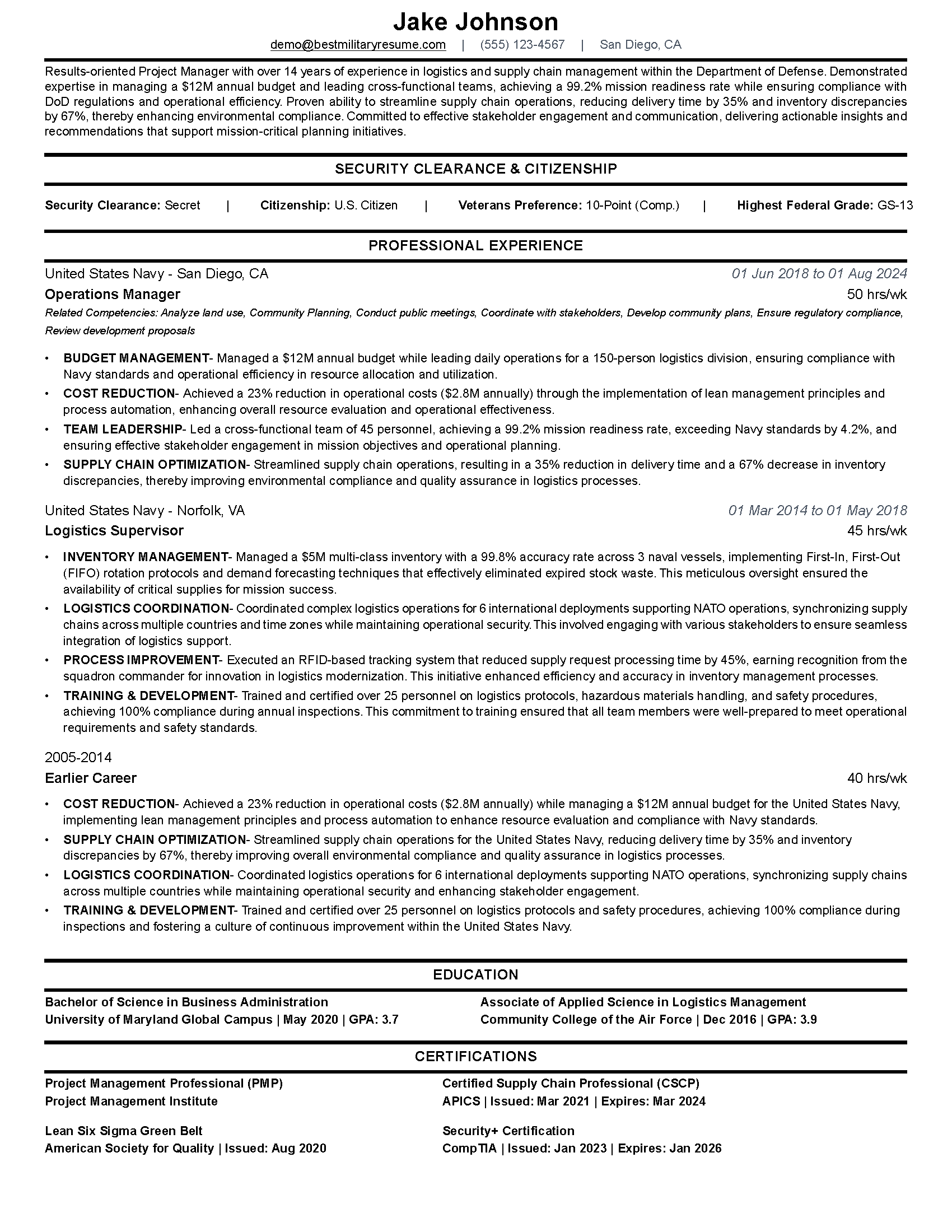
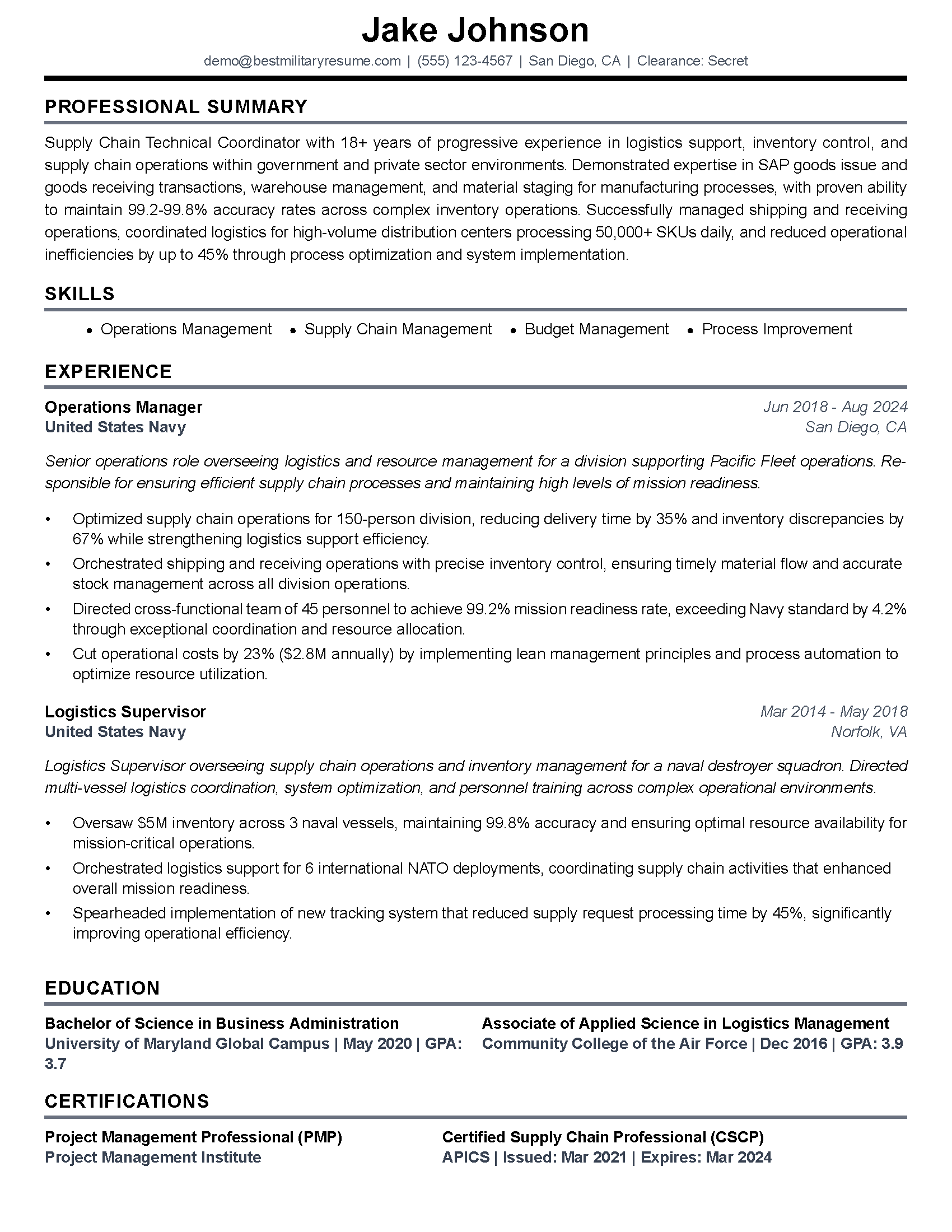
Through November 22, 2026, 79,689 resumes were built on BMR. Use BMR's Resume Builder to make each federal resume for one announcement. Write your duties in civilian words. Then your answers on the call match the resume you sent. A free veteran account gives you one federal tailored resume and one private one.
Get ready before the phone rings
Work through these steps in order when the agency reaches out.
- Find the announcement number. GoGovernment says, "Each job announcement has a reference number. Use that number when you communicate with an agency so your application can quickly be located."
- If you applied to other jobs too, make sure you know which job this call is for.
- Open the exact resume version you sent for that announcement. Don't prep from a newer draft.
- Mark each duty in the announcement that your resume shows. OPM says your application should fully and accurately describe the duties you did in service.
- Check your USAJOBS status. GoGovernment says a status like "Referred" "may provide clues about where your application stands." Our guide to USAJOBS status explains each one.
Opening questions from 18F's archived screener guide
18F's phone screen guide was written for software engineer roles. It is archived as of January 20, 2025. Its questions are one team's real example. They are not a rule for every agency.
The guide told its own screeners that "Phone screens are a rough filter: it can't be used to really qualify a candidate, but it can be used to disqualify." It also used the call to "Make sure the candidate is aware of the unique nature of the job, and is happy to move forward."
The guide opens with four questions. Each has a plain way to answer.
Your professional story
18F's guide has the screener ask, "I’ve had the opportunity to take a look at your resume, but I’d love to hear in your own words a brief version of your professional story."
Keep it short. Name the work you did in civilian words, then where you want to go. Point back to the duties on your federal resume.
Example: I ran supply for a Navy ship's repair shop. I ordered parts, kept the budget and trained new sailors on the stock system. Now I want to do that work for an agency.
Your recent projects
Next comes, "Tell me about a few of your recent projects."
Pick projects your resume already lists. Say what you did and how it turned out.
Example: My last big project moved our parts records into a new tracking system. I set up the steps, trained the shop and caught errors before the audit.
The role you want next
Then, "What are you looking for in your next ideal role, and what things are most important for you?"
Tie your answer to this job. Name what matters to you in plain words.
Example: I want work where I keep supplies moving for people who count on them. A steady team and clear standards matter most to me.
Why this position
Last, "What got you interested in this position?"
Use the announcement. Match its duties to the ones on your resume.
Example: The announcement asks for inventory control and property records. That is the work my resume shows, and I want to keep doing it for the public.
Questions about the job and how you work
18F's guide then walked through the job and asked how the candidate had worked. Its behavioral questions ask for a real time from your past. Tell what happened, what you did and how it ended.
When plans changed
18F asked, "Can you tell me about a time when a project changed and you had to reset expectations for your work?"
Show that you told people early and set a new plan.
Example: Our training plan changed when the ship's schedule moved up. I told my team what would slip and set new due dates with my chief. We still passed inspection.
When you taught someone
18F also asked, "Can you tell me about a time when you've taught or coached others and how you went about it?"
Show how you taught, not just that you did.
Example: A new sailor in my shop struggled with the ordering system. I walked her through real orders, then had her teach the next new hire. Her mistakes dropped off.
Tools and skills on your resume
GoGovernment says interviewers "may also ask you direct questions about your experience using certain types of software, databases or professional skills you put on your resume." It adds that you "should answer these questions honestly and tie in any experience you noted on your federal resume."
Name each military system by what it did.
Example: I used the Navy's supply database to order parts and track stock on the shelf. It did the same job as a warehouse inventory system.
Your questions, then the thank-you note
18F's screener gave the end of the call to the candidate: "I’ve asked all of the questions on my list, and the rest of the time is yours. What questions can I answer for you?"
Our advice is to have these ready:
- Which duties in the announcement matter most to this team?
- What would a strong start in this job look like?
- What is the next step in this hiring process?
After the call, GoGovernment says to "send a brief thank-you email within 24 hours of your interview." If you move to another round, our guide to what federal panels ask can help. Read our structured interview prep guide and our federal interview tips for veterans too.
Quotes here come from the GoGovernment, IRS, 18F and OPM pages linked above. We read them in November 2026.
Frequently Asked Questions
How long is a federal job interview?
How long after the deadline do agencies call for interviews?
Will a federal agency call or email to set up an interview?
About the author
Brad Tachi is the CEO and founder of Best Military Resume and a 2025 Military Friendly Vetrepreneur of the Year award recipient for overseas excellence. A former U.S. Navy Diver with over 20 years of combined military, private sector, and federal government experience, Brad brings unparalleled expertise to help veterans and military service members successfully transition to rewarding civilian careers. Having personally navigated the military-to-civilian transition, Brad deeply understands the challenges veterans face and specializes in translating military experience into compelling resumes that capture the attention of civilian employers. Through Best Military Resume, Brad has helped thousands of service members land their dream jobs by providing expert resume writing, career coaching, and job search strategies tailored specifically for the veteran community.