Loading...
Loading...
The civilian and federal jobs that hire Air Force Nuclear Weaponss — with real salaries and the resume that gets callbacks.
Every 2W2X1 has more options than a Google search will tell you. Below: career paths, BLS salary data, federal GS series, certifications by target career, and how to translate your experience without losing what made you valuable to the Air Force in the first place.
Free · No credit card · Tailored resume in under 5 minutes
After the Navy I got hired into 6 federal career fields and tech sales, and sat on federal hiring panels along the way. I spent the last 2 years rebuilding everything I learned into BMR, tuned for how AI actually screens resumes today. This is the system I wish I'd had on day one.
One page, built in our template, with your military experience translated into civilian terms hiring managers and ATS systems read. Use it as a reference for your own. Drop your email and we'll send you the download link.
Free. We'll also send occasional job-search tips. Unsubscribe anytime.
As a 2W2X1 Nuclear Weapons Airman, you worked the most procedurally controlled job in the Air Force. You inspected, assembled, disassembled, and maintained nuclear weapons, bomb racks, launchers, reentry systems, and the associated handling and test equipment, every action governed line-by-line by technical orders with zero tolerance for deviation. You operated inside the Personnel Reliability Assurance Program, held a Top Secret clearance with a Single Scope Background Investigation, and trained at the 363rd Training Squadron at Sheppard AFB in Wichita Falls, Texas before you ever touched a live system.
The pipeline is short on paper and brutal in standard: roughly 67 days of technical training covering nuclear weapons theory, system components, safety rules, handling procedures, and the technical-order discipline that defines the career field. From there you served at a limited set of locations, the bases that host the bomber and ICBM mission, places like Minot, F.E. Warren, Malmstrom, Kirtland, Whiteman, and Barksdale. The work is precision mechanical and electromechanical maintenance under continuous two-person-concept control and surety inspection.
Civilian employers value this background for reasons that have nothing to do with the word "nuclear" on a badge. You are a precision technician who follows controlled procedures exactly, documents every step, passes audits as a routine part of the job, and holds a clearance that most applicants will never obtain. That combination of mechanical skill, procedural discipline, and a verified clearance is rare. If you want to see how your AFSC maps across the civilian and federal worlds, start with the military-to-civilian career crosswalk, and if you are weighing how to phrase any of this on paper, the EPR/OPR translation guide is built for Air Force records. Two adjacent Air Force career fields, 2W0X1 Munitions Systems and 2W1X1 Aircraft Armament Systems, share a lot of your translation problem.
When I separated from the Navy I spent 18 months applying with no callbacks, and that was for a job people could at least picture. A 2W2X1 has the harder version of that problem: the most sensitive specialty in the Air Force does not have an obvious civilian title, so the resume reads as a security blank instead of a precision-maintenance career. The work translates cleanly once you describe it as controlled-procedure mechanical maintenance, surety inspection, and audit-ready documentation. The clearance and the discipline are the asset. The translation is what costs you the callback. — Brad Tachi, Navy Diver veteran & BMR founder
The number that matters when you're deciding what's next: how does civilian pay compare to what you make now?
Military comp is approximate (varies by location/dependents). Civilian is BLS median. Federal includes locality pay. Your real number depends on duty station, family status, GS step, and overtime.
Your skill set lands cleanly in precision maintenance, manufacturing quality, and safety roles. All salary figures below are BLS OEWS May 2024 medians.
Industrial and precision mechanical roles. Industrial Machinery Mechanics (O*NET 49-9041.00) earn a median of $63,510, and Electro-Mechanical and Mechatronics Technicians (17-3024.00) earn $70,760. Both reward the exact strength of the AFSC: diagnosing, assembling, and maintaining complex mechanical and electromechanical systems against documented standards. Nuclear utilities and precision manufacturers actively recruit this profile because the work is procedure-driven and audited, which is precisely how you already operated.
Quality and calibration. Quality Control Inspectors (51-9061.00) earn a median of $47,460, and Calibration Technologists and Technicians (17-3023.00) earn $65,040. Surety inspection and test-equipment work map directly here. The market for these roles is steady wherever manufacturing and defense production concentrate.
Safety and high-end technical operations. Occupational Health and Safety Specialists (19-5011.00) earn a median of $83,910, and for those near commercial nuclear power, Nuclear Technicians (19-4051.00) earn $104,240. The commercial nuclear sector is geographically concentrated around operating plants, so these roles cluster in specific regions and are worth a relocation conversation rather than assuming they exist everywhere.
Many of these same civilian paths are shared by ordnance and gunnery backgrounds in other branches. If you are comparing notes, the Army 89B Ammunition Specialist and Navy Gunner's Mate (GM) pages cover overlapping employers. When you are ready to put salary-backed titles on paper, the military resume builder structures the experience, or you can build your resume now.
| Civilian Job Title | Industry | BLS Median Salary | Outlook | Match |
|---|---|---|---|---|
Industrial Machinery Mechanic O*NET: 49-9041.00 | Manufacturing & Maintenance | $63,510 | 13% (Much faster than average) | strong |
Electro-Mechanical and Mechatronics Technician O*NET: 17-3024.00 | Precision Manufacturing | $70,760 | 2% (As fast as average) | strong |
Quality Control Inspector O*NET: 51-9061.00 | Manufacturing & Defense Production | $47,460 | -3% (Decline) | strong |
Calibration Technologist and Technician O*NET: 17-3023.00 | Precision Instrumentation | $65,040 | 5% (Faster than average) | strong |
Occupational Health and Safety Specialist O*NET: 19-5011.00 | Safety & EHS | $83,910 | 7% (Faster than average) | strong |
Nuclear Technician O*NET: 19-4051.00 | Commercial Nuclear Power | $104,240 | 0% (Little or no change) | moderate |
Power Plant Operator O*NET: 51-8013.00 | Energy & Utilities | $103,600 | -3% (Decline) | moderate |
BMR rewrites your 2W2X1 experience for any of the civilian roles above — keywords, achievements, and language hiring managers actually scan for.
Free · No credit card · 2 tailored resumes included
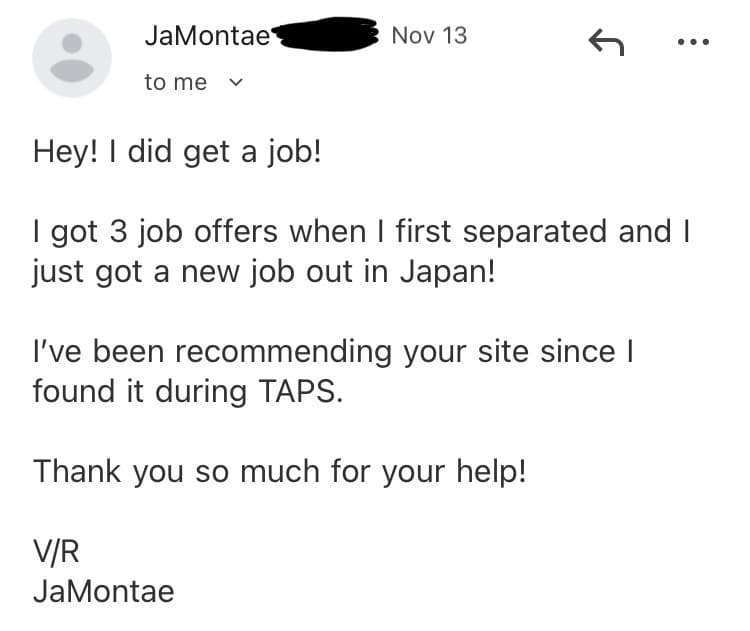
“Hey! I did get a job! I got 3 job offers when I first separated and I just got a new job out in Japan! I’ve been recommending your site since I found it during TAPS. Thank you so much for your help! V/R JaMontae ”
Federal service is one of the strongest landing spots for a 2W2X1 because the qualification standards reward documented technical maintenance and the clearance carries directly into cleared federal billets. Veterans' Preference adds 5 or 10 points to your rated score and can move you to the top of a certificate. Use your eligibility documentation for the preference claim, not as resume source material.
GS-1670 Equipment Services. This series covers the specialists who manage, inspect, and provide technical oversight of specialized equipment and weapon-system support gear. The AFSC's component-level maintenance and test-equipment experience maps here at GS-7 through GS-11 depending on grade at separation.
GS-0018 Safety and Occupational Health Management. Surety culture, two-person concept, and mishap-prevention discipline are exactly what these positions assess. Entry is common at GS-7 and GS-9 with progression to GS-11 and above.
GS-1306 Health Physics. For those who pursue radiation-safety coursework, this series at DOE, NNSA, and the national labs values hands-on familiarity with radiological controls and surety procedures. It typically requires specific academic credit, so treat it as a build-toward target.
GS-1910 Quality Assurance. Inspection, nonconformance documentation, and audit experience translate without friction into federal QA work across defense and energy components.
Wage-grade trade positions are also in play: WG-6502 Explosives Operating covers the federal handling-and-operations trade that most closely mirrors munitions and weapons work. Several of these GS series are shared targets with other ordnance fields, so the Army 89B federal section is worth a read. For USAJobs strategy and how to format a federal resume that survives the rating panel, see the military-to-civilian job titles guide, then build the document with the federal resume builder or start your federal resume.
| GS Series | Federal Job Title | Typical Grades | Match | Explore |
|---|---|---|---|---|
| GS-1670 | Equipment Services | GS-7, GS-9, GS-11 | View Details → | |
| GS-0018 | Safety and Occupational Health Management | GS-7, GS-9, GS-11 | View Details → | |
| GS-1910 | Quality Assurance | GS-7, GS-9, GS-11 | View Details → | |
| GS-1306 | Health Physics | GS-7, GS-9 | View Details → | |
| GS-5378 | Powered Support Systems Mechanic | WG-8, WG-10 | View Details → | |
| GS-2003 | Supply Program Management | GS-9, GS-11, GS-12 | View Details → | |
| GS-0802 | Engineering Technician | GS-6, GS-7, GS-9 | View Details → |
Federal hiring uses keyword-matching and structured experience. BMR builds federal-format resumes (USAJobs-ready) with the right keywords, hours/week, and supervisor info — for any GS series above.
Free · No credit card · Federal + civilian resume formats included
Not everyone wants to stay in a related field. These career paths leverage your transferable skills — leadership, risk management, logistics, project planning — in completely different industries.
You can explain complex technical systems with authority, which is exactly what closes sales of industrial and instrumentation products to engineering buyers.
Running a production floor is about holding people to exacting, documented standards. That is the environment you already lived in daily.
Compliance work is structured auditing against rules that cannot be bent. Surety culture is that mindset applied to regulated industries.
Estimating depends on reading technical specifications precisely and accounting for every component, a habit your maintenance documentation built.
You qualified peers on procedures where mistakes were unacceptable. That instructional rigor transfers to technical and safety training programs.
Underwriting is structured risk evaluation against defined rules. The judgment you applied to surety and reliability decisions transfers to it.
Controlling traffic demands flawless procedural execution where a single error has severe consequences, the exact pressure you worked under.
The skills that made you a good Marine, Sailor, Airman, or Soldier transfer further than you think. BMR rewrites your bullets for any of the pivot careers above — without making you sound like you've never done the work.
Free · No credit card · Try unlimited career angles
If you are staying in precision maintenance, quality, or the nuclear sector, your terminology already translates: recruiters in those fields know what a technical order and a surety inspection are. This section is for 2W2X1 Airmen targeting careers OUTSIDE nuclear and weapons work, where a civilian hiring manager has never heard your vocabulary.
The principle is simple. Describe the transferable action, not the classified mission. You can convey the rigor of the job without naming a single weapon system.
Before: "Performed T.O.-directed maintenance and surety inspections on nuclear weapon systems under PRP."
After: "Executed controlled-procedure maintenance on high-consequence electromechanical systems, completing compliance audits against zero-defect standards with 100% documentation accuracy across recurring inspections."
For a broader reference, the 50 Military Terms Translated to Civilian Language glossary and the military skills for resume list both help. To apply this to your own bullets fast, the military resume builder does the translation step for you.
BMR turns your 2W2X1 duties and accomplishments into civilian bullets that match the job you're applying for — no manual translation, no rewriting.
Free · No credit card · Tailored to each job posting
Which certifications you need depends on where you're headed. Find your target career path below.
The wrong placement can sink an otherwise strong application. BMR knows where each cert ranks, what to call it, and how to frame it for ATS keyword matching and hiring manager attention.
Free · No credit card · Built around your real certs and clearance
Concrete next steps, split by direction.
Staying in maintenance, quality, or nuclear:
Careers outside the specialty:
Build the resume: the military resume builder and federal resume builder handle private-sector and USAJobs formats. When you are ready to commit, get started here. Explore adjacent paths with the career crosswalk.
See also: 2A6X2 Aerospace Ground Equipment, 2W0X1 Munitions Systems, and the Navy Gunner's Mate page. For interview prep on translating sensitive work, the translating military jobs on Indeed guide is a practical starting point.
Most veterans do this backwards — they wait until terminal leave to start, then panic. Here's the actual sequence that works.
Print this. Tape it to your monitor. Veterans who treat the transition like a 90-day op get hired faster than the ones who treat it like an emergency.
Stop rewriting from scratch every time you apply. BMR turns your military experience into civilian and federal resumes — tailored to each job.