Loading...
Loading...
The civilian and federal jobs that hire Navy Missile Technician (Submarine)s — with real salaries and the resume that gets callbacks.
Every MT has more options than a Google search will tell you. Below: career paths, BLS salary data, federal GS series, certifications by target career, and how to translate your experience without losing what made you valuable to the Navy in the first place.
Free · No credit card · Tailored resume in under 5 minutes
After the Navy I got hired into 6 federal career fields and tech sales, and sat on federal hiring panels along the way. I spent the last 2 years rebuilding everything I learned into BMR, tuned for how AI actually screens resumes today. This is the system I wish I'd had on day one.
If you held the MT rating, you ran the strategic weapons system on a ballistic-missile submarine (SSBN). That is the Trident II (D5) fire-control suite, the missile tubes and launcher subsystems, the high-pressure air and hydraulic systems that eject a missile from a flooded tube, and the digital and electromechanical equipment that keeps the deterrent ready around the clock. You did all of it inside the Personnel Reliability Program, under a Single Scope Background Investigation, with two-person-integrity rules and quality-assurance procedures that left no room for "close enough."
The pipeline that produced you is long and selective. After boot camp at Great Lakes you went through Basic Enlisted Submarine School in Groton, then MT "A" and "C" school work tied to the Trident weapons system, with hands-on training on launcher, fire-control, and handling equipment before reporting to a blue or gold crew out of Bangor, Washington or Kings Bay, Georgia. Roughly half of a 20-year MT career is sea duty on an SSBN and half is shore duty at a strategic weapons facility or missile assembly plant.
Here is what civilian employers actually buy when they hire an MT: someone who maintained safety-critical, high-consequence systems where a procedural shortcut is never an option. The combination of electromechanical, hydraulic, high-pressure air, and digital troubleshooting is rare on the outside, and the nuclear-grade discipline around it is rarer still. That signature, not the word "missile," is what opens doors. Use the military-to-civilian career crosswalk to see where it maps, and compare notes with the closely related Navy Fire Controlman (FC) and Sonar Technician, Submarine (STS) paths.
BMR has built more than 60,000 resumes across every rating and MOS, and MTs are one of the smallest, most specialized communities we see. That works for you, not against you. The trick is to stop writing "Trident" and "fleet ballistic missile" and start writing the transferable engine underneath: high-consequence systems maintenance, hydraulic and high-pressure air work, and quality assurance that an inspector would sign off on. Describe the discipline, not the weapon, and the resume reads as a maintenance professional any plant would want. — Brad Tachi, Navy Diver veteran & BMR founder
The number that matters when you're deciding what's next: how does civilian pay compare to what you make now?
Military comp is approximate (varies by location/dependents). Civilian is BLS median. Federal includes locality pay. Your real number depends on duty station, family status, GS step, and overtime.
The most direct civilian destinations for an MT sit in electronics maintenance, electro-mechanical technician work, and instrumentation. According to BLS Occupational Employment and Wage Statistics (May 2024), electrical and electronics installers and repairers earned a median of $71,270, electro-mechanical and mechatronics technologists and technicians earned $70,760, and electrical and electronic engineering technologists and technicians earned $77,180. These roles reward exactly the multi-discipline troubleshooting an MT does daily: read the print, isolate the fault across electrical, mechanical, and hydraulic subsystems, and verify the repair against a standard.
Avionics offers a strong adjacent lane. BLS reports avionics technicians at a median of $81,390 (May 2024), and the diagnostic logic on aircraft electronic systems is close to the fire-control and guidance work you already know. On the industrial side, industrial machinery mechanics earned a median of $63,510 and inspectors, testers, sorters, samplers, and weighers earned $47,460. Be honest with yourself about geography and shift: power, aerospace, and heavy-industry maintenance jobs cluster around specific plants and many run rotating shifts, which feels familiar after blue-and-gold crew rotations but is worth confirming before you commit.
One real advantage: defense primes that build and sustain submarine and strategic systems actively recruit from this community, and your clearance history shortens their onboarding. If you want to leave electronics maintenance entirely, the career-change section below maps the less obvious moves. Veterans coming from other electronics ratings such as the Navy Electronics Technician (ET) and the cross-branch Air Force Aircraft Armament Systems (2W1X1) path chase many of the same employers. When you are ready to translate the work, the military resume builder walks you through it.
| Civilian Job Title | Industry | BLS Median Salary | Outlook | Match |
|---|---|---|---|---|
Avionics Technician O*NET: 49-2091.00 | Aerospace & Defense | $81,390 | 4% (As fast as average) | strong |
Electro-Mechanical and Mechatronics Technician O*NET: 17-3024.00 | Manufacturing & Automation | $70,760 | 2% (Little or no change) | strong |
Electrical and Electronic Engineering Technician O*NET: 17-3023.00 | Engineering Services | $77,180 | 2% (Slower than average) | strong |
Electrical and Electronics Installer and Repairer O*NET: 49-2094.00 | Industrial Maintenance | $71,270 | 0% (Little or no change) | strong |
Industrial Machinery Mechanic O*NET: 49-9041.00 | Manufacturing | $63,510 | 13% (Much faster than average) | moderate |
Quality Control Inspector O*NET: 51-9061.00 | Manufacturing & Defense | $47,460 | 1% (Little or no change) | moderate |
Calibration Technician O*NET: 17-3023.00 | Test & Measurement | $77,180 | 2% (Slower than average) | moderate |
BMR rewrites your MT experience for any of the civilian roles above — keywords, achievements, and language hiring managers actually scan for.
Free · No credit card · 2 tailored resumes included
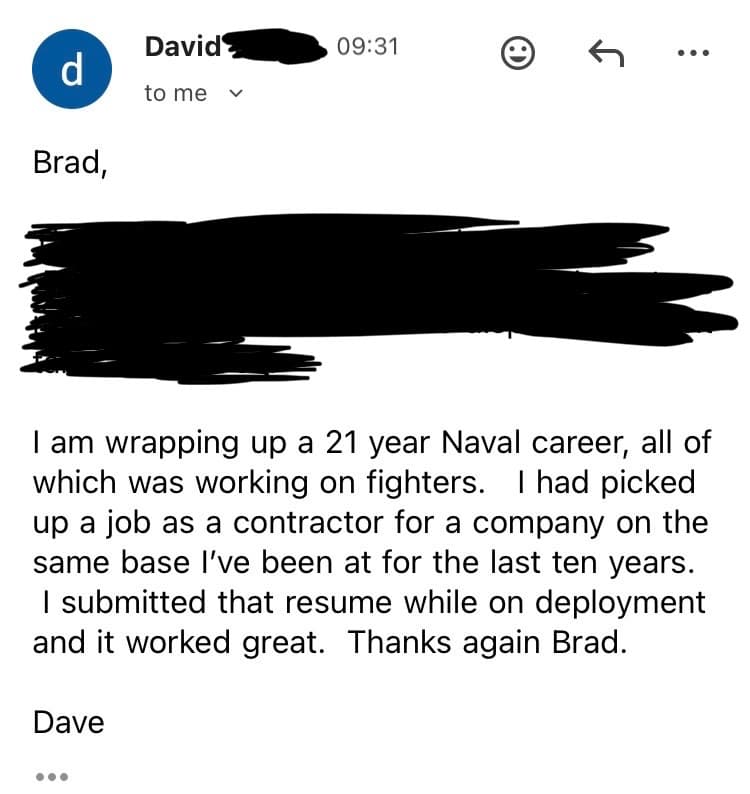
“I am wrapping up a 21 year Naval career, all of which was working on fighters. I had picked up a job as a contractor for a company on the same base I’ve been at for the last ten years. I submitted that resume while on deployment and it worked great. Thanks again Brad. Dave ”
Federal maintenance and engineering-technician work is one of the cleanest fits for an MT, because the government runs the same kinds of high-consequence systems you maintained and grades them on the same documentation discipline. The closest match is the GS-0856 Electronics Technician series, which covers maintenance, calibration, and repair of complex electronic systems at Navy and DoD activities. The GS-2604 Electronics Mechanic series captures hands-on repair of electronic and electromechanical equipment, and GS-0802 Engineering Technician covers the broader technician role on engineering projects.
If you want to lean into the mechanical and quality side, look at GS-0830 Mechanical Engineering support roles, GS-1910 Quality Assurance, and GS-3306 Optical Instrument Repair for the precision alignment work. Safety-minded MTs translate well into GS-0018 Safety and Occupational Health Management and GS-0803 Safety Engineering. Those with strong theory and any relevant coursework can target the professional engineering series such as GS-0855 Electronics Engineering or GS-0850 Electrical Engineering, though those carry a positive education requirement you would need to meet.
Most enlisted MTs enter around the GS-7 to GS-11 band depending on grade-level experience, with technician series typically opening at GS-5 to GS-9. Veterans' Preference adds 5 or 10 points to your rated score and, under category rating, floats eligible veterans to the top of the qualified tier. Your clearance history is a genuine accelerator at the shipyards, strategic weapons facilities, and warfare centers that hire these series. To see this overlap from another technical rating, compare the ET federal paths, and read how veterans move from contractor to federal employee. When you are ready to build the federal version, start your federal resume now.
| GS Series | Federal Job Title | Typical Grades | Match | Explore |
|---|---|---|---|---|
| GS-0856 | Electronics Technician | GS-9, GS-11, GS-12 | View Details → |
Federal hiring uses keyword-matching and structured experience. BMR builds federal-format resumes (USAJobs-ready) with the right keywords, hours/week, and supervisor info — for any GS series above.
Free · No credit card · Federal + civilian resume formats included
If you are staying in electronics or instrumentation maintenance, your terminology already translates. Avionics shops, plant maintenance teams, and defense sustainment contractors use the same fault-isolation language you do. This section is for MTs targeting careers outside weapons-system maintenance, where a hiring manager has never heard of a launcher subsystem and needs to see the business value, not the hardware.
The pattern is simple: name the discipline, the scale, and the standard, and drop the classified specifics. A few before-and-after examples:
For more on stripping jargon, read 50 military terms translated to civilian language and how to explain military experience in a civilian interview. The military resume builder turns the rating into civilian bullets without you having to guess at the wording.
BMR turns your MT duties and accomplishments into civilian bullets that match the job you're applying for — no manual translation, no rewriting.
Free · No credit card · Tailored to each job posting
If you are continuing in maintenance, line up credentials and contacts in your lane. The ISA Certified Control Systems Technician (CCST) speaks directly to instrumentation and control work, and an associate degree in electronics or mechatronics technology rounds out the theory employers want to see. SkillBridge fellowships with defense sustainment contractors and aerospace maintenance firms let you start a civilian role before you separate. Compare paths with the closely related Fire Controlman (FC) and Electronics Technician (ET) communities, and the cross-branch Air Force Nuclear Weapons (2W2X1) path.
If you are leaving the specialty, lean on the quality, safety, and project credentials that translate anywhere: a PMP or CAPM for project work, a Six Sigma Green Belt for quality, and the OSHA 30 plus a CSP track for safety. For federal jobs, get comfortable with USAJobs and Veterans' Preference, and use American Corporate Partners (ACP) for one-on-one veteran mentorship. Plan the timeline early with SFL-TAP transition resources and the SkillBridge program guide.
See also: the Interior Communications Electrician (IC) and Electrician's Mate (EM) career guides. Helpful reading: best certifications for veterans by career field and what your security clearance is worth in salary. Explore every rating with the career crosswalk, or just build your resume now.
Most veterans do this backwards — they wait until terminal leave to start, then panic. Here's the actual sequence that works.
Print this. Tape it to your monitor. Veterans who treat the transition like a 90-day op get hired faster than the ones who treat it like an emergency.
Stop rewriting from scratch every time you apply. BMR turns your military experience into civilian and federal resumes — tailored to each job.