Loading...
Loading...
The civilian and federal jobs that hire Navy Interior Communications Electricians — with real salaries and the resume that gets callbacks.
Every IC has more options than a Google search will tell you. Below: career paths, BLS salary data, federal GS series, certifications by target career, and how to translate your experience without losing what made you valuable to the Navy in the first place.
Free · No credit card · Tailored resume in under 5 minutes
After the Navy I got hired into 6 federal career fields and tech sales, and sat on federal hiring panels along the way. I spent the last 2 years rebuilding everything I learned into BMR, tuned for how AI actually screens resumes today. This is the system I wish I'd had on day one.
If you held the IC rating, you installed, operated, and repaired the systems that let a ship talk to itself. Gyrocompass and the navigation repeaters that feed it. The 1MC and dial-telephone interior communication circuits. General, flooding, and collision alarm systems. Engine order telegraphs and rudder-angle indicators. SITE TV and ship's entertainment distribution. You traced AC/DC circuits on a live combatant, read the schematics, isolated the fault, and brought the casualty back up before the next watch. That is electronics, electrical, and electromechanical work layered on top of one another, and civilian employers pay for exactly that blend.
The pipeline backs it up. After Recruit Training Command Great Lakes, ICs report to roughly 21 weeks of Class "A" technical training at Great Lakes, IL, covering technical documentation, electricity and electronics theory, basic mechanical theory, electrical math, schematics, and AC/DC circuit analysis. Normal color perception is required because you live in color-coded wiring all day. Some ICs go on to advanced courses such as gyrocompass and advanced TV maintenance depending on command and platform. ICs hold a Secret clearance to work on alarm, navigation, and ship-control systems.
Here is why hiring managers value the background once they understand it. A civilian "electronics technician" usually specializes in one system family. You worked alarm circuits, analog and digital indicators, motor-driven synchro systems, telephone switching, and video distribution, then documented every repair to a maintenance standard. That breadth plus disciplined troubleshooting is rare on the outside. If you want to see how your rating sits next to other Navy electrical and electronics jobs, the EM Electrician's Mate and ET Electronics Technician pages map the same family, and the full military-to-civilian career crosswalk lets you compare paths side by side. For a primer on naming the skills employers do not know you have, the hidden military skills guide is a good starting point.
I was a Navy Diver, not an IC, but after the Navy I pivoted into tech sales and that is the move I tell electronics ratings to look hard at. When you have actually torn down a gyrocompass or chased a fault through an alarm circuit, you can sell industrial electronics and controls to engineers who can smell a rep that has never touched the hardware. That technical credibility is worth more than a sales background most of the time. The trick is writing the resume so a civilian sees the systems work, not just "Navy." — Brad Tachi, Navy Diver veteran & BMR founder
The number that matters when you're deciding what's next: how does civilian pay compare to what you make now?
Military comp is approximate (varies by location/dependents). Civilian is BLS median. Federal includes locality pay. Your real number depends on duty station, family status, GS step, and overtime.
The most direct civilian fit is industrial and commercial electronics repair. BLS OEWS (May 2024) puts the median annual wage for Electrical and Electronics Repairers, Commercial and Industrial Equipment (O*NET 49-2094.00) at $71,300, though BLS projects a slight employment decline through 2034 as some legacy equipment ages out. Roles that lean more toward design support and test pay more: Electrical and Electronic Engineering Technicians (17-3023.00) sit at a $77,180 median, and Avionics Technicians (49-2091.00) reach $81,390 with a much-faster-than-average outlook, a strong target if you worked navigation and indicator systems.
Two honest market notes. First, geography drives this field. Shipyard towns, defense-heavy metros, and industrial corridors carry far more of these openings than the national average suggests, so be willing to look at where the work concentrates. Second, the broad "electronics repair" category is flat to declining at BLS, but the controls and automation adjacent roles are not. Electro-Mechanical and Mechatronics Technicians (17-3024.00) run a $70,760 median, and that work, programmable controllers, sensors, and motor systems, is where your synchro, indicator, and alarm-circuit experience transfers cleanly.
If you prefer the trades route, licensed Electrician work (47-2111.00) carries a $62,350 median and a much-faster-than-average growth outlook, and your shipboard AC/DC and conduit experience shortens the apprenticeship conversation. Audiovisual Equipment Installers and Repairers (49-2097.00) at a $50,620 median map to your SITE TV and entertainment-distribution background. Cross-branch, the same civilian paths open to Air Force 3E0X1 Electrical Systems and Marine Corps 1141 Electrician Marines, so those pages are worth a look if you are comparing how the trade reads across services. When you are ready to put it on paper, the military resume builder translates the rating into civilian language, or you can build your resume now.
| Civilian Job Title | Industry | BLS Median Salary | Outlook | Match |
|---|---|---|---|---|
Electrical and Electronics Technician O*NET: 17-3023.00 | Engineering & Test | $77,180 | Slower than average (1% to 2%) | strong |
Industrial Electronics Technician O*NET: 49-2094.00 | Industrial Maintenance | $71,300 | Decline (-1% or lower) | strong |
Avionics Technician O*NET: 49-2091.00 | Aviation & Defense | $81,390 | Much faster than average (7% or higher) | strong |
Instrumentation and Controls Technician O*NET: 17-3024.00 | Industrial Automation | $70,760 | Slower than average (1% to 2%) | strong |
Building Automation Technician O*NET: 49-9071.00 | Facilities Management | $48,620 | Average (3% to 4%) | moderate |
Electrician O*NET: 47-2111.00 | Construction & Trades | $62,350 | Much faster than average (7% or higher) | strong |
Audiovisual Equipment Technician O*NET: 49-2097.00 | Media & Communications | $50,620 | Much faster than average (7% or higher) | moderate |
BMR rewrites your IC experience for any of the civilian roles above — keywords, achievements, and language hiring managers actually scan for.
Free · No credit card · 2 tailored resumes included
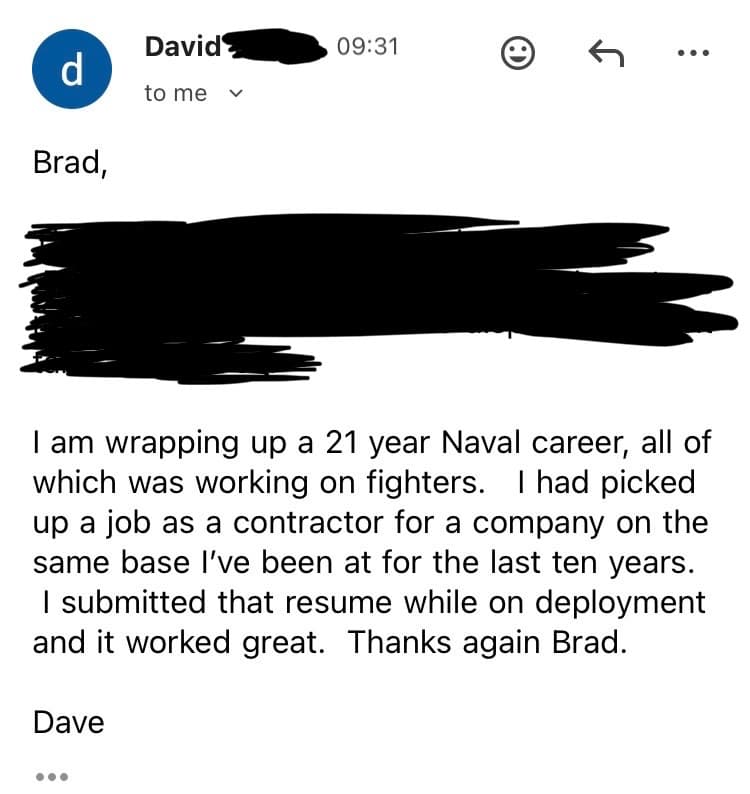
“I am wrapping up a 21 year Naval career, all of which was working on fighters. I had picked up a job as a contractor for a company on the same base I’ve been at for the last ten years. I submitted that resume while on deployment and it worked great. Thanks again Brad. Dave ”
Federal technical and trades work is one of the strongest landing zones for the IC rating, and the qualifying standards run on demonstrated experience, not a specific degree. The closest match is the WG-2604 Electronics Mechanic series, where shipboard alarm, indicator, and communication-circuit repair maps almost directly. WG-2805 Electrician covers your AC/DC power and wiring side, and WG-2606 Electronic Industrial Control Mechanic fits the synchro, motor-control, and indicator-system work specifically.
On the General Schedule side, GS-0856 Electronics Technician is the white-collar equivalent for test, calibration, and systems support, typically entered around GS-7 through GS-11 depending on experience and education. GS-0802 Engineering Technician opens design-support and drawing-interpretation roles, and GS-1601 General Facilities and Equipment Management is a path into managing the systems you used to repair. Naval shipyards, NAVSEA, the Bureau of Reclamation, and the Coast Guard's shore facilities all hire against these series.
Veterans' Preference adds 5 or 10 points to your rated federal score and can be decisive on a referral list, but it never lowers the qualification bar, so the experience write-up still has to carry the application. Federal resumes are their own format: longer, accomplishment-dense, and keyed to the series qualification standard. Our federal resume tips for veterans walks the structure, and the 2026 federal resume length guide covers the new page expectations. The federal resume builder formats it to the standard, or start your federal resume when you are ready. The ET Electronics Technician page shares the GS-0856 target if you are weighing both ratings.
| GS Series | Federal Job Title | Typical Grades | Match | Explore |
|---|---|---|---|---|
| GS-2604 | Electronics Mechanic | WG-8, WG-10, WG-11 | View Details → | |
| GS-2606 | Electronic Industrial Control Mechanic | WG-8, WG-10, WG-11 | View Details → | |
| GS-2805 | Electrician | WG-8, WG-10, WG-11 | View Details → | |
| GS-0856 | Electronics Technician | GS-7, GS-9, GS-11 | View Details → | |
| GS-2210 | Information Technology Management | GS-7, GS-9 | View Details → | |
| GS-1601 | General Facilities and Equipment | GS-7, GS-9, GS-11 | View Details → | |
| GS-0802 | Engineering Technician | GS-7, GS-9, GS-11 | View Details → |
Federal hiring uses keyword-matching and structured experience. BMR builds federal-format resumes (USAJobs-ready) with the right keywords, hours/week, and supervisor info — for any GS series above.
Free · No credit card · Federal + civilian resume formats included
Not everyone wants to stay in a related field. These career paths leverage your transferable skills — leadership, risk management, logistics, project planning — in completely different industries.
Engineers buy from reps who have actually touched the hardware. An IC who has torn down a gyrocompass and chased faults through alarm circuits can sell industrial electronics and controls with credibility a pure salesperson cannot fake.
Selling technical and scientific products rewards people who understand what they are selling. Your shipboard systems background lets you talk shop with plant and facility buyers instead of reading from a script.
Running an IC watch is supervising a technical crew under a strict standard. That translates directly to leading a production floor, where scheduling, safety, and throughput accountability are the job.
IC experience owning maintenance programs and equipment readiness lines up with running a plant's production and uptime. You already think in terms of scheduled maintenance, failure reduction, and standards.
Your SITE TV and entertainment-distribution work is closer to a broadcast facility than most realize. Maintaining signal chains and video equipment under a live schedule is the same discipline.
ICs verify repairs against a maintenance standard and document the result. That inspect-test-record discipline is exactly what manufacturing quality assurance asks for.
The skills that made you a good Marine, Sailor, Airman, or Soldier transfer further than you think. BMR rewrites your bullets for any of the pivot careers above — without making you sound like you've never done the work.
Free · No credit card · Try unlimited career angles
If you are staying in electronics, electrical, or controls work, your terminology already translates. A hiring manager at a controls integrator or a shipyard knows what a synchro, a gyrocompass repeater, and an alarm circuit are. This section is for ICs targeting careers OUTSIDE the electronics trade, where a civilian recruiter has never heard your rating and reads "Interior Communications Electrician" as a job title with no civilian meaning.
The fix is translating the system, the scale, and the outcome into business language. You did not just "fix alarms." You maintained safety-critical warning systems with near-zero tolerance for failure. You did not "do PMS." You executed a scheduled preventive-maintenance program against documented standards.
For the full vocabulary swap, the 50 military terms translated to civilian language glossary is the reference to keep open, and how to explain military experience in a civilian interview carries the same translation into the room. The military resume builder does this swap automatically, or build your resume now and see the translated bullets.
BMR turns your IC duties and accomplishments into civilian bullets that match the job you're applying for — no manual translation, no rewriting.
Free · No credit card · Tailored to each job posting
Which certifications you need depends on where you're headed. Find your target career path below.
The wrong placement can sink an otherwise strong application. BMR knows where each cert ranks, what to call it, and how to frame it for ATS keyword matching and hiring manager attention.
Free · No credit card · Built around your real certs and clearance
If you are keeping the trade, certifications and apprenticeships convert your experience into civilian credentials fast. The ETA International CET (Certified Electronics Technician) and ISA CCST (Certified Control Systems Technician) are the recognized marks for electronics and controls work. For the licensed-electrician route, a state apprenticeship will credit some of your shipboard hours, so ask the local Joint Apprenticeship and Training Committee how military time applies. SkillBridge internships with defense electronics and controls firms are a clean on-ramp before you separate. See also the EM Electrician's Mate and FC Fire Controlman paths for adjacent rating crossovers.
If you are leaving the trade entirely, lead with the transferable signature: disciplined troubleshooting, safety-critical system ownership, and technical credibility you can sell. American Corporate Partners (ACP) offers free veteran mentorship to map a new field. A PMP or Six Sigma credential repositions you toward operations and quality. For federal moves, USAJobs plus Veterans' Preference is the lever. The cross-branch Army 25U Signal Support Systems Specialist page covers similar comms-to-civilian ground.
Next steps that actually move the needle: explore the full military-to-civilian job crosswalk, use the military resume builder or federal resume builder for the version you need, and review SFL-TAP transition resources before you out-process. When you are ready, build your resume now. For SkillBridge planning, the SkillBridge guide covers timing and approval.
Most veterans do this backwards — they wait until terminal leave to start, then panic. Here's the actual sequence that works.
Print this. Tape it to your monitor. Veterans who treat the transition like a 90-day op get hired faster than the ones who treat it like an emergency.
Stop rewriting from scratch every time you apply. BMR turns your military experience into civilian and federal resumes — tailored to each job.