Loading...
Loading...
The civilian and federal jobs that hire Air Force Historians — with real salaries and the resume that gets callbacks.
Every 3H0X1 has more options than a Google search will tell you. Below: career paths, BLS salary data, federal GS series, certifications by target career, and how to translate your experience without losing what made you valuable to the Air Force in the first place.
Free · No credit card · Tailored resume in under 5 minutes
After the Navy I got hired into 6 federal career fields and tech sales, and sat on federal hiring panels along the way. I spent the last 2 years rebuilding everything I learned into BMR, tuned for how AI actually screens resumes today. This is the system I wish I'd had on day one.
Of the more than 60,000 resumes BMR has built, the 3H0X1 Historian is the rare one where the job title actively works against the person who held it. The work is real research and writing held to a publishable standard, but on a resume it too often reads as "wrote unit histories" and stops there. The skill underneath is rare: you locate primary sources, interview principals while events are still fresh, synthesize conflicting accounts into a defensible narrative, and preserve the record so the next analyst can trust it.
As a 3H0X1 you perform and manage historical activities for a wing, numbered air force, MAJCOM, or joint command. That means collecting source documents (correspondence, message traffic, staff studies, briefing slides, plans, and meeting minutes), conducting oral-history interviews with commanders and action officers, and writing the annual or periodic history that becomes the official record of what a unit did and why. You build and maintain the document repository that supports reference and research requests, and you advise leadership on the history and heritage program. The specialty requires routine access to Top Secret material, so much of the source base is classified, and the judgment to handle it correctly is part of the job.
This is a prior-service-only Air Force specialty, so everyone holding it already proved they can do the work somewhere else first. Civilian employers value that combination for a specific reason: deep primary-source research plus narrative writing to a standard plus disciplined records handling is exactly what museums, federal history offices, universities, research institutions, and corporate knowledge teams pay for. If you want to see how that experience maps to specific job titles and salary data, the military-to-civilian career explorer is the place to start, and the related 3N0X6 Public Affairs and 5J0X1 Paralegal pages cover adjacent research-and-writing fields. For turning your appraisals into civilian language, the EPR/OPR translation guide walks through the mechanics.
The Historian career field carries a translation problem most veterans never see coming: the work is genuinely high-skill, but the title makes a hiring manager picture someone filing old papers. I have watched 3H0X1s land archivist and research roles fast once the resume leads with what they actually did, primary-source research, oral-history interviews, and synthesis to a publishable standard, instead of the job title. The credibility is already there. The translation is the work. — Brad Tachi, Navy Diver veteran & BMR founder
The number that matters when you're deciding what's next: how does civilian pay compare to what you make now?
Military comp is approximate (varies by location/dependents). Civilian is BLS median. Federal includes locality pay. Your real number depends on duty station, family status, GS step, and overtime.
Historians (BLS SOC 19-3093) earned a median annual wage of $74,050 in May 2024 per BLS OEWS, though dedicated historian positions are concentrated in government, federal contractors, museums, and historical societies, so the title itself is a small market. The stronger near-term targets for a transitioning 3H0X1 are the adjacent roles that hire in volume and use the same core skills.
Archivist (O*NET 25-4011.00) is the closest high-volume match. BLS OEWS reports a median of $70,640 (May 2024). Archivists appraise, arrange, describe, and preserve records, which is the records-repository half of the 3H0X1 job done for a museum, university, corporation, or government agency. Curator (O*NET 25-4012.00, $71,560 median) and Librarian and Media Collections Specialist (O*NET 25-4022.00, $72,840 median) hire from the same talent pool, especially in institutions with archives or special collections.
On the writing side, Technical Writer (O*NET 27-3042.00) is the highest-paying near match at a $91,670 median, because the skill of taking messy source material and producing a clear, accurate document to a standard transfers directly. Writer and Author (O*NET 27-3043.00, $72,270 median) and editorial roles fit historians who want to keep writing as the core of the job.
Be honest with yourself about the market. Pure historian and curator jobs are competitive and often cluster around major museums, federal history offices, and research universities, so geography matters and a relocation may be part of the plan. Archivist and technical-writer roles are broader and more portable. Many of these positions value or require a master's degree (an MLIS for archivist and librarian tracks), so the GI Bill strategy in the resources section is worth reading before you apply. The Navy Mass Communication Specialist and Army 46S Public Affairs Specialist pages share several of these writing-and-records destinations. When you are ready to put it on paper, the military resume builder structures the research and writing experience for civilian reviewers, or you can build your resume now.
| Civilian Job Title | Industry | BLS Median Salary | Outlook | Match |
|---|---|---|---|---|
Archivist O*NET: 25-4011.00 | Libraries & Archives | $70,640 | 5% (Faster than average) | strong |
Historian O*NET: 19-3093.00 | Research & Government | $74,050 | 3% (As fast as average) | strong |
Technical Writer O*NET: 27-3042.00 | Professional & Technical Services | $91,670 | 4% (As fast as average) | strong |
Curator O*NET: 25-4012.00 | Museums & Cultural Institutions | $71,560 | 3% (As fast as average) | moderate |
Librarian and Media Collections Specialist O*NET: 25-4022.00 | Libraries & Archives | $72,840 | 3% (As fast as average) | moderate |
Writer and Author O*NET: 27-3043.00 | Media & Communications | $72,270 | 5% (Faster than average) | moderate |
Records and Information Manager (Government Information Specialist track) O*NET: 13-1111.00 | Information Management | $101,190 | 10% (Much faster than average) | moderate |
BMR rewrites your 3H0X1 experience for any of the civilian roles above — keywords, achievements, and language hiring managers actually scan for.
Free · No credit card · 2 tailored resumes included
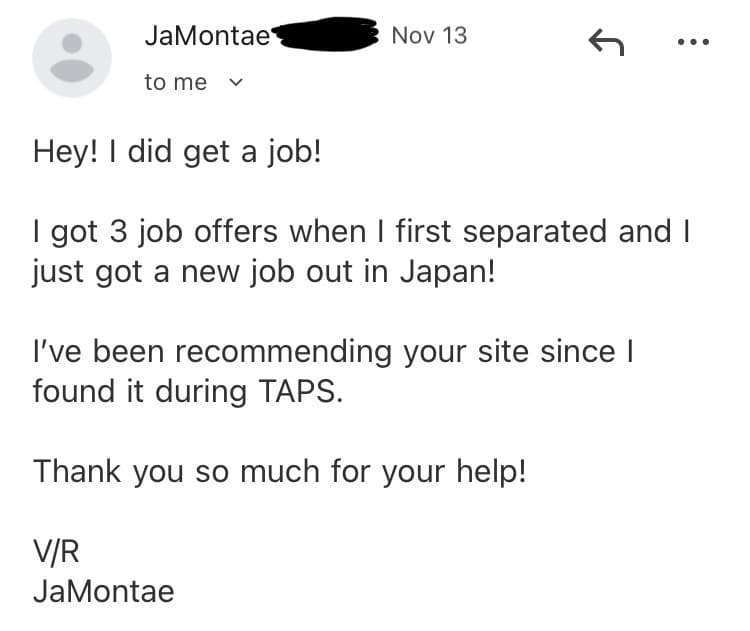
“Hey! I did get a job! I got 3 job offers when I first separated and I just got a new job out in Japan! I’ve been recommending your site since I found it during TAPS. Thank you so much for your help! V/R JaMontae ”
Federal service is the most direct landing zone for a 3H0X1, because the government runs the largest history and archives enterprise in the country and several GS series were built for this exact work. The marquee match is GS-0170 (History), the series that staffs command history offices across the Air Force, Army, Navy, the Office of the Secretary of Defense, and agencies like the National Park Service. A 3H0X1 with a degree in history and documented experience writing official histories often qualifies at the GS-9 to GS-11 entry band, with GS-12 and above reachable as experience and education stack.
GS-1420 (Archivist) is the records-and-preservation track, staffing the National Archives and Records Administration, presidential libraries, and agency records programs. GS-1421 (Archives Technician) is the on-ramp version at lower grades for those still completing the degree. GS-0306 (Government Information Specialist) covers FOIA, declassification, and information-access work, where your Top Secret access history and records discipline are direct assets. GS-1082 (Writing and Editing) fits historians whose strongest civilian pitch is the writing itself, and GS-0343 (Management and Program Analyst) is the broad analytic series that values the synthesize-conflicting-sources skill on staff and program work.
Two things move a federal application for this field. First, Veterans' Preference adds 5 or 10 points to your assessed score and can be decisive in a tightly ranked archivist or history register. Second, federal history and archivist jobs are unusually credential-sensitive, so the position's qualification standard will often name a specific number of semester hours in history or archival science, read it before you apply. For the mechanics of the federal format, the OPM federal resume format guide and the USAJOBS announcement decoder are the two to read first. The federal resume builder handles the length and detail a GS-0170 or GS-1420 package needs, or you can start your federal resume.
| GS Series | Federal Job Title | Typical Grades | Match | Explore |
|---|---|---|---|---|
| GS-0170 | History | GS-9, GS-11, GS-12 | View Details → | |
| GS-1420 | Archivist | GS-9, GS-11, GS-12 | View Details → | |
| GS-0306 | Government Information Specialist | GS-7, GS-9, GS-11 | View Details → | |
| GS-1082 | Writing and Editing | GS-9, GS-11, GS-12 | View Details → | |
| GS-0343 | Management and Program Analyst | GS-9, GS-11, GS-12 | View Details → | |
| GS-1421 | Archives Technician | GS-5, GS-6, GS-7 | View Details → |
Federal hiring uses keyword-matching and structured experience. BMR builds federal-format resumes (USAJobs-ready) with the right keywords, hours/week, and supervisor info — for any GS series above.
Free · No credit card · Federal + civilian resume formats included
Not everyone wants to stay in a related field. These career paths leverage your transferable skills — leadership, risk management, logistics, project planning — in completely different industries.
Competitive and market intelligence is the historian skill applied to companies instead of campaigns: gather scattered, sometimes contradictory signals and synthesize them into a sourced conclusion leadership can act on.
A historian already writes the authoritative account of what happened and why. Corporate communications needs exactly that skill turned outward to audiences and media.
Designing training content is research synthesis with a teaching goal. The skill of turning dense source material into a clear, structured product is the daily work of a corporate L&D designer.
An Air Force historian already does the hard part of editing: take a pile of primary sources, resolve contradictions, and turn it into accurate, readable narrative that survives review. Moving that into a publishing house, university press, or content team trades the archive for an author queue, but the judgment about accuracy, structure, and clarity is identical work in a completely different industry.
Oral-history work is structured qualitative research: design the questions, conduct the interviews, code the answers, and report the findings. That is the core of survey and user research in product and policy teams.
Litigation and compliance run on exactly the historian skill set: research a large body of documents, verify sources, and assemble an accurate, well-organized record. Document discipline is the daily currency of the role.
The skills that made you a good Marine, Sailor, Airman, or Soldier transfer further than you think. BMR rewrites your bullets for any of the pivot careers above — without making you sound like you've never done the work.
Free · No credit card · Try unlimited career angles
If you are targeting a history office, archive, museum, or university, the people reading your resume already speak your language, so you do not need to translate "oral history," "primary source," or "finding aid." This section is for 3H0X1s aiming at careers OUTSIDE history and archives, where a hiring manager has never run a command history program and needs the work described in business terms.
The pattern that works: name the civilian function first, then show the scale. A history office produces deadline-bound written deliverables from scattered, sometimes contradictory inputs, under classification rules. Said in civilian language, that is research, knowledge management, and content production. The glossary in our hidden military skills guide covers the broader translation pattern, and the interview translation guide shows how to say it out loud.
A few before-and-after examples for non-history roles:
Once the experience is framed in civilian terms, the military resume builder keeps the formatting clean so a non-history reviewer sees the skill, not the jargon.
BMR turns your 3H0X1 duties and accomplishments into civilian bullets that match the job you're applying for — no manual translation, no rewriting.
Free · No credit card · Tailored to each job posting
Which certifications you need depends on where you're headed. Find your target career path below.
The wrong placement can sink an otherwise strong application. BMR knows where each cert ranks, what to call it, and how to frame it for ATS keyword matching and hiring manager attention.
Free · No credit card · Built around your real certs and clearance
Use these resources to move from research-and-writing experience to a civilian or federal offer. They are split by whether you want to stay close to history and archives or move into a different field entirely.
Most veterans do this backwards — they wait until terminal leave to start, then panic. Here's the actual sequence that works.
Print this. Tape it to your monitor. Veterans who treat the transition like a 90-day op get hired faster than the ones who treat it like an emergency.
Stop rewriting from scratch every time you apply. BMR turns your military experience into civilian and federal resumes — tailored to each job.