Loading...
Loading...
The civilian and federal jobs that hire Marines Metrology Technicians — with real salaries and the resume that gets callbacks.
Every 2874 has more options than a Google search will tell you. Below: career paths, BLS salary data, federal GS series, certifications by target career, and how to translate your experience without losing what made you valuable to the Marines in the first place.
Free · No credit card · Tailored resume in under 5 minutes
After the Navy I got hired into 6 federal career fields and tech sales, and sat on federal hiring panels along the way. I spent the last 2 years rebuilding everything I learned into BMR, tuned for how AI actually screens resumes today. This is the system I wish I'd had on day one.
As a 2874 Metrology Technician you sat at the top of the Marine Corps calibration pyramid. The 2871 Calibration Technician path feeds into it, but the 2874 is where the standards live. You calibrated the highest-precision Test, Measurement and Diagnostic Equipment in the inventory: electronic, mechanical, physical, dimensional, optical, infrared, and laser TMDE, automated test sets, and the laboratory standards every other Marine relies on. You did not just turn a wrench. You decided whether a piece of gear could be trusted to measure at all.
The work is built on traceability. Every measurement you certified tied back through higher-echelon laboratory standards to the national references held by NIST. You ran the measurement-uncertainty math, documented the calibration, maintained the lab environment inside tight temperature and humidity tolerances, and enforced the Marine Corps calibration quality assurance program. This is a senior MOS, E-5 through E-9, because the job is as much about running a standards lab and training junior Marines as it is about the bench work itself.
Civilian employers value this background because calibration is a regulated, auditable discipline that does not tolerate guessing. A 2874 already understands ISO 17025 thinking, NIST-traceable standards, uncertainty budgets, and the documentation rigor that quality systems demand. That is a rare combination, and it transfers cleanly into aerospace, semiconductor, pharmaceutical, defense, and federal standards-lab work. If you worked the electronics side as well, the 2862 Electronics Maintenance Technician page covers the general-repair lane. The translation step is what quietly costs interviews, and the sections below break it down.
I spent years in federal environmental and engineering work, and the calibration trade is one of the cleanest translations I have seen. A 2874 walks into a civilian lab already fluent in traceability, uncertainty, and audit documentation, which is exactly what the certification bodies and federal standards labs are screening for. The competition for calibration seats is thin, so the resume just has to prove you already think in NIST-traceable terms. — Brad Tachi, Navy Diver veteran & BMR founder
The number that matters when you're deciding what's next: how does civilian pay compare to what you make now?
Military comp is approximate (varies by location/dependents). Civilian is BLS median. Federal includes locality pay. Your real number depends on duty station, family status, GS step, and overtime.
Calibration and metrology is a small, specialized field, which works in your favor. Employers struggle to find technicians who can run an uncertainty budget without supervision, so a separating 2874 enters a thin labor market with rare skills.
The closest direct match is the Calibration Technologist or Technician role, which BLS now tracks as its own occupation (O*NET 17-3028) with a median wage of $65,040 per year as of the BLS Occupational Employment and Wage Statistics May 2024 release. The top 10 percent earned more than $105,440, and the highest pay clusters in aerospace, semiconductor fabrication, and pharmaceutical manufacturing where measurement error carries real cost. Metrology Technician titles in standards labs and accredited calibration houses fall in the same band.
If you lean toward the electronics and instrumentation side, Electrical and Electronic Engineering Technologists and Technicians (O*NET 17-3023) posted a median of $77,180 per year, and Electro-Mechanical and Mechatronics Technologists and Technicians (O*NET 17-3024) posted $70,760. Quality and Test Technician roles that draw on your inspection and standards background track to Inspectors, Testers, Sorters, Samplers, and Weighers (O*NET 51-9061) at a $47,460 median, though calibration-heavy quality roles pay above that floor.
Geography matters in this field. The strongest concentrations of calibration work sit near aerospace and defense corridors: Southern California, Seattle, Dallas-Fort Worth, Huntsville, Phoenix, and the Florida space coast. Semiconductor growth in Arizona, Texas, and Ohio is adding standards-lab demand. Many accredited labs also need technicians willing to travel for on-site calibration, which pays a premium. Marines who held related electronics MOSs land in the same companies, so the Navy ET Electronics Technician and Air Force 2P0X1 PMEL paths compete for the same seats. To package this experience for a civilian hiring manager, you can build your resume now, and the best certifications by career field guide shows which credentials move you up a pay band.
| Civilian Job Title | Industry | BLS Median Salary | Outlook | Match |
|---|---|---|---|---|
Calibration Technician O*NET: 17-3028.00 | Aerospace & Defense Manufacturing | $65,040 | 5% (Faster than average) | strong |
Metrology Technician O*NET: 17-3028.00 | Semiconductor & Precision Manufacturing | $65,040 | 5% (Faster than average) | strong |
Standards Lab Technician O*NET: 17-3028.00 | Accredited Calibration Laboratories | $65,040 | 5% (Faster than average) | strong |
Instrumentation Technician O*NET: 17-3024.00 | Energy, Process & Manufacturing | $70,760 | 2% (Slower than average) | strong |
Electronics Test Technician O*NET: 17-3023.00 | Electronics & Telecommunications | $77,180 | 3% (As fast as average) | strong |
Quality / Test Technician O*NET: 51-9061.00 | Manufacturing Quality | $47,460 | -2% (Decline) | moderate |
Field Service Calibration Engineer O*NET: 17-3023.00 | Test & Measurement Equipment Vendors | $77,180 | 3% (As fast as average) | moderate |
BMR rewrites your 2874 experience for any of the civilian roles above — keywords, achievements, and language hiring managers actually scan for.
Free · No credit card · 2 tailored resumes included
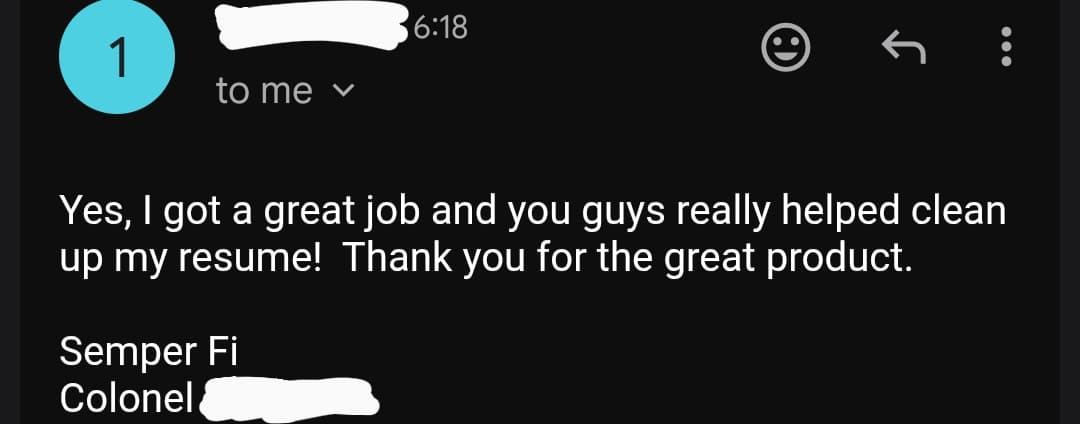
“Hey Brad, Just wanted to send out a quick thank you. You've created something amazing with BMR and your continued advocacy for transitioning service members does not go unnoticed. It was the most effective resource I used in my transition and I know it played a key role in landing a six figure…”
Federal standards work is one of the most natural destinations for a 2874, because the government runs the very traceability chain you already lived inside. DoD calibration labs, military depots, and civilian agencies all need technicians who understand NIST-traceable standards and measurement uncertainty without a training ramp.
The strongest fit is the GS-0856 Electronics Technician series, which covers the bench calibration and TMDE repair work directly. Most separating 2874s qualify at the GS-9 to GS-11 range given supervisory and standards-lab time, and the series reaches GS-12 in lead roles. GS-0802 Engineering Technician is the adjacent series for dimensional, mechanical, and physical measurement work, and it carries the same grade ladder. For the quality-program side of your record, GS-1910 Quality Assurance rewards your experience enforcing a calibration QA program and maintaining laboratory traceability.
If you pursue a degree, the engineering series open up. GS-0855 Electronics Engineering and GS-0801 General Engineering both qualify with the right academic background, and GS-0830 Mechanical Engineering fits the physical-standards path. Veterans Preference adds 5 or 10 points to your rated score under category rating, and a 30 percent or greater disability rating can open non-competitive appointment authorities. Read 10 federal job series every veteran should search and 15 federal resume tips that get veterans referred before you apply. The federal resume builder formats your experience to the USAJOBS standard, and the Coast Guard ET page shares several of these same GS targets.
| GS Series | Federal Job Title | Typical Grades | Match | Explore |
|---|---|---|---|---|
| GS-0802 | Engineering Technician | GS-9, GS-11, GS-12 | View Details → | |
| GS-0856 | Electronics Technician | GS-9, GS-11, GS-12 | View Details → | |
| GS-1910 | Quality Assurance | GS-9, GS-11 | View Details → | |
| GS-0801 | General Engineering | GS-7, GS-9, GS-11 | View Details → | |
| GS-0830 | Mechanical Engineering | GS-7, GS-9, GS-11 | View Details → | |
| GS-0855 | Electronics Engineering | GS-7, GS-9, GS-11 | View Details → |
Federal hiring uses keyword-matching and structured experience. BMR builds federal-format resumes (USAJobs-ready) with the right keywords, hours/week, and supervisor info — for any GS series above.
Free · No credit card · Federal + civilian resume formats included
Not everyone wants to stay in a related field. These career paths leverage your transferable skills — leadership, risk management, logistics, project planning — in completely different industries.
Metrology techs already think in calibrated instruments, tight tolerances, and documented procedures, which is exactly how nuclear medicine equipment and dose measurement are run.
Photogrammetry is measurement at scale; the accuracy discipline and error analysis a 2874 uses on optical and dimensional TMDE transfers directly to spatial data.
Survey instruments demand the same calibrated, repeatable measurement habits a 2874 lives by, just applied to land and structures instead of TMDE.
Audio engineering is applied signal measurement; the RF and electronic-signal instincts from calibrating TMDE map onto setting levels, analyzing signals, and tuning systems.
Environmental monitoring runs on calibrated field instruments and defensible data; a metrology tech already owns the traceability and documentation mindset regulators require.
A 2874 spends every day quantifying variation and confidence in measurements, which is the core of measurement-system analysis used to improve manufacturing processes.
Running a calibration QA program is operations analysis: finding where a system drifts, documenting it, and driving corrective action. That is the analyst job description.
The skills that made you a good Marine, Sailor, Airman, or Soldier transfer further than you think. BMR rewrites your bullets for any of the pivot careers above — without making you sound like you've never done the work.
Free · No credit card · Try unlimited career angles
If you are staying in calibration, metrology, or a standards lab, your terminology already matches the industry. Hiring managers at accredited labs use TMDE, traceability, and uncertainty every day. This section is for Marines targeting careers OUTSIDE the calibration field, where a civilian recruiter has never heard your job titles and will not decode them for you.
The pattern is simple. Lead with the measurable outcome, name the standard or system in civilian language, and quantify the precision. Here are translations drawn from real 2874 work:
A before-and-after for a project-coordination resume, not a lab resume:
Before: Calibrated precision TMDE and maintained traceability to higher-echelon standards for the calibration lab.
After: Managed a precision-measurement quality program serving 40-plus units, enforcing documented tolerances and an auditable traceability chain that passed every external inspection with zero findings.
The military terms glossary in our 50 military terms translated to civilian language guide covers more conversions, and how to explain military experience without jargon handles the interview side. The military resume builder applies these patterns for you.
BMR turns your 2874 duties and accomplishments into civilian bullets that match the job you're applying for — no manual translation, no rewriting.
Free · No credit card · Tailored to each job posting
Which certifications you need depends on where you're headed. Find your target career path below.
The wrong placement can sink an otherwise strong application. BMR knows where each cert ranks, what to call it, and how to frame it for ATS keyword matching and hiring manager attention.
Free · No credit card · Built around your real certs and clearance
The credential that matters most here is the ASQ Certified Calibration Technician. It maps almost exactly to what you already did, and Marine Corps COOL lists it as a recommended credential for the 2874. NCSL International (NCSLI) and the NIST Office of Weights and Measures both run metrology training and conferences that keep you current and build a civilian network. SkillBridge can place you in an accredited calibration lab before you separate. See the SkillBridge guide and the Military COOL program guide for funding your certs.
If you are pivoting out of the lab, lean on your quality-systems and precision-data background. ASQ Certified Quality Technician and Six Sigma Green Belt open quality and process roles in almost any industry. PMP or CAPM frames your lab-management experience as project leadership. For federal work, study how USAJOBS announcements work and prep with 25 behavioral interview questions for veterans. American Corporate Partners (ACP) offers free veteran mentorship if you want a guide through the switch.
Build the document that carries all of this: build your resume now. Explore adjacent paths with the career crosswalk, tailor a federal version for USAJOBS, and use your installation transition assistance program while you still have access. See also the 2841 Ground Radio Repairer and Navy AT Aviation Electronics Technician paths for related options, and read Six Sigma for veterans if quality work appeals to you.
Most veterans do this backwards — they wait until terminal leave to start, then panic. Here's the actual sequence that works.
Print this. Tape it to your monitor. Veterans who treat the transition like a 90-day op get hired faster than the ones who treat it like an emergency.
Stop rewriting from scratch every time you apply. BMR turns your military experience into civilian and federal resumes — tailored to each job.