Career After Medical Retirement: A Veteran Job Search Plan
Michael got only rejections. Then a $100K facilities manager role.
Michael, E-7, Navy, tried a ton of outside help before BMR
I'm a Navy Diver veteran. The job stays with you long after the bag is packed. When a medical board picks your last day for you, the loss can hit harder and faster.
Medical retirement often lands on someone else's timeline. A board decides you can't stay. A date shows up on paper. And the career you planned for twenty years may end at six, or twelve, or eighteen. You may be asking a hard question right now. "What do I even do now that my old job is gone?" It's a fair question.
This guide answers that question. It's a step-by-step plan for your career after medical retirement, starting from scratch. You'll work through it in order. First comes the identity hit, then the timeline and a direction. Next come a skills list, a target list, and the resume. Last come the interview answer and your first 90 days.
Want a slow ramp back to work? The part-time return to work plan covers that path. This one covers the full search.
Why Does Medical Retirement Feel Different From a Normal Exit?
A normal exit has a runway. You pick a date, take leave, and plan the move for a year or more. A medical exit can move on a board's schedule. Your body made the call, and the paperwork followed.
That matters for the job search, because the grief and the search can happen at the same time. You may still be in physical therapy while you write a resume. You may feel like you failed, even though you didn't choose any of it.
The board judged one job
The Physical Evaluation Board (PEB) answers one narrow question. Can you still do the job of your rating, MOS, or AFSC in uniform? That question does not ask if you can run a project, manage a budget, or lead a team. A civilian employer asks those questions.
So write this down early. "I can't do my old job" is true. "I can't do good work" is a different claim, and it's usually false. Keep the two apart in your head, and the rest of this plan gets easier.
Give the loss a name
A lot of veterans skip this step and go straight to applications. Then the search stalls, and they can't say why. Talk to someone who gets it. That could be a buddy who left early, a chaplain, or a VA counselor. You don't need to be "over it" to start. You just need to know it's there.
When Should You Start the Job Search if You're Still in the MEB or PEB?
Start now. The Medical Evaluation Board (MEB) writes up your conditions. The PEB then decides if you're fit to stay. Both steps take time, and that time is your runway. Use it.
Know which outcome you're facing
Your disability rating matters for your money, and money sets how picky you can be. Under 10 U.S.C. 1201, the military can medically retire you at a rating of at least 30 percent. Other tests apply too. Members with 20 years of service can also qualify. Below 30 percent and under 20 years, the usual result is separation with severance pay, not retirement.
Retired pay gives you a floor each month. Severance is a one-time check. Plan your search around which one you get. Wondering how retired pay and VA pay fit together? The CRSC vs CRDP guide walks through it. This article stays on the job search.
If you land on the TDRL
Some members go on the Temporary Disability Retired List (TDRL) because their condition isn't stable yet. Under 10 U.S.C. 1210, you get a physical exam at least once every 18 months. The service makes a final call no later than three years after you go on the list. It can come sooner if an exam shows your condition is stable.
For your job search, that means two things. Plan for exam dates you'll need to attend. And build a career that doesn't depend on one TDRL result. Your rating may go up, go down, or stay the same.
A simple runway plan
- Now: Start your skills list and a draft resume.
- Once you know your likely outcome: Set your pay floor and target list.
- Last 90 days in uniform: Apply, network, and book interviews.
- After separation: Keep the rhythm going every week until the offer.
How Do You Pick a Direction When Your Old Job Is Off the Table?
This is the step that freezes people. The path you trained for is closed, so every option looks equal. That's too many doors. Narrow them with four filters, one at a time.
- What your body allows now: Write down your real limits. Lifting, standing, travel, screen time, shift work. Be honest with yourself here. Nobody else needs to see this list.
- What you liked doing: Look past the job title. Did you like training people? Tracking parts? Planning missions? Fixing broken systems? The parts you liked often travel well. The military to civilian jobs pages show where your job maps.
- What pays enough: Add your retired pay or severance plan to the math. Your floor may be lower than a peer's, which can buy you room to pick a better fit.
- Where you'll live: Some fields cluster in a few cities. Others hire everywhere. Your location trims the list fast.
Run all four filters, and you may end up with a short list of real directions. That's a list you can work with.
Use VR&E as a tool in the plan
VA's Veteran Readiness and Employment program can help you pick a direction and pay for training. VA says veterans can apply with a service-connected rating of at least 10 percent. The discharge can't be dishonorable. A counselor then decides if you qualify for services.
Still in uniform and going through the MEB or PEB? VA says you may be able to apply before discharge.
Does your new direction need a degree or a cert? Talk to VR&E before you pay for it yourself. The VR&E Chapter 31 guide covers the tracks and who qualifies. This step only asks if your top direction needs training. If it does, ask if VR&E can help pay.
If you're older, or this is a full restart
Some medical retirees are in their late thirties or forties. A full field change at that age is normal. The career change after 40 guide covers that angle in depth.
What Skills Do You Still Have After a Medical Retirement?
More than you think. Your injury may take away the physical part of a job. It rarely takes away what you learned to run, track, teach, and fix. This step pulls those skills out of your head and onto paper.
List every duty, not just your title
Open a blank page. List every job you held in uniform, plus any collateral duties. Under each one, write what you actually did each week. Don't filter yet. Write it all down, even the boring parts.
Then add scope to each line. How many people? How much gear? How much money? How many sites or shifts? Scope is what tells a civilian reader your level. Leave it off, and they guess low.
Sort the list into what travels
Now mark each line with one of three tags.
- Keep: Work you can still do and want to do. Planning, training, records, budgets, supervising, quality checks, safety programs.
- Translate: Work tied to the old job, but with a skill inside it. A hands-on repair job still holds troubleshooting, parts tracking, and inspection records.
- Drop for now: Work you can't do anymore and that doesn't fit your new direction.
Here's a made-up example. A Navy petty officer, call her Jane Sample, worked as a heavy equipment mechanic. She can't do the lifting now. Her "Translate" list still holds a parts budget, a team of six, and a shop inspection program. Those lines point toward maintenance planning, inventory control, or safety roles.
How Do You Build a Target List of Jobs and Employers?
A target list turns "I need a job" into a weekly plan. Without one, people apply at random and get random results. Build the list before you send a single application.
Start with real postings
Pick one of your directions. Search for 10 to 20 real postings you would actually take. Save each one. Read them side by side and look for repeats: the same tools, the same duties, the same words. Those repeats tell you what that field wants.
Start with the ones that pay the most or carry the best benefits. Then work down. That's your order of attack.
Run federal and private at the same time
If you would take either, apply to both. The facts on your resume are the same. Only the shape changes.
The federal side has hiring paths that may fit a medical retiree. Schedule A lets agencies hire people with disabilities without the normal competition. The OPM disability hiring page explains how agencies use it. There's also a separate authority for veterans with a 30 percent or higher disability rating. These guides cover each path in detail:
One note on federal resumes. They run two pages for most federal jobs. Always check the announcement, because some are exceptions.
Add people, not just postings
Next to each target employer, write one name. That could be a veteran who works there, a recruiter, or a friend of a friend. A search by company name plus "veteran" is a good start. Send short notes. Ask what the job is like day to day, not for a job. Those talks often turn into referrals later.
What Goes on Your Resume First?
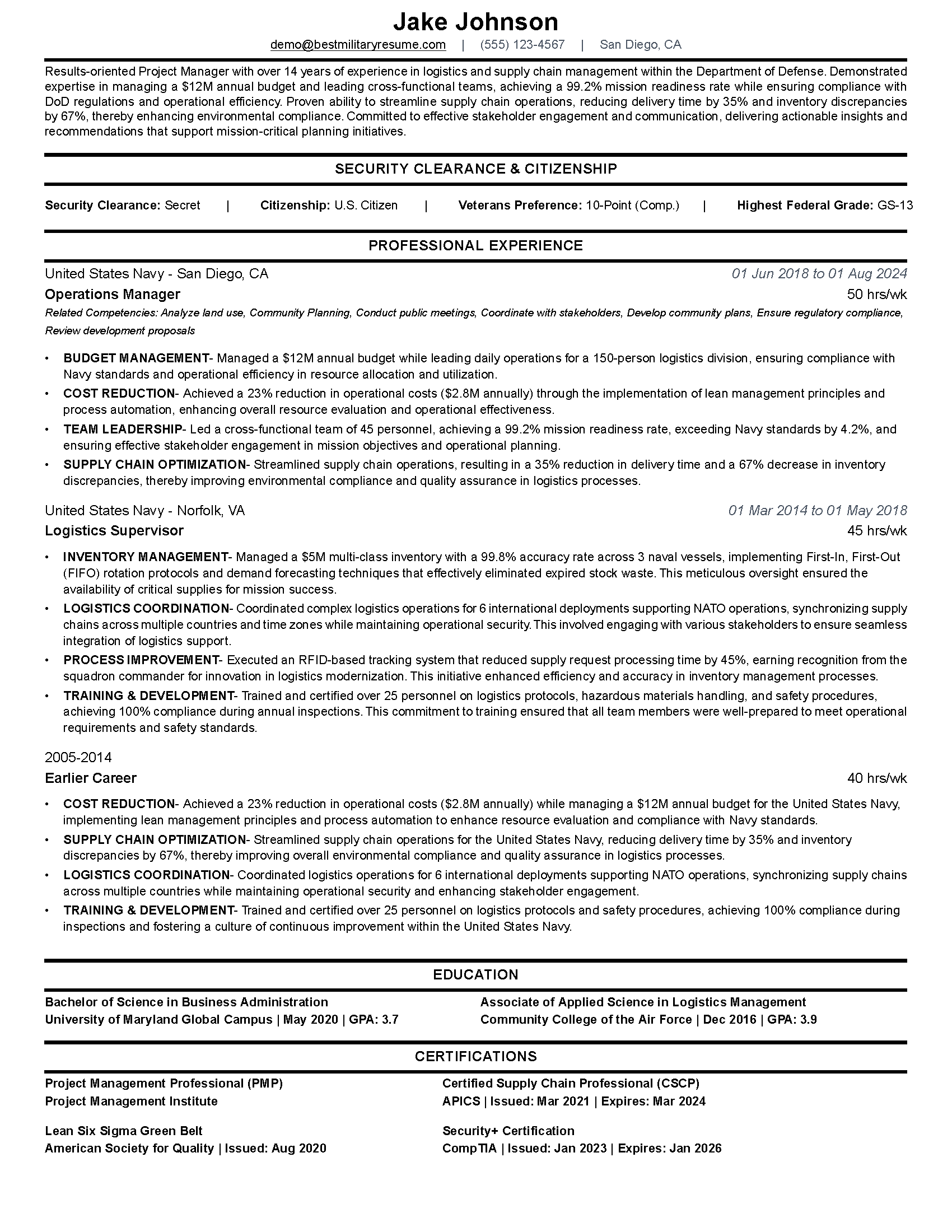
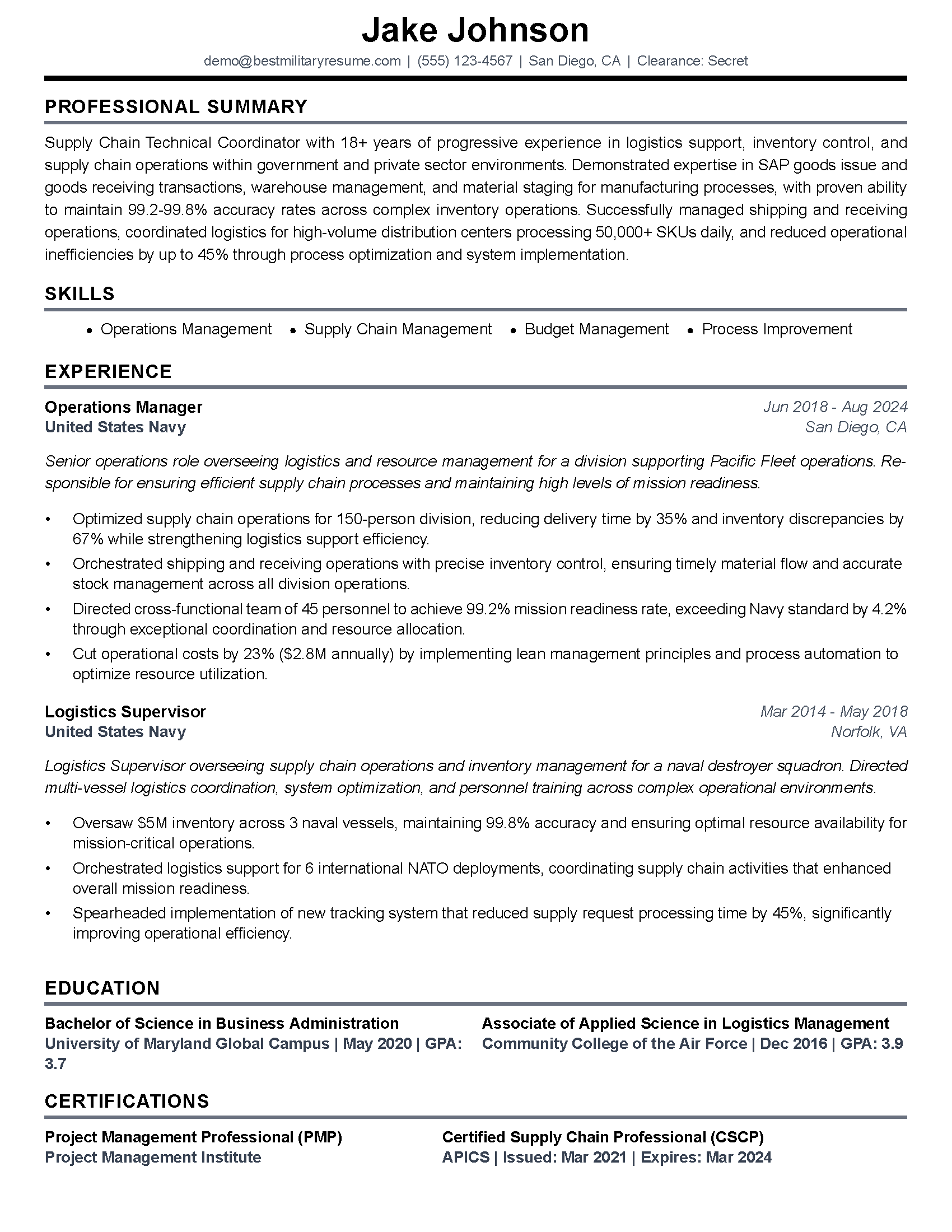
Build one base resume that holds everything. Every job, every duty, every number from your skills list. Don't trim the base. Then cut a tailored version from it for each posting on your target list.
Put the work in civilian words
The rank comes off. The size of what you ran stays on. Use the posting's own words for the work you've actually done. Spell out every acronym the first time you use it. The military to civilian resume guide walks through this line by line.
Here's one of Jane Sample's lines on a first try.
"Responsible for maintenance of equipment and supervising personnel."
Now the same work, with scope and a result.
"Led a 6-person repair team and ran a $250K yearly parts budget. Cut repeat repairs by setting up weekly inspections."
Same job. The second line gives a hiring manager something to call about. Your numbers will be different, so use your own.
Your medical history doesn't go on the page
Your resume shows what you can do. It doesn't need a diagnosis or a rating. How to handle a short gap, and when to disclose a disability, are their own decisions. The disabled veteran resume guide covers both.
How Do You Explain a Medical Retirement in an Interview?
Someone will ask why you left. You don't owe them your medical file. You do want a short, calm answer that moves the talk back to the job.
Keep it to three beats: what happened, in one line. Why you're ready, in one line. Why this job, in one line. Here's a sample you can adjust.
"I was medically retired after an injury, so I couldn't stay in my old role. That chapter is closed, and I'm ready for this kind of work. The planning side of this job drew me in. That's the part I liked most in uniform."
Practice it out loud until it feels boring. Boring is good. It tells the interviewer there's nothing to worry about. For more versions of this answer, read how to answer "why did you leave the military". Is an employer confused about retired pay? The guide to explaining military retirement to an employer has scripts for that.
What they can and can't ask
For federal jobs, OPM says hiring officials can't ask about your disability unless it relates to the work. If a question about your health doesn't connect to the job, you can steer back. "I'm able to do the duties in this posting. Can I tell you how I handled something like that before?" Then tell that story.
What Should Your First 90 Days on the Job Look Like?
Landing the job is a big win. The first 90 days decide if it becomes a career or just a paycheck. Plan them before you start.
Days 1 to 30: learn the job
Find out who you report to and how they measure good work. Ask early. Civilian standards are often less written down than military ones. Write down every term and acronym you don't know, and look them up at night.
Days 31 to 60: set up your support
Do you need an accommodation, like a set schedule for medical visits? Ask for it now. Don't wait until you're hurting. Keep your VA appointments on the calendar. Missing care to look good at a new job often backfires later.
Days 61 to 90: show a result
Pick one small problem on your team and fix it. Track the number before and after. That result goes straight onto your base resume, so your next search starts from a stronger page.
If the search itself stalls before you ever get here, that's normal too. The guide to restarting a stalled job search shows how to reset without starting over.
What to Do Next
You have a plan now. The next step is the one that turns it into interviews: the resume. Pick your top direction from the four filters. Open your skills list. Then build the base resume that holds all of it.
BMR's Resume Builder does that step with you. It turns your military duties into civilian language and keeps the scope in each line. Then it tailors a version to each posting on your target list. The free tier includes one federal tailored resume and one private. So you can test both paths at no cost.
Start the base resume this week, even if your board isn't done. The runway is shorter than it looks. Every week you build now is a week you don't scramble later.
Frequently Asked Questions
Can I work a civilian job after a medical retirement from the military?
When should I start my job search if I'm still going through the MEB or PEB?
What rating does the military need to medically retire me?
How does the TDRL affect my job search?
Can VR&E help me pick a new career after medical retirement?
Do I have to put my medical retirement on my resume?
How do I explain a medical retirement in a job interview?
About the Author
Brad Tachi is the CEO and founder of Best Military Resume and a 2025 Military Friendly Vetrepreneur of the Year award recipient for overseas excellence. A former U.S. Navy Diver with over 20 years of combined military, private sector, and federal government experience, Brad brings unparalleled expertise to help veterans and military service members successfully transition to rewarding civilian careers. Having personally navigated the military-to-civilian transition, Brad deeply understands the challenges veterans face and specializes in translating military experience into compelling resumes that capture the attention of civilian employers. Through Best Military Resume, Brad has helped thousands of service members land their dream jobs by providing expert resume writing, career coaching, and job search strategies tailored specifically for the veteran community.
