Data and Business Analyst Resume for Veterans
Michael got only rejections. Then a $100K facilities manager role.
Michael, E-7, Navy, tried a ton of outside help before BMR
You already do analyst work. You just call it something else.
You track readiness in a spreadsheet. You build the slide that shows the trend. You brief the numbers to the boss every week. That is what a data analyst and a business analyst do all day. The tools have civilian names. The work is the same.
The problem is the resume. You write "maintained unit readiness" and a hiring manager has no idea you ran the data. So the resume ranks low and nobody calls. I know that silence. I sent out application after application after the Navy and heard nothing back for a long time. My skills were fine. My resume just described them in words no civilian could read.
This guide fixes the translation. You will learn how to turn your military work into analyst bullets. Reporting, tracking, readiness numbers. All of it, in words a hiring manager reads. Real tools. Real numbers. Bullets a hiring manager understands in the six seconds they spend on your resume.
What does a data or business analyst actually do?
Both roles turn messy information into decisions. The difference is small but worth knowing.
A data analyst pulls raw data, cleans it, and finds the pattern. They write queries. They build charts. They answer questions like "why did returns spike in March?" The Bureau of Labor Statistics groups a lot of this work under operations research and data roles.
A business analyst sits between the people and the data. They gather what a team needs. They map the process. They write it up so leaders can act. BLS tracks this under management analysts.
Which one should you aim for? Look at your last job. If you lived in spreadsheets and reports, lean data analyst. If you spent more time in meetings fixing how a shop ran, lean business analyst. You can list both on one resume and let each posting decide.
A lot of these jobs are remote or hybrid now. That helps if you are still moving with the military or landing in a new town after separation. Both the government and private companies need people who can make sense of their data.
Here is the part that matters for you. You have done both jobs already. You cleaned rosters. You found the gap in a supply report. You briefed leadership on what to fix. The military just never handed you the job title.
"You already have the skills. The words on the page are what hold you back. Fix the words and the calls start."
Which military jobs already do analyst work?
Some jobs are analyst work with a uniform on. If you held one of these, the fit is obvious once you translate it.
You do not need a fancy job title to qualify. What matters is the pattern of the work. Did you gather information, make sense of it, and hand a decision to someone above you? If yes, you ran the analyst loop. Your MOS name does not change that.
Military roles that map straight to analyst jobs
Intelligence analysts
You collected data, found patterns, and briefed a decision. That is the analyst loop.
Maintenance and readiness trackers
You ran the numbers on parts, downtime, and mission-capable rates.
Supply and logistics
You tracked stock, forecast demand, and cut waste. That is business analysis.
Personnel and manpower
You managed rosters, pulled reports, and flagged gaps in the data.
Army intel folks should read the 35F Intelligence Analyst career guide for the full civilian crosswalk. Air Force analysts have their own pages for the 1N0X1 All-Source Intelligence Analyst and the 2R2X1 Maintenance Management (formerly 2R0X1) roles. Marines who ran personnel systems should check the 0171 Manpower Information Systems Analyst guide.
Did not hold one of these? You can still get there. The path is in our military to data analyst career guide. This article is about the resume itself.

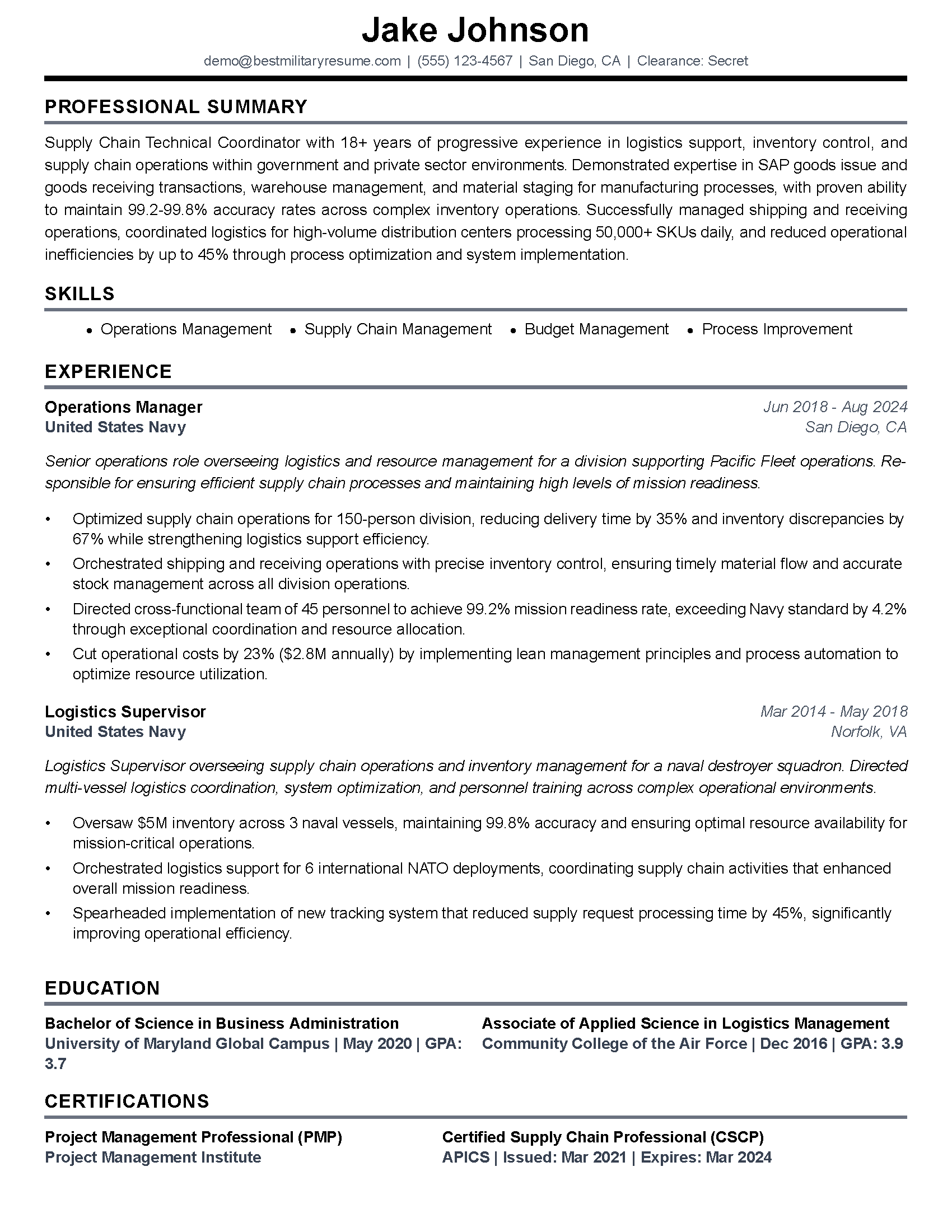
How do you translate a military bullet into an analyst bullet?
Use a simple formula. It works every time.
Action + tool + what you analyzed + the result in numbers.
Most military bullets skip the tool and the number. They say what you were responsible for. An analyst bullet shows what you found and what changed. Look at the difference.
Responsible for tracking maintenance readiness for the squadron.
Built weekly Excel dashboards tracking readiness across 40 aircraft, spotting a parts delay that cut downtime by 18%.
See what changed? The good version names the tool. It shows the scale. It ends with a number that a hiring manager cares about. That is the whole game.
Here is a second example, this time for a business analyst role. A supply sergeant might write "managed warehouse inventory." Reframe it. "Analyzed inventory data across 5,000 line items, forecast demand, and cut excess stock 22% in one year." Same job. Now it reads like analysis, because it always was analysis.
Notice the verbs. "Analyzed," "forecast," "built," "tracked," "flagged." These are analyst verbs. Swap out "responsible for" and "assisted with" every time you see them. Those weak verbs hide your work.
Your evaluations are a goldmine for this. Your NCOER, OER, or FITREP already lists results. Pull the numbers from there and reframe them. We walk through this in the guide on how to convert evaluations into resume bullets. Your evaluation is a real source. A DD-214 is not. Do not try to build a resume off your discharge paper.
What tools and skills belong on the resume?
Analyst jobs list tools in the posting. You need to match them. But only list what you can actually do. If you put SQL on there, be ready to write a query in the interview.
Here are the tools worth learning and listing, from most common to least.
1 Excel
2 SQL
3 Power BI or Tableau
4 Process mapping
A cheap certification helps you prove the tool. Many are free or covered by the GI Bill. See our list of the best tech careers for veterans without a degree for where to start.
How do you quantify analyst work that felt classified or routine?
This is where a lot of veterans freeze. Either the work was sensitive, or it felt too routine to count. Both problems have a fix.
You do not need the classified detail. You need the scale and the result. Swap the sensitive part for a plain number.
Think about three things for every task: how big, how often, and what changed. How many records. How many people. How many reports a week. What went up or down because of your work.
Keep it OPSEC-safe
Never list classified numbers, unit locations, or mission details. Use general scale instead. "Analyzed thousands of records" works. The specific count of a sensitive dataset does not.
Try it on a real task. Say you pulled a weekly personnel report. Rewrite it like this. "Produced 52 weekly reports on a 300-person unit, flagging staffing gaps that leadership fixed before they hit the mission." You did not add any work. You just showed the size, the frequency, and the result.
Routine work counts too. You cleaned a roster every morning. That is data cleaning. You caught errors before they hit the report. That is quality control. Give it a number and it becomes a real bullet.
For a deeper walkthrough, read our guide on how to quantify military experience with real examples.
How do you get an analyst resume past ATS?
Companies run your resume through software first. People call it the ATS. It does not throw your resume in the trash. It ranks you against everyone else who applied.
If the job posting says "SQL" and your resume says "database queries," the software may rank you lower. It looks for the exact words in the posting. So you have to mirror them.
Read the posting first
Pull out the exact tool names and skills. Those are your keywords.
Match the exact words
Use their term, not yours. "Data visualization" beats "made charts" if that is what they wrote.
Tailor for every job
One resume for all jobs ranks low everywhere. Each posting gets its own version.
This is the single biggest miss I see. Veterans send the same resume to 50 jobs and wonder why it goes quiet. Learn more in our piece on how to build an ATS resume that still gets read by humans. You can also check your fit against a posting with our guide to match percentage against a job description.
Where should the analyst keywords go on the page?
Good bullets are only half the job. Where you put them decides if they get seen. A hiring manager scans the top third of the page first. Make it count.
Start with a two-line summary at the very top. Say what you are. "Data analyst with 6 years turning operational data into decisions." Skip the objective statement. Nobody reads those anymore.
Right under it, add a skills section. List the tools in plain rows. Excel. SQL. Power BI. This is the first place both the software and the human look. Keep it honest and keep it short. Do not list a tool you cannot use.
Then comes your experience. Lead each job with your strongest analyst bullet. The one with the biggest number. Push the routine duties lower down. In six seconds, a hiring manager should see the tool, the scale, and one clear result. If they have to hunt for it, you already lost the read.
How do you handle no degree and no civilian analyst title?
Plenty of analysts got in without a data degree. Some without any degree. What they had was proof they could do the work.
Your proof is your bullets. A tool you can use. A number you moved. A dashboard you built. That beats a title on paper. Put a short skills section near the top so a hiring manager sees the tools fast.
One more thing on titles. Do not call yourself a "Senior Data Analyst" if the Army called you a Specialist. Use your real rank and role, then let the bullets show the analyst work. Honesty reads better and it holds up when they ask about it in the interview.
If you are new to civilian resumes entirely, start with the basics in how to add military experience to a resume. Want the federal route instead? The GS-0343 Management Analyst federal resume guide covers the government version of a business analyst role.
Key Takeaway
A hiring manager buys proof, not a title. Name the tool, show the scale, end with a number. Do that in every bullet and the analyst door opens.
Build your analyst resume next
You have the raw material already. You tracked the data. You found the problem. You briefed the fix. All that is left is putting it on the page in words a hiring manager reads fast.
Picture the day it lands. A recruiter opens your resume, sees "Excel dashboards" and "cut downtime 18%," and pulls you into the phone screen. That is the difference translation makes. Not more experience. Better wording of the experience you have.
Our Resume Builder does the translation for you. Paste the analyst job posting, and it tailors your resume to that role. It pulls the right keywords and formats it clean for the ATS. Built by veterans who have sat on both sides of the hiring desk. Two tailored resumes are free. Start with one analyst posting and see how your work reads when it is written right.
Frequently Asked Questions
Can I become a data analyst with only military experience?
What is the difference between a data analyst and a business analyst?
Which military jobs translate best to analyst roles?
What tools should I put on a data analyst resume?
How do I quantify analyst work that was classified?
Do I need a degree to get a data or business analyst job?
How do I get my analyst resume past the ATS?
About the Author
Brad Tachi is the CEO and founder of Best Military Resume and a 2025 Military Friendly Vetrepreneur of the Year award recipient for overseas excellence. A former U.S. Navy Diver with over 20 years of combined military, private sector, and federal government experience, Brad brings unparalleled expertise to help veterans and military service members successfully transition to rewarding civilian careers. Having personally navigated the military-to-civilian transition, Brad deeply understands the challenges veterans face and specializes in translating military experience into compelling resumes that capture the attention of civilian employers. Through Best Military Resume, Brad has helped thousands of service members land their dream jobs by providing expert resume writing, career coaching, and job search strategies tailored specifically for the veteran community.
