DCSA Explained: What It Does for Veterans and Your Clearance
Corey landed a federal security specialist role.
Corey, E-7, Air Force, translated military security experience that actually got read
If you hold a security clearance, one agency touches more of your career than you probably realize. It is the Defense Counterintelligence and Security Agency. Most people just call it DCSA.
You will see the name on a background investigation. You will see it again when a recruiter says "DCSA is still processing your case." You may see it years after you separate, when you try to confirm your clearance is still good. But almost nobody explains what this agency actually does. So the whole thing feels like a black box.
It is not a black box. It is a large federal agency with a few clear jobs. Once you understand those jobs, the clearance process stops feeling random. You know who is doing what, and why a step takes the time it takes.
When I sat on hiring panels for federal jobs, a clean clearance story moved a candidate up the list fast. A confused one slowed everything down. This guide breaks DCSA down in plain English so your clearance works for you, not against you.
What Is DCSA in Simple Terms?
DCSA stands for the Defense Counterintelligence and Security Agency. It is part of the Department of Defense. It is the agency that decides who can be trusted with the government's secrets.
Think of it as the gatekeeper. Before you can touch classified work, someone has to check your background. DCSA runs that check. It is the largest security agency of its kind in the federal government.
Here is the scale. DCSA conducts about 95 percent of the federal government's background investigations. That is not just for the military. It covers most federal agencies and more than 12,000 cleared contractor facilities that do classified work. So if you have a clearance, the odds are very high that DCSA built your case.
The agency was formed in 2019. It pulled together a few older offices into one place. The biggest piece came from the old National Background Investigations Bureau. So when you read about clearance work from before 2019, you may see different names. DCSA is the agency that holds that mission now.
For you, the takeaway is simple. DCSA is the office that vets people for trust. Your clearance lives inside their system. When you know what they do, the rest of the process makes sense.
What Does DCSA Actually Do for Veterans?
DCSA has more than one job. The agency groups its work into a few main mission areas. Each one touches a different part of your clearance life. Let me walk through the ones that matter most to a veteran or a cleared job seeker.
Background investigations and personnel vetting
This is the big one. When you apply for a clearance, you fill out a long form about your life. DCSA takes that form and checks it. They confirm where you lived. They talk to references. They look at your finances and your record.
This is called personnel vetting. The goal is to decide if you can be trusted with classified information. Most clearances you held in the military were built this way.
Continuous vetting
The old system checked you once every several years. That left long gaps. DCSA moved to a better model called continuous vetting. Instead of one big check every few years, the system watches certain records on an ongoing basis.
If something comes up, like an arrest or a serious financial issue, it can flag for review. On October 1, 2021, DCSA enrolled all DoD clearance holders in continuous vetting. So if you held a clearance after that point, you were likely in this program. It is part of a bigger push called Trusted Workforce 2.0.
Industrial and facility security
DCSA does not just vet people. It also oversees the companies that do classified work. A defense contractor has to protect secrets too. DCSA inspects those companies and helps them stay secure. This matters to you if you are heading into a contractor job after service.
Insider threat and counterintelligence
The agency also works to spot insider threats. That means catching people who already have access but turn into a risk. The "counterintelligence" in the name points to this work. It is a smaller part of your day-to-day clearance, but it is why the vetting is so thorough.
DCSA's Main Mission Areas
Personnel vetting
Background investigations that decide who can hold a clearance
Continuous vetting
Ongoing record checks that replaced the old periodic reinvestigation
Industrial security
Oversight of contractors and facilities that handle classified work
Insider threat and counterintelligence
Spotting risk from people who already hold access
You can read the agency's own mission breakdown on the official DCSA website. For a veteran, the first two areas are what you will deal with most.

What Is NBIS and Why Does It Matter to You?
NBIS stands for the National Background Investigation Services. It is the computer system that runs the background check process. Think of it as the software side of DCSA's vetting work.
Older clearance work used a different system. DCSA has been building NBIS to replace it. The goal is faster processing and better data sharing between agencies. When you hear that the government is "modernizing" the clearance system, NBIS is usually what they mean.
Part of NBIS is a new application called eApp. This is the online form you fill out to start a clearance. It replaced the older e-QIP form for many cases. If you have applied recently, you may have used eApp without knowing the name.
NBIS is still rolling out
NBIS is a long, ongoing build. Some parts are live and some are still in progress. So your experience may differ from a friend who applied a year earlier. That is normal during a system rollout.
Why does this matter to you? Two reasons. First, the system you apply through affects how long your case takes. Second, if you want a deeper look at the prep work, we cover the e-QIP background investigation and how to prep your documents in a separate guide.
You do not need to be a tech expert. Just know that NBIS is the engine behind your clearance file. When it works well, your case moves faster.
How Does DCSA Relate to DISS and the Adjudication Side?
This is where people get lost. There are a few system names that all sound alike. Let me sort them out.
DCSA does the investigation. But finishing the investigation is not the same as getting cleared. After the check is done, someone has to make a decision. That decision is called adjudication. It means a trained official reviews your file and rules on your eligibility.
The record of that decision lives in a system called DISS. That stands for the Defense Information System for Security. DISS holds your clearance eligibility and your investigation status. Security officers at your unit or company use DISS to confirm your access.
The office that makes the call used to be known as the DoD CAF, short for the Consolidated Adjudication Facility. DCSA has updated how it labels this work. Today the adjudication mission falls under DCSA's Adjudication and Vetting Services. You may still see the old "CAF" name floating around in forums and old guides. Both point to the same basic job: deciding who is eligible.
- •DCSA gathers the facts on your background
- •NBIS and eApp run the application and case
- •This step confirms what is true about your record
- •Adjudicators rule on your eligibility
- •DISS records the result and your status
- •Security officers check DISS to confirm access
So the order goes like this. DCSA investigates. An adjudicator decides. DISS stores the result. When a recruiter says "we are waiting on DCSA," they usually mean one of these steps is still open.
Curious how long each step runs? We break down the wait in the security clearance investigation timeline guide. This article keeps things at the overview level.
What Does a Veteran Actually Interact With?
You will not deal with every part of DCSA. Most veterans touch just a few points. Here is what shows up in real life.
First, the application. When you start a clearance, you complete the security form. That form is the Standard Form 86, or SF-86. It is long and detailed. Every section feeds your investigation. If you want to know what HR looks at, read our SF-86 form explainer. You can also find the official form on the OPM standard forms page.
Second, the interview. For many investigations, a DCSA investigator will talk with you. They may also reach out to your references. This is a normal step, not a red flag. Be honest and complete.
Third, the status check. After you separate, you may need to confirm your clearance is still valid. This is one of the most common DCSA questions veterans search for. The agency has a process for requesting your status. We walk through it in our guide on how to check your security clearance status after the military.
You fill out the SF-86
The application starts your case in the NBIS or eApp system.
DCSA investigates
Investigators confirm your record and may interview you and your references.
An adjudicator decides
A trained official rules on your eligibility based on the file.
Your status lands in DISS
Security officers use DISS to confirm and reuse your clearance.
That is the full loop for most people. You apply, they investigate, someone decides, and the result gets recorded. Knowing the loop helps you answer a recruiter with confidence instead of a shrug.
Why Does DCSA Matter for Your Job Search?
A clearance is money. It is one of the most valuable things a veteran carries into the civilian market. Cleared roles often pay more and have less competition. But you have to handle the clearance right on paper and in interviews.
Here is the part many veterans miss. When you leave service, your clearance does not vanish overnight. It can stay eligible for a window of time. If a new employer can reuse it, you skip a long wait. That is a huge selling point. We cover the rules in our guide on how long a Secret clearance stays active after separation.
There is also reciprocity. That means one agency can accept another agency's clearance decision. It saves time and avoids a fresh full investigation. If you move from a DoD job to another federal role, this matters. We explain it in our guide on security clearance reciprocity between agencies.
"A clearance only helps if a hiring manager can find it on your resume in six seconds. Bury it and you lose the edge."
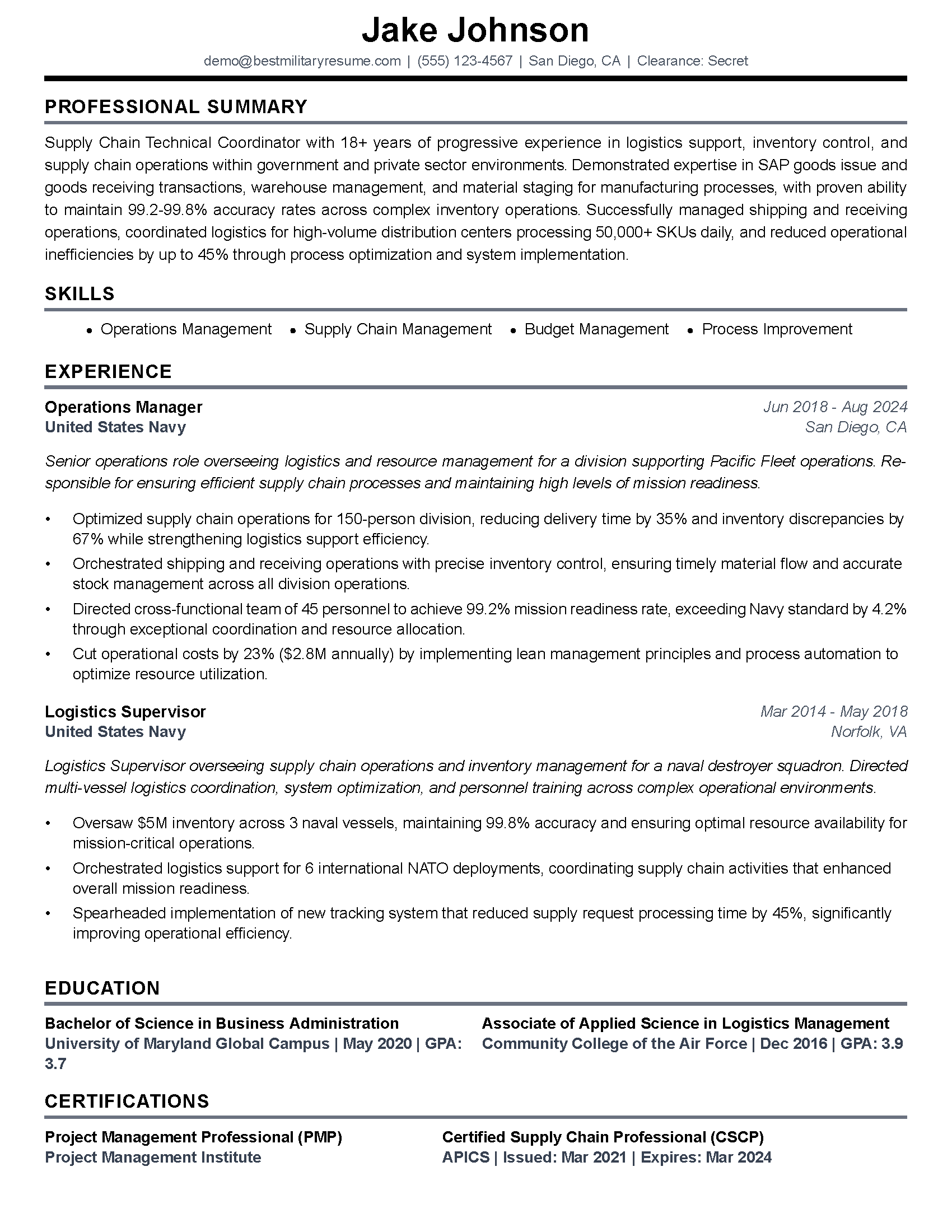
So how do you present a clearance? Put it near the top of your resume. State the level and whether it is active or eligible. Do not hide it in a dense paragraph. A recruiter scanning fast needs to see it right away.
That is exactly the kind of translation our Resume Builder handles for you. You tell it your clearance and target role. It places the right language where a hiring manager looks first. Built by veterans who have sat on both sides of the hiring desk.
What Should You Do Next?
You now know what DCSA is and why it matters. It investigates, it vets, and it keeps the trust system running. Your clearance is one of your strongest cards. The job is to play it well.
Start by confirming your own status. Know your clearance level. Know if it is active or eligible. If you are not sure, our guide on DoD security clearance status after separation walks you through verification step by step.
Next, get the clearance onto your resume in a clear, scannable spot. Then target cleared roles that match your skills. The clearance gives you an edge over candidates who have to start the process from zero. That edge is real, and it is yours.
Build your cleared-ready resume free with the BMR Resume Builder. Paste a job posting, and it tailors your resume to that role, clearance language included. No black box. Just a clear path from your service record to a cleared civilian job.
Frequently Asked Questions
What does DCSA stand for?
Does DCSA handle my security clearance after I leave the military?
What is the difference between DCSA and DISS?
What is NBIS?
What is continuous vetting?
How do I check my clearance status with DCSA?
Why does DCSA matter for my civilian job search?
About the author
Brad Tachi is the CEO and founder of Best Military Resume and a 2025 Military Friendly Vetrepreneur of the Year award recipient for overseas excellence. A former U.S. Navy Diver with over 20 years of combined military, private sector, and federal government experience, Brad brings unparalleled expertise to help veterans and military service members successfully transition to rewarding civilian careers. Having personally navigated the military-to-civilian transition, Brad deeply understands the challenges veterans face and specializes in translating military experience into compelling resumes that capture the attention of civilian employers. Through Best Military Resume, Brad has helped thousands of service members land their dream jobs by providing expert resume writing, career coaching, and job search strategies tailored specifically for the veteran community.
