Emergency Management Resume for Veterans: Ops to EM
Michael got only rejections. Then a $100K facilities manager role.
Michael, E-7, Navy, tried a ton of outside help before BMR
You stood watch in an emergency operations center. You wrote the OPORD for a real response. You ran the exercise that tested the plan. Then you got out. Now you want an emergency management job. But your resume reads like a mission brief. A civilian hiring manager sees acronyms and stops reading.
That is the problem this guide fixes. Emergency management is one of the cleanest moves a veteran can make. The work you already did maps almost one to one. The gap is the words on the page, not the skill in your hands.
I will keep it plain. You will see the exact civilian terms. You will see before and after bullets. You will see which free FEMA courses to add. By the end you will have a resume that a county office, a hospital, or FEMA can score.
What does an emergency management job actually want?
Emergency management keeps people safe before, during, and after a disaster. Think floods, hurricanes, active shooters, chemical spills, power outages. The field runs on four phases. Mitigation. Preparedness. Response. Recovery. Every EM job lives inside those four words.
Employers fall into a few buckets. Federal agencies like FEMA. State and county emergency management offices. Hospitals and health systems. Big companies that need business continuity. Airports, ports, and utilities. Each one wants the same core skill. Plan for the worst, then run the response when it hits. Titles change from coordinator to specialist to director. The core work does not change much.
The common language across all of them is NIMS and ICS. NIMS is the National Incident Management System. ICS is the Incident Command System. If you worked in a joint operations center, you already used a version of this. Your resume needs to say so in words they use.
The one word that opens doors
NIMS is the shared language of civilian emergency management. Show that you worked inside an incident command structure. A hiring manager then reads you as one of their own.
Why does your military experience already fit emergency management?
You may not have called it emergency management. But you did the work. Standing watch in an EOC is emergency operations. Writing an OPORD is operational planning. Running a field exercise is a preparedness drill. Cleaning up after a real incident is recovery.
Directors care about one thing most. They want people who stay calm when the plan breaks. That is hard to teach. You learned it by living it. A veteran who ran a 12-hour watch during a real crisis brings something a fresh grad does not.
The four EM phases line up with tasks you already know:
- Mitigation: lines up with risk assessment and force protection planning.
- Preparedness: lines up with training, exercises, and rehearsals.
- Response: lines up with battle drills, watch standing, and command post work.
- Recovery: lines up with after-action reviews and getting the unit back to full readiness.
That mapping is your whole resume strategy. Name the phase. Show the proof.
Some career fields translate even cleaner. The Air Force 3E9X1 Emergency Management field is a direct match. So is Army 74D CBRN Specialist, Coast Guard Operations Specialist, and Marine 5711 CBRN Defense Specialist. If you held one of these, your background carries heavy EM weight.
What if you were not in an ops or EM job?
Not every veteran stood watch in an EOC. You may have been infantry, a mechanic, a medic, or a supply clerk. You can still move into emergency management. The field rewards people who plan, lead, and act under pressure. That covers a lot of military jobs.
Find the EM angle in what you already did:
- Infantry and combat arms: you ran battle drills, briefed plans, and led people through chaos. That is response and preparedness.
- Maintenance and logistics: you kept resources ready and moving under pressure. That is resource management and continuity.
- Medical: you triaged and treated when things went bad. That is mass casualty and response work.
- Admin and supply: you tracked accountability and moved information fast. That is EOC and coordination work.
The move is the same for everyone. Find the task that looks like one of the four EM phases. Name it in civilian terms. Add a number. Then back it up with the free FEMA courses so a recruiter sees the vocabulary too.
If you came from a combat arms background, start with our combat veterans resume guide. It shows how to reframe tactical work for civilian readers.
How do you translate military operations into EM resume bullets?
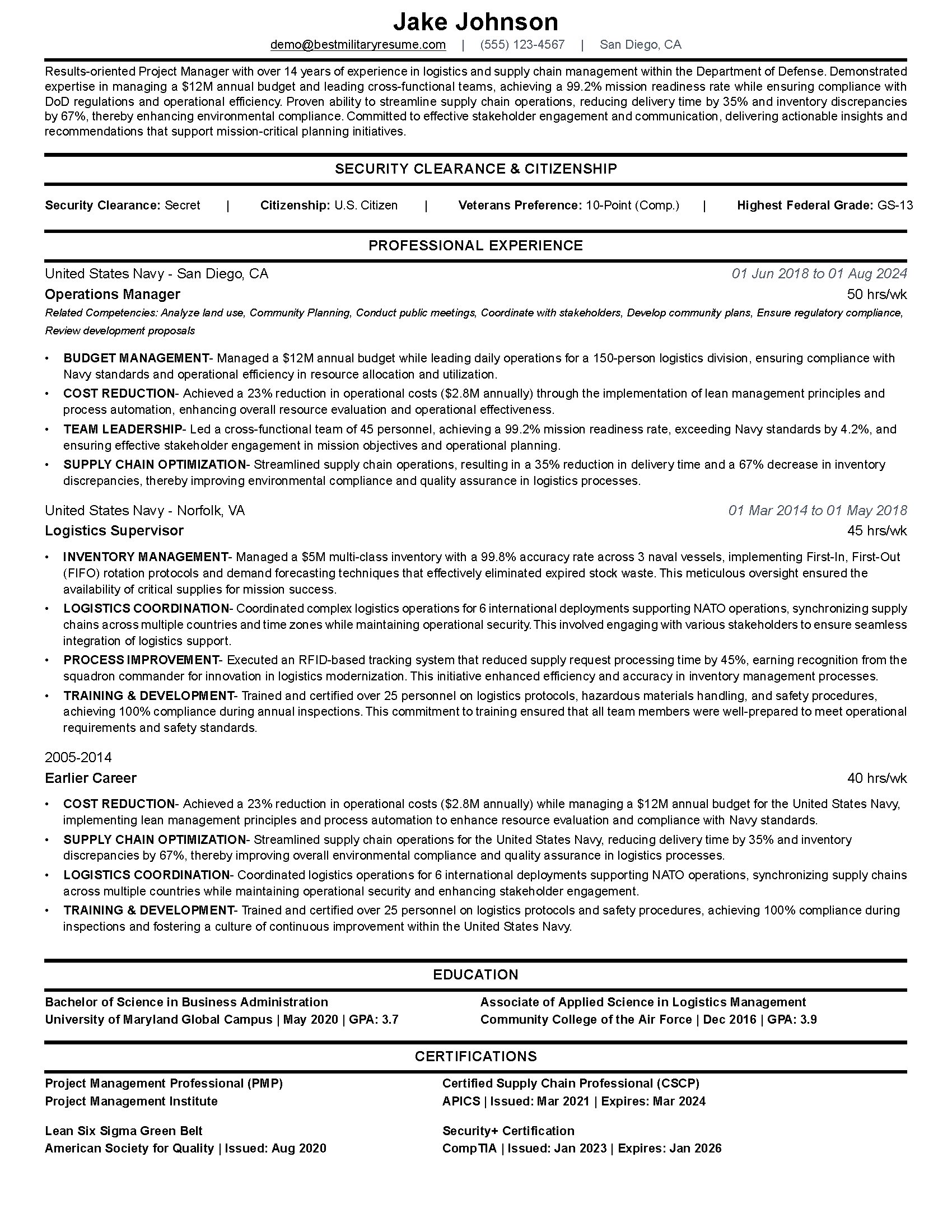
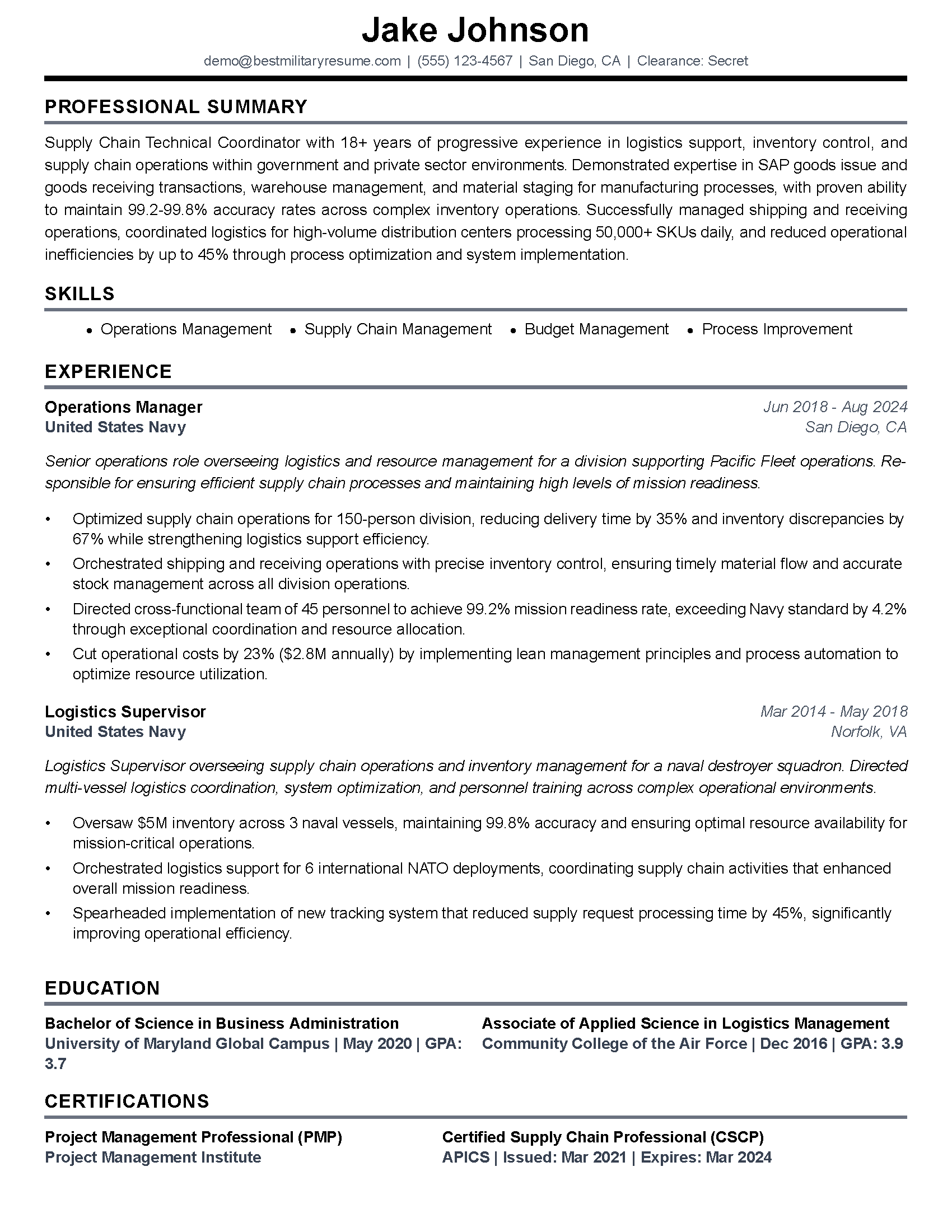
This is where most veteran resumes fall apart. You write "served as EOC watch officer" and stop. The reader has no idea what that means or how big it was. Fix it with the formula every strong bullet uses. Action, scope, result.
Take the military term. Add a plain civilian label next to it. Add a number. Add the outcome. That is the whole move.
Stood watch in the JOC and tracked unit movements. Wrote OPORDs for training events.
Ran 12-hour emergency operations center (EOC) watch tracking 40+ assets across a 500-mile response area. Authored operational plans for 15 exercises coordinating 6 agencies and 300 personnel with zero safety incidents.
The number is the part veterans skip. You do not need a perfect figure. A defensible estimate beats a vague verb. If you tracked "a lot" of assets, count a typical shift and use that count.
For more help putting numbers to your service, read our guide on quantifying military experience on a resume. To turn tactical wording into business wording, see translating tactical experience to corporate language.
Which emergency management keywords should be on your resume?
Civilian EM runs on its own vocabulary. Your resume needs those exact words. Not because a machine tosses you out. Applicant tracking systems do not reject you. They rank you. Miss the keywords and you sink to the bottom of the list. Hit them and you rise to where a human reads you.
Core EM keywords to work in where they are true
NIMS, ICS, and EOC
Incident command, national incident management, emergency operations center
The four phases
Mitigation, preparedness, response, recovery
COOP and risk work
Continuity of operations, hazard and risk assessment, damage assessment
Coordination terms
After-action report (AAR), mutual aid, interagency coordination, mass notification
When I sat on hiring panels and reviewed applications for openings I oversaw, one thing stood out. The resumes that scored well used the language of the job posting. Read the EM announcement. Mirror its words where they fit you. Never invent a skill you do not have.
What certifications strengthen a veteran emergency management resume?
The fastest credibility boost is free. FEMA runs the Emergency Management Institute. Its Independent Study courses are online, self-paced, and cost nothing. Recruiters know them on sight.
Start with these four from FEMA's Emergency Management Institute:
- IS-100.c: Introduction to the Incident Command System
- IS-200.c: Basic Incident Command System for Initial Response
- IS-700.b: An Introduction to the National Incident Management System
- IS-800.d: National Response Framework, An Introduction
Some veterans already hold these from a service EM or CBRN billet. If you do, list them with the course numbers. If you do not, you can knock out all four in a weekend. That alone moves your resume up the stack.
Key Takeaway
Four free FEMA courses and the right keywords can lift a raw military resume into a competitive one. It takes a single weekend. The experience is already yours. This just labels it.
Beyond the free courses, a couple of paid credentials carry weight over time. The Certified Emergency Manager from IAEM is the field standard, but it needs experience first. A degree helps for director roles. It is not always needed to start as a coordinator or specialist.
How should you structure an emergency management resume?
Keep it clean and short. Two pages max for private sector and hospital roles. Federal EM resumes on USAJOBS also run two pages, with more detail under each job. The old idea that federal resumes need four to six pages is out of date.
Summary that names the target
One line. "Emergency management professional with 8 years of operations and response experience."
A skills line from the keywords
NIMS, ICS, EOC operations, COOP, hazard assessment, interagency coordination.
Experience in reverse order
Each role with 3 to 5 quantified bullets. Action, scope, result.
Certifications, education, clearance
FEMA course numbers, any degree, and an active clearance if you hold one.
One note on documents. Your DD-214 is not a resume source. It lists your service dates, discharge status, MOS, and awards. Save it for veterans preference paperwork. Your resume content comes from your evaluations, your training records, and what you actually did on the job.
Applying to a federal EM role changes the format a little. Our breakdown of the federal resume versus the civilian resume walks through what to add for USAJOBS.
What emergency management paths can veterans target?
You have more than one door. Pick by pay, location, and how fast you want in.
- •Federal: FEMA and other agencies hire under the GS-0089 series. Veterans preference helps.
- •State and county: EM offices hire coordinators and planners. Often close to home.
- •Hospital: nearly every health system needs an emergency preparedness coordinator.
- •Corporate: big employers hire business continuity and crisis managers.
The federal door has a clear entry. FEMA and other agencies hire under the GS-0089 Emergency Management Series. The basic title is Emergency Management Specialist. Your veterans preference can move you up the list.
The pay is real. The median wage for emergency management directors was $86,130 in May 2024, per the Bureau of Labor Statistics. Employment is projected to grow 3 percent from 2024 to 2034. Director roles sit at the top. Coordinator and specialist roles are the common way in.
State and county offices are often the fastest way in. They hire steadily and they value local knowledge. If you already live near the community, that counts for a lot. A security clearance is a bonus for federal and contractor EM roles. So is any second language, since a disaster does not stop at a language barrier. List both if you have them. And do not wait for the perfect posting. Apply to the coordinator and specialist roles now, then climb toward director once you are inside.
Adjacent fields hire the same background. Safety and EHS roles value your risk work. Fire and EMS value your response work. If one of those fits better, read our safety manager resume guide and our firefighter and EMS resume guide.
What should you do next?
Emergency management may be the shortest bridge from your military job to a civilian paycheck. The skill is already yours. The work is the same shape. The only real task is putting it in words a hiring manager scores in six seconds.
Do this. Pull your last two or three roles. Write each bullet as action, scope, result. Add the EM keywords that are true for you. Knock out the four free FEMA courses. Then tailor the resume to one specific EM posting. Do not send the same resume to ten jobs. Tailoring to the posting beats volume every time.
"For a veteran, emergency management runs on skills you already built in uniform. The civilian name is the only new part. Your job now is proving it on the page."
BMR's Resume Builder does the military-to-civilian translation and the ATS formatting for you. Paste the EM job posting. Get a resume tailored to that exact role. It was built by veterans who have sat on both sides of the hiring desk. Start free with the military resume builder.
Once you land the role, set yourself up to keep it. Our guide to your first 90 days on a civilian job covers the next step.
Frequently Asked Questions
Do you need a degree to work in emergency management?
What FEMA courses should a veteran take first?
Is GS-0089 the federal emergency management job series?
How long should an emergency management resume be?
Can infantry or combat arms veterans move into emergency management?
How much do emergency management jobs pay?
Does a security clearance help in emergency management?
About the Author
Brad Tachi is the CEO and founder of Best Military Resume and a 2025 Military Friendly Vetrepreneur of the Year award recipient for overseas excellence. A former U.S. Navy Diver with over 20 years of combined military, private sector, and federal government experience, Brad brings unparalleled expertise to help veterans and military service members successfully transition to rewarding civilian careers. Having personally navigated the military-to-civilian transition, Brad deeply understands the challenges veterans face and specializes in translating military experience into compelling resumes that capture the attention of civilian employers. Through Best Military Resume, Brad has helped thousands of service members land their dream jobs by providing expert resume writing, career coaching, and job search strategies tailored specifically for the veteran community.
