Project Management for Military Spouses: PMP and Jobs
Luana, a military spouse, landed a Staff Policy and Procedures Analyst role.
Luana, military spouse, policy and procedures analyst
Why Do Military Spouses Make Strong Project Managers?
Military spouses coordinate PCS moves across time zones, manage household budgets during deployments, run volunteer organizations on base, and keep families functioning through constant change. That is project management. The difference between doing it informally and getting paid for it comes down to one thing: proving it on paper.
After helping 15,000+ veterans and military spouses through BMR, we see the same pattern repeatedly. Spouses who have organized fundraisers, led Family Readiness Groups, or managed cross-country relocations already have the core PM skills employers want. They just need the right credentials and the right way to present that experience on a military spouse resume.
Project management is one of the best career fits for military spouses for four reasons: it pays well, it is in high demand, many PM roles are fully remote, and the skills transfer across industries. Whether you stay in one location for four years or PCS every 18 months, a PM career follows you.
This guide covers the certifications that matter, free and discounted training options available specifically to military spouses, how to translate your military life experience into PM credentials, and where to find remote PM jobs that work with a military lifestyle.
What Is the Difference Between PMP and CAPM Certification?
The two main project management certifications from the Project Management Institute (PMI) are the PMP (Project Management Professional) and the CAPM (Certified Associate in Project Management). They serve different experience levels, and picking the right one saves you time and money.
Requirements: High school diploma + 23 hours of PM education
Experience needed: None
Exam: 150 questions, 3 hours
Cost: $300 (PMI members) / $400 (non-members)
Best for: Spouses new to formal PM work
Renewal: Every 5 years, retake the exam
Requirements: 35 hours of PM education + 36 months leading projects (with a degree) or 60 months (without a degree)
Exam: 180 questions, 230 minutes
Cost: $405 (PMI members) / $555 (non-members)
Best for: Spouses with 2+ years of PM-adjacent work
Renewal: 60 PDUs every 3 years
Here is the key insight for military spouses: PMI counts volunteer project leadership toward PMP eligibility. If you led an FRG, organized a military ball, managed a thrift shop operation, or coordinated spouse support during a deployment cycle, those hours count. You do not need a formal PM job title to qualify for the PMP.
If you have fewer than two years of project leadership experience (paid or volunteer), start with the CAPM. It gives you a credential to put on your resume while you build experience. If you have been managing projects informally for years through volunteer work, FRG leadership, or prior employment, go straight for the PMP.

Which Free Training Programs Can Military Spouses Use?
The biggest barrier to PM certification is not the exam itself. It is paying for the training hours required to sit for it. Military spouses have access to programs that cover most or all of the cost.
Top PM Training Options for Military Spouses
MyCAA (Military Spouse Career Advancement Account)
Up to $4,000 for certification and training. Covers PMP/CAPM prep courses, exam fees, and related education. Available to spouses of active duty service members, regardless of rank.
Google Project Management Certificate (Coursera)
Free for military families through Google and Coursera partnerships. Covers PM fundamentals, Agile, and real-world tools. Earns 35 contact hours toward PMP eligibility.
Syracuse University IVMF (Onward to Opportunity)
Free professional training and certifications for military spouses, including PM tracks. Fully online, self-paced courses with career coaching included.
Hiring Our Heroes Corporate Fellowship (HOH)
Career fellowship program that places military spouses with companies in PM and operations roles. Includes mentorship and job placement support.
The smartest path for most spouses: use MyCAA funds to cover a PMP prep course, complete the Google PM Certificate for free to earn your 35 contact hours, then sit for the exam. Total out-of-pocket cost can be under $100 if you combine these programs correctly. Check the full list of military spouse employment programs for additional funding sources.
MyCAA Eligibility Note
The SpouseWorks Scholarship (formerly MyCAA) is available to spouses of active duty service members regardless of rank. The old E6 and above cutoff no longer applies. Onward to Opportunity (O2O) through Syracuse and employer-sponsored tuition reimbursement are worth stacking alongside it.
How Do You Turn Military Life Experience Into PM Resume Bullets?
This is where most military spouses get stuck. You have real PM experience, but it does not look like PM experience on paper. Translating volunteer work, FRG leadership, and PCS coordination into resume language requires reframing, not exaggeration.
One of our Army spouse users came to BMR after years of leading FRG meetings and organizing unit events. She had never held a paid PM role, but once we helped her reframe that experience using PM terminology, she landed a remote project coordinator position within two months. The experience was always there. The resume just was not showing it.
Here is how to translate common military spouse experiences into PM language on your work experience section:
PCS Move Management: You coordinated timelines across moving companies, housing offices, schools, and medical transfers. On a resume, this becomes: "Managed cross-functional relocation projects involving 5+ stakeholders, $15K+ budgets, and 60-day timelines from initiation to completion."
FRG Leadership: You planned meetings, managed communication chains, organized events, and supported families during deployments. Resume version: "Led volunteer organization of 40+ members, planned and executed quarterly events with budgets up to $5,000, and maintained stakeholder communication across multiple channels."
Volunteer Event Coordination: Base fundraisers, holiday parties, spouse appreciation events. Resume version: "Planned and delivered community events for 100+ attendees, managing vendor contracts, volunteer teams of 8-12, and event budgets from proposal through post-event reporting."
Deployment Support: Managing a household solo, coordinating with unit leadership, handling finances and logistics for months. Resume version: "Managed all operational and financial logistics for a multi-month period, including budget tracking, contractor coordination, and stakeholder communication with organizational leadership."
Key Takeaway
PM hiring managers care about scope, budget, timeline, and stakeholder management. If you managed any of those things, even unpaid, you have PM experience. Frame every bullet with numbers: how many people, how much money, what timeline, what outcome.
What PM Tools Should You Learn Before Applying?
Certifications open doors. Tools close deals. Most PM job postings list specific software, and knowing even two or four of these before you apply sets you apart from other entry-level candidates.
Must-know tools:
- Microsoft Project or Smartsheet — Traditional project scheduling and Gantt charts. Used heavily in government and defense contracting.
- Jira — The standard for Agile and software development PM. If you are targeting tech companies, learn Jira first.
- Asana or Monday.com — Popular in mid-size companies and marketing teams. Easier to learn than Jira or MS Project.
- Confluence or SharePoint — Documentation and knowledge management. Almost every PM role requires one of these.
Most of these tools offer free tiers you can practice with. Spend a weekend building a sample project in Jira or Asana. Create a mock project plan with tasks, milestones, and dependencies. Screenshot it for your portfolio. Hiring managers want to see that you can actually use the tool, not just list it on your resume.
Beyond tools, learn the methodology behind them. Agile and Scrum dominate tech PM roles, while Waterfall is still common in government and construction. You do not need to master all of them, but you should understand the basics of each and know which one a job posting is asking for. The Google PM Certificate covers both Agile and Waterfall, which is another reason it is a strong starting point.
One practical exercise: pick a project you have already completed, like organizing a unit fundraiser or managing a PCS move. Map it out using PM terminology. Identify the stakeholders, define the scope, list the deliverables, note the risks you mitigated, and calculate the budget. This exercise does two things: it gives you practice thinking in PM frameworks, and it gives you ready-made interview answers for behavioral questions about your PM experience.
When listing skills on your resume, separate PM tools into their own section. Do not bury "Jira" in a paragraph of soft skills. Give it a dedicated line with your proficiency level.
Where Can Military Spouses Find Remote PM Jobs?
Remote work is not just a perk for military spouses. It is a career survival strategy. Every PCS means either finding a new local job or having a remote role that moves with you. PM is one of the best fields for remote work because the entire job is coordination, and coordination happens digitally.
I built BMR specifically because my own transition was a mess, and I have seen the same portability problem hit military spouses even harder than veterans. A career that disappears every time you PCS is not a career. It is a series of restarts. PM solves that.
1 Military-Friendly Job Boards
2 General Remote Job Platforms
3 Government and Defense Contractors
4 Tech Companies with Spouse Programs
When searching job boards, do not limit yourself to the exact title "Project Manager." Search for project coordinator, program manager, program coordinator, implementation specialist, and client success manager. These roles often involve the same PM work under a different title, and they may have lower experience requirements. For more remote job ideas for military spouses, we have a full guide covering the best options in 2026.
How Should You Structure Your PM Resume as a Military Spouse?
Your resume needs to pass two tests: the ATS keyword scan and the hiring manager review. For PM roles, that means hitting specific keywords and showing measurable results.
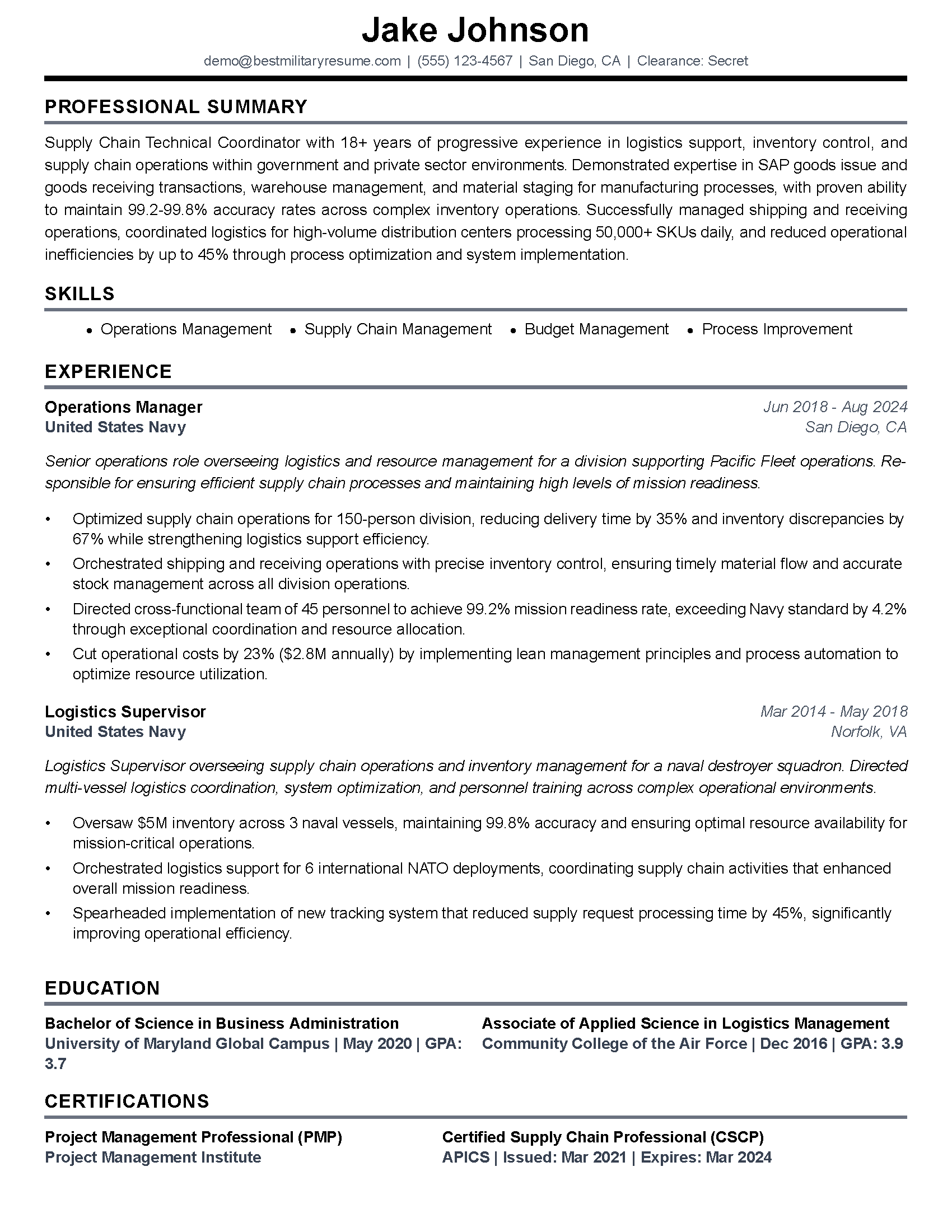
Start your professional summary with your certification (or in-progress certification), years of relevant experience, and one headline result. Something like: "CAPM-certified project coordinator with 4+ years of volunteer and professional project leadership experience. Managed 12+ community events with budgets up to $8,000 and teams of 15 volunteers."
For the experience section, use the STAR format (Situation, Task, Action, Result) but keep each bullet to one or two lines. Start every bullet with a strong action verb: managed, coordinated, delivered, tracked, executed. Include numbers wherever possible.
Your skills section should list PM tools (Jira, Asana, MS Project, Smartsheet), methodologies (Agile, Scrum, Waterfall, hybrid), and soft skills that PM postings actually mention (stakeholder communication, risk assessment, timeline management). Do not just list "communication" and "leadership." Be specific about what kind.
BMR's Resume Builder handles the ATS formatting and military-to-civilian translation for you. Paste a PM job posting in, and it tailors your resume to match the specific keywords and qualifications that posting is looking for. The free tier includes two tailored resumes, so you can test it on two different PM job postings before committing.
If you have employment gaps from PCS moves, do not try to hide them. List your volunteer work, FRG leadership, and certification coursework in those gaps. A resume that shows "Volunteer Project Lead, Fort Liberty FRG, 2023-2025" during a gap is stronger than a resume that leaves 18 months blank.
Key Takeaway
A PM resume is not about job titles. It is about demonstrating that you can manage scope, budget, timelines, and people. Military spouse experience checks all four boxes if you frame it correctly with specific numbers and outcomes.
Frequently Asked Questions
Can military spouses use MyCAA for PMP certification?
Does volunteer work count toward PMP eligibility?
What is the difference between PMP and CAPM?
How much does PMP certification cost for military spouses?
What PM tools should I learn first?
Can I get a PM job with no paid work experience?
Are project management jobs remote-friendly?
How do I list FRG leadership on a PM resume?
About the Author
Brad Tachi is the CEO and founder of Best Military Resume and a 2025 Military Friendly Vetrepreneur of the Year award recipient for overseas excellence. A former U.S. Navy Diver with over 20 years of combined military, private sector, and federal government experience, Brad brings unparalleled expertise to help veterans and military service members successfully transition to rewarding civilian careers. Having personally navigated the military-to-civilian transition, Brad deeply understands the challenges veterans face and specializes in translating military experience into compelling resumes that capture the attention of civilian employers. Through Best Military Resume, Brad has helped thousands of service members land their dream jobs by providing expert resume writing, career coaching, and job search strategies tailored specifically for the veteran community.
