How to Write Your Resume While Still on Active Duty
Michael got only rejections. Then a $100K facilities manager role.
Michael, E-7, Navy, tried a ton of outside help before BMR
Most service members wait too long to write a resume. They wait until the uniform comes off. Then the clock is already running and the bills do not stop. That gap is where the stress lives.
You do not have to wait. You can write a strong civilian resume while you are still in. In fact, that is exactly when you should. Your work is fresh. Your awards are easy to pull. Your numbers are still in your head.
I work directly with two of the largest SkillBridge providers in the country. Every week I run resume training for cohorts who are still on active duty. The ones who win start their resume months before they leave. This guide walks you through how to do that.
One more reason to start now. You are not just writing a resume. You are learning a new skill. The first draft is always the slowest. By the time you separate, you want that learning curve behind you, not ahead of you.
Why Should You Write Your Resume Before You Separate?
Time is the reason. When you separate, your pay can stop before your first civilian check lands. That gap can run weeks or months. A resume you wrote early closes that gap.
There is a second reason. Right now you have access you will lose later. You can pull your evaluations. You can grab your award citations. You can ask your chief for real numbers. After you leave, that gets harder.
Your memory is also sharp now. You know how many people you led. You know how much gear you tracked. You know the budget you ran. Wait a year and those numbers blur. Write them down while they are clear.
Key Takeaway
Start your resume 6 to 12 months out. Your records, your numbers, and your time are all on your side while you are still in.
When Should You Start Writing It?
The sweet spot is 12 months out. That sounds early. It is not. The first months are for gathering, not polishing.
You do not need the perfect resume a year early. You need the raw material. Pull your records. List your jobs. Write down your wins. The polish comes later as you target real openings.
If you plan to use SkillBridge, you need a resume even sooner. Host companies want to see one before they take you. You apply to those programs months ahead. So the resume has to exist first.
12 months out: Gather
Pull your evals, awards, and training records while you still have easy access.
9 months out: Draft
Build a base resume. Translate your job into plain civilian words.
6 months out: Target
Tailor the base resume to real job postings you want to apply for.
3 months out: Apply
Send tailored versions. Start interviews. Lock in your next move.
This lines up with the rest of your transition. For a full month-by-month plan, read our ETS transition timeline from 12 months out to terminal leave. The resume is one piece of a bigger checklist.

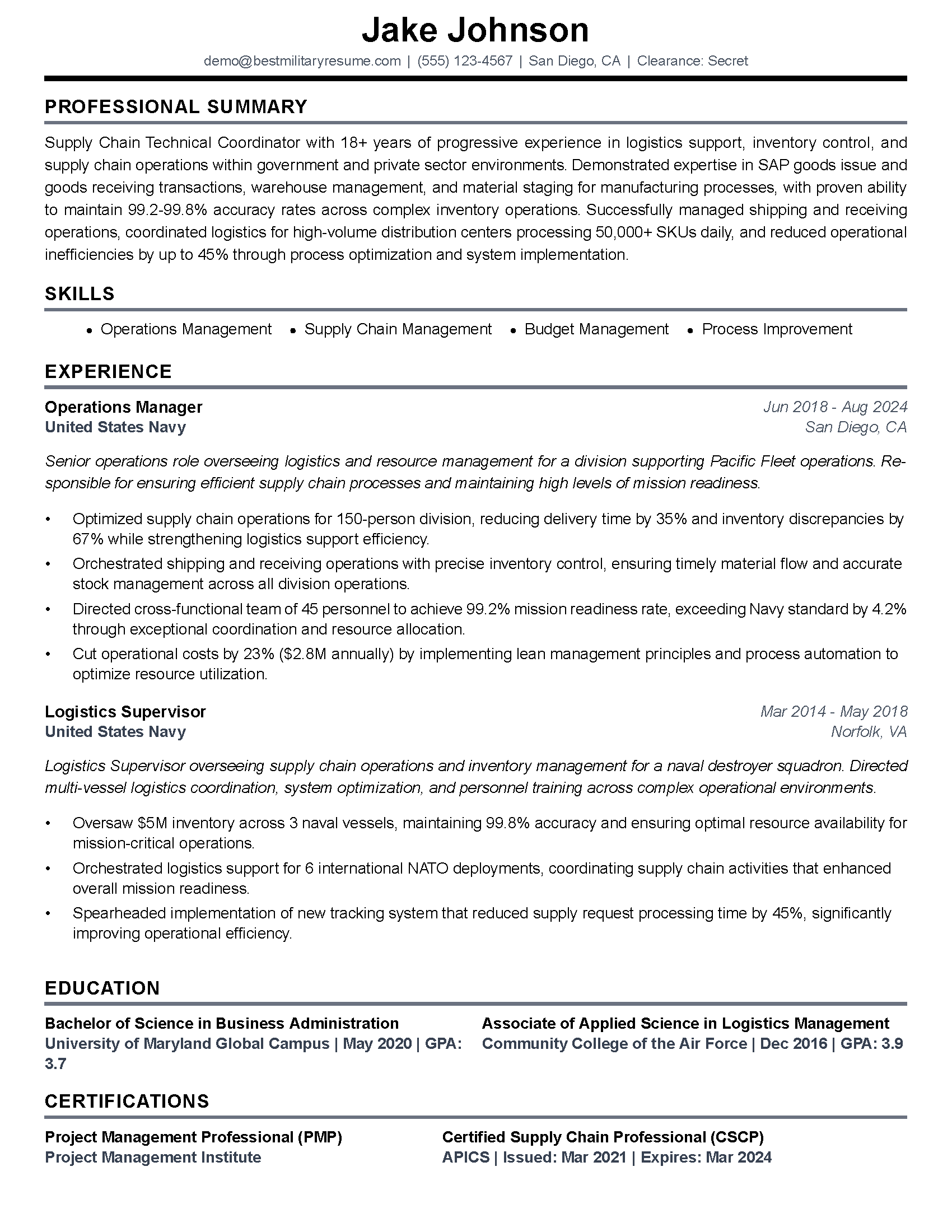
Present Tense or Past Tense While You Are Still In?
This trips up a lot of people. You are still doing the job. So do you write it in present tense? Yes. While you hold the role, use present tense for it.
Your current job gets present tense. Your past jobs get past tense. That is the simple rule. It is the same rule civilians use.
Here is what that looks like in real bullets. Use action verbs at the start. Keep the tense matched to whether you still hold the job.
"Led a team. Manages supply for 200 personnel. Responsible for training."
"Manage supply chain for 200 staff. Train 15 junior workers each quarter on safety steps."
Notice the second version uses present tense for the job you still hold. It also drops the word "personnel" for "staff." Small word swaps add up. They make a civilian reader trust the page faster.
How Do You Translate Military Words Into Civilian Words?
This is the hard part. Your job has its own language. A civilian reading your resume may not speak it. Your job is to translate, not to dumb it down.
Start with your title. "Platoon Sergeant" means little outside the gate. "Operations Supervisor leading 40 staff" means a lot. Same job. Clearer words.
Then hit your duties. Drop the acronyms. Spell out what you did in plain terms. A hiring manager often gives your resume a fast first scan, sometimes as little as 6 to 10 seconds. Make those seconds count.
4 Steps to Translate a Bullet
Cut the acronym
Replace NCOIC, MOS, or AOR with plain words.
Name the skill
What civilian skill did you use? Lead, plan, budget, train.
Add a number
People led, dollars saved, gear tracked, hours cut.
Read it out loud
If a friend outside the military gets it, you are done.
Need help with the words themselves? We built a full list of swaps. Check our guide on 50 military terms translated to civilian language. Keep it open while you draft.
What Records Should You Pull Before You Leave?
This is the step people skip. Then they regret it. Pull your records now while you have access. Save them somewhere you control, not just a work computer.
Your evaluations hold gold. They list your wins in writing. Mine them for numbers and outcomes. Do not paste eval language straight in. Translate it. But use it as a source.
Save these to a personal email or drive before your account closes. Once you separate, getting copies takes time you may not have.
1 Performance evaluations
2 Award citations
3 Training and certificates
4 Your Joint Services Transcript
Do not build your resume from your DD-214
Your DD-214 is a separation document. It records your service dates, discharge status, and a basic list of your awards and training. But it does not give you the detail you need to write strong resume bullets. Use your evals and award write-ups for the full story instead.
Build a simple folder while you are still in. One spot for every record. Drop in each eval, award, and cert as you find it. When you draft bullets later, the source material is all in one place. This one habit saves hours down the road.
How Does SkillBridge Change Your Resume Timing?
SkillBridge moves your whole timeline up. You can spend your last months working at a civilian company while still on active-duty pay. But you have to get into the program first. That takes a resume.
Host companies look at your resume before they take you. So does your command when you ask for approval. You need a clean draft early, not a rushed one the week before.
Think of it as competitive. Good programs get more applicants than slots. The service members who get selected come prepared. A sharp resume is part of that package.
You can read the official program rules straight from the source at DoD SkillBridge. For the steps to land a spot, see our guide on how to find a SkillBridge employer.
"The cohorts who win start their resume months before they leave. The ones who wait spend their first weeks out scrambling. Same skills. Different prep."
What If You Have Time On Base But No Civilian Job Yet?
Use the time you have. Many bases run a transition program with resume help. The instructors are trying hard. Many are veterans too. They can give you a solid first draft.
But a first draft is not a finished resume. The transition class gives you one generic version. Real jobs need a tailored one. You take what they teach and build on it.
The Department of Labor also runs free employment workshops for transitioning members. You can find them through DOL VETS. Stack these free resources while you still have base access.
Once you have a base resume, tailor it for each job. That step matters more than any other. A resume aimed at one posting beats a generic one every time. Our walkthrough on how to build a military resume in 15 minutes shows the fast path.
How Do You Handle Your Clearance On the Resume?
If you hold a clearance, it has value. List it. Many cleared jobs pay more and want people who already passed the check. Put it near the top.
Keep it simple. State the level and the status. You do not need to share dates of investigations or case details on the page. Just the fact that you hold or held it.
Your clearance does not stay active forever after you leave. The window matters for cleared jobs. We break it down in our guide on DoD security clearance status after separation.
How Do You Add Numbers Without Crossing a Line?
Numbers make a resume strong. But some of your work may be sensitive. You can still show scale without sharing anything you should not.
Round and generalize. You do not need the exact count of a sensitive item. "Tracked over 500 pieces of gear worth more than $2 million" tells the story. It shares scale, not secrets.
Skip anything classified. No locations, no unit details, no mission specifics that are not public. If you are unsure, leave it out. A vague win beats a violation every time.
Focus on the kind of numbers civilian jobs care about. People led. Money saved. Time cut. Error rates dropped. Those translate to any job, in any field.
- •People you led or trained
- •Dollars saved or managed
- •Hours or steps you cut
- •Gear or assets you tracked
- •Classified counts or specs
- •Unit names and locations
- •Mission details not public
- •Anything you are unsure about
What Do Civilian Readers Want to See?
A civilian reader is not grading your service. They are trying to picture you in their open job. Your resume has to help them see it.
They want results, not duties. Not "responsible for supply." They want "cut supply order errors by 30 percent in six months." One tells them your task. The other tells them your impact.
They also want to read it fast. Short bullets. Plain words. No wall of text. From the hiring side of the desk on positions in my federal chain, the resumes that moved up were always the easy ones to scan.
And they want proof you can do the work they need. That is why tailoring matters so much. You match your real wins to what their posting asks for. Same resume base. New focus each time.
Your time on active duty is the best window to learn this skill. You are not under pressure yet. Practice now. Get the base right. Then each tailored version takes minutes, not hours.
Let the Tool Do the Translation
You can do all of this by hand. Many do. But the translation step is where most people stall. The military words come easy. The civilian ones do not.
That is why I built BMR. You paste a job posting. You add your military background. The Resume Builder handles the military-to-civilian translation and the formatting for you. It is built by veterans who have sat on both sides of the hiring desk.
The free tier gives you two tailored resumes and two cover letters. That is enough to test it against real jobs before you separate. Start while you are still in. Your future self will thank you.
Start now, not later
A resume written while you are still in is your bridge across the pay gap. Pull your records, draft your base version, and tailor it as real openings come up.
Frequently Asked Questions
Should I write my resume before I separate from the military?
Do I use present or past tense for my current military job?
What military records should I pull before I leave?
Can I use my DD-214 to build my resume?
How does SkillBridge affect my resume timing?
How do I translate my military job into civilian words?
Should I list my security clearance on my resume?
About the Author
Brad Tachi is the CEO and founder of Best Military Resume and a 2025 Military Friendly Vetrepreneur of the Year award recipient for overseas excellence. A former U.S. Navy Diver with over 20 years of combined military, private sector, and federal government experience, Brad brings unparalleled expertise to help veterans and military service members successfully transition to rewarding civilian careers. Having personally navigated the military-to-civilian transition, Brad deeply understands the challenges veterans face and specializes in translating military experience into compelling resumes that capture the attention of civilian employers. Through Best Military Resume, Brad has helped thousands of service members land their dream jobs by providing expert resume writing, career coaching, and job search strategies tailored specifically for the veteran community.
