Retired Military Board of Directors: Land Your First Seat
Michael got only rejections. Then a $100K facilities manager role.
Michael, E-7, Navy, tried a ton of outside help before BMR
You're a few months from retirement. A mentor or a former boss leans in and says it. "You'd be great on a board." It sounds like a compliment and a plan at the same time. Then you go looking for the job posting, and you can't find one.
That catches a lot of retiring O-5s, O-6s, flag officers, and E-9s. A board seat usually isn't a job you apply for on a website. Someone offers you the seat. First they read about you and talk about you. Then they decide you fill a gap. So the two papers that do the talking for you matter a lot. One is your resume. The other is a short board bio.
This guide covers one goal: a retired military board of directors seat. Still choosing between second careers? Start with our guide to second careers for retired O-5s and O-6s. This one is narrower. You'll get the types of boards, the ethics rules to check, and a fill-in board bio. The resume changes that back it up are here too.
What kind of board are you actually aiming at?
"Board" covers very different seats. They carry different duties, different pay, and different paths in. Pick the type before you write a word, because the bio changes with it.
Corporate boards (fiduciary)
A corporate board of directors oversees a company for its owners. Directors have legal duties. Cornell's law site says a fiduciary duty includes the duty of care and the duty of loyalty. It also says directors of corporations carry these duties. In plain words, you must pay attention and you must put the company ahead of yourself.
Public company boards are the hardest seats to land. Private company boards, often owned by founders or investors, are a more common first step. Both expect you to read the numbers, ask hard questions, and vote.
Nonprofit boards (also fiduciary)
A nonprofit board is still a governing board. Its members are usually unpaid. They hire and oversee the executive director, approve the budget, and protect the mission. Many nonprofit boards also expect members to give money or raise it. Ask about that before you join, not after.
Advisory boards (not fiduciary)
An advisory board gives advice. It doesn't vote on the company's big decisions, and its members usually don't carry fiduciary duties. Startups and small firms use them a lot. The pay may be small, or it may be equity. The bar to get in is often lower, and the time ask is lighter.
For a first seat, many retired leaders start with a nonprofit or an advisory board. That's a fine first step. It gives you real board time to put on the next bio.
- •Governs the group and votes on big decisions
- •Owes the duty of care and the duty of loyalty
- •Found at companies and nonprofits
- •Gives advice but doesn't vote on big decisions
- •Members usually don't carry fiduciary duties
- •Lighter time ask and a common first seat
How do people actually land a first board seat?
Most board seats fill through people who know people. A board often has a nominating or governance committee. It looks at the skills the board has, spots the gaps, and asks around for names. Your job is to be one of the names, with a bio that makes the gap obvious.
That changes how you search. Aim for fewer, better talks. Have them with people who sit on boards, advise boards, or recruit for them. Each one should end with a clear ask.
Here's a weak ask: "Let me know if you hear of anything." Nobody can act on that. A better one: "I want a first board seat at a veterans nonprofit. An advisory seat at a firm that sells to the government works too. Who should I talk to?" Now the person has a picture and a next step.
Some seats do get posted. Some nonprofits advertise open seats. Treat those as a bonus, not the main plan.
Board searches can move slowly. So it's often smart to start these talks before your last day in uniform. Just follow your ethics rules while you're still serving.
What does a board want from a retired military leader?
Management runs the company. The board watches, asks, approves, and replaces the boss if it must. A line like "I led 4,000 people" is only a start.
The pitch is the gap you fill. Read the board's current members on the group's website. Then ask what they're missing. A retired senior leader often brings skills a board may lack.
- Risk and crisis: You've made calls with lives and money on the line. Often fast, and with bad information. Boards spend a lot of time on risk.
- Running something big: Budgets, gear, people, and moving parts across many sites. Say the numbers.
- People and talent: You've built leaders, fired people, and planned who comes next. Boards own the question of who replaces the CEO.
- Security and cyber: Did your last jobs touch security, data, or insider threats? That's a common board gap.
- Government buyers: A firm that sells to the government may want someone who knows the buyer.
Pick one or two of these for each board. Don't claim all five. A bio that says you can do everything tells the committee you haven't read their board.
There's one more thing boards look for. They want to know you can switch from commander to director. In the military, your word often closed the matter. On a board, you're one vote. You ask questions, you push, and then you support what the group decides. If you can show you've worked as one voice among equals, say so. Joint staff work, a council, or a peer committee all count.
Do ethics rules limit which boards you can join?
Yes, some of them may. Check these before you accept any seat, and ideally before you retire. Your service's ethics counselor is the person to ask. These rules depend on your status, grade, and last jobs. So get advice on your own facts.
Boards tied to a foreign government
The Constitution limits pay and gifts from foreign governments. Many people who hold a U.S. office need Congress's consent first. For retirees, the law that handles this is 37 U.S.C. 908. It covers retired members of the uniformed services. It also covers many Reserve members.
The basic rule is simple to state. You may take civil work and pay from a foreign government only if two officials approve it first. One is your service's Secretary, called the "Secretary concerned" in the law. The other is the Secretary of State. A seat on a board that a foreign government owns or controls may raise the same question.
A second law sits on top of that one. It is 10 U.S.C. 989, added in 2023. It covers anyone who retired or separated from the active or reserve forces.
It bars work, representation, or advice tied to national security, intelligence, the military, or internal security. That covers six named governments: China, Russia, Iran, North Korea, Cuba, and Syria. It also covers any country the Secretary of Defense finds is a go-between for one of them. The ban also reaches companies those governments control or fund in whole or in major part.
Only a temporary waiver from the Secretary of Defense lifts it. Don't guess on any of this. Ask your legal office, and get the approval in writing before you start.
Talking to your old agency on behalf of the company
The next rule is 18 U.S.C. 207. It doesn't stop you from joining a board. It limits what you can do for that board's company once you're there.
Part of it lasts for life. It covers former officers and civilian employees of the executive branch. They can't contact the government for someone else to influence a particular matter. That's for matters they worked on personally and substantially.
The statute doesn't apply to enlisted members, so a retired E-9 isn't bound by 207. The foreign government rules above still apply.
Another part of 207 adds a one-year cooling-off period for senior people. One group it names is commissioned officers serving at pay grade O-7 or above. For one year, they can't contact the agency they served in during their last year for someone else. That covers seeking official action on any matter, even one they never worked on.
This matters most on defense company boards. A director who calls their old command to push a contract could cross the line. So could one who shows up at a meeting to help close a deal. Learn where the lines sit before the first board meeting.
Other rules worth asking about
Two more sets of rules are worth asking about. The first covers pay from a Department of Defense (DoD) contractor. It can apply to a general or flag officer on a buy over $10 million. That's if they worked on it personally and substantially. It also covers program managers, contracting officers, and source selection officials on DoD contracts over $10 million.
If you're covered, this rule runs for two years after you leave. In that time, a contractor generally can't pay you without a check first. You must ask a DoD ethics counselor for a written opinion. Then you need the opinion in hand, or 30 days must pass with no answer. The rule is DFARS 252.203-7000.
The second set starts while you're still in uniform. Federal ethics rules count serving as a director as employment, paid or not. So board talks can mean stepping back from official work that affects that group.
Say you work personally and substantially on a contract award over $350,000. Then a bidder brings up a job, or you do. Under 41 U.S.C. 2103, you must report that in writing. Then you must turn it down or step away from the award.
Ask your ethics counselor how these rules apply to your grade. Ask for a briefing on post-government work too. Bring a list of the boards you're talking to. It's a short meeting that can save a lot of trouble.
Check before you say yes
Talk to your ethics counselor early. If you're still in uniform, do it before your first board talk. Bring your list of boards. Ask how 37 U.S.C. 908, 10 U.S.C. 989, 18 U.S.C. 207, and DFARS 252.203-7000 apply to you.
How do you write a board bio?
A board bio is a short story in the third person. It answers one question. Why should this board want this person in the room?
Keep it to roughly 150 to 250 words. One page at most, with a photo if the group asks for one. Write it in plain words. Spell out every acronym or cut it. A hospital board chair may not know what your old job code means.
The order that works
- Who you are now: One line. Your name, "retired Army colonel" or "retired Navy master chief," and what you do today.
- The gap you fill: One or two lines on the board skills you bring. Match them to the board you're sending it to.
- Proof with scope: Two or three lines on your biggest jobs. Use the size of what you ran: people, budget, sites, gear.
- Board and governance time: Any board, council, or committee you've served on, paid or not.
- Education and credentials: Degrees and any director training you've done.
- A human line: Where you live, and a cause you care about. Keep it short.
A fill-in example
Here's a sample built from made-up details. Swap in your own facts and numbers.
[Name] is a retired U.S. Air Force colonel and the [current role] at [organization]. [He/She] brings [risk oversight / large-scale operations / workforce planning] experience to boards serving [sector].
In [his/her] last assignment, [Name] led a [number]-person organization across [number] sites with a yearly budget of $[amount]. [He/She] built the plan that [result, with a number]. Earlier, [he/she] oversaw [security / logistics] for [scope]. [He/She] led the response to [type of crisis], with [result].
[Name] has served on the [board name] since [year]. [He/She] chairs its [finance] committee. [He/She] holds a [degree] from [school]. [He/She] lives in [city] and volunteers with [cause].
Notice what's missing. There's no rank-heavy list of every assignment. There are no medals listed. There's no unit name a civilian would need to look up. It names the gap you fill, in words any civilian knows.
Before and after: one line of the bio
Here's a line many first drafts start with.
"Served 26 years in positions of increasing responsibility, culminating as Commander, [unit]."
Here's the same career, written for a nominating committee.
"Led 3,200 people and a $410 million yearly budget. Cut equipment downtime by a third in two years."
Both lines are about the same job. Those numbers are made up for the example. Use yours. The second line gives scope and a result.
What should change on your resume for a board search?
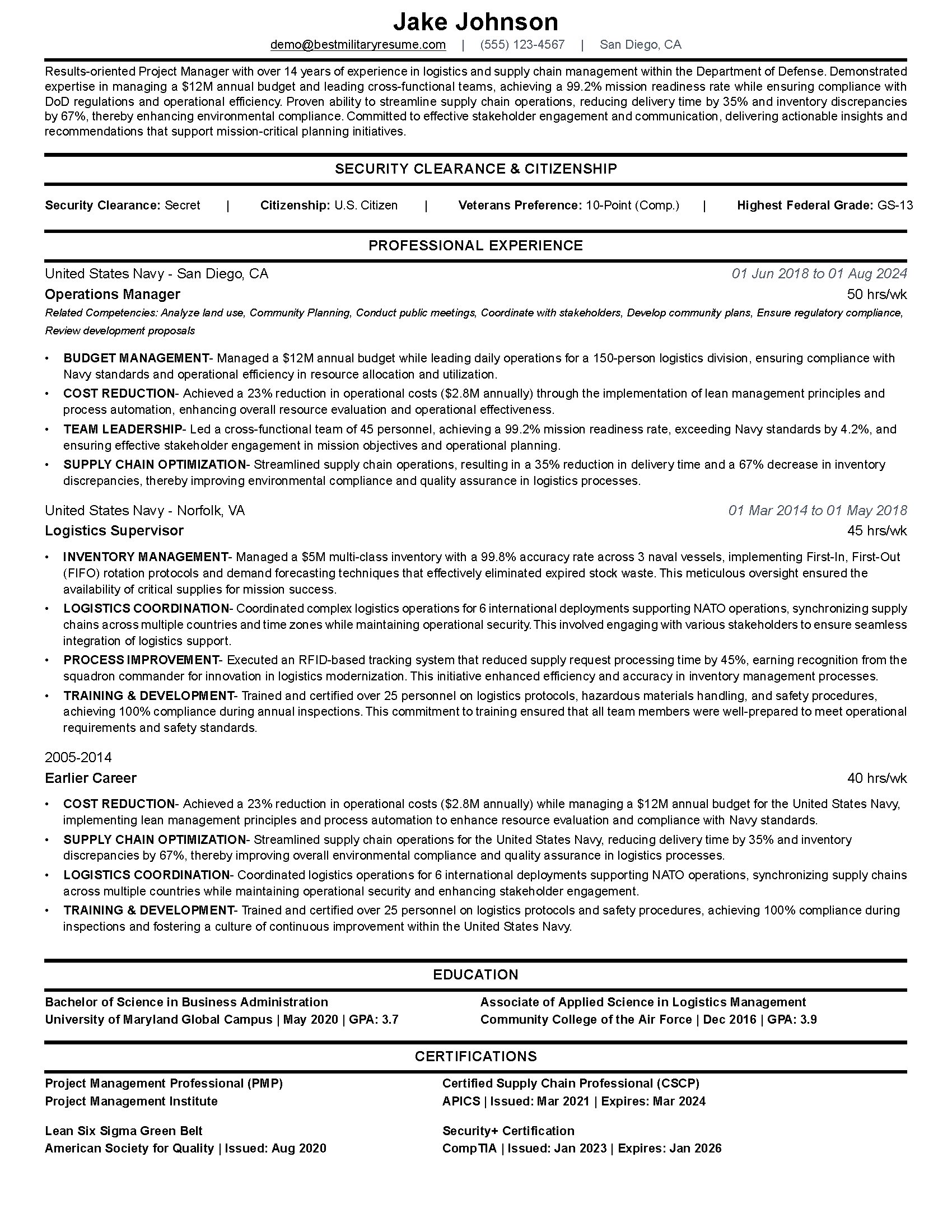
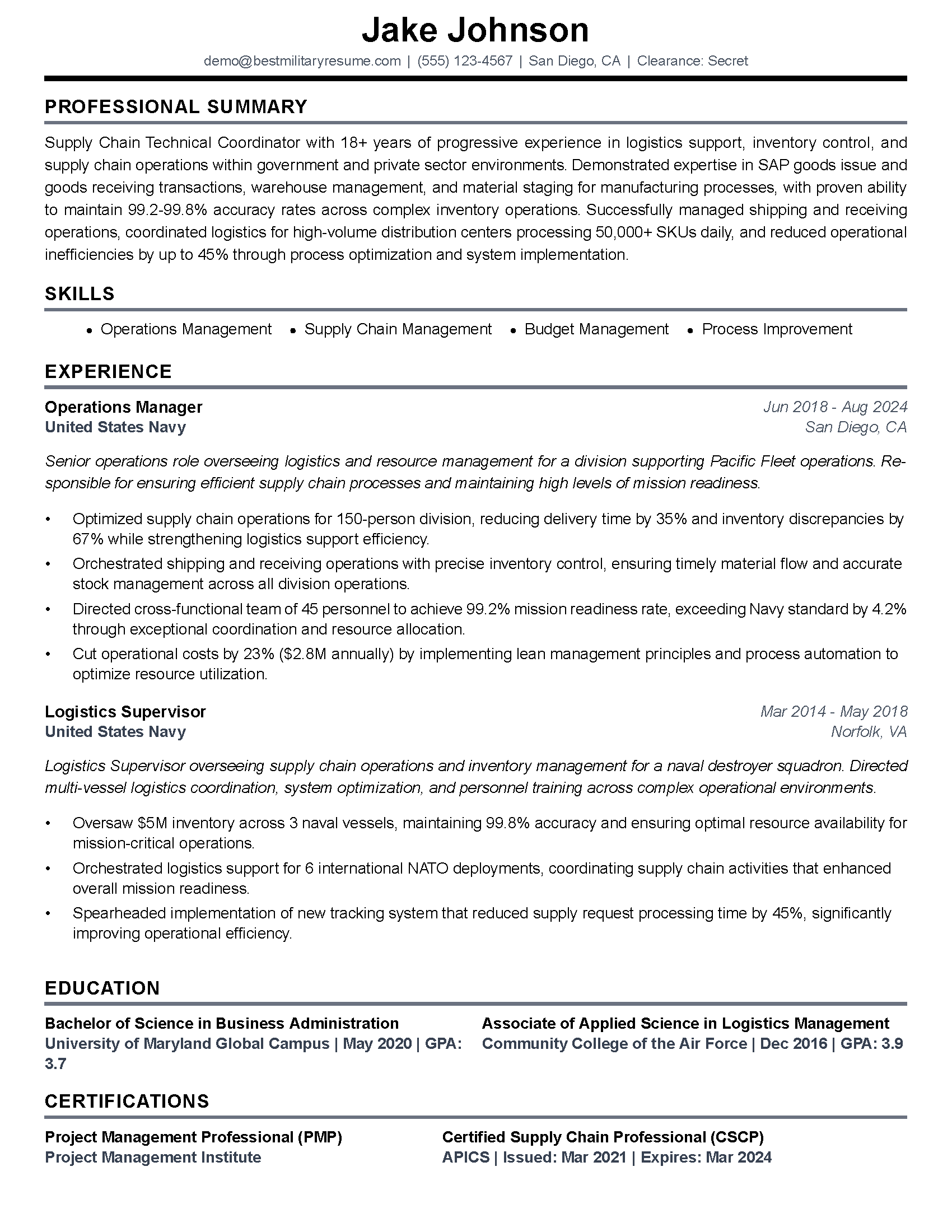
The bio opens the door. The resume backs it up. The committee will usually ask for one. It has to match the bio fact for fact.
Already built a resume for a civilian job search? Cut a board version from it. Our guide to writing a resume after 20 years of service covers the base. These are the parts that shift for a board version.
- The summary: Lead with the board skills, not your next job title. "Retired Navy captain with oversight experience in safety, risk, and a $300 million budget" reads like a director. Again, use your real numbers.
- Scope on every role: People, money, sites, gear. Our guide on showing director-level scope on a resume walks through how to write it.
- A governance section: List any board, council, or committee time, even unpaid. A school foundation, a credit union volunteer committee, or a local nonprofit all count. Say what you did there, like "chaired the audit committee."
- Oversight bullets: Pick bullets where you checked others' work or set policy. Audits, inspections, and risk calls count too. Those read like board work.
- Less detail on early years: Give the most room to your last ten to fifteen years. Older roles can sit in a short "earlier career" line.
Keep it short. Two pages is plenty for a private board resume. And keep the words civilian. Our officer resume guide for O-3 to O-6 has the translation rules if you need them.
If you're an E-9, the same advice holds. A command senior enlisted leader often owned discipline, morale, training, and the people side of a large unit. That maps well to a board's talent and culture questions. Say the size of the organization you advised and the results you drove.
Where do you find the first seat?
Start where people already know you. A first seat often comes from a group you've already given time to. Work it in four steps.
Step 1: Make a target list of 10 to 20 groups
Write down nonprofits you care about. Add local firms that sell to the government and startups in fields you know. Add any group where you already volunteer. Look up each board online and note the gaps.
Step 2: Tell your network the specific ask
Reach out to former bosses and peers who retired ahead of you. Add civilians you worked with. Send the bio, not just the resume. Use the specific ask from earlier. Our guide to the leadership style answer for senior veterans helps here. A board talk often turns into "How do you lead?"
Step 3: Ask the right questions before you say yes
- Time: How many meetings a year, and how much prep between them?
- Money: Is there pay? For a nonprofit, is there a give-or-get amount?
- Insurance: Does the group carry directors and officers (D&O) insurance?
- Health: Can you see the last two years of budgets and audits?
Step 4: Do the seat well, then use it
One good year on a nonprofit board gives you a real line for the next bio. Join a committee. Chair something if you can. Then update the bio and the resume, and aim one step higher.
Want a full-time nonprofit role too? Our military to nonprofit career guide covers that path.
Key Takeaway
Boards often pick people who fill a gap. Name one or two gaps, check the ethics rules early, and make your bio and resume match.
What to Do Next
Do it in this order. The resume comes first, because the bio is cut from it. If the facts live in one place, the bio and the resume will always match.
- Build or update your base resume: Put every big job in with its scope. People, money, sites, gear, and results.
- Cut a board version: Lead the summary with one or two board skills. Add a governance section.
- Write the 200-word bio: Use the six-part order above. Pull every number from the resume.
- Book the ethics talk: Bring your target list. Ask how 37 U.S.C. 908, 10 U.S.C. 989, 18 U.S.C. 207, and DFARS 252.203-7000 apply to you.
- Send five specific asks this week: Bio attached, gap named, one clear next step.
Best Military Resume's free resume builder handles step one. It turns your military record into civilian words and keeps the scope numbers in. BMR doesn't have a board bio button. But the resume you build there holds every fact your bio needs. The free elevator pitch tool gives you a short version to say out loud. You'll need it when someone asks what you bring to a board.
Build the resume first. The bio takes an hour after that.
Frequently Asked Questions
Can retired military officers serve on a corporate board of directors?
Do retired military members need approval to join a board owned by a foreign government?
What is the difference between an advisory board and a board of directors?
How long should a board bio be?
Does 18 U.S.C. 207 stop a retired general from joining a defense company board?
Do nonprofit board members have to donate money?
About the Author
Brad Tachi is the CEO and founder of Best Military Resume and a 2025 Military Friendly Vetrepreneur of the Year award recipient for overseas excellence. A former U.S. Navy Diver with over 20 years of combined military, private sector, and federal government experience, Brad brings unparalleled expertise to help veterans and military service members successfully transition to rewarding civilian careers. Having personally navigated the military-to-civilian transition, Brad deeply understands the challenges veterans face and specializes in translating military experience into compelling resumes that capture the attention of civilian employers. Through Best Military Resume, Brad has helped thousands of service members land their dream jobs by providing expert resume writing, career coaching, and job search strategies tailored specifically for the veteran community.
