Cover Letter With No Civilian Experience
Erinn got a call from the firm owner 20 minutes after applying.
Erinn, Air Force veteran, used the free version, landed a legal career
Is Having No Civilian Experience Really a Problem?
Short answer: no. But it feels like one, and that feeling changes how you write. Veterans with zero civilian work history tend to write cover letters that apologize for their background instead of selling it. They open with "Although I lack civilian experience" or "Despite having no private sector background." Both of those sentences kill your application before it starts.
Hiring managers do not care whether your experience happened in uniform or in an office park. They care whether you can do the job. Your military career gave you real experience managing people, budgets, equipment, timelines, and operations. The issue is not a lack of experience. The issue is translating military experience into language a civilian hiring manager understands immediately.
When I separated as a Navy Diver in 2015, my entire work history was military. Every job, every certification, every leadership role happened in the Navy. I had zero civilian experience on paper. But I had managed dive operations, supervised teams in high-risk environments, maintained equipment worth millions, and tracked detailed compliance records. All of that translated directly into civilian roles once I learned how to present it.
Your cover letter is where that translation happens in narrative form. The resume shows the bullet points. The cover letter tells the story. And if you tell it right, nobody reading your application will think "this person has no experience." They will think "this person has exactly the experience we need."
"I had zero civilian experience when I left the Navy. Not a single line on my resume that did not involve the military. I still got hired. The cover letter was how I connected the dots."
What Should Your Opening Paragraph Say?
Your opening paragraph sets the tone for the entire letter. Get it wrong and the hiring manager stops reading. Get it right and they want to know more. The key is confidence without arrogance.
Do not open with your military rank or branch. The hiring manager does not know what an E-6 is, and they should not have to Google it. Open with what you bring to their specific role. Reference the job title and company name in the first sentence, then immediately connect your strongest qualification to their top requirement.
A strong opener for a veteran with no civilian experience might read: "With eight years of operations management experience leading 40-person teams through high-pressure environments, I am applying for the Operations Manager position at [Company]." Notice there is no mention of the military yet. You are leading with the skill, not the source.
Save the military context for the body paragraphs, where you have room to explain it. The opening paragraph should make the hiring manager think "this person has what we need" before they ever learn where you got it.

How Do You Write Body Paragraphs Without Civilian Examples?
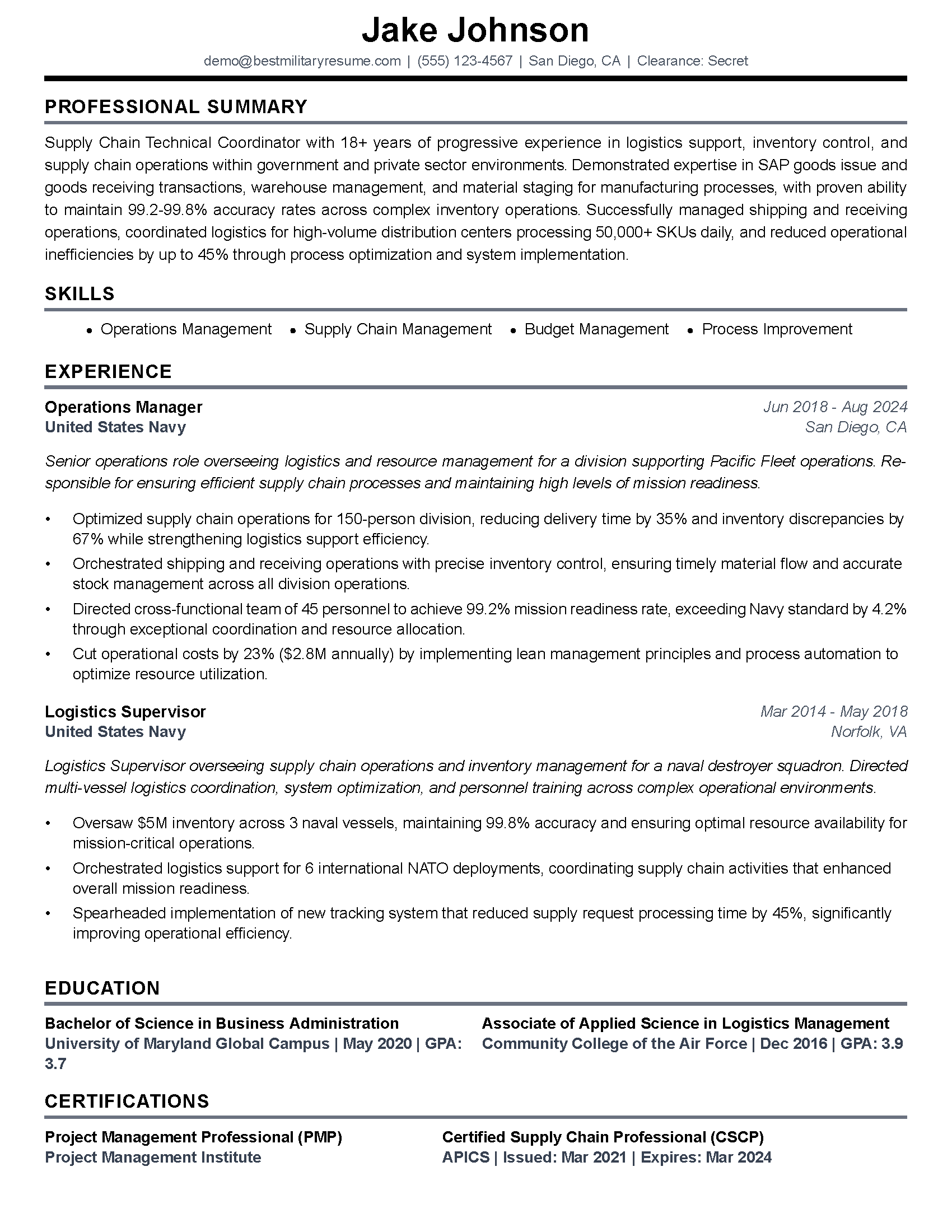
The body of your cover letter is where you prove you can do the job. Without civilian examples to reference, you need to reframe your military experience using the language of the industry you are targeting. This is not about hiding your military background. It is about presenting it in terms the reader already understands.
Match Their Language First
Read the job posting carefully. Highlight every skill, requirement, and duty they list. Then go through your military experience and identify where you did the same thing, even if you called it something completely different. A motor pool sergeant managed a fleet. A communications specialist managed IT infrastructure. An intelligence analyst did business intelligence before corporate America had a name for it.
Write each body paragraph around one key requirement from the job posting. Start with their language, then back it up with your military example translated into civilian terms. Two body paragraphs is enough for most cover letters. Pick your two strongest matches and go deep on those rather than skimming across everything you have done.
"In the Army, I was responsible for many different tasks including personnel management, inventory control, and various administrative duties. I believe these skills would transfer well to your company."
"Your posting requires inventory management for a 50,000+ SKU warehouse. In my previous role, I managed a supply operation tracking 38,000 line items valued at $12M, maintaining 99.2% accuracy across quarterly audits."
Numbers Close the Gap
The single most effective way to overcome the "no civilian experience" perception is numbers. Budget figures, team sizes, inventory counts, completion rates, cost savings. Numbers are universal. A hiring manager who has never served still understands "$4.2M budget" and "led a 35-person team."
Go through your military career and pull every quantifiable achievement you can. How many people did you supervise? What was the value of equipment you maintained? How much did you reduce costs or processing time? What was your inspection pass rate? These numbers become the backbone of your cover letter body paragraphs and immediately establish credibility regardless of where the experience came from.
Should You Address the Military-to-Civilian Transition Directly?
Yes, but briefly. One sentence is usually enough. Something like "After six years of active duty service, I am excited to bring my operations management experience to the private sector." That acknowledges the transition without dwelling on it or apologizing for it.
Do not spend a full paragraph explaining why you left the military. The hiring manager does not need your separation story. They need to know you can do the job they are filling. Keep the transition mention short, positive, and forward-looking. Then get back to proving your qualifications.
Where transition context helps most is when you are changing career fields. If you were an infantryman applying for a project management role, a brief sentence explaining the connection is valuable. Something like "Leading combat operations taught me to manage complex projects with shifting timelines, limited resources, and zero margin for error." That reframes the experience without requiring the reader to figure out the connection themselves.
Your military experience translation should be woven throughout the letter, not concentrated in one apologetic paragraph. Every sentence should demonstrate capability, not explain background.
What Cover Letter Mistakes Are Unique to Veterans With No Civilian Experience?
Beyond the generic mistakes everyone makes, veterans with exclusively military backgrounds tend to fall into four specific traps.
The Apology Opener. Starting with "Although I have no civilian experience" or "While my background is entirely military" immediately puts you on the defensive. Never open with a disclaimer about what you lack. Open with what you bring.
The Military Dictionary. Using acronyms, rank structures, and unit designations that mean nothing to the reader. Your cover letter should be readable by someone who has never set foot on a military installation. If they need to Google a term to understand your letter, you have lost them.
Common Trap: The Identity Paragraph
Some veterans spend an entire paragraph explaining their branch, MOS, deployments, and awards. While impressive to other veterans, this reads as filler to civilian hiring managers. Save those details for the interview and use your cover letter space to prove you match the job requirements.
The Identity Paragraph. Spending four sentences explaining your branch, your MOS, your deployments, and your awards. None of that tells the hiring manager whether you can do their job. Save the military pride for the interview. Your cover letter should be about their needs, not your biography.
The Soft Skills Dump. Filling the cover letter with "I am a hard worker with strong leadership skills and attention to detail." Every applicant says this. It means nothing without evidence. Replace soft skill claims with specific examples that prove those skills exist.
How Do You Close a Cover Letter When You Have No Civilian References?
Your closing paragraph does not need civilian references. It needs a clear call to action and confidence. Two to four sentences is the right length. Thank them for their time, express genuine interest in the specific role (not just "a position at your company"), and state your availability for an interview.
If you have a clearance that is relevant to the role, mention it in the closing. Active security clearances have real value in defense, government contracting, and many private sector roles. A simple "I hold an active Secret clearance" adds value without needing civilian context.
Do not end with "I hope to hear from you." End with "I look forward to discussing how my experience aligns with your needs for this role." The difference is subtle but real. One sounds uncertain. The other sounds prepared.
As for references, your military supervisors and colleagues count. Former commanding officers, senior NCOs, and peers who can speak to your work ethic and results are legitimate professional references. You do not need civilian managers to have strong references. Just make sure your references can speak in terms the hiring manager will understand when they call.
How Can BMR Help Veterans Write Cover Letters Without Civilian Experience?
BMR was built specifically for veterans making this transition. The cover letter tool takes your military experience and the job posting you are targeting, then generates a cover letter that matches the language of the position. It handles the translation automatically.
The free tier includes two tailored resumes, two cover letters, LinkedIn optimization, elevator pitches, an email signature generator, two company reports, and a job tracker. For veterans with no civilian experience, having a tool that knows how to frame career transitions saves hours of guesswork.
Your military experience is real experience. Full stop. The only thing missing is the translation. Once you frame your background in civilian language, back it up with numbers, and match it to specific job requirements, having no civilian experience stops being a weakness. It becomes irrelevant because your qualifications speak for themselves.
Key Takeaway
No civilian experience does not mean no experience. Lead with translated skills and numbers, never apologize for your military background, and tailor every cover letter to the specific job posting. The gap is in the language, not in your qualifications.
How Do You Practice Writing Cover Letters Before Applying?
One technique that works well for veterans new to cover letter writing: find four job postings you are interested in but not ready to apply for yet. Write a cover letter for each one as practice. Time yourself. Your goal is to produce a solid, one-page letter in under 45 minutes.
The first letter will take an hour or more. By the fourth, you will have a rhythm. You will know which parts of your military experience map to which types of job requirements. You will get faster at finding the key duties in a posting and matching them to your background. This practice removes the pressure of writing your first cover letter for a real application you care about.
Ask a civilian friend or mentor to read your practice letters. Not for grammar. For clarity. Can they understand what you did without Googling military terms? If any sentence requires military knowledge to understand, rewrite it. The civilian perspective is the most valuable feedback you can get on a cover letter because it mirrors what the hiring manager will experience.
After your practice round, you will have reusable paragraphs for common job requirements. A paragraph about your leadership experience, one about your project management background, one about your technical skills. You can mix and match these building blocks for future applications while still tailoring each letter to the specific posting. It is not a template. It is a library of proven paragraphs you can draw from.
Veterans who invest two hours in practice cover letters before their real applications consistently report better results. The confidence shows in the writing, and the speed improvement means you can apply to more positions without burning out on the writing process.
What About Cover Letters for Remote Positions?
Remote work has expanded significantly since 2020, and many veterans target remote roles during their transition. Cover letters for remote positions need one additional element: proof that you can work independently and manage your own time without in-person supervision.
Military veterans actually have a strong case here. You have worked in environments where you received a mission and executed it with minimal micromanagement. You have operated in distributed teams across time zones during deployments. Frame that experience in remote work terms: "Coordinated operations across four time zones with a distributed team of 25, maintaining daily communication through digital channels and delivering all milestones on schedule."
Mention any experience with remote collaboration tools. If you used Microsoft Teams, Slack, or project management software in the military, include it. Remote employers want to know you are comfortable with the digital communication tools their teams rely on. Your military experience with video teleconferences, digital reporting systems, and remote coordination provides exactly the evidence they are looking for.
Write yours now: Build a military cover letter in minutes with the free BMR Cover Letter Builder.
Frequently Asked Questions
How do I write a cover letter with only military experience?
Should I mention I have no civilian experience in my cover letter?
What numbers should I include from my military career?
How long should a veteran cover letter be?
Can I use military supervisors as references?
Should I explain why I left the military?
What is the biggest mistake veterans make in cover letters?
Does BMR help with cover letters for veterans?
About the author
Brad Tachi is the CEO and founder of Best Military Resume and a 2025 Military Friendly Vetrepreneur of the Year award recipient for overseas excellence. A former U.S. Navy Diver with over 20 years of combined military, private sector, and federal government experience, Brad brings unparalleled expertise to help veterans and military service members successfully transition to rewarding civilian careers. Having personally navigated the military-to-civilian transition, Brad deeply understands the challenges veterans face and specializes in translating military experience into compelling resumes that capture the attention of civilian employers. Through Best Military Resume, Brad has helped thousands of service members land their dream jobs by providing expert resume writing, career coaching, and job search strategies tailored specifically for the veteran community.
