GS-1712 Resume: Specialized Experience for Military Instructors
Christopher was selected for GS-13 on his first-ever USAJOBS application.
Christopher, E-7, Coast Guard, now writes policy for the work he did on active duty
OPM's standard for the GS-1712 Training Instruction series counts teaching on a "military installation" as qualifying specialized experience. Above GS-5, the experience route asks for one year of work at the next lower 1712 grade. The 1712 ladder moves in steps of two through GS-11, so a GS-9 job needs GS-7 level work. From GS-12 up, it moves one grade at a time. Your resume has to show it with hours, classes and results.
This guide is for drill instructors, MTIs, schoolhouse instructors and unit trainers. By the end you'll have the grade ladder in one table. Your duties will be matched to OPM's four examples. You'll also have worked bullets for platform hours, course design and student evaluation.
For what the series pays and where the jobs are, BMR's GS-1712 career page has the reference facts. This post is about the GS-1712 resume.
What does OPM count as GS-1712 specialized experience?
The OPM Training Instruction Series 1712 standard asks for two kinds of knowledge. One is "a practical knowledge of the subject area of the position." The other is knowledge "of the methods and techniques of instruction." You need both on the page: the subject you taught and proof you know how to teach.
OPM then gives four examples. Here they are word for word, next to the military work that usually fits each one.
| OPM's example (quoted) | Military work that fits it | What your resume has to show |
|---|---|---|
| "Teaching or instructing in an adult education program, secondary school, college, military installation, or industrial establishment in the appropriate field(s)." | Drill instructor, drill sergeant, MTI, schoolhouse or AIT instructor, formal school instructor. | Hours on the platform, class size, number of classes, subject. |
| "Supervising or administering a training program." | Course manager, lead instructor, unit training NCO, training chief. | Number of instructors, courses or Soldiers run through, the schedule you owned. |
| "Development or review of training/course materials, aids, devices, etc., and evaluation of training results." | Writing lesson plans, building practical exercises, writing tests, reviewing course critiques. | What you wrote, how many, who approved it, what changed after. |
| "Work in the occupation or subject-matter field of the position to be filled that required training or instructing others on a regular basis." | A mechanic, medic or comms tech who trained the shop every week. | How often you trained, how many people, on what tasks. |
The fourth row matters for people who never held an instructor billet. A crew chief who trained new mechanics every week may still fit. The resume has to say how often and how many.
Which grade can you apply for?
GS-1712 uses OPM's group standard for administrative and management positions. That table sets the ladder. Here it is for this series.
| Grade | Education route | Experience route |
|---|---|---|
| GS-5 | A 4-year course of study leading to a bachelor's degree. | 3 years of general experience, 1 of them at least equal to GS-4. |
| GS-7 | 1 full year of graduate education, or superior academic achievement. | 1 year of specialized experience equal to GS-5. |
| GS-9 | A master's degree, or 2 full years of graduate education. | 1 year of specialized experience equal to GS-7. |
| GS-11 | A Ph.D., or 3 full years of graduate education. | 1 year of specialized experience equal to GS-9. |
| GS-12 and up | None. | 1 year of specialized experience equal to the next lower grade, such as GS-11 for GS-12. |
Education stops counting at GS-12. From there up, only the year of experience works. The grades also skip by two. The OPM flysheet for GS-1712 (TS-104, May 1991) says so. It calls 1712 "a two-grade interval series." So you'll mostly see 5, 7, 9, 11 and 12 on postings. OPM also lets you combine education and experience at the grades where both count.
There is no GS grade for your rank, and no civilian title for it either. The same E-7 lands a GS-9 or a GS-13 depending on what they ran. What sets your level is scope: how many people, how much gear, how much money, how far your decisions reached. Put that on the page and the grade follows. Leave it off and they guess low.
For the general GS-11 bar across all series, see the GS-11 federal resume guide.
OPM standard, group table and flysheet checked November 2026.
Training Instructor or Training Specialist: which jobs should you search?
The flysheet gives the series two main titles. "Training Instructor is the title for nonsupervisory positions that primarily involve instruction." "Training Specialist is the title for nonsupervisory positions that primarily involve development or evaluation of training materials."
That split tells you which postings to chase first.
- Training Instructor: Pick this if most of your time was on the platform. Drill instructors, MTIs and range instructors usually start here.
- Training Specialist: Pick this if you wrote the lesson plans, built the tests or ran the course reviews. Course writers and training managers fit here.
- Supervisory titles: Look for Supervisory Training Instructor or Supervisory Training Specialist if you led other instructors.
The flysheet also covers "training in military or civilian occupational specialties." Its example is radar or communications equipment operation. So your old job's subject can be the subject you teach as a civilian. A 3F2X1 from Air Force Education and Training brings both halves. So does a Marine 0911 Drill Instructor who taught recruits for two or three years.
Two nearby series are not this one. The flysheet sends technician support work to GS-1702. Jobs that advise on and promote apprenticeship training in industry go to GS-0243. If a posting's duties read like scheduling and records, check the series number before you write to it.
Do instructor courses count as the year of experience?
No, not by themselves. A course proves you learned the methods. The year comes from the time you spent teaching after the course. The flysheet backs this up. It says instruction skill "can normally be acquired by on-the-job training combined with study and practice."
So list the course, and then show the hours that came after it. Two of the services describe their own courses this way.
- Army CFD-IC: The Common Faculty Development Instructor Course overview (Henry H. Lind NCO Academy, March 31, 2025) calls it "a 10-day, 80-hour" course. It says graduates can "prepare for instruction, deliver instruction, and assess student performance." That's the methods half of the OPM test.
- Navy MTS: NETC's Master Training Specialist FAQ calls MTS a program "for certified Navy Instructors (805A)." An MTS is expected to "mentor, instruct and evaluate other instructors and develop curricula products." That lines up with OPM's course-development example.
- CCAF instructors: OPM's 1712 standard adds one rule for Community College of the Air Force jobs only. Faculty there "must hold at least an associate's degree."
Put the course in the training section with its length and date. Then put the teaching that followed in the work history, with hours and results. The year comes from the work history. The course gives it weight.
Course facts checked November 2026. Course lengths and names can change, so check your own record.
What do real 1712 postings ask your resume to show?
Each posting lists the duties it wants your resume to show. The Federal Retirement Thrift Investment Board posted a GS-9 Training Instructor job that closed in August 2026. It asked for these duties.
- "Delivering instructor-led training, presentations, or briefings to groups of participants."
- "Modifying existing training materials, presentations, visual aids, or job aids."
- "Collecting and evaluate participant feedback, survey results, or learning assessments to identify training needs."
It also gave the rule that matters most. "Experience not documented in the resume cannot be credited." Applicants "must clearly describe their experience in their own words." So pasting the posting back does not work. Your own numbers do.
National Guard units post 1712 jobs too. The California Army National Guard posted a GS-9 Training Instructor job that closed in September 2025. It asked for "Experience conducting training through classroom presentations and practical exercises." It said the year "may also have been obtained in the private sector." Some Guard 1712 jobs are Title 32 positions. Read the conditions of employment first. They can add rules the duty list doesn't show.
From the hiring side of the desk, "Served as instructor for the unit" names a role. It gives no hours, no students and no results. The fix is the bullets below.
How do you write GS-1712 bullets that prove the year?
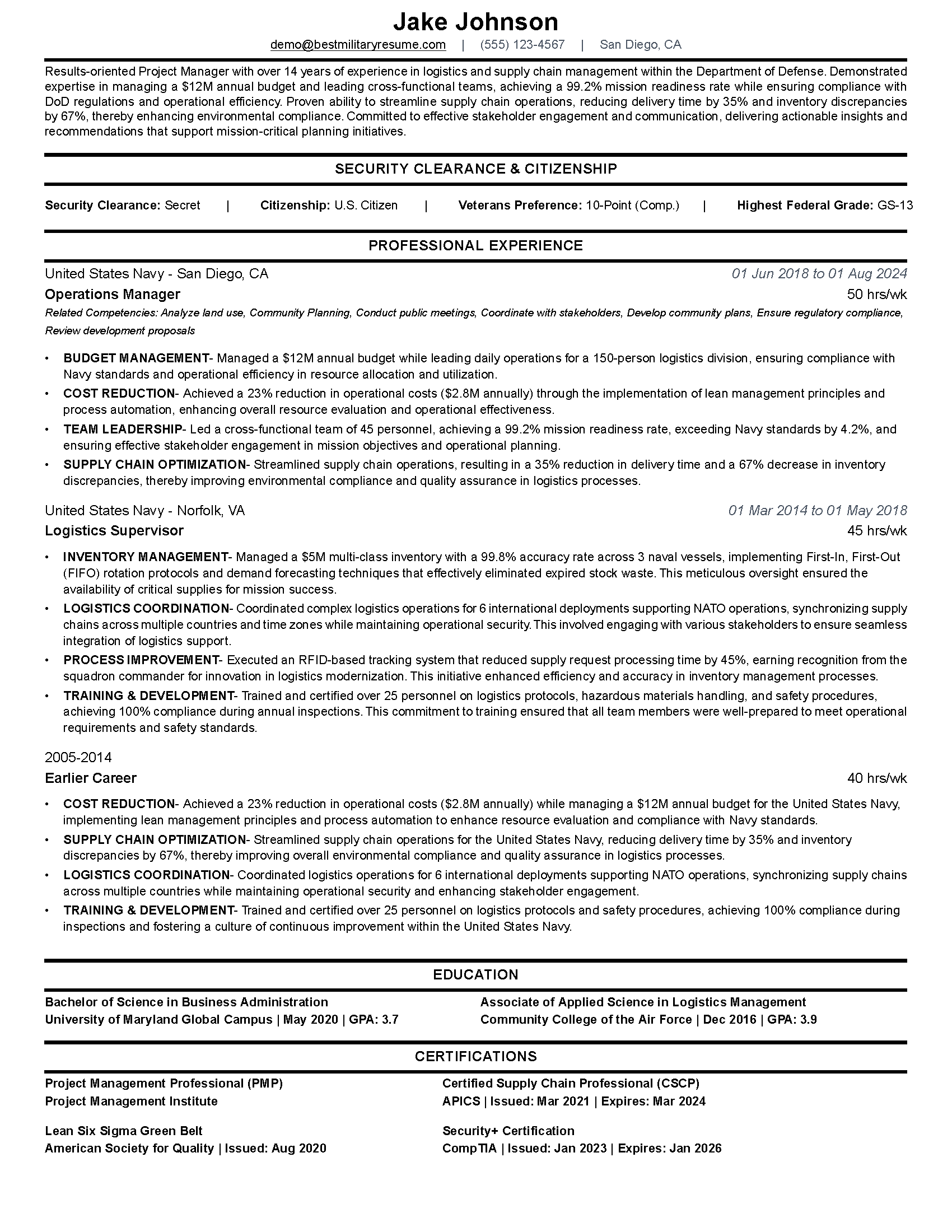
A strong federal bullet follows one shape. A short header in capitals names the skill. Then one or two sentences say what you did, how big it was and what changed. That runs 40 to 60 words. Every bullet is past tense and opens with a verb that shows the work. Every figure is your real figure.
Before you write, pull these numbers from your records and memory.
- Platform hours: Total hours taught, or hours per week times weeks.
- Classes and class size: How many classes and how many students in each.
- Course length and subject: The course name in plain words, plus days or weeks.
- What you built: Lesson plans, tests, practical exercises, with counts.
- Results: Pass rates, retrain counts, scores, before and after.
- Dates and hours per week: Month and year on every job, and your weekly hours.
These are three worked bullets, one for each instructor task OPM names. The figures are an example. Use your own.
Platform hours (OPM: teaching on a military installation)
- PLATFORM INSTRUCTION- Delivered 420 hours of platform instruction on M240B machine gun maintenance and range safety to 18 classes of 24 Soldiers over 12 months, using lecture, demonstration and hands-on practical exercises, and raised first-time pass rates on the graded hands-on exam from 81% to 94%.
Course design (OPM: development of training materials)
- LESSON PLANS AND EXAM- Rebuilt the 5-day vehicle recovery course from an outdated lesson plan, developing 14 lesson plans, 3 practical exercises and a 60-question written exam that the schoolhouse approved for use by all 4 instructors, and cut students sent back for retraining from 9 to 2 per class.
Student evaluation (OPM: evaluation of training results)
- TRAINING RESULTS- Tracked training results from 300 hands-on performance tests and end-of-course critiques for 18 classes of 24 Soldiers in 12 months, logging every failed task in one shared spreadsheet and briefing the course manager monthly, which drove 2 lesson revisions and raised the class average from 78% to 88%.
Each one names the subject, the method, the scope and the result. That covers both halves of OPM's test in one line. A drill sergeant from 13B Cannon Crewmember can write the same three with their own numbers.
The questionnaire comes next. Your bullets have to back up every "expert" answer you pick. The USAJOBS questionnaire guide walks through that match. If you also want a private-sector version for training jobs at companies, the instructor summary templates cover that.
What to Do Next
Pick one open 1712 posting. Copy its specialized experience lines into a note. Under each line, write the bullet that proves it. Use your own hours, class sizes and results.
Then fit it to the page. A federal resume runs two pages for most federal jobs. Always check the announcement, because some are exceptions. The two-page federal resume example shows how the sections fit.
Tailoring to the posting is what worked for Jerod, a Navy Petty Officer Second Class (E-5). He applied for a GS-11 federal job with one tailored BMR resume. In his words: "Not only did I get the job, but they let me become a GS 12 instead of an 11! It was the first resume I ever used from BMR and it came through!"
Paste the posting into BMR's federal resume builder. It writes your instructor time into header bullets like the three above, tailored to that posting. Then the condense step fits the tailored resume to two pages.
Frequently Asked Questions
Do I need a teaching degree for a GS-1712 job?
Does volunteer or unpaid instruction count toward GS-1712?
How does part-time instructor duty count?
What is the difference between GS-1712 and GS-1702?
Are college teaching jobs in the GS-1712 series?
Which college majors count for the GS-1712 education route?
About the author
Brad Tachi is the CEO and founder of Best Military Resume and a 2025 Military Friendly Vetrepreneur of the Year award recipient for overseas excellence. A former U.S. Navy Diver with over 20 years of combined military, private sector, and federal government experience, Brad brings unparalleled expertise to help veterans and military service members successfully transition to rewarding civilian careers. Having personally navigated the military-to-civilian transition, Brad deeply understands the challenges veterans face and specializes in translating military experience into compelling resumes that capture the attention of civilian employers. Through Best Military Resume, Brad has helped thousands of service members land their dream jobs by providing expert resume writing, career coaching, and job search strategies tailored specifically for the veteran community.
