Loading...
Loading...
The civilian and federal jobs that hire Air Force Education and Trainings — with real salaries and the resume that gets callbacks.
Every 3F2X1 has more options than a Google search will tell you. Below: career paths, BLS salary data, federal GS series, certifications by target career, and how to translate your experience without losing what made you valuable to the Air Force in the first place.
Free · No credit card · Tailored resume in under 5 minutes
After the Navy I got hired into 6 federal career fields and tech sales, and sat on federal hiring panels along the way. I spent the last 2 years rebuilding everything I learned into BMR, tuned for how AI actually screens resumes today. This is the system I wish I'd had on day one.
One page, built in our template, with your military experience translated into civilian terms hiring managers and ATS systems read. Use it as a reference for your own. Drop your email and we'll send you the download link.
Free. We'll also send occasional job-search tips. Unsubscribe anytime.
If you held the 3F2X1 Education and Training AFSC, you ran the machinery that turns a curriculum requirement into a working program. You wrote learning objectives to Air Force academic and technical standards, picked the instructional design and delivery method, built the courseware and the tests that measured whether Airmen actually learned, and stood in front of the room to deliver it. Inside Force Support, 3F2X1 is a retraining specialty. You arrived already holding a 5-skill level in another AFSC and an E-4 or above, so you brought subject-matter depth to the instructor role on top of the formal training in instructional systems design.
The work covered the full ADDIE cycle: analyzing a training gap, designing objectives and sequencing, developing materials and media, delivering at squadron training, the Community College of the Air Force, technical training, or a Mission Support Group schoolhouse, and evaluating results against measurable standards. You managed E&T programs, ran education services and tuition assistance counseling, and kept the records that survive an inspection. That is a rare combination on a resume: someone who can build a program from a needs analysis and also defend its outcomes with data.
Civilian employers value this because corporate learning and development is exactly the same discipline with different vocabulary. Instructional design, competency assessment, and large-scale program management are the load-bearing skills, and they transfer cleanly into training departments, ed-tech, healthcare, and any regulated industry that has to prove its workforce is qualified. The hard part is translation. "Developed E&T courseware to AFI standards" reads as government jargon to a hiring manager who runs an L&D team. Get the language right and the experience speaks for itself. Start by exploring the military-to-civilian career crosswalk, and if you came from a personnel-side background, the 3F0X1 Personnel and 3F1X1 Services pages cover adjacent Force Support paths.
BMR has built more than 60,000 resumes across every branch and specialty, and the 3F2X1 pages that convert fastest are the ones that stop calling the work "training" and start calling it instructional design, curriculum development, and program evaluation. You already do the job a corporate L&D manager does. The resume just has to say so in their language. — Brad Tachi, Navy Diver veteran & BMR founder
The number that matters when you're deciding what's next: how does civilian pay compare to what you make now?
Military comp is approximate (varies by location/dependents). Civilian is BLS median. Federal includes locality pay. Your real number depends on duty station, family status, GS step, and overtime.
The corporate side of education and training is healthy and the titles map almost directly to what you did in uniform. Salary figures below are BLS Occupational Employment and Wage Statistics, May 2024.
Training and Development Specialist is the closest match. BLS reports a median wage of $65,850 (May 2024), with employment projected to grow 11 percent through 2034, much faster than average. This title absorbs most instructional designers, courseware developers, and corporate trainers. Instructional Coordinator roles, which BLS tracks separately at a $74,720 median, sit closer to the curriculum and standards work you did writing objectives and sequencing programs. If you move up into running the function, Training and Development Managers earn a $127,090 median.
Be realistic about the market. Pure instructional-design roles cluster in larger employers and ed-tech, and many postings now expect familiarity with an LMS (Cornerstone, Workday Learning, SAP SuccessFactors) and at least one authoring tool such as Articulate Storyline or Adobe Captivate. The military gave you the design and delivery fundamentals; the civilian tool stack is what you will name on the resume to clear the first screen. Demand is strongest in healthcare systems, financial services, and large manufacturers that run continuous compliance training.
You can use the military resume builder to draft these in civilian language, and when you are ready to apply, build your resume now. Veterans from related admin and personnel specialties chase overlapping roles, so the Army 42A Human Resources Specialist and Navy Yeoman pages are worth a look for how those backgrounds position for L&D and HR work.
| Civilian Job Title | Industry | BLS Median Salary | Outlook | Match |
|---|---|---|---|---|
Training and Development Specialist O*NET: 13-1151.00 | Corporate Learning & Development | $65,850 | 11% (Much faster than average) | strong |
Instructional Coordinator O*NET: 25-9031.00 | Education | $74,720 | 2% (Slower than average) | strong |
Training and Development Manager O*NET: 11-3131.00 | Corporate Learning & Development | $127,090 | 7% (Faster than average) | strong |
Instructional Designer O*NET: 13-1151.00 | Ed-Tech & Corporate Training | $65,850 | 11% (Much faster than average) | strong |
Corporate Trainer O*NET: 13-1151.00 | Corporate Learning & Development | $65,850 | 11% (Much faster than average) | strong |
Human Resources Specialist O*NET: 13-1071.00 | Human Resources | $72,910 | 8% (Faster than average) | moderate |
Technical Trainer O*NET: 13-1151.00 | Technology & Manufacturing | $65,850 | 11% (Much faster than average) | moderate |
BMR rewrites your 3F2X1 experience for any of the civilian roles above — keywords, achievements, and language hiring managers actually scan for.
Free · No credit card · 2 tailored resumes included
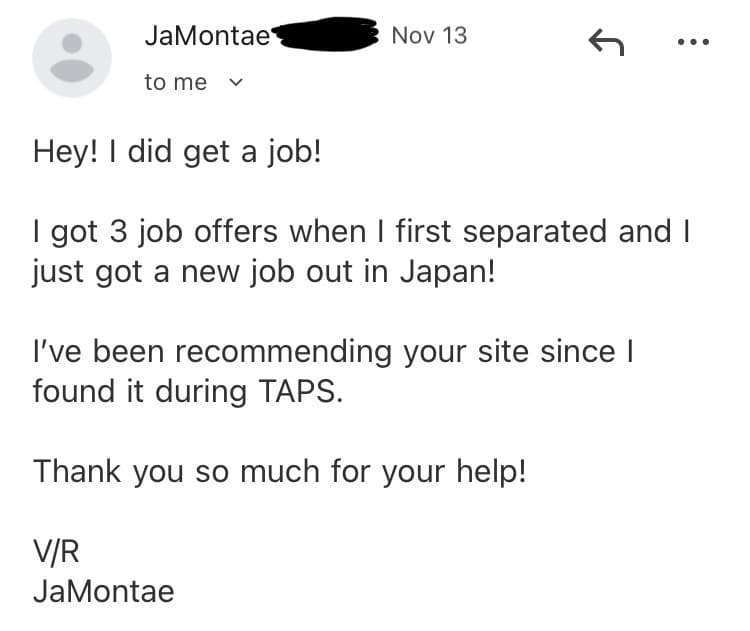
“Hey! I did get a job! I got 3 job offers when I first separated and I just got a new job out in Japan! I’ve been recommending your site since I found it during TAPS. Thank you so much for your help! V/R JaMontae ”
Federal service has a dedicated occupational family for exactly what you did, which is unusual and works in your favor. The GS-1700 group covers education and training, and your CFETP-documented instructional design experience maps to it without forcing the fit.
The GS-1712 Training Instruction series is the direct line. It covers positions that deliver instruction and training, and OPM's standard explicitly counts instructing on a military installation as qualifying specialized experience. Community College of the Air Force faculty already sit in GS-1712. The GS-1701 General Education and Training series is the professional catch-all that fits the design-and-development side of your work, building courses and programs when the work spans more than one education area. GS-1710 Education and Vocational Training fits vocational and technical instruction roles, and GS-1702 Education and Training Technician is a viable entry point for records and program-coordination work. If you ran education services and tuition-assistance counseling, GS-0201 Human Resources Management values that workforce-development side. For program leadership, look at GS-0340 Program Management and GS-0343 Management and Program Analyst, where running an E&T program with measurable outcomes is the qualifying story.
Most veterans entering these series land between GS-9 and GS-12 depending on years of instructional experience and education. Apply your Veterans' Preference and, if you are retiring, remember VRA and the 30 percent disabled hiring authorities can route you around the competitive register entirely. The federal resume is its own format with its own length and detail expectations. Our guide to the 2026 OPM federal resume format walks the structure, and the GS-12 federal job guide covers how to target that grade. When you are ready, start your federal resume. The Navy Personnel Specialist page shares several of these GS targets.
| GS Series | Federal Job Title | Typical Grades | Match | Explore |
|---|---|---|---|---|
| GS-1701 | General Education and Training | GS-9, GS-11, GS-12 | View Details → | |
| GS-1712 | Training Instruction | GS-9, GS-11, GS-12 | View Details → | |
| GS-0201 | Human Resources Management | GS-9, GS-11, GS-12 | View Details → | |
| GS-1710 | Education and Vocational Training | GS-9, GS-11 | View Details → | |
| GS-0343 | Management and Program Analyst | GS-9, GS-11, GS-12 | View Details → | |
| GS-1702 | Education and Training Technician | GS-5, GS-7, GS-9 | View Details → | |
| GS-0340 | Program Management | GS-11, GS-12, GS-13 | View Details → |
Federal hiring uses keyword-matching and structured experience. BMR builds federal-format resumes (USAJobs-ready) with the right keywords, hours/week, and supervisor info — for any GS series above.
Free · No credit card · Federal + civilian resume formats included
Not everyone wants to stay in a related field. These career paths leverage your transferable skills — leadership, risk management, logistics, project planning — in completely different industries.
Building a Plan of Instruction means turning complex technical content into clear, sequenced, learnable text. That is the core of technical writing, applied to manuals, procedures, and product documentation instead of courseware.
The analyze-design-evaluate loop you ran on courseware is the same loop UX teams run on products: study the user, design for comprehension, test, and revise against measured results. Instructional designers cross into UX through that shared methodology.
Health education is curriculum design and program delivery aimed at behavior change. The objective-writing, facilitation, and evaluation skills from 3F2X1 transfer directly into building community and patient education programs.
Museum education programming is instructional design for the public: building exhibits, tours, and learning experiences that teach a non-expert audience. The curriculum-design and audience-analysis skills carry over even though the setting is entirely different.
Regulated industries run mandatory training and have to prove every employee completed it. Designing programs to a standard and keeping inspection-ready records is exactly the compliance-training role, applied to finance, healthcare, or manufacturing rules.
Writing valid tests and analyzing course-evaluation data is applied measurement. Survey research uses the same instrument-design and data-interpretation skills to build and field surveys instead of assessments.
The front-end analysis you ran to define training requirements is the same disciplined questioning market research uses to define a business need. The instinct to gather data, interpret it, and brief a recommendation transfers cleanly.
The skills that made you a good Marine, Sailor, Airman, or Soldier transfer further than you think. BMR rewrites your bullets for any of the pivot careers above — without making you sound like you've never done the work.
Free · No credit card · Try unlimited career angles
If you are staying in instructional design, corporate training, or L&D, your terminology already matches the field and you do not need to translate it. This section is for 3F2X1 veterans targeting careers OUTSIDE education and training, where AFI and Air Force shorthand reads as government noise to a hiring manager.
The goal is to keep the scale and the measurable results while dropping the acronyms. Lead with what you designed, how many people it reached, and what changed because of it.
Our 50 military terms translated to civilian language glossary and the Air Force-specific EPR/OPR to civilian resume guide go deeper on rewriting evaluation bullets. The military resume builder handles the translation as you draft.
BMR turns your 3F2X1 duties and accomplishments into civilian bullets that match the job you're applying for — no manual translation, no rewriting.
Free · No credit card · Tailored to each job posting
Which certifications you need depends on where you're headed. Find your target career path below.
The wrong placement can sink an otherwise strong application. BMR knows where each cert ranks, what to call it, and how to frame it for ATS keyword matching and hiring manager attention.
Free · No credit card · Built around your real certs and clearance
Concrete next steps, split by whether you are staying in education and training or moving into a different field.
SkillBridge can place you in a corporate training or instructional-design team for your final months on active duty. Browse remote SkillBridge programs if you want to start building civilian L&D experience before you separate. The Association for Talent Development (ATD) is the field's primary professional body and runs the credential most postings recognize. If you came up through CCAF instruction, your teaching hours and any associate or bachelor's degree are a real differentiator. The transition timeline guide helps you sequence the move.
American Corporate Partners (ACP) pairs transitioning veterans with corporate mentors for free and is the networking route to recommend. For federal moves, USAJobs plus your Veterans' Preference is the path. Use the career crosswalk to see where your skill signature points, and the SFL-TAP transition resources for the full timeline and checklist.
Draft a private-sector version with the military resume builder and a USAJobs version with the federal resume builder. When the experience is in, get started here.
See also: 3F0X1 Personnel, Marine Corps 0111 Administrative Specialist, and Army 42A Human Resources Specialist for adjacent career paths.
Most veterans do this backwards — they wait until terminal leave to start, then panic. Here's the actual sequence that works.
Print this. Tape it to your monitor. Veterans who treat the transition like a 90-day op get hired faster than the ones who treat it like an emergency.
Stop rewriting from scratch every time you apply. BMR turns your military experience into civilian and federal resumes — tailored to each job.