Highly Qualified Expert Appointment for Retired Officers
Christopher was selected for GS-13 on his first-ever USAJOBS application.
Christopher, E-7, Coast Guard, now writes policy for the work he did on active duty
When I sat on federal hiring panels, every name I saw came off a certificate. HR built the list. The panel worked from it. The selecting official picked from it. That's how a lot of federal jobs get filled.
A highly qualified expert appointment can skip that whole line. The Department of Defense (DoD) can bring in one person by name. That person knows something the workforce lacks. No cert. No rating panel. For a retired officer or senior enlisted leader, that sounds like a back door built for you.
It can be. But the rules are tight, and the door opens from the inside. This guide covers what an HQE appointment is and who qualifies. It covers how long it lasts, what it pays, and how the hire starts. It ends with the one thing you control: the resume that goes into the package. The 180-day rule and retiree pay rules have their own guides. I link them below.
What Is a Highly Qualified Expert Appointment?
An HQE appointment is a DoD hiring authority. It comes from 5 U.S.C. 9903, a law Congress passed in 2003. It lets the Secretary of Defense "attract highly qualified experts in needed occupations" for DoD. The 9903 authority belongs to DoD alone. The intelligence community runs a separate HQE program under its own rules. This guide is only about DoD's version.
The law gives DoD three powers. It can appoint people from outside the civil service and the uniformed services. It can set their pay outside the normal GS tables. And it can pay some extra money on top, within limits.
DoD runs the program under DoD Instruction 1400.25, Volume 922. That volume is dated April 3, 2013. It includes Change 1, effective January 18, 2017. Ask your hiring office if a newer change has come out since then.
A few facts from those two sources set the frame:
- Cap: The law allows no more than 2,500 HQEs across DoD at any one time.
- Type of job: HQEs get "Excepted Not To Exceed" appointments of up to 5 years.
- Pay plan: The pay plan is "Experts Other," coded EE, not GS.
- Schedule: The job can be full-time, part-time, or intermittent.
- Purpose: The policy calls HQEs "a temporary infusion of talent" for short-term work.
That last line matters most. An HQE job is a short tour with an end date. If you want a permanent federal seat, the veteran hiring authorities are the better road.
Who Counts as a Highly Qualified Expert?
The Defense Civilian Personnel Advisory Service (DCPAS) runs policy for this authority. Its page sets a high bar. An HQE has "uncommon, special knowledge, skills, and experience" in a field. They also have judgment that peers or the public treat as an authority.
Volume 922 makes the test sharper. Your expertise has to go "beyond what is available within the federal workforce" when DoD needs it. So being good at your job won't carry it alone. Your skill set has to be one the federal workforce can't supply right now.
The policy also says where HQE expertise usually comes from. It says HQEs "generally" build their expertise "in private industry or academia" first. It adds that it "could, in certain circumstances," come from uniformed service.
Uniform experience can count. But the default HQE comes from industry or a university. Rank alone won't make a retired O-6 an HQE. A strong case pairs a rare skill with a need DoD has now.
Some examples of the kind of expertise that fits the definition:
- Niche technical depth: A retired officer who ran a weapons test program. Then they spent years at a defense firm on the same system.
- Rare operational skill: A retired senior enlisted leader who wrote doctrine for a capability few people have run.
- Academic standing: A retiree who now teaches and publishes in a field DoD is short on.
- Industry practice: Someone who scaled a commercial process DoD wants to copy.
Notice that two of these pair the uniform with work that came after it. That's what the policy language points to.
Can a Retired Officer Get an HQE Appointment?
Yes, and the policy plans for it. But it puts guard rails around former service members. These are the ones that apply to you.
The break in service
Volume 922 sets a gap for anyone leaving the civil service or uniformed services. You need "at least a minimum 4-day break" first. You also still need the expert credentials. So you can't roll from your last day in uniform straight into an HQE seat.
The 180-day rule
The same paragraph says the 180-day rule still applies. That rule lives in 5 U.S.C. 3326. It covers a retired member appointed to a DoD civilian job within 180 days of retirement. In that window, the hire needs approval first. HQE does not get you around it. My guide to the 180-day rule for military retirees covers how that approval works.
What HQE can't be used for
Volume 922 lists hires the authority can't make. These matter to senior retirees most:
- Component head: No one can be appointed head of a DoD Component as an HQE.
- SES jobs: HQE can't fill a position that meets the Senior Executive Service definition.
- Bridge jobs: HQE can't give someone temporary work "in anticipation of a permanent appointment."
- Annuitant fit: It can't hire a federal annuitant when another DoD rule fits better.
The SES line is easy to miss. If you want an executive seat, that's a different path with its own rules. Start with how veterans reach the Senior Executive Service.
For a regular HQE, the test is expertise, not rank. So a retired senior enlisted leader with rare expertise fits the same test. The Senior Mentor role below is different. The policy limits it to retired officers and senior retired civilian officials.
How Does an HQE Appointment Start?
Most federal jobs start with an announcement. You find the posting, and you apply. An HQE hire usually runs the other way. An office spots a need first. Then it finds the person who can fill it.
The law lets DoD make these hires without the normal title 5 hiring rules. Volume 922 says HQE hires can skip "any competitive service requirements" too. So there may be no open posting to find. The checklist below asks for a named person and their resume. So the office knows who it wants before the file moves.
That's why your network matters so much here. The people who know your work are the ones who bring your name forward. If you are still in uniform, my 12-month networking plan before retirement is a good place to start.
What goes in the package
Once an office wants you, it builds a file. Volume 922 calls it the HQE Appointment Checklist. Part I applies to every HQE hire. It asks for five things:
- The billet that will be used for the HQE position.
- Your qualifications, with your resume attached.
- Proof the work is short-term, 5 years or less, or a succession plan if it runs longer.
- The scope of the work, the delivery schedule, and the mission goal it supports.
- The total pay proposed, with a reason for each part.
Item two is the one you own. Your resume goes into a file that someone above the office may review. It has to prove the expertise on paper, without you in the room.
When a higher review kicks in
Some hires need approval from a senior DoD personnel official before the appointment. Volume 922 lists those cases. One case is a former political appointee. Another is a former non-career SES member. Both trigger it if they held the job in the last 2 years. The list also covers someone who already served as an HQE with less than a 4-day break.
Paperwork after you say yes
You file an ethics form within 30 days of appointment. Most HQEs file OGE Form 450, the confidential financial disclosure report. HQE Senior Mentors file OGE Form 278, the public report. The office must also brief you on ethics, conflict of interest, and re-employment rules when you start.
How Long Does an HQE Appointment Last?
The law caps it at 5 years. The Secretary can add up to 1 more year for a particular person. That extension needs a finding that it helps DoD's national security mission.
Volume 922 puts it in plain terms. An appointment "may not exceed 5 years." Extensions come in steps of no more than 1 year. Total service can't pass 6 years. The office has to justify each extension, including the impact on the mission if you leave.
There's one more line to know before you sign. HQEs "serve at the will of the appointing official" and can be let go at any time. The policy says you should get at least 3 days of notice when practical. That's a short leash next to a career federal job.
So plan for the end on day one. Ask what the office expects you to deliver and by when. The checklist already asks them to write that down. Get a copy of the scope so you know what success looks like.
What Does an HQE Get Paid?
HQE pay does not follow the GS table. The office sets it based on what the market pays for similar work. Volume 922 lists factors it can weigh. Those include your skills, the work schedule, budget, and the mission impact of the job. One listed factor is "type of degree or retirement rank."
The limits on pay
- Basic pay cap: DoD policy caps basic pay at Executive Level IV. Basic pay plus locality pay can't pass Executive Level III. Policy says basic pay typically falls between GS-15, step 1 ($126,353 base in 2026, before locality) and that cap.
- Extra payments: Extras in any 12-month period can't top the lesser of two amounts. One is half your basic pay. The other started at $50,000 in fiscal 2004, and DoD can adjust it yearly.
- Total cap: Total pay per calendar year can't pass the Vice President's salary under 3 U.S.C. 104.
The extra payments are things like recruitment, relocation, or retention incentives. Each one needs a written reason. If you take a recruitment, relocation, or retention incentive, you sign a service agreement before it's paid.
What HQEs don't get
The law bars HQEs from any bonus or monetary award beyond what the HQE rules allow. A narrow exception covers contingency operations. Volume 922 spells out the rest. HQEs can't receive performance awards. They also can't get premium pay like overtime or comp time, or time-off awards.
Pay can still rise during the tour. The office can raise basic pay for extraordinary results tied to the mission. It can also raise it for a big change in duties.
Your military retired pay is a separate question. How it interacts with a federal salary has its own rules. My guide on dual compensation for military retirees covers it. Ask the hiring office about your case before you sign.
What Is an HQE Senior Mentor?
An HQE Senior Mentor is a special type of HQE. Volume 922 sets the policy for both under one roof. Senior Mentors are hired under the same 5 U.S.C. 9903 authority. A separate law, section 1102 of Public Law 111-383, makes DoD hire them that way.
Their job is narrow. Per DCPAS, they give "experience-based mentoring, teaching, training, advice" and recommendations. The audience is senior military officers, staffs, and students. The setting is war games, warfighting courses, operational planning, and exercises.
This HQE path is limited to retired officers and senior retired civilian officials. The value is the judgment you built in command and on staffs. A few differences from a regular HQE:
- Review: Senior Mentors are exempt from the pre-appointment staffing review.
- Ethics form: They file the public OGE Form 278, not the confidential 450.
One rule covers both types. Any HQE or Senior Mentor who falls short of "In Good Standing" must be terminated.
The same 5-year limit and pay caps apply. Senior Mentors may also get an optional extra payment for some long, pre-approved warfighting events. It runs up to $2,500 or $4,500 per event, inside the same yearly cap. If you have done this work as a contractor, compare the pay. My guide on what military retirees charge as consultants can help.
What Should Your Resume Show for an HQE Package?
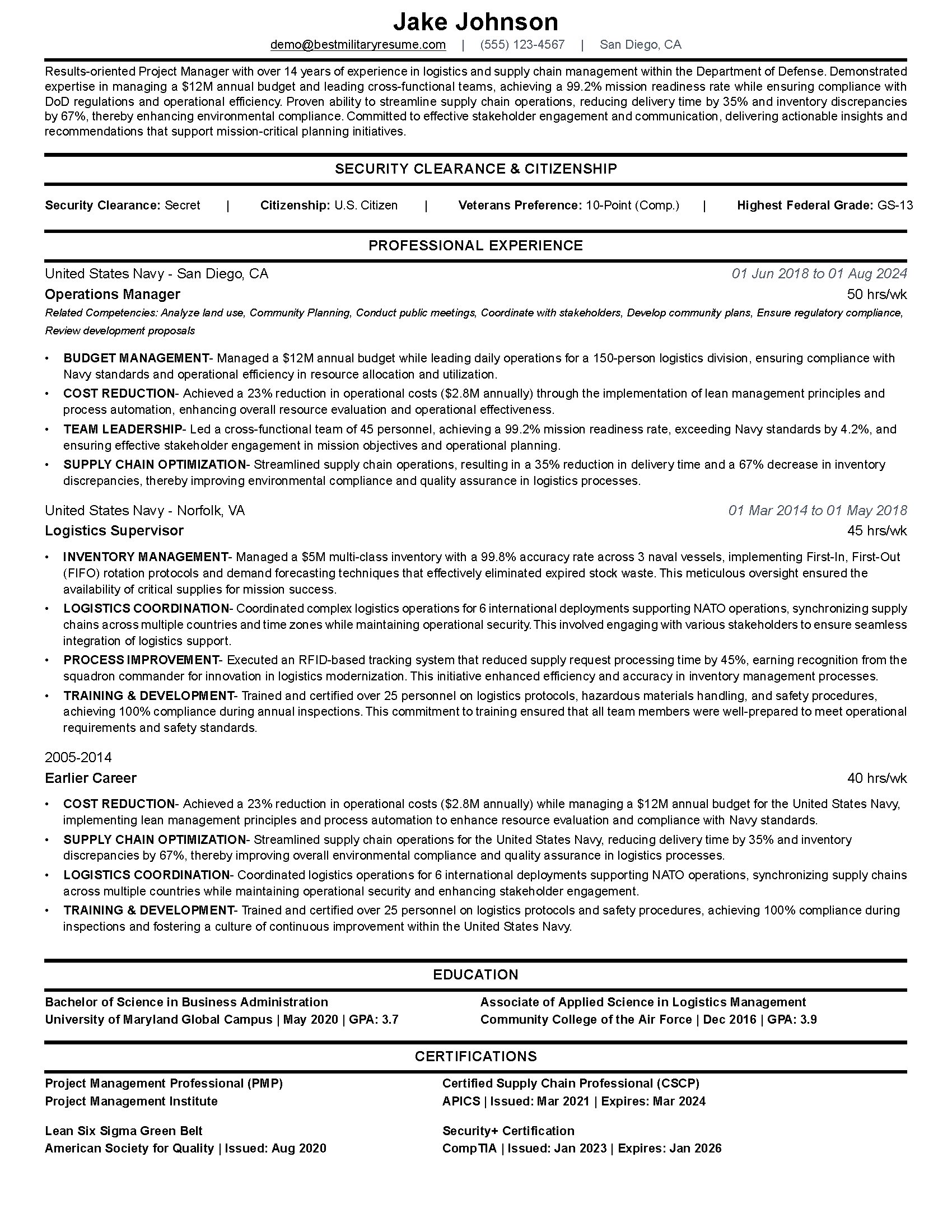
Your resume does a different job here. On a normal federal job, you write it to fit an announcement. In an HQE file, it has to prove the expertise test. It needs to show skill that goes beyond what DoD has on hand right now.
That changes what you lead with. This is how I'd build it.
Lead with the expertise
A rank and a year count do not prove a rare skill. Put the field first, then the proof.
Weak opening line:
"Retired Colonel with 26 years of leadership experience in diverse assignments."
Stronger opening line, with brackets for your real details:
"[Field] expert. Ran [program name] test and fielding for [number] years. Then spent [number] years at [company type] on the same system."
The second line names the field, the depth, and the time outside the uniform. That's the shape the policy language describes.
Show the work outside the uniform
The policy says expertise usually comes from industry or academia. So give that time real space on the page. Name the role, the scope, and one result. If you teach, list courses and publications. If you consult, list the problem you solved. My guide to fractional executive roles for retirees shows how to write that kind of work.
Make the rare part easy to see
Someone outside your field may read this resume. Spell out every acronym the first time. Say what the program does in plain words. Then show why few people can do it. A line like "one of [number] people who ran [capability] in the fleet" helps. Use it only if it's true and you can prove it.
Keep a second version ready
An HQE seat is short and runs at the will of the office. So keep a standard federal resume ready too. For most federal jobs, that's two pages. Always check the announcement, because some set a different limit. My guide to a retired military resume after 20 years covers what to cut. On any tailored resume, BMR's condenser compresses older roles so you stay at two pages.
What to Do Next
An HQE appointment usually comes to the person whose expertise is already visible. So the next step is to put yours on paper before anyone asks.
- Write one line that names your field and the rare part of your skill.
- List the work you did after the uniform, or plan it, with one result for each role.
- Check your timeline against the 4-day break and the 180-day rule.
- Tell a few people in DoD offices what you know and when you're free.
- Build a base federal resume you can tailor for an HQE file or a USAJOBS posting.
BMR's Federal Resume Builder does step five. It turns your service history into a federal resume you can tailor to each opening. It's free to start, so you can have a base draft before your next call with that office.
Frequently Asked Questions
Is an HQE appointment a permanent federal job?
Do I apply for an HQE job on USAJOBS?
Does the 180-day rule apply to an HQE appointment?
Can a retired officer use HQE to get into the Senior Executive Service?
Can retired senior enlisted leaders be HQEs?
Do HQEs get bonuses or overtime?
What is an HQE Senior Mentor?
About the Author
Brad Tachi is the CEO and founder of Best Military Resume and a 2025 Military Friendly Vetrepreneur of the Year award recipient for overseas excellence. A former U.S. Navy Diver with over 20 years of combined military, private sector, and federal government experience, Brad brings unparalleled expertise to help veterans and military service members successfully transition to rewarding civilian careers. Having personally navigated the military-to-civilian transition, Brad deeply understands the challenges veterans face and specializes in translating military experience into compelling resumes that capture the attention of civilian employers. Through Best Military Resume, Brad has helped thousands of service members land their dream jobs by providing expert resume writing, career coaching, and job search strategies tailored specifically for the veteran community.
