Answer "What Is Your Biggest Weakness?" as a Vet
Taylor sent 200+ applications for 5 interviews. With BMR, 20 resumes all hit.
Taylor, E-7, Army, defense industry
Why Does This Question Feel Like a Trap?
Every veteran walking into a civilian interview dreads this question. After years of military culture where admitting weakness could get someone hurt, being asked to volunteer your shortcomings to a stranger who controls your employment feels counterintuitive at best and dangerous at worst.
But this question is not a trap. Hiring managers ask it because they want to see self-awareness, honesty, and evidence that you are actively working to improve. They are not looking for a fatal flaw that disqualifies you. They are looking for a candidate who can reflect on their own performance and take corrective action. That is exactly what the military trained you to do with AARs (after-action reviews). You just need to apply that same approach in civilian terms.
The real trap is giving a non-answer. "I work too hard" or "I care too much" are transparent dodges that hiring managers have heard thousands of times. Those answers signal that you either lack self-awareness or you are not willing to be honest. Both are worse than admitting an actual weakness.
When I moved from federal logistics into tech sales, I had to answer this question in a completely different context. My weakness was genuinely that I had zero sales experience. Instead of hiding it, I told the interviewer exactly how I was closing that gap. That honesty is what got me the job, not a polished dodge.
The Real Trap
Giving a fake weakness like "I am a perfectionist" or "I work too hard" is worse than naming a real one. Hiring managers see through it instantly and it signals you are not being genuine.
What Makes a Good Weakness Answer?
A strong weakness answer has four elements. First, it names a real professional weakness. Second, it gives a brief example of how that weakness has shown up. Third, it explains what you are doing to address it. Fourth, it shows progress or results from your improvement efforts.
The weakness you choose matters. Pick something that is genuine but not central to the job you are applying for. If you are interviewing for a project management role, do not say your weakness is staying organized. If you are applying for a customer-facing position, do not say you struggle with communication. Choose a real weakness that is adjacent to the role, not at its core.
Veterans have a unique advantage here because military service builds specific strengths that come with predictable corresponding weaknesses. The same discipline that made you effective in the military can create friction in civilian workplaces. These are honest, relatable weaknesses that hiring managers respect when you frame them correctly.
Name a Real Weakness
Choose something genuine that is not central to the job requirements. Be specific, not vague.
Give a Brief Example
Show how it has appeared in your work. One sentence is enough. Do not over-explain.
Explain Your Fix
What specific steps have you taken to improve? Name the action, not just the intention.
Show Progress
Demonstrate that your improvement efforts are producing results. Measurable progress is ideal.

What Are Strong Weakness Examples for Veterans?
These are real weaknesses that veterans commonly experience during their transition. Each one is honest, relatable, and framed in a way that shows growth. Pick the one that actually applies to you.
Delegation
In the military, if something needed to be done right, you often did it yourself because the stakes were too high for mistakes. In civilian workplaces, that instinct becomes micromanagement. A strong answer sounds like this:
"My biggest weakness is delegation. In the military, I was responsible for outcomes where mistakes could have serious consequences, so I developed a habit of doing critical tasks myself. In a civilian setting, I have recognized that this limits my team's growth and my own bandwidth. I have been actively working on assigning tasks with clear expectations, checking in at milestones instead of hovering, and trusting my team to deliver. In my last volunteer project, I delegated four major workstreams and only stepped in when asked. The project finished ahead of schedule."
Adjusting Communication Style
Military communication is direct, blunt, and efficient. Civilian workplaces often expect more nuance, diplomacy, and softening of feedback. This is a genuine adjustment that takes time.
"I tend to be very direct in my communication style. In the military, clear and concise communication was expected and valued. I have learned that in civilian settings, delivering feedback with more context and framing helps people receive it better. I have been practicing by asking for feedback on my communication from colleagues and mentors, and I have seen a real improvement in how my input is received during group projects."
Asking for Help
Military culture rewards self-sufficiency. Asking for help can feel like admitting failure. In civilian workplaces, asking questions early prevents bigger problems later.
"I sometimes hesitate to ask for help when I am stuck on something. In the military, there was an expectation to figure things out on your own. I have been intentionally pushing myself to ask questions earlier in the process, especially when learning new systems or processes. I have found that asking for help in the first hour saves me from spending half a day going in the wrong direction."
Adjusting to Ambiguity
Military operations have clear mission orders, timelines, and chains of command. Civilian projects often have vague goals, shifting priorities, and no single decision-maker. This transition is genuinely difficult.
"I am used to working with very clear objectives and defined parameters. In civilian environments, I have noticed that goals can be more fluid and priorities shift faster than I was used to. I have been working on getting comfortable with ambiguity by asking clarifying questions early and building flexibility into my project plans. In a recent certification course, I practiced adapting my approach as requirements changed mid-project, and it went much better than I expected."
Key Takeaway
The best weakness answer for veterans ties a military strength to its civilian friction point, then shows specific steps you are taking to adapt. Honesty plus action equals credibility.
What Weaknesses Should You Avoid Mentioning?
Some weaknesses will hurt you no matter how well you frame them. Stay away from these categories.
Anything that is a core job requirement. If the job posting emphasizes teamwork, do not say you prefer working alone. If the role requires attention to detail, do not say you sometimes miss small things. Read the job description and eliminate any weakness that overlaps with their top priorities.
Personality traits framed as weaknesses. "I am too honest" or "I care too much about quality" are not weaknesses. They are thinly disguised brags that make the interviewer question your self-awareness. Name something you are genuinely working to improve.
Anything related to integrity, reliability, or attendance. "Sometimes I am late" or "I have trouble following through" are disqualifying answers. Do not volunteer anything that suggests you cannot be counted on to show up and do the job.
Mental health or personal struggles. While veterans should absolutely seek support for mental health challenges, a job interview is not the setting to discuss them. Keep your answer focused on professional development, not personal battles. You are not obligated to share medical or personal information.
Anger management or conflict with authority. Even if you struggled with certain leaders in the military, saying you have trouble with authority or managing frustration is a red flag that no amount of framing will fix. Pick a different weakness.
- •Delegation or micromanaging tendencies
- •Adjusting communication directness
- •Comfort with ambiguity
- •Public speaking or presentations
- •Asking for help early enough
- •Core job requirements
- •Fake weaknesses disguised as strengths
- •Reliability or attendance issues
- •Personal or medical struggles
- •Anger or authority conflicts
How Do You Practice This Answer?
Unlike other interview questions where you might use different stories each time, your weakness answer should be consistent across all interviews. You have one weakness prepared, and you deliver it the same way every time. Only adjust the "why this role" connection if needed.
Write your answer using the four-part framework: weakness, example, fix, progress. Read it aloud five times. Then practice without the script. Your answer should take 45-60 seconds. If it is shorter, you are skipping the improvement steps. If it is longer, you are over-explaining the weakness itself.
Ask a civilian friend to listen to your answer and give you honest feedback. The two questions to ask: "Does this sound like a real weakness or a fake one?" and "Do I come across as self-aware or defensive?" You want real and self-aware. If they say it sounds rehearsed or fake, choose a different weakness or adjust your delivery.
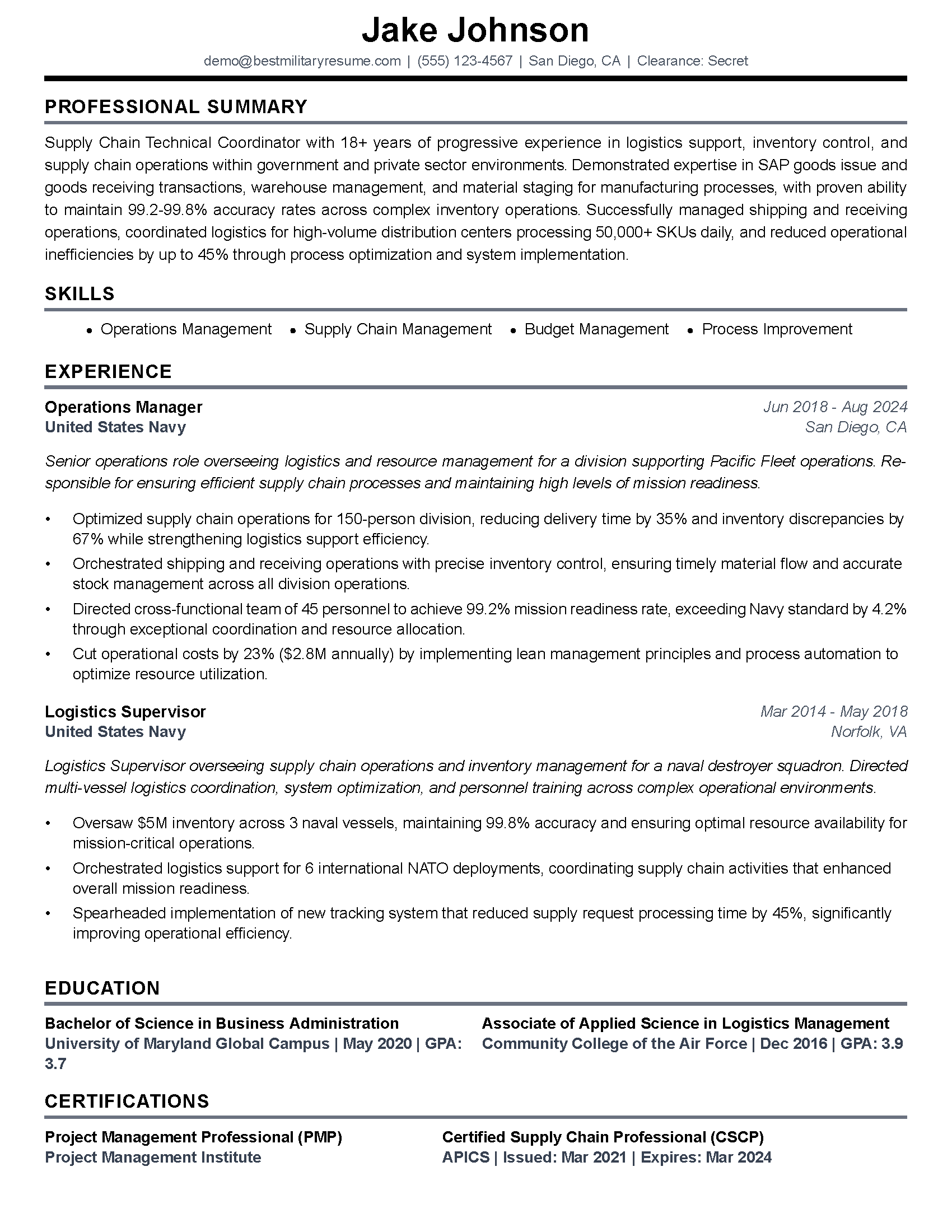
Your weakness answer should complement the strengths on your resume. And once you have this answer locked in, prepare for the rest of the interview using the STAR method for behavioral questions. If your resume action verbs emphasize leadership and results, your weakness should be something that does not undercut those themes. Delegation is a great weakness for a strong leader to name because it shows you are aware of the gap between doing everything yourself and empowering others.
"After helping thousands of veterans through BMR, I can tell you the ones who get hired are the ones who show they can reflect honestly on their own performance. That is what this question is really testing."
Does This Question Come Up in Federal Interviews?
Federal structured interviews follow a specific format where every candidate gets the same scored questions. "What is your biggest weakness?" is less common in formal federal panels because the questions tend to be competency-based (tell me about a time you...) rather than self-assessment questions.
However, federal interviews sometimes include a variation like "describe a professional development area you are working on" or "what skill are you currently trying to improve?" These are the same question wearing a different outfit. Your four-part answer works for all of them.
If you are interviewing for federal contractor positions rather than direct federal hire, the interview format is more likely to resemble private sector interviews. Expect the standard "biggest weakness" question and prepare your answer accordingly.
Regardless of interview type, your career transition timeline should include interview preparation as a dedicated step, not something you cram the night before. Practice answering this question weeks before your first interview so your response is polished when it counts.
Can You Prepare Two Weaknesses Just in Case?
Some interviewers ask for two weaknesses, or they phrase it as "what are some areas you are working to improve?" Having a second answer ready prevents you from being caught off guard and scrambling for something on the spot.
Your second weakness should follow the same four-part framework but cover a different category. If your primary weakness is about delegation (a leadership skill), your backup could be about public speaking (a communication skill) or learning new software quickly (a technical skill). Keep them in different lanes so they do not paint a pattern.
The second answer can be shorter than the first. Two or four sentences covering the weakness, what you are doing about it, and a quick progress point. The interviewer is not looking for another 60-second deep dive. They want to see that your self-awareness extends beyond one rehearsed answer.
If the interviewer only asks for one weakness, do not volunteer the second one. Keep it in reserve. You prepared it so you are ready if needed, not so you can demonstrate how many flaws you have identified. One strong, well-framed weakness answer is always better than two rushed ones.
Show Self-Awareness, Not Weakness
This question is not about confessing a flaw. It is about demonstrating that you can assess your own performance honestly, identify areas for growth, and take action to improve. The military calls this an after-action review. Civilians call it self-awareness. The skill is the same.
Pick a real weakness that does not undercut the core job requirements. Give a brief example. Explain what you are doing about it. Show measurable progress. Keep it to 45-60 seconds. Practice until it sounds honest and natural, not scripted or defensive.
Veterans who prepare this answer in advance walk into interviews with one less thing to worry about. And that confidence shows. The hiring manager is not looking for a perfect candidate. They are looking for someone who can grow. Your answer to this question is your chance to prove you are exactly that kind of person.
Practice with BMR: Try the free Interview Preparation tool to get AI-powered practice questions tailored to your target role.
Frequently Asked Questions
What is a good weakness to say in an interview as a veteran?
Should I say I am a perfectionist as my weakness?
How long should my weakness answer be?
Can I mention something military-related as my weakness?
What weaknesses should I never mention in an interview?
Do federal interviews ask this question?
Should I use the same weakness answer for every interview?
What if the interviewer asks for multiple weaknesses?
About the Author
Brad Tachi is the CEO and founder of Best Military Resume and a 2025 Military Friendly Vetrepreneur of the Year award recipient for overseas excellence. A former U.S. Navy Diver with over 20 years of combined military, private sector, and federal government experience, Brad brings unparalleled expertise to help veterans and military service members successfully transition to rewarding civilian careers. Having personally navigated the military-to-civilian transition, Brad deeply understands the challenges veterans face and specializes in translating military experience into compelling resumes that capture the attention of civilian employers. Through Best Military Resume, Brad has helped thousands of service members land their dream jobs by providing expert resume writing, career coaching, and job search strategies tailored specifically for the veteran community.
