How to Ace a Federal Structured Interview
 Brad Tachi10 min read
Taylor sent 200+ applications for 5 interviews. With BMR, 20 resumes all hit.
Taylor, E-7, Army, defense industry
What Is a Federal Structured Interview?
Federal interviews are nothing like private sector interviews. In the private sector, the hiring manager might ask whatever comes to mind, follow tangents, and make decisions based on gut feel. Federal interviews follow a rigid structure mandated by merit system principles and equal employment regulations. Every candidate gets the exact same questions, in the exact same order, evaluated against the exact same scoring criteria.
This structure exists to ensure fairness. It also means the interview is highly predictable once you understand the format. A federal structured interview typically consists of five to eight behavioral and situational questions, each tied to a specific competency listed in the job announcement. The panel scores each answer independently using a predetermined rubric, usually on a scale of 1 to 5.
For veterans, this format is actually an advantage. You already know how to brief a room full of people using a structured format. The federal interview is just a different type of brief. Instead of SALUTE reports or OPORD formats, you are using the STAR method to deliver organized, evidence-based responses.
Panel Interviews Are Standard
Most federal interviews use a panel of two to four people. One panelist typically leads the questions while others take notes and score. Do not be intimidated by the panel size. Address each person when answering, making eye contact around the room.
How Do You Identify the Competencies They Will Test?
The competencies they test in the interview come directly from the job announcement on USAJOBS. Every federal job listing includes a section called "Qualifications" or "How You Will Be Evaluated." That section lists the knowledge, skills, and abilities (KSAs) the agency cares about. These are your interview prep targets.
Pull up the job announcement and find every competency mentioned. Common federal competencies include problem solving, oral communication, teamwork, leadership, decision making, and technical proficiency specific to the role. Write each one down. Then for every competency, prepare at least two STAR stories from your military or work experience that demonstrate that specific skill.
For example, if the announcement lists "ability to manage competing priorities under time constraints," think about a deployment, exercise, or duty rotation where you handled multiple urgent tasks simultaneously. Be specific about what happened, what you did, and what the outcome was. Vague answers like "I am good at multitasking" earn low scores on the rubric.
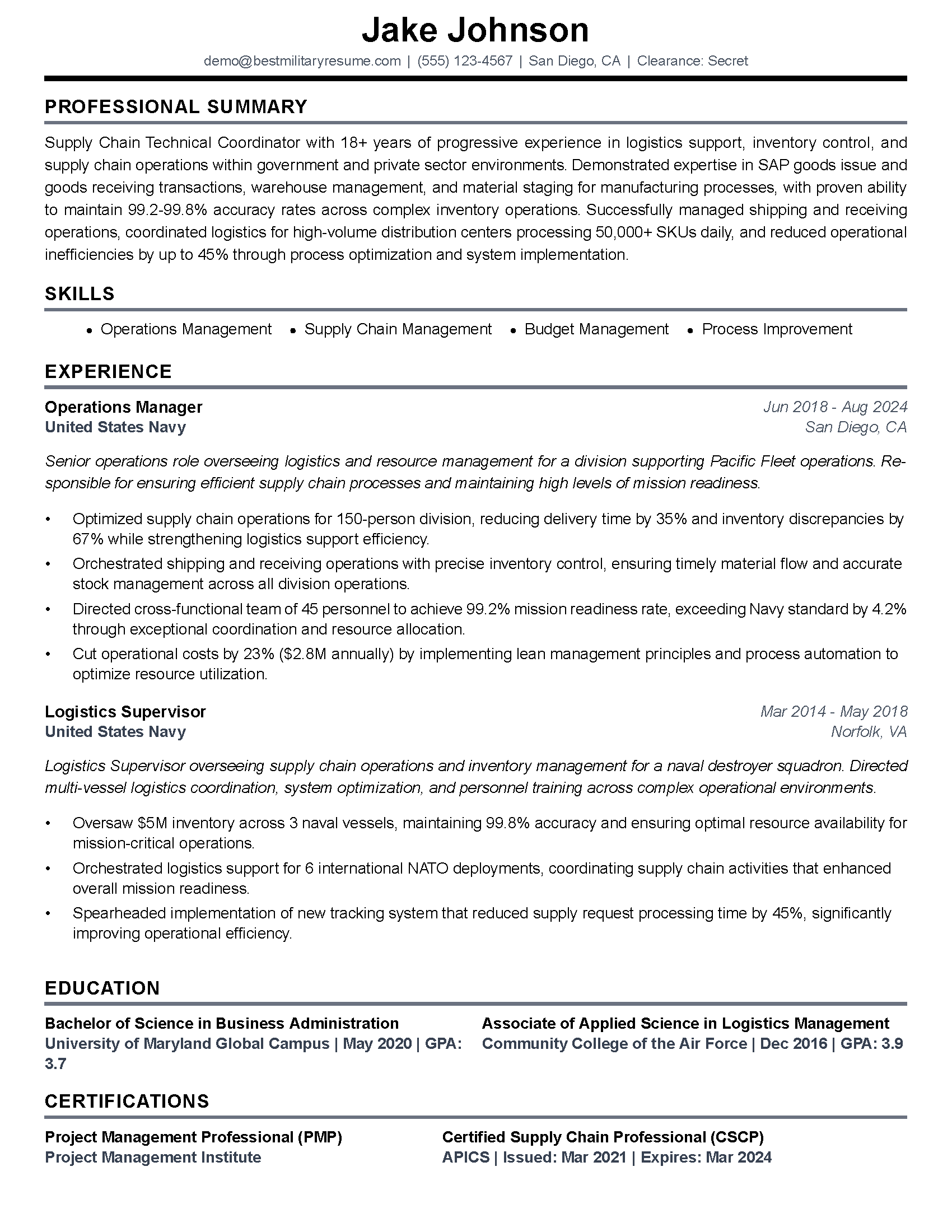
Having already built a civilian-translated resume for the position helps here. The same accomplishment bullets you used on your resume can become the foundation of your STAR stories. You have already done the translation work.

What Is the STAR Method and How Do Veterans Use It?
STAR stands for Situation, Task, Action, Result. It is the standard format for answering behavioral interview questions, and it works perfectly in federal structured interviews because it matches how the scoring rubric is organized. The panel is literally looking for each element.
Breaking Down Each Element
Situation: Set the scene in two to four sentences. Where were you? What was happening? Give enough context for a civilian to understand without drowning them in military jargon. "While serving as the supply chief for a 200-person unit deployed to [location]" gives them what they need.
Task: What was your specific responsibility? Not the team's responsibility, yours. "I was responsible for tracking and distributing $4.2M in equipment across five operating locations" is specific and measurable.
Action: What did you actually do? This is the longest part of your answer. Detail the steps you took. Use first person. "I created a tracking spreadsheet, established daily inventory checks, coordinated with the S-4 for resupply timelines, and briefed the commander weekly on equipment readiness rates."
Result: What happened because of your actions? Use numbers whenever possible. "Equipment readiness went from 78% to 96% over four months, and we had zero losses during the deployment." Results close the loop and prove your impact.
Situation
Set the scene in 2-4 sentences. Where, when, what was the context? Translate military setting for civilians.
Task
Your specific responsibility. Not the unit's mission. Your role and what was expected of you personally.
Action
The longest part. Detail the specific steps YOU took. Use first person. Show your decision-making process.
Result
What happened because of your actions? Use numbers. Percentages, dollars saved, time reduced, people impacted.
Translating Military Jargon in Your Answers
Federal interviewers are often veterans themselves, but you cannot count on it. Even in DoD agencies, the panel might include civilian HR specialists who have never served. Strip the acronyms out of your answers. Say "logistics operations center" instead of "LOC." Say "performance evaluation" instead of "NCOER." Say "unit of 200 personnel" instead of "battalion."
The one exception: if the job is specifically military-adjacent (like a DA civilian position at a military installation), the panel probably knows military terminology. But even then, cleaner language scores higher because the rubric is designed around civilian competency descriptions.
What Questions Should You Expect on a Federal Panel?
Federal structured interview questions fall into two categories: behavioral and situational. Behavioral questions ask about past experience. Situational questions ask what you would do in a hypothetical scenario. Both follow the competencies from the job announcement.
Common Behavioral Questions
"Tell me about a time you had to manage a project with a tight deadline." This tests planning and time management. Your STAR story should include specific timelines, how you prioritized tasks, what resources you coordinated, and whether you met the deadline.
"Describe a situation where you had to resolve a conflict between team members." This tests interpersonal skills and leadership. Do not just say you mediated. Walk them through how you identified the root cause, what approach you took, and how the working relationship improved afterward.
"Give an example of when you had to make a decision without complete information." This tests judgment and decision-making under uncertainty. Military experience is loaded with these examples. Pick one where the stakes were real and the outcome was positive.
Common Situational Questions
"If you discovered a colleague was not following proper procedures, what would you do?" This tests integrity and adherence to policy. Walk through your approach step by step: assess the situation, determine the risk, address it directly if appropriate, escalate if necessary. Do not just say "I would report it." Show your thought process.
"How would you handle being assigned a project in an area where you have limited experience?" This tests adaptability and self-awareness. The best answers show that you would research the topic, identify subject matter experts, create a learning plan, and set milestones to track your progress.
"I am a good leader. In the military, I led teams all the time and always got the mission done. I would bring that same leadership to this position."
"As a team lead for 12 technicians, I noticed our equipment failure rate was 23%. I implemented a preventive maintenance schedule, trained the team on inspection protocols, and tracked results weekly. Within 5 months, failures dropped to 8%."
How Do You Prepare the Week Before a Federal Interview?
Preparation for a federal interview is more structured than for a private sector interview because the format is more predictable. Use that predictability to your advantage with a focused prep plan.
Start by re-reading the job announcement word by word. Highlight every competency, skill, and requirement mentioned. Count them. You should have a STAR story prepared for each one. If the announcement lists eight competencies and you only have stories for five, you have gaps to fill before interview day.
Next, research the agency and the specific office. Check the agency website, recent press releases, and any strategic plans they have published. Federal agencies publish annual performance reports and strategic plans publicly. Knowing the agency's current priorities lets you connect your experience to their mission during your answers.
Practice your answers out loud. Time them. Each STAR response should take 90 seconds to two minutes. Shorter answers feel incomplete to the panel. Longer answers lose their attention. If you are running over two minutes, trim the Situation section first since it is the least scored component.
When preparing for any interview, having a well-crafted elevator pitch ready for the opening "tell me about yourself" question sets the tone for the entire session.
1 Re-Read the Announcement
2 Research the Agency
3 Write STAR Stories
4 Practice Out Loud
5 Prepare Your Questions
What Should You Do During the Interview Itself?
On interview day, arrive 15 minutes early. For virtual interviews, log in 10 minutes before. Bring a notepad and pen. You are allowed to take notes during a federal panel interview, and jotting down key words from each question helps you structure your response before speaking.
When a question is asked, pause for five to ten seconds before answering. This is not awkward in a federal interview. The panel expects it. Use that pause to mentally organize your STAR response. Rushing into an answer often leads to rambling, backtracking, and lower scores.
If you do not understand a question, ask the panelist to repeat it. If you need clarification on what they are looking for, ask. The panel can typically restate the question but cannot rephrase it or give hints. Still, hearing it a second time often helps you identify which competency they are testing.
After each answer, the panel may ask follow-up or probing questions. These are a good sign. They mean the panel wants more detail, which usually indicates your answer was on the right track but needs additional depth. Respond to probing questions with more specifics from the same story rather than jumping to a new example.
How Does Veterans Preference Affect the Interview Process?
Veterans preference gives you points in the hiring process, but it does not change the interview itself. Your veterans preference points are applied to your overall score after the interview, during the final ranking of candidates. The interview questions, scoring criteria, and rubric are identical for all candidates regardless of veteran status.
This means your interview performance still matters significantly. A 5-point or 10-point preference boost helps, but it cannot overcome a poor interview. Think of it as a tiebreaker advantage. If you and a non-veteran candidate score similarly, your preference points push you ahead. But you still need to earn a competitive score through your interview answers.
When I was hired into my first federal position, the interview panel included veterans and civilian employees from completely different backgrounds. The scoring was blind to my veteran status during the interview phase. My preference points were added afterward by HR. Knowing that going in helped me focus on preparing strong answers rather than assuming preference would carry me through.
What Happens After a Federal Interview?
Federal hiring timelines are notoriously slow. After your interview, expect to wait two to eight weeks for a decision. Some agencies move faster, but many do not. Do not assume silence means rejection. The federal hiring process involves multiple approval layers, and delays are common even for the top candidate.
You will typically receive a tentative offer first, which is conditional on a background check, security clearance verification, and sometimes a physical exam. The tentative offer will include your grade, step, salary, and duty location. This is the stage where you can negotiate your step using a superior qualifications request.
After the tentative offer is accepted and all conditions are met, you receive a final offer with a specific start date. Only after the final offer should you give notice at your current job. Do not resign based on a tentative offer since the process can still fall through during the background investigation phase.
If you do not get selected, you can request interview feedback from the HR office. Not all agencies provide it, but many will share your score or general areas where you fell short. This information is valuable for improving your performance on the next federal interview.
Key Takeaway
Federal structured interviews are predictable. The competencies come from the job announcement, the questions test those competencies, and the scoring follows a rubric. Prepare a STAR story for every competency listed, practice until each response fits in 90 seconds to two minutes, and translate your military experience into civilian language. The structure works in your favor if you prepare for it.
Practice with BMR: Try the free Interview Preparation tool to get AI-powered practice questions tailored to your target role.
Find your match: Explore 350+ federal job series to see which GS positions match your military experience.
Frequently Asked Questions
How long does a federal structured interview last?
Can I bring notes to a federal interview?
How is a federal interview scored?
Do all federal jobs require a panel interview?
What if I do not have a civilian example for a STAR story?
How long after a federal interview do you hear back?
Can I negotiate my GS step after a federal interview?
Should I ask questions at the end of a federal interview?
About the Author
Brad Tachi is the CEO and founder of Best Military Resume and a 2025 Military Friendly Vetrepreneur of the Year award recipient for overseas excellence. A former U.S. Navy Diver with over 20 years of combined military, private sector, and federal government experience, Brad brings unparalleled expertise to help veterans and military service members successfully transition to rewarding civilian careers. Having personally navigated the military-to-civilian transition, Brad deeply understands the challenges veterans face and specializes in translating military experience into compelling resumes that capture the attention of civilian employers. Through Best Military Resume, Brad has helped thousands of service members land their dream jobs by providing expert resume writing, career coaching, and job search strategies tailored specifically for the veteran community.
