Why Veterans Talk Too Long in Interviews (and How to Fix It)
Taylor sent 200+ applications for 5 interviews. With BMR, 20 resumes all hit.
Taylor, E-7, Army, defense industry
You answered the question. Then you kept going. You gave the setting, the unit, the mission, and the people. By the time you got to the result, the interviewer had already looked at the clock. If that sounds familiar, you're not alone. It's also one of the most fixable habits in a job search.
Navy Diver veteran here. The job stays with you long after the bag is packed, and so do the briefing habits. In uniform, a good brief often gave the full picture before anyone acted. That habit served us well. In a civilian interview, it can bury your best answer under two minutes of setup.
This guide covers why veterans tend to talk too long in interviews. Then it shows you how to fix it. It works for a phone screen, a panel, a video call, or a federal structured interview. You'll get an answer-first order you can use today. You'll also get a target length for each kind of question. Then come landing lines that tell you when to stop, two before-and-after examples, and a five-day drill.
Why do veterans talk too long in interviews?
Long answers rarely come from ego. They usually come from good habits that worked in the military and don't fit the interview room. Once you can name the habit, you can catch it mid-sentence. Here are six that show up often.
Do you give the full context before the point?
Military briefs often run in a set order. Situation first, then the mission, then the plan. That order makes sense when people act on what you say. In an interview, it puts the answer last. The interviewer has to sit through the setting before they hear what you did.
Are you afraid to leave out the team?
Many veterans were taught that nothing got done alone. So they name the team, the shifts, and the other sections first. Their own part comes last. That loyalty is a good trait. But a long list of who helped can push your own work out of the answer.
Do you defend every decision before anyone asks?
In a chain of command, you often had to justify your call to someone above you. So you learned to explain the why before anyone asked. In an interview, that turns into a defense of every step. The interviewer may only want the result and one reason.
Are you used to an audience that can't cut you off?
A junior troop rarely stops a senior leader mid-brief. Many of us spent years talking to rooms that listened until we were done. Civilian interviewers may not cut in either, but they may stop listening. A polite nod is not always a sign they want more.
Does translating jargon add length?
You say a military term, then stop to explain it. Then you explain the explanation. Each fix adds a sentence. Do the translation before the interview so the answer comes out in plain words the first time. Our guide on how to explain military experience without jargon covers that part.
Do nerves make you fill the silence?
Silence feels like failure when you're nervous. So you keep talking to fill it. The answer gets longer, and the point gets harder to find. A short pause after a clear answer is normal. If you lose your place mid-answer, read our guide on how to recover when you freeze up.
What does a long answer cost you?
A long answer is not always fatal. But it often costs you in quiet ways you won't see in the room. These costs add up across a full interview.
- Your result gets buried: The best part of your story comes last, when attention is lowest.
- You get fewer questions: Most interviews have a set time. Long answers can leave less room for the questions where you shine.
- Follow-ups dry up: A short answer invites the interviewer to ask for more. A long one often answers questions they didn't ask.
- The notes get thin: Many interviewers take notes as you talk. If they can't find your main point, it may not make the notes at all.
Federal interviews add one more reason. In a structured interview, OPM says all candidates get the same questions in the same order. The OPM structured interviews page also says every response is judged on the same rating scale and standards. So what scores is content that matches the standard.
How do you put the answer first?
You already know the fix. You've used it in writing for years. The Army calls it bottom line up front. AR 25-50, the Army's correspondence rule, lists it in paragraph 1-38. It says to put the main point at the beginning. Apply that same habit to how you talk.
This is the order I'd use for most answers.
- Answer line: One sentence that answers the question or names the result.
- Proof: What you did, in two to four short sentences.
- Result: The number or outcome, if you didn't lead with it.
- Landing line: One short sentence that ties it to the job, then stop.
This works with STAR too. You still cover the situation, task, action, and result. You just open with a one-line preview so the listener knows where the story ends. Our STAR method guide for veterans covers the full structure. This article only fixes the length.
A good answer line is short and plain. Say the question is about a tight deadline. Your answer line might be, "I got a 30-day job done in 18 days with two shifts." Everything after that line just backs it up.
How long should each answer be?
There's no single correct length. Some interviewers want more and some want less. But having a target keeps you from drifting. Treat these as working targets. Adjust them to the room.
- Yes or no and fact questions: One or two sentences. Are you willing to travel? Answer it, add one detail, and stop.
- Why this job or why this company: About 30 to 45 seconds. Two reasons tied to the posting are plenty.
- Behavioral stories: About 90 seconds to two minutes. That covers one clear story with a result.
- Tell me about yourself: This one has its own shape. See our guide to answering tell me about yourself.
- Your questions at the end: One sentence each. Ask, then listen.
Federal panels can run differently. Some give you a set time per question. Our guide on structured vs. unstructured federal interviews covers federal timing in more detail.
Don't time yourself in the room. Time yourself at home, so the right length turns into a feel. When you practice, a phone timer tells you fast if a two-minute story is really four.
How do you know when to stop talking?
Most long answers don't start long. They run long because there's no clear place to stop. So build the stop into the answer before you walk in. That's what a landing line does.
What is a landing line?
A landing line is one short sentence that closes the story. It often ties your result to the job you want. Once you say it, you stop and let the interviewer talk. Here are a few you can adapt.
- Tie to the job: That's the same kind of planning this role needs.
- Name the lesson: I still use that checklist on every project.
- Offer more: I'm happy to go deeper on any part of that.
- Close the loop: We hit the date, and the process stuck after I left.
The offer-more line is useful when you're not sure you said enough. It hands control back to the interviewer. In most interviews, if they want the details, they'll ask. If not, you saved time for the next question. A federal structured panel is different. It may not be allowed to ask follow-ups. So cover what you did and the result before you land it.
How do you read the interviewer?
People usually show you when they want more. Watch for these signs, but don't treat any one as a sure thing.
- Signs they want more: They lean in, take notes, or ask you to tell them more.
- Signs to wrap up: They look down at their sheet, glance at the time, or start nodding fast.
- A cut-in: If they interrupt, stop and answer what they asked. That's a gift.
Reading the room gets harder on a call or with several people. On video, a small lag can look like a pause. Our virtual interview tips for veterans cover that setup. With a panel, watch the person who asked, then check the others. The panel interview guide goes deeper on that.
What backstory can you cut?
Most long answers carry the same extra weight. You can cut a lot of it without losing the story. Here's what usually goes, and what stays.
What can you usually cut?
- Unit history: The interviewer rarely needs to know how the unit got there.
- The chain of command: Say who you reported to in a few words, or skip it.
- Every team member: One line covers it. I led a team of 12, for example.
- The full timeline: Give the length of the job, not each week of it.
- Side problems: If it didn't change the result, leave it out.
What should you keep?
- The problem: One sentence on what was wrong or at stake.
- Your part: What you decided and did, with the word I.
- The result: A number when you have one, an outcome when you don't.
Using I tells the interviewer what you will bring to their team. You can still give the team a nod in one short line.
What does a before and after look like?
These are illustrations with made-up people. They show the same story told long and told short. Read them out loud and notice where the point shows up.
Example 1: What does a deadline answer look like?
Jane Sample is a former Army supply sergeant. The question is this: Tell me about a time you met a tight deadline.
Before (the long version). So, we were getting ready for a field exercise, and our battalion had a new commander. The new commander wanted a full inventory in 30 days, before we rolled out. We had about 400 line items across three warehouses. Our section was short two people because one was on leave and one was at a school. I talked to the first sergeant, and he said we could pull help from another company. That took a few days to set up. We built a tracker, split into two shifts, and worked through the weekends. There were some issues with the hand receipts not matching. In the end, we finished the inventory in 18 days, and the commander was happy.
After (about half the length). I finished a 30-day inventory in 18 days by running two shifts. We had about 400 line items across three warehouses and were short two people. I borrowed help from another unit and built a simple tracker. I also fixed the hand receipts that didn't match as we went. We finished 12 days early. I'd bring that same planning to your inventory work.
The facts are the same. The second version leads with the result. It drops the leave and school details and ends on a landing line.
Example 2: Why are you leaving the military?
John Sample is a former Air Force crew chief with 20 years in. This question tempts a lot of retirees into a long story.
Before. Well, I joined right out of high school, and I've done a lot over 20 years. I moved bases six times and deployed four times. My kids are getting older. My wife and I talked a lot about whether I should stay for 24. The promotion picture was tough, and I had some health stuff. In the end, we decided it was time.
After. I hit 20 years, and I'm ready to build a career in one place. I've spent two decades keeping aircraft ready to fly. I want to bring that to a maintenance team like yours.
The short version answers the question and turns toward the job. It also skips personal details the interviewer doesn't need. If they want more, they can ask. For a related question, see how to answer why should we hire you.
How do you drill the habit out?
Knowing the fix is not the same as doing it under pressure. A habit built over years takes reps to change. This five-day plan focuses on length only. For the general how-to of practice, see our guide to practicing interview answers alone.
- Day 1, write answer lines: Pick ten likely questions. Write one answer line for each. Pull them from the results on your resume.
- Day 2, time the long version: Say each answer out loud the way you'd tell it now. Time it and write the number down.
- Day 3, cut: Strike the backstory from each answer. Add a landing line. Time it again.
- Day 4, get cut off: Have a friend ask the questions and interrupt you when you drift. Our mock interview with a battle buddy guide shows how to set that up.
- Day 5, run it clean: Go through all ten in a row. Answer line first, landing line last, then stop.
Don't memorize the answers word for word. Memorize the answer line and the landing line. The middle can change each time. That keeps you sounding natural and keeps you short.
One more tip. The first answer sets your pace for the rest of the interview. If you open short and sharp, you'll usually stay that way. Our guide to the first 90 seconds of an interview covers that opening.
What to Do Next
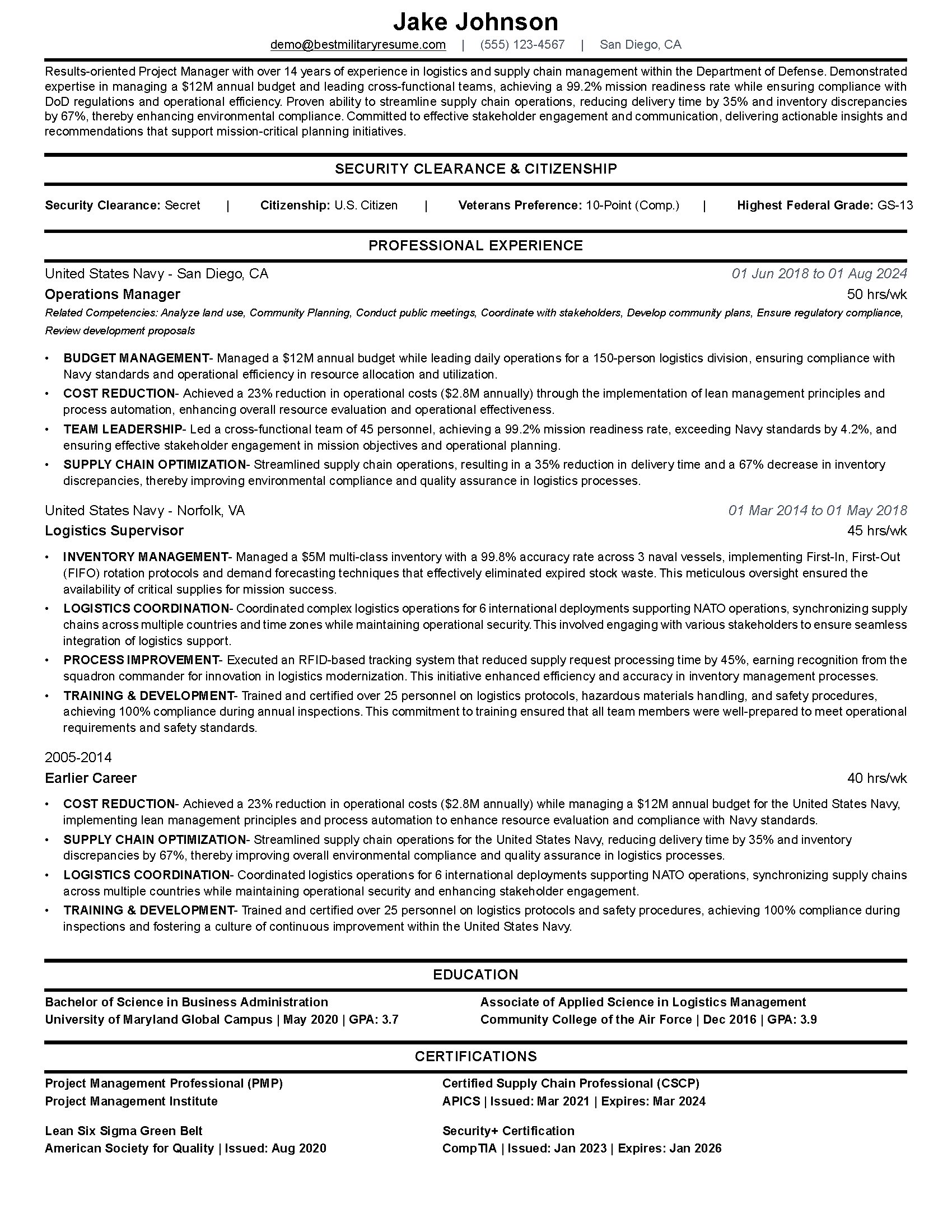
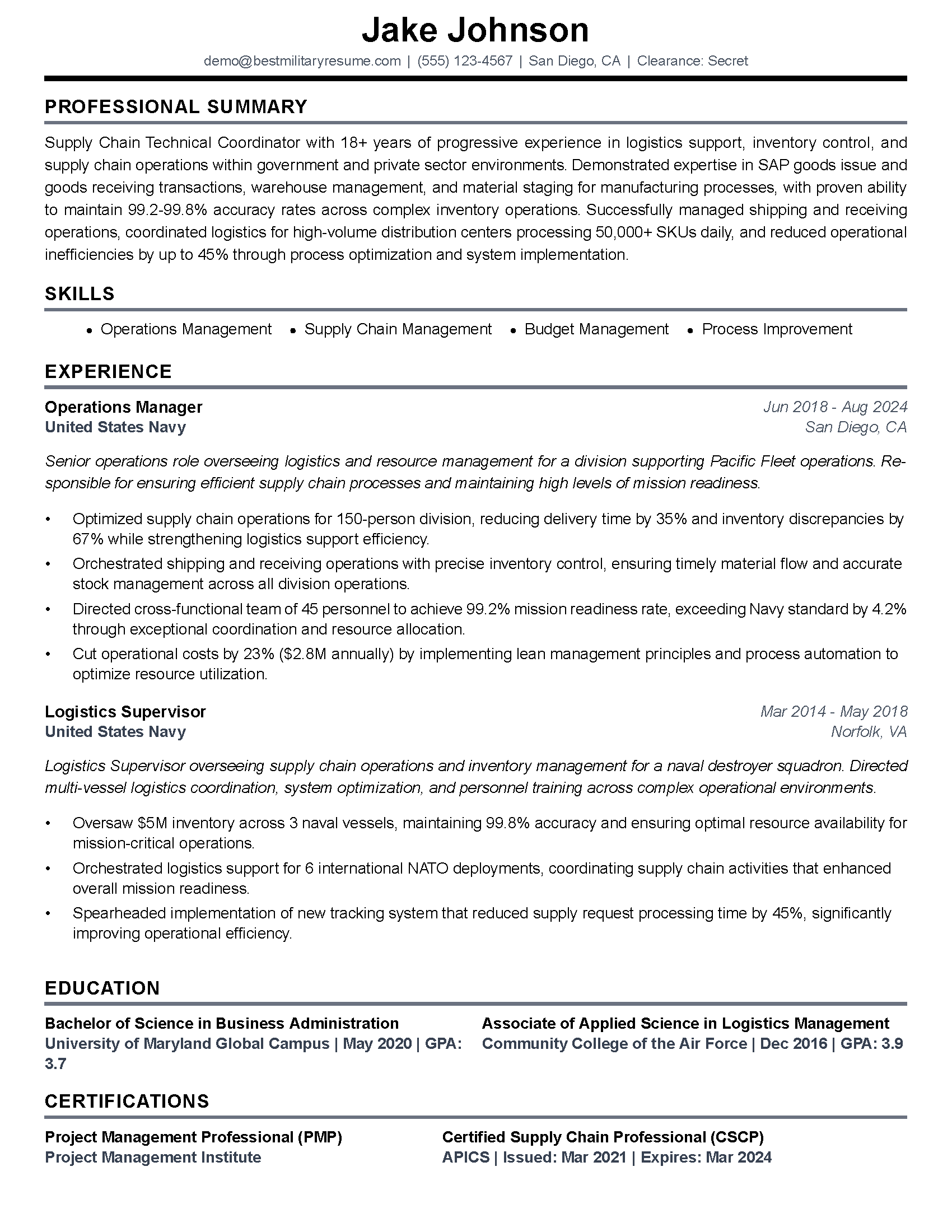
Your short answers start on your resume. Each bullet with a number is a ready-made answer line. If a bullet only lists duties, you'll struggle to find a result to lead with.
So start there. Pull up the job you're aiming for and tailor your resume to it. Make sure every key bullet names what you did and what changed. The BMR Resume Builder turns military duties into plain, results-first bullets. It also tailors them to a posting.
Then practice. BMR's mock interview asks you questions for the job you want. You type your answers, or speak them with the mic button. Then you get feedback on each one. Free accounts get two sessions. Run one, check which answers ran long, and cut them before the real interview.
Frequently Asked Questions
Why do veterans talk too long in interviews?
How long should an interview answer be?
What is the fastest way to stop rambling in an interview?
Does bottom line up front work in a job interview?
Is it okay to say I instead of we in an interview?
What if the interviewer wants more detail?
Do long answers score higher in a federal structured interview?
About the Author
Brad Tachi is the CEO and founder of Best Military Resume and a 2025 Military Friendly Vetrepreneur of the Year award recipient for overseas excellence. A former U.S. Navy Diver with over 20 years of combined military, private sector, and federal government experience, Brad brings unparalleled expertise to help veterans and military service members successfully transition to rewarding civilian careers. Having personally navigated the military-to-civilian transition, Brad deeply understands the challenges veterans face and specializes in translating military experience into compelling resumes that capture the attention of civilian employers. Through Best Military Resume, Brad has helped thousands of service members land their dream jobs by providing expert resume writing, career coaching, and job search strategies tailored specifically for the veteran community.
