68W Combat Medic: Civilian Healthcare Career Guide
 Brad Travis9 min read
Desiree landed a $135K hybrid senior financial consultant role.
Desiree, E-5, Army National Guard, the interviewer loved the resume from the top down
Why Do Combat Medics Struggle to Get Civilian Healthcare Jobs?
You spent years performing medical procedures under conditions that most civilian healthcare workers will never experience. You have managed trauma in austere environments, made life-or-death decisions without a physician standing over you, and maintained composure while treating casualties under fire. And yet, when you apply for civilian healthcare jobs, your resume gets overlooked because it does not speak the language that civilian hiring managers and credentialing boards understand.
The problem is not your skills — it is the translation. Civilian healthcare is one of the most credential-driven industries in existence. Every role requires specific licenses, certifications, or degrees that are verified before you are allowed to touch a patient. Your military medical training, no matter how extensive, does not automatically convert to these civilian credentials. The DD-214 lists your MOS and dates of service, but it does not prove to a hospital credentialing committee that you meet their specific requirements.
This guide covers the specific career paths available to 68W combat medics, which civilian certifications you can earn fastest based on your existing training, and how to write a resume that translates your combat medical experience into language that gets you hired.
Combat medicine is not just an Army job. If you served as a Navy Hospital Corpsman, an Air Force Aerospace Medical Technician, or a Coast Guard Health Services Technician, the same credentialing gap and the same civilian healthcare paths apply to you.
Brad's Take
Combat medics are some of the most capable medical professionals I have seen transition out of the military — and some of the most frustrated by the civilian credentialing process. The skills are there. The experience is real. But the civilian system needs to see specific certifications and resume language before it will let you practice. This guide is about bridging that gap as fast as possible.
What Civilian Healthcare Career Paths Are Available to 68W Medics?
Your 68W training opens doors to multiple healthcare career paths. The right choice depends on how much additional education you are willing to pursue, your timeline, and whether you want to stay in direct patient care or move into healthcare administration or education.
Emergency Medical Technician (EMT-Basic): This is the fastest path to a civilian medical credential. Many states allow 68W medics to challenge the National Registry of Emergency Medical Technicians (NREMT) exam with minimal additional coursework — some require only a bridge course of 40-80 hours. EMT-Basic positions pay $35,000-$45,000 annually in most markets, with higher wages in urban areas and fire departments. This is often used as a stepping stone while pursuing higher credentials.
Paramedic (EMT-P): Paramedics perform advanced procedures that align closely with what combat medics do — IV access, medication administration, advanced airway management, cardiac monitoring. Paramedic programs typically require 1,200-1,800 hours of training, but your 68W background covers significant portions of the curriculum. Some programs offer accelerated tracks for military medics that cut the timeline by 30-50%. Paramedics earn $45,000-$65,000 annually, with senior paramedics and flight medics earning $70,000+.
Registered Nurse (RN): Nursing is the most popular long-term healthcare career for combat medics, and the GI Bill covers the full cost of nursing programs. Associate Degree in Nursing (ADN) programs take two years; Bachelor of Science in Nursing (BSN) programs take four years but open more career advancement opportunities. Some nursing schools offer credit for military medical training, which can reduce your program length. RN salaries range from $60,000-$90,000 depending on specialty and location, with travel nurses and specialized roles earning significantly more. Combat medics who become ER nurses or trauma nurses find the transition particularly natural — the fast-paced, high-acuity environment mirrors what you experienced in military medicine. Many hospitals actively recruit veterans into their emergency departments specifically because of this comfort with high-stress clinical situations.
Physician Assistant (PA): PA programs require a bachelor's degree plus completion of a PA master's program (typically 27 months). Your 68W experience provides strong clinical hours that support your application — most PA programs require 1,000-3,000 hours of direct patient care experience, and your military medical service counts. PAs earn $115,000-$140,000 annually and practice medicine under physician supervision — diagnosing conditions, prescribing medications, and performing procedures. This path requires the most education but offers the highest earning potential in direct patient care. Several PA programs specifically recruit military medics and corpsmen, recognizing that your clinical experience in austere environments demonstrates a level of independent medical decision-making that few civilian applicants can match.
Healthcare Administration: Not every medic wants to stay in clinical work. Healthcare administration roles — hospital operations, medical facility management, clinical coordination — leverage your medical knowledge plus your military leadership and organizational skills. A bachelor's degree in healthcare administration combined with your 68W experience qualifies you for coordinator and manager positions paying $55,000-$85,000, with senior administrators earning $100,000+.
Medical Sales and Medical Device Representatives: Your clinical knowledge gives you credibility that most sales representatives lack. Medical device companies and pharmaceutical firms actively recruit veterans with medical backgrounds because you can speak the clinical language that physicians and nurses use. Entry-level medical sales positions pay $60,000-$80,000 base plus commissions that can double your total compensation.
Surgical Technologist: If you assisted with surgical procedures in a combat surgical hospital or forward surgical team, surgical technology is a natural transition. Surgical techs prepare operating rooms, assist during procedures, and manage surgical instruments. Programs are typically 12-24 months, and your military surgical experience may qualify for advanced placement. Surgical techs earn $50,000-$65,000 annually with hospital surgical techs in specialty departments earning more.
Occupational Health and Safety: Your training in hazard assessment, environmental health monitoring, and preventive medicine translates to occupational health and safety roles in construction, manufacturing, and corporate settings. OSHA certifications are relatively quick to obtain, and many employers value the disciplined approach to safety protocols that military medics bring. Safety specialists earn $55,000-$80,000, with senior safety managers in high-risk industries earning $90,000+.

Which Certifications Should 68W Medics Get First?
Prioritize certifications that directly unlock job opportunities rather than collecting credentials broadly. Here is the recommended order based on speed to employment and return on investment.
Step 1: NREMT (National Registry EMT). This should be your first certification if you do not already have it. Many 68W medics maintain NREMT certification during service, but if yours has lapsed, you can recertify through continuing education or by retaking the exam. NREMT certification is required for EMT and paramedic positions in most states. Check your state's specific requirements — some states have their own certification in addition to or instead of NREMT.
Step 2: State EMT License. NREMT certification alone does not allow you to practice in most states. You need to apply for your state EMT license, which typically requires NREMT certification plus a state-specific application. Processing times vary from days to several weeks depending on the state — apply early so you are licensed before you start your job search. Some states with large military populations like Texas, North Carolina, and Virginia have streamlined processes for military medical personnel.
Step 3: BLS, ACLS, and PALS. Basic Life Support (BLS), Advanced Cardiovascular Life Support (ACLS), and Pediatric Advanced Life Support (PALS) certifications through the American Heart Association are required for most clinical healthcare positions. These are straightforward for 68W medics — the content covers skills you already have. Each certification requires a one to two-day course and exam. Keep these current on your resume.
Step 4 (if pursuing paramedic): Enroll in an accredited paramedic program. Look for programs that offer military medic bridge courses or credit for prior learning. The GI Bill covers paramedic programs at approved institutions, and some programs specifically recruit military medics.
Additional high-value certifications: Depending on your target career path, consider Certified Emergency Nurse (CEN) if pursuing ER nursing, Tactical Combat Casualty Care (TCCC) instructor certification if moving into training roles, Certified Medical Assistant (CMA) for outpatient clinic work, or Pharmacy Technician Certification (CPhT) if your 68W duties included medication management. Each of these builds on skills you already have and adds a credential that civilian employers require or prefer.
Check the Pathways Program for federal healthcare positions — VA hospitals and military treatment facilities hire former medics through Recent Graduate and Internship tracks that provide structured development and conversion to permanent positions. Federal healthcare positions through the VA offer competitive salaries plus federal benefits, and your military medical experience gives you a direct advantage in VA hiring.
Start Before You Separate
Use Army COOL (Credentialing Opportunities On-Line) to fund your NREMT exam and other certifications while still on active duty. COOL covers exam fees for dozens of medical certifications. This is separate from your GI Bill — use COOL first so you do not burn education benefits on certifications you can get for free while serving.
How Do You Write a 68W Resume for Civilian Healthcare Jobs?
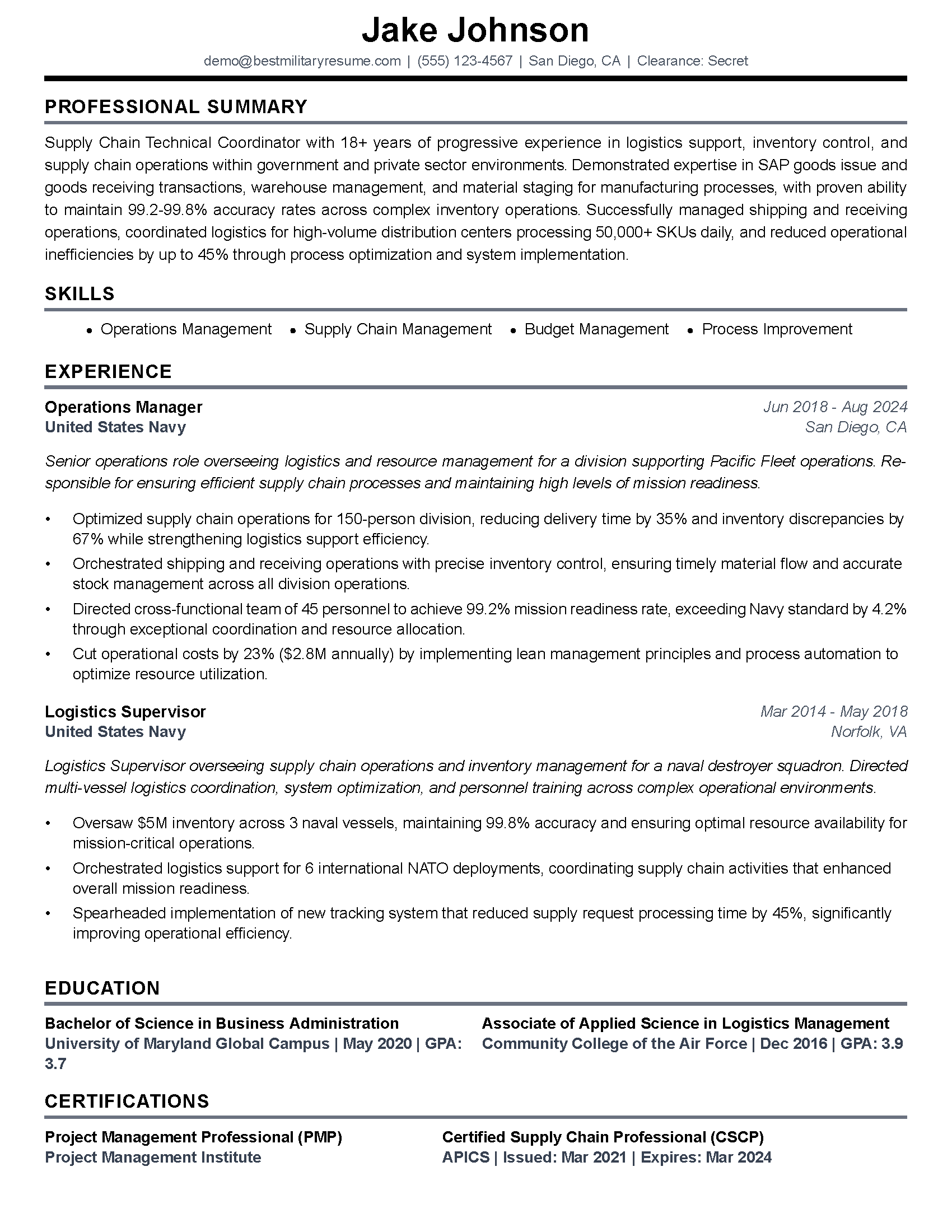
Your resume needs to accomplish two things: prove you have the clinical skills for the position and translate your military medical experience into terms that civilian hiring managers and credentialing committees recognize.
Lead with certifications and licenses. In healthcare, credentials come before experience. Create a prominent section near the top of your resume listing every current certification: NREMT, state EMT license, BLS, ACLS, PALS, TCCC, and any additional certifications. Include certification numbers and expiration dates — healthcare employers verify these before scheduling interviews.
Translate your clinical experience specifically. Do not write "Provided medical treatment to soldiers in combat." Instead, document the specific clinical skills you performed:
- "Performed patient assessments, triage, and emergency stabilization for 600+ personnel in austere field environments"
- "Administered IV therapy, medication management, and wound care for acute trauma and chronic conditions"
- "Managed medical records and documentation for a battalion aid station supporting 800 service members"
- "Conducted sick call operations averaging 15-20 patient encounters daily, including assessment, diagnosis support, and treatment"
- "Trained and supervised 12 combat lifesavers in emergency medical procedures, achieving 100% certification rate"
Quantify your patient care experience. Civilian employers care about patient volume, types of procedures performed, and settings where you practiced. Include numbers: patients treated per day, personnel supported, training classes conducted, medication types administered. If you worked in a battalion aid station, emergency room, or troop medical clinic, name the setting — these translate directly to civilian clinical environments.
Address the combat experience question. You can reference deployment experience without graphic details. "Provided emergency medical care in combat operations across two deployments" communicates your experience level without making civilian employers uncomfortable. Focus on the clinical skills demonstrated, not the combat context. Phrases like "high-stress environment," "resource-limited setting," and "mass casualty triage" translate well without requiring military-specific context.
Include your military medical education. List your 68W Advanced Individual Training (AIT) at Fort Sam Houston, any additional skill identifiers (ASIs) like W1 (Special Forces Medical Sergeant) or flight medic training, Combat Medic Advanced Skills Training (CMAST) if completed, and any continuing medical education courses. These demonstrate the depth of your training even if civilian employers do not recognize the specific course names. Describe each in civilian terms — for example, "16-week intensive emergency medicine training program covering trauma assessment, pharmacology, and clinical procedures" for your AIT.
Tailor for each specific role. A resume targeting an ER nurse position should emphasize your trauma and emergency care experience. A resume for a medical device sales role should highlight your clinical knowledge, your ability to communicate with healthcare professionals, and any training or leadership experience. Do not use the same resume for every healthcare application — the clinical emphasis should match the specific position. BMR's resume builder can help you create tailored versions for each career path you are pursuing.
Use the 68W Combat Medic civilian career guide on BMR to see exactly which civilian job titles match your 68W experience and what salary ranges to expect in each career path.
Key Takeaway
Your 68W training gave you clinical skills that most entry-level healthcare workers spend years developing. The gap is credentialing, not capability. Get your NREMT and state EMT license first for immediate employment, pursue paramedic or nursing programs using the GI Bill for long-term career growth, and write a resume that leads with certifications and translates your patient care experience into specific, quantifiable clinical terms. The healthcare industry needs you — your resume just needs to prove it in their language.
Also see the complete military resume guide.
Related: The complete military resume guide for 2026 and how to list military experience on a resume.
Frequently Asked Questions
Can 68W combat medics work as EMTs without additional training?
Does the GI Bill cover paramedic or nursing school?
How long does it take a 68W to become a registered nurse?
What is the salary difference between EMT and paramedic?
Should I list combat medical experience on my civilian resume?
What certifications should I get before separating from the Army?
About the Author
Brad Tachi is the CEO and founder of Best Military Resume and a 2025 Military Friendly Vetrepreneur of the Year award recipient for overseas excellence. A former U.S. Navy Diver with over 20 years of combined military, private sector, and federal government experience, Brad brings unparalleled expertise to help veterans and military service members successfully transition to rewarding civilian careers. Having personally navigated the military-to-civilian transition, Brad deeply understands the challenges veterans face and specializes in translating military experience into compelling resumes that capture the attention of civilian employers. Through Best Military Resume, Brad has helped thousands of service members land their dream jobs by providing expert resume writing, career coaching, and job search strategies tailored specifically for the veteran community.
