How to Address Deployment Gaps on Your Resume
Desiree landed a $135K hybrid senior financial consultant role.
Desiree, E-5, Army National Guard, the interviewer loved the resume from the top down
You served for four years, eight years, maybe twenty. You were employed the entire time. But when you sit down to write your resume, your military career looks like Swiss cheese: a deployment here, a PCS there, six months at one duty station, twelve months at another, a gap where you were in transit or on leave between assignments.
Civilian hiring managers see those irregular timelines and their first thought is "job hopper" or "what happened during this gap?" They don't understand that military careers move differently than civilian ones. You didn't quit and take six months off. You got orders. You moved. You deployed. You came back and picked up a new role at a new command, sometimes in a completely different part of the world.
This article breaks down exactly how to present deployment-driven timelines on a civilian resume so the gaps disappear and the experience reads clearly. No over-explaining, no apology letters in your work history section. Just clean structure that makes sense to someone who has never read a military resume before.
Why Deployment Timelines Confuse Civilian Employers
A civilian career path usually looks like this: Company A for three years, Company B for five years, Company C for two years. Clean entries, clean dates, logical progression. A military career path looks completely different.
Take a typical Army infantryman with eight years of service. In that time, they might have: completed basic training and AIT at Fort Moore, PCS'd to Fort Liberty, deployed to Iraq for nine months, returned to garrison for six months, deployed to Afghanistan for twelve months, PCS'd to Fort Drum, spent eighteen months as a team leader, then ETS'd. That is one employer (U.S. Army) but six or seven distinct assignments across multiple continents.
If you list each assignment as a separate entry with exact dates, the resume looks fragmented. If you list the whole thing as one block, you bury the actual experience. The hiring manager at a logistics company or a project management firm doesn't know that PCS stands for Permanent Change of Station. They don't know that a nine-month gap between listed assignments was you sitting in a transient barracks waiting for your household goods to arrive at your next duty station.
"When I separated as a Navy Diver, my resume had seven different assignments across six years. Every single one was the same employer. But laid out individually, it looked like I couldn't hold a job for more than a year."
The fix is structural. You need to present your military career in a format that a civilian reader can follow without a military decoder ring, while still capturing the depth of what you actually did.
Should You List Each Deployment Separately or Consolidate?
This is the biggest decision you will make when formatting your military experience, and the answer depends on how different your roles were across assignments.
When to Consolidate Into One Entry
If your core role stayed the same across deployments and duty stations, consolidate. An E-5 who served as a 68W Combat Medic for six years, deploying twice and PCS'ing once, held essentially the same job the whole time. The scope changed, the location changed, but the function didn't. In that case, one resume entry works best:
Combat Medic (68W), U.S. Army
Fort Liberty, NC | Iraq | Afghanistan | June 2016 – August 2022
Then underneath, your bullet points pull from ALL assignments. You are not lying about dates. You are presenting continuous employment in a single role, which is exactly what happened. The locations tell the reader you moved around. The date range tells them you were there for six years straight.
When to Split Into Two or Three Entries
If your role changed significantly between assignments, split them. An NCO who spent three years as an intelligence analyst and then two years as a drill sergeant held two fundamentally different jobs. Consolidating those into one block would force you to water down both descriptions. Split them into distinct entries, each with its own title, location, and date range.
The key: when you split, make the date ranges continuous. If you left Fort Bragg in March 2020 and reported to Fort Jackson in April 2020, your first entry ends March 2020 and your second starts April 2020. No visible gap. Because there wasn't one. You were employed the entire time.
Infantry Team Leader, U.S. Army
Fort Liberty, NC | Jan 2019 – Sep 2019
Deployed, OIR, Kuwait
Oct 2019 – Jul 2020
Infantry Squad Leader, U.S. Army
Fort Drum, NY | Oct 2020 – Mar 2022
Infantry Team Leader / Squad Leader, U.S. Army
Fort Liberty, NC | Kuwait (OIR) | Fort Drum, NY
Jan 2019 – Mar 2022
Led 4-9 personnel across garrison and deployed environments. Managed equipment valued at $2.1M. Promoted to squad leader after deployment.
Notice the consolidated version eliminates the two visible gaps (Sep-Oct 2019 and Jul-Oct 2020) without hiding anything. You were in the Army the whole time. The resume now reflects that reality.

How to Handle PCS Gaps and Transit Time
PCS moves create the most confusing gaps on military resumes. You finished one assignment in June, reported to the next in September, and those three months in between you were on leave, driving across the country, and waiting for housing. To a civilian employer scanning your resume, it looks like you were unemployed for a quarter of the year.
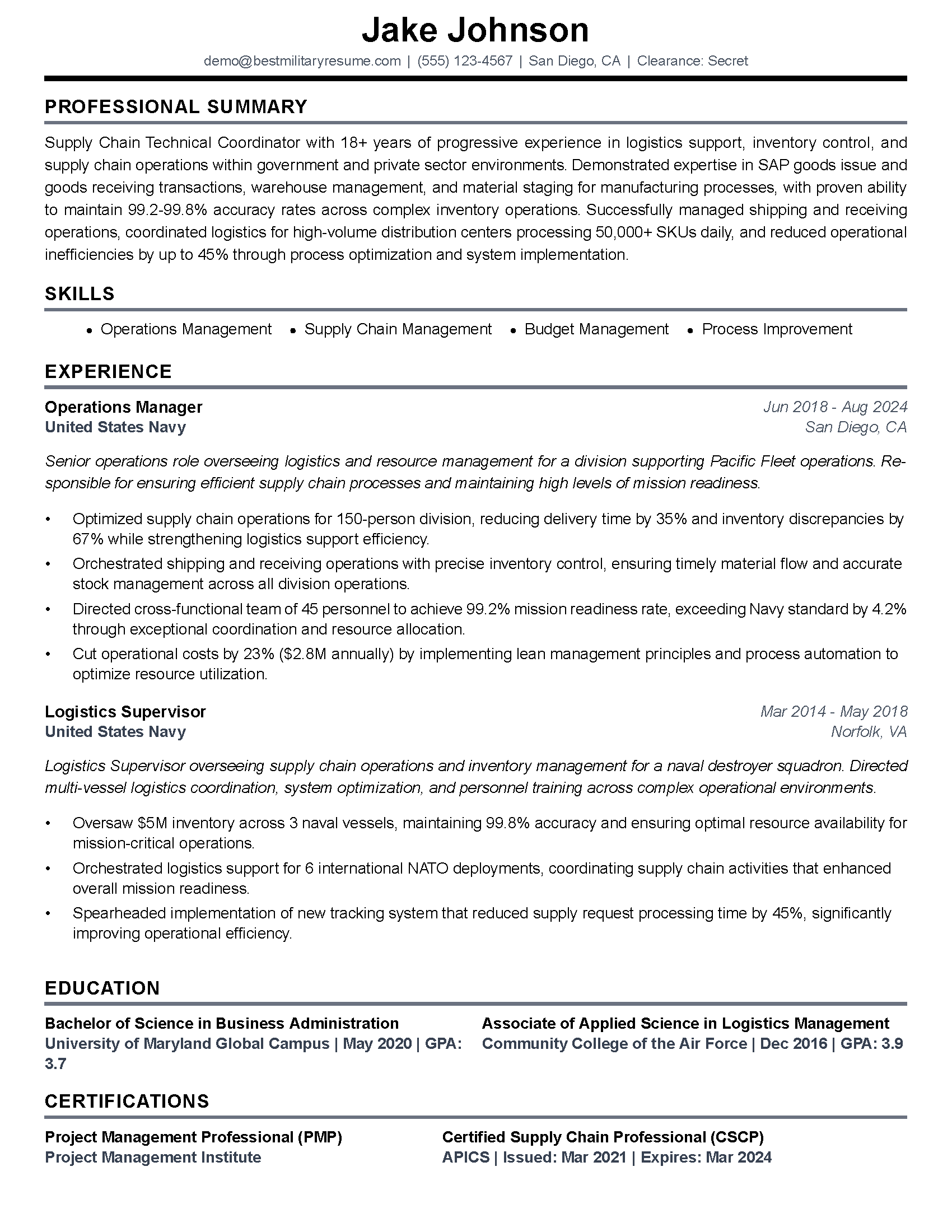
The fix is simple: don't create the gap in the first place. If you consolidate your military service into one or two entries, PCS transit time disappears inside the continuous date range. If you split entries, overlap the months. Your last month at one command and your first month at the next often overlap anyway (signed out, travel, signed in). Use that overlap.
What you should never do is add a line item explaining the gap. Writing "PCS Move, June 2021 – August 2021" on your resume wastes space and raises questions. The hiring manager now has to figure out what PCS means, and they are wondering why you listed a move as a job. Just close the date gap between entries and move on.
Do Not List PCS Moves as Line Items
Adding "PCS to Fort Drum, Jul–Sep 2020" as a separate entry on your resume creates more confusion than it solves. Close the date gap between your assignments and let the continuous employment speak for itself.
What About OCONUS Assignments and Deployments to Multiple Locations?
Veterans who served overseas at multiple locations face a unique formatting challenge. Maybe you were stationed in Okinawa, then deployed to the Philippines for a joint exercise, came back to Japan for six months, then deployed to Korea. Each location had different duties, different teams, and different operational tempos. But your resume doesn't need to read like an itinerary.
For OCONUS assignments with the same or similar role, list the primary duty station and note deployed locations inline:
Operations Specialist, U.S. Navy
Yokosuka, Japan (deployed: Philippines, Republic of Korea) | Mar 2018 – Feb 2021
This gives the hiring manager geographic context without fragmenting your timeline. They can see you worked internationally, which is a selling point for companies with global operations, defense contractors, or government agencies. You don't need a separate line for each TDY or deployment rotation.
If the deployments involved fundamentally different work, call that out in your bullet points, not in separate entries. For example:
- Managed watch floor operations for a 15-person team during garrison operations at Yokosuka Naval Base
- Coordinated joint communications infrastructure for a 200-person bilateral exercise in the Philippines, reducing setup time by 30%
- Served as lead operations planner for a multinational exercise in the Republic of Korea, synchronizing logistics across 4 allied nations
Each bullet shows different scope and different locations. The single entry keeps the timeline clean. For more on structuring your experience section, check out our veteran resume walkthrough with real examples.
How Do You Explain Deployment Gaps in an Interview?
If you format your resume using the consolidated approach, you may never get asked about gaps. But sometimes interviewers look at a military background and ask broad questions like "I see you were in the Army for eight years. Can you walk me through what you did?" This is your chance to tell the story clearly.
Keep it to 60 seconds. Hit three points: what your job was, where you served, and what you accomplished. Do not give a chronological tour of every duty station. Hiring managers don't need your assignment history. They need to understand what you can do for their organization.
A good answer sounds like this: "I was an infantry team leader in the Army for eight years. I led a four-person team in garrison and on two combat deployments to the Middle East. My main responsibilities were mission planning, personnel management, and maintaining over two million dollars in equipment. I was promoted to squad leader based on deployment performance and finished my service supervising nine soldiers."
That answer covers eight years, two deployments, three duty stations, and a promotion. It takes 20 seconds. No gaps to explain because you framed it as continuous service, which it was.
Interview Framework: The 60-Second Military Summary
Your role and branch
"I was a logistics coordinator in the Marine Corps for six years."
Where you served (high-level)
"Stationed at Camp Lejeune and deployed twice to the Middle East."
Key accomplishments with numbers
"Managed $4M in equipment, led a 12-person team, zero losses across two deployment cycles."
Why you are here now
"I am transitioning those logistics and leadership skills into supply chain management."
What NOT to Over-Explain on Your Resume
Veterans tend to over-explain their military timelines because they know the gaps look weird. This instinct backfires. Every extra line you add to explain a transition, a move, or a gap is a line that doesn't sell your qualifications. Here is what to leave off:
Don't list leave periods. Terminal leave, regular leave between assignments, block leave after deployment. These are not resume events. They are normal parts of military employment, and listing them creates gaps that weren't really gaps.
Don't explain short assignments. If you were at a duty station for four months because of a school, a temporary duty assignment, or an administrative hold, fold it into the nearest assignment. A four-month TDY to Fort Huachuca for intelligence school is part of your professional development, not a standalone job entry.
Don't label deployments as separate employers. Your employer was the U.S. Army, Navy, Marines, Air Force, Space Force, or Coast Guard. A deployment is an assignment under that employer, not a different company. Listing "OIR Task Force, Kuwait" as if it were a separate employer confuses the timeline and makes it look like you worked for a foreign organization.
Don't include your rank progression as separate entries. Getting promoted from E-4 to E-6 doesn't mean you changed jobs three times. If your role was similar across those ranks, consolidate. Mention the promotion in a bullet point: "Promoted from Specialist to Staff Sergeant based on deployment performance and leadership evaluations."
If you are a junior enlisted veteran (E-1 to E-4) with only one or two short assignments, this is especially important. You don't have enough experience to afford wasting resume space on explanatory filler.
How to Format Deployments on a Federal Resume
Federal resumes follow different rules than civilian ones, but the core principle is the same: you were continuously employed. The difference is that federal resumes require more detail per entry: hours worked per week, supervisor name and phone number, and specific duties tied to the position.
For federal applications, you can afford to be more granular because the format expects detail. But you still don't want to fragment your timeline unnecessarily. Here is the approach that works:
If your duties changed significantly (different MOS, different role, or different level of responsibility), create separate entries for each assignment. Include the full federal resume details for each: 40 hours/week, supervisor contact, and duties specific to that assignment.
If your duties stayed consistent across multiple deployments and duty stations, use one entry with a combined date range. In your duties section, note the different locations and any expanded scope. Federal hiring managers reviewing your application on USA Staffing will see continuous employment with progressively broader responsibilities, which is exactly what they want.
For specifics on structuring the rest of your military background for federal applications, our after-military-service resume checklist walks through every section. And remember: federal resumes are 2 pages max, not the 4-6 pages you will see recommended on outdated forums.
Federal Resume Tip
Federal resumes require hours per week and supervisor contact info for each position entry. If you consolidate deployments under one entry, use your most recent supervisor from that assignment period. List 40 hours/week (or more, if applicable to deployed environments).
The Continuous Service Framing That Makes Gaps Disappear
The single most effective technique for handling deployment gaps is reframing your entire military career as what it actually was: continuous employment with one organization. You didn't have gaps. You had assignments.
A civilian who works at Google for six years and switches between teams, offices, and projects doesn't list each team as a separate job with gaps in between. They list "Google, 2018-2024" and describe what they did. Your military service works the same way.
For veterans with 4-8 years of service and a consistent role, one consolidated entry is usually the cleanest approach. For veterans with 20+ years of service, two or three entries covering different phases of your career makes more sense. An E-7 who started as a motor pool mechanic and finished as a maintenance platoon sergeant held two meaningfully different jobs. Split those into separate entries, each with its own scope and accomplishments.
The guiding question is always: does splitting this entry make my experience clearer or more confusing? If separating two assignments helps the hiring manager understand two distinct skill sets, split them. If separating them just creates visual clutter and a gap, consolidate.
What If You Have Gaps After Military Service?
This article focuses on gaps between deployments and assignments during your service. But many veterans also have a gap between their ETS/retirement date and their first civilian job. That is a different problem with a different solution.
If you separated and spent three months, six months, or a year figuring out your next move, that gap shows up on your resume as a period with no employment. The techniques above won't help because the gap isn't hidden inside a larger employment block.
For that situation, check out our full guide on how veterans should explain employment gaps. It covers education, volunteer work, certifications, and other strategies for filling that post-service period on your resume.
If your military service was years ago and you are trying to decide how far back to go, our guide on putting military service on a resume years later covers that specific scenario.
What to Do Next
Pull up your current resume right now. Count how many separate entries you have for your military service. If you have more than two or three and your core role didn't change that dramatically, you are probably over-fragmenting your timeline.
Try consolidating. Take your assignments that had similar duties and merge them into one entry with a combined date range and multiple locations. See if the resume reads more cleanly. In almost every case, it will.
If you are building your resume from scratch or want to see how the consolidated format works with real examples, BMR's Resume Builder structures your military experience into the right format automatically. You paste the job posting you are targeting, and it builds the resume around that specific role. The deployment timeline, the PCS moves, the rank progressions — it handles the formatting so you can focus on the content.
For a full walkthrough of how every section of a veteran resume should look, read our veteran resume walkthrough with real examples. It covers headers, summaries, experience, education, and certifications with actual before-and-after samples.
Frequently Asked Questions
Are deployment gaps the same as employment gaps?
Should I list each deployment as a separate job on my resume?
How do I handle a 3-month gap between duty stations on my resume?
Should I explain PCS moves on my resume?
How do I list OCONUS deployments on a civilian resume?
Do federal resumes handle deployment gaps differently?
What if my military service was years ago and I have gaps after separating?
Can I combine different ranks into one resume entry?
About the Author
Brad Tachi is the CEO and founder of Best Military Resume and a 2025 Military Friendly Vetrepreneur of the Year award recipient for overseas excellence. A former U.S. Navy Diver with over 20 years of combined military, private sector, and federal government experience, Brad brings unparalleled expertise to help veterans and military service members successfully transition to rewarding civilian careers. Having personally navigated the military-to-civilian transition, Brad deeply understands the challenges veterans face and specializes in translating military experience into compelling resumes that capture the attention of civilian employers. Through Best Military Resume, Brad has helped thousands of service members land their dream jobs by providing expert resume writing, career coaching, and job search strategies tailored specifically for the veteran community.
