Military Police to Civilian Law Enforcement Resume Guide
Desiree landed a $135K hybrid senior financial consultant role.
Desiree, E-5, Army National Guard, the interviewer loved the resume from the top down
Why Do Military Police Veterans Need a Different Resume?
Military Police (31B) and Master-at-Arms (MA) veterans have some of the most direct career paths into civilian employment. You already do law enforcement. You have patrol experience, arrest authority, use-of-force training, and often criminal investigation exposure. But here is the problem: military law enforcement operates under UCMJ and DoD regulations, while civilian agencies operate under state law, local ordinances, and federal statutes. Your resume needs to reflect the civilian framework, not the military one.
When I reviewed resumes for federal positions, the military police resumes that failed were not weak on experience. They were loaded with military jargon that civilian hiring panels could not quickly connect to their job requirements. Terms like "PMCS" and "garrison law enforcement" and "AR 190-30" mean nothing to a city police chief reading 200 applications. The real experience is right there — the language just needs to change.
This guide covers exactly how to translate your 31B or MA experience into a resume that works for local police departments, federal law enforcement agencies, private security management, and corporate security roles. Every recommendation here is grounded in what actually gets veterans hired, not generic advice.
"MP and MA veterans have the experience. The resume translation is smaller than most MOSs — but the details matter more because law enforcement hiring panels are extremely specific about qualifications."
What Civilian Career Paths Are Open to Military Police Veterans?
Your options are broader than just becoming a city cop. Military police experience qualifies you for local, state, and federal law enforcement, plus a growing private sector security industry. The Bureau of Labor Statistics reports that police and detectives earn a median salary of $77,310 per year, with federal law enforcement positions paying significantly more.
Local and State Law Enforcement
This is the most common path for MP veterans, and for good reason. The day-to-day work is nearly identical to what you did on active duty — patrol, traffic stops, incident response, report writing, and community interaction. The transition is less about learning new skills and more about adapting to civilian legal frameworks and department-specific procedures.
City police departments, county sheriff offices, and state patrol agencies all value military police experience. Many states offer academy waivers or shortened academy programs for veterans with documented military law enforcement training. Check your state POST (Peace Officer Standards and Training) commission for specific waiver policies — they vary significantly by state. Texas and Florida have well-documented pathways for military police. Virginia grants only case-by-case partial waivers. California POST explicitly excludes military police from its Basic Course Waiver. You complete the full Regular Basic Course there.
Starting salaries for local police officers vary a lot by department and location. Most run from the high $40,000s to the mid $60,000s. BLS puts the lowest 10 percent of police and detectives under $48,160. Large metro departments (NYPD, LAPD, Chicago PD) start higher but have higher costs of living. Smaller departments start lower but promote faster.
Federal Law Enforcement
This is where military police veterans often find the best combination of pay, benefits, and mission alignment. Federal agencies actively recruit veterans, and your MP background gives you direct qualifying experience for multiple agencies.
Customs and Border Protection (CBP) — The largest federal law enforcement agency. Border Patrol Agents are hired in the 1896 Border Patrol Enforcement series at GL-5, GL-7, or GL-9. CBP entry announcements advertise $51,632 to $92,912 at GL-5/GL-7, and $65,545 to $124,717 at GL-9/GS-11. Your patrol experience and use-of-force training translate directly.
U.S. Marshals Service (USMS) — Deputy U.S. Marshals handle fugitive operations, witness protection, prisoner transport, and court security. If your MP experience included high-risk apprehensions or detainee operations, this is a natural fit. USMS typically fills the position at grades 5, 7, or 9. Those grades sit on the GL law enforcement pay table. That table runs above the regular GS base rate at the same grade.
Federal Protective Service (FPS) — Security of federal buildings. Your access control and physical security experience maps directly. FPS hires its law enforcement staff in the GS-1801 series, not as GS-0083 police officers. For GS-0083 police work, look at DoD installations and the Pentagon Force Protection Agency.
FBI, Secret Service, ICE HSI — These agencies hire for the 1811 Criminal Investigator series. You typically need a bachelor's degree plus qualifying experience, and MP investigation work counts. 1811 positions include Law Enforcement Availability Pay (LEAP), which adds 25% to your base salary.
Age Limits for Federal Law Enforcement
Most federal law enforcement jobs set a maximum entry age, but the agency sets it, not statute. The U.S. Marshals Service uses the 37th birthday. CBP Border Patrol currently uses the 40th birthday. That is a temporary CBP increase above the DHS-wide limit of 37 in Directive 251-03. There is no year-for-year credit that pushes your cutoff back by your years of service. CBP states the age restriction does not apply if you are a Veterans' Preference eligible. The U.S. Marshals Service says the same, unless it has determined age is essential to the job. One catch: retiring at O-4 or above can cost you preference eligibility. Under 5 U.S.C. 2108(4), those retirees are not preference eligible unless they are disabled veterans. Read the age section of every announcement.
Private Sector Security
Do not overlook the private sector. Corporate security is a growing field, and companies are willing to pay well for professionals who understand threat assessment, physical security planning, and investigations. This path often offers better work-life balance than sworn law enforcement, with comparable or higher pay at the management level.
Corporate security management, loss prevention, and private investigations are growing fields. O*NET puts the 2025 median for security managers at $106,660 a year. Director-level roles at large companies run higher. Loss Prevention Managers at major retailers are a common landing spot. Pay varies widely by retailer and region. Your MP experience in investigations, physical security, and personnel management positions you well for these roles. Large security services firms include Allied Universal, Securitas, and GardaWorld. They hire heavily at the supervisor and manager level.
Use BMR's career crosswalk tool to see the full range of civilian jobs matched to your military law enforcement background, including salary data and growth projections.

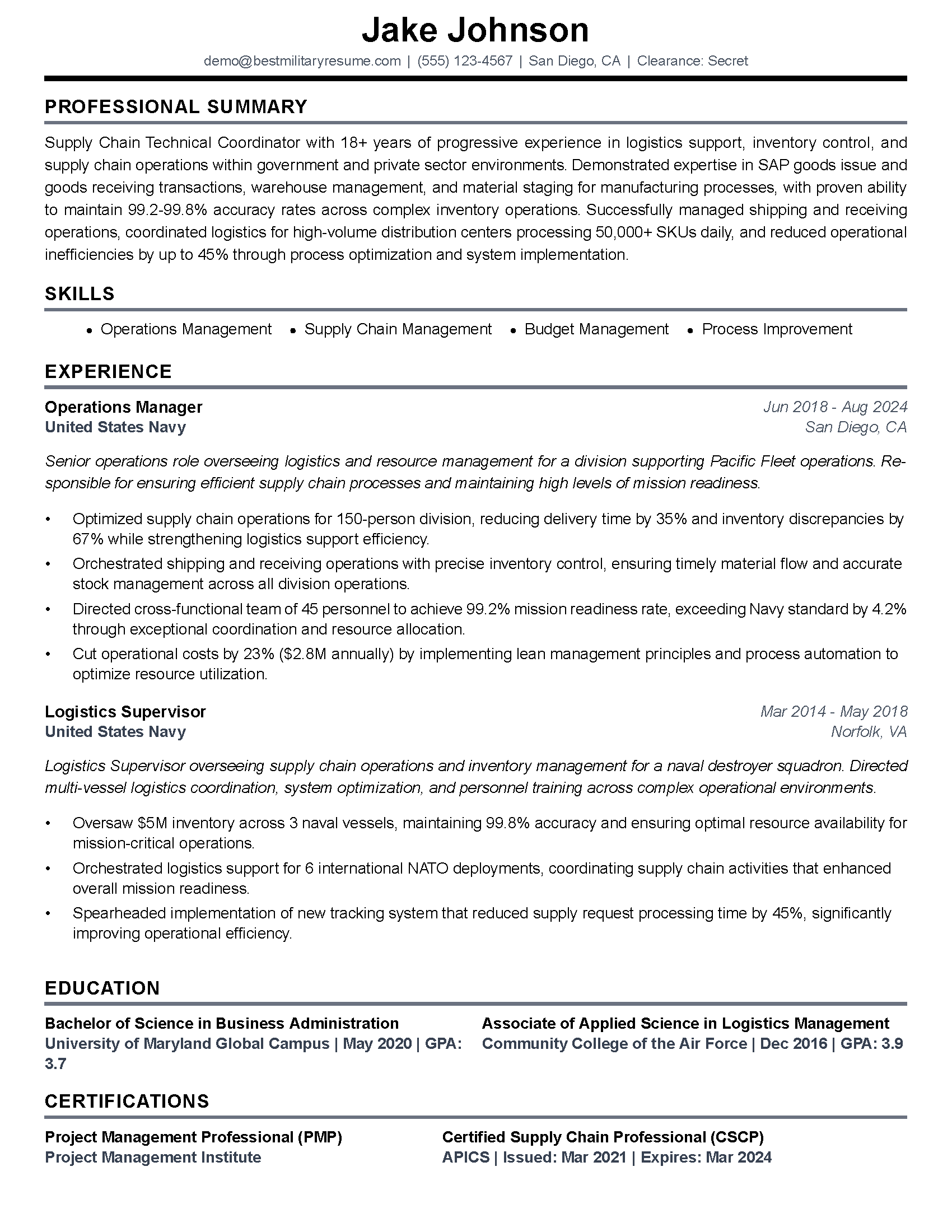
How Do You Translate Military Police Experience on a Resume?
The translation from military to civilian law enforcement is more subtle than other MOSs because the work is fundamentally similar. You are not trying to convince someone that "leading a fire team" equals "project management." You are showing that your patrol operations, investigations, and security work meet the same standards as civilian agencies — just under a different legal framework.
Here are the key translations for converting military terminology into civilian law enforcement language.
Conducted LE patrols in garrison environment IAW AR 190-30. Performed PMCS on assigned patrol vehicle. Processed subjects IAW UCMJ and installation SOP. Maintained desk operations and completed DA Form 3975 blotters.
Conducted law enforcement patrols across a jurisdiction of 15,000+ personnel. Performed vehicle inspections and maintained fleet readiness. Processed arrests and incident reports in compliance with federal regulations. Managed dispatch operations and maintained daily activity logs.
Law enforcement patrol — Your terminology is already close. Replace "garrison" with "jurisdiction" and quantify the population you served. An installation with 15,000 to 40,000 personnel is effectively a small city. That context matters to hiring panels who want to know your operational tempo.
Military justice and UCMJ — Translate this to "criminal investigation" and "federal law enforcement." If you processed crime scenes, interviewed witnesses, or wrote sworn statements, say exactly that. Drop the UCMJ reference and focus on the investigative skills: evidence collection, witness interviews, report writing, case file management.
Access control and gate operations — This becomes "physical security operations" and "access control management." Include numbers: how many entry points, daily vehicle and pedestrian throughput, credential verification volume. A main gate at a large installation processes thousands of vehicles per day.
Traffic enforcement — Translates directly to "traffic enforcement and public safety operations." Include DUI/DWI enforcement, accident investigation, and citation volume. If you used radar or lidar, mention it — these are the same tools civilian agencies use.
Use-of-force training — List your specific qualifications: firearms certifications (M9/M17 pistol qualification translates to handgun proficiency), taser certification, OC spray certification, baton training, defensive tactics. Be specific about recertification frequency because it shows you understand ongoing training requirements.
Should You List Your Security Clearance on a Law Enforcement Resume?
Yes — if you have or had a security clearance, it belongs on your resume. For federal law enforcement positions, a clearance is often required, and having one already saves the agency months of processing time and thousands in background investigation costs. For positions at agencies that require clearances, it can be the difference between getting an interview and getting passed over.
List your clearance level (Secret, Top Secret, TS/SCI), the date it was granted or last investigated, and whether it is current. If your eligibility lapsed, it can often be picked back up without a fresh investigation. Under SEAD 7, agencies must reciprocally accept a prior investigation unless it is over seven years old. New derogatory information or an interim eligibility can still break reciprocity. Place your clearance details in a dedicated "Clearance" section at the top of your resume, below your contact information and professional summary.
Even for state and local law enforcement where clearances are not required, listing it demonstrates that you have already passed an extensive background investigation. Hiring panels know what a federal clearance investigation entails, and it signals reliability.
Key Takeaway
A current security clearance is a tangible asset on a law enforcement resume. For federal positions, it saves the agency time and money. For local agencies, it proves you have already survived a rigorous background check.
What About LEOSA and Physical Fitness Requirements?
Two topics that frequently come up for MP veterans transitioning to civilian law enforcement: LEOSA concealed carry rights and physical fitness standards. Both deserve attention during your transition planning, and knowing how they work gives you an edge over civilian applicants who have never dealt with either one.
Two topics that frequently come up for MP veterans transitioning to civilian law enforcement: LEOSA concealed carry rights and physical fitness standards. Both deserve space on your resume or in your application materials.
LEOSA (Law Enforcement Officers Safety Act / HR 218)
LEOSA is one of the benefits that many MP veterans do not realize they may qualify for. Understanding it before you start applying to civilian agencies shows hiring panels that you know the legal landscape of law enforcement beyond just military regulations.
LEOSA may apply if you served as a military police officer with arrest authority. You also have to meet the qualifying criteria. LEOSA can let you carry a concealed firearm across state lines without a state permit. It has limits. 18 U.S.C. 926C(b) still lets private property owners bar carry on their property. States can still bar firearms on state or local government property, buildings, and parks. The qualifications include at least 10 years of aggregate service as a law enforcement officer (which can include military LE time), separation in good standing, and annual firearms qualification. This is not a resume line item per se, but it is relevant during interviews and application processes for positions that value off-duty carry capability.
Physical Fitness Standards
Most law enforcement agencies require a physical fitness test as part of the hiring process. The good news: your military fitness background almost certainly has you prepared. However, the specific tests vary by agency. Some use the Cooper Standards (1.5-mile run, push-ups, sit-ups), others use the POPAT (Police Officer Physical Abilities Test), and federal agencies have their own standards.
On your resume, include relevant physical fitness accomplishments if they are exceptional — APFT/ACFT scores in the top percentile, completion of special schools (Air Assault, Airborne, combatives instructor), or competitive fitness achievements. These signal that you will not struggle with the academy fitness requirements.
For federal positions in the 0083 Police Officer series and 1811 Criminal Investigator series, check the specific agency fitness requirements during the application window. Most publish their standards online. Apply early in the hiring cycle when you are in peak condition.
Ready to Build Your Law Enforcement Resume?
Military police and Master-at-Arms veterans have a head start that most civilian candidates cannot match. You have real patrol experience, real use-of-force training, real investigation skills, and often a professional network that extends across military and federal law enforcement communities. The gap is not in your qualifications — it is in how you present them on paper.
One of our BMR users, an Army 31B with 8 years of MP experience, was getting zero callbacks applying to CBP. After rebuilding his resume to translate military terminology into federal law enforcement language and tailoring it specifically to the CBP posting, he received an interview invitation within six weeks. The experience did not change. The resume did.
BMR's resume builder handles the military-to-civilian translation automatically. Paste a law enforcement job posting, and it converts your MP experience into the language that agency is looking for. One free federal tailored resume and one free private-sector tailored resume, plus cover letters and LinkedIn optimization. Built by a veteran who spent 1.5 years figuring out what actually gets callbacks — so you do not have to.
Related: Military resume keywords that beat ATS by industry and resume red flags that get veteran resumes rejected.
Frequently Asked Questions
Can military police experience count toward civilian police academy?
What federal law enforcement agencies hire military police veterans?
Is there an age limit for federal law enforcement positions?
How do I list firearms qualifications on a law enforcement resume?
What is LEOSA and does it apply to military police?
Should I include my security clearance on a police resume?
What salary can military police veterans expect in civilian law enforcement?
How do I translate military police patrol experience for a civilian resume?
About the Author
Brad Tachi is the CEO and founder of Best Military Resume and a 2025 Military Friendly Vetrepreneur of the Year award recipient for overseas excellence. A former U.S. Navy Diver with over 20 years of combined military, private sector, and federal government experience, Brad brings unparalleled expertise to help veterans and military service members successfully transition to rewarding civilian careers. Having personally navigated the military-to-civilian transition, Brad deeply understands the challenges veterans face and specializes in translating military experience into compelling resumes that capture the attention of civilian employers. Through Best Military Resume, Brad has helped thousands of service members land their dream jobs by providing expert resume writing, career coaching, and job search strategies tailored specifically for the veteran community.
